THAAD: Who Operates It in the Middle East, and How Does It Work?



THAAD (Terminal High Altitude Area Defense) is Lockheed Martin’s hit-to-kill missile defense system, built to intercept short-, medium- and intermediate-range ballistic missiles in their terminal phase, inside or just outside the atmosphere. Two MENA states operate it: the UAE, the system’s first-ever foreign customer, has run two batteries since 2015-16 and has twice used them to intercept Houthi missiles in combat; Saudi Arabia contracted for seven batteries in 2017 and activated its first into service in July 2025, with the rest scheduled through 2028. No African state is a confirmed or reported THAAD customer.
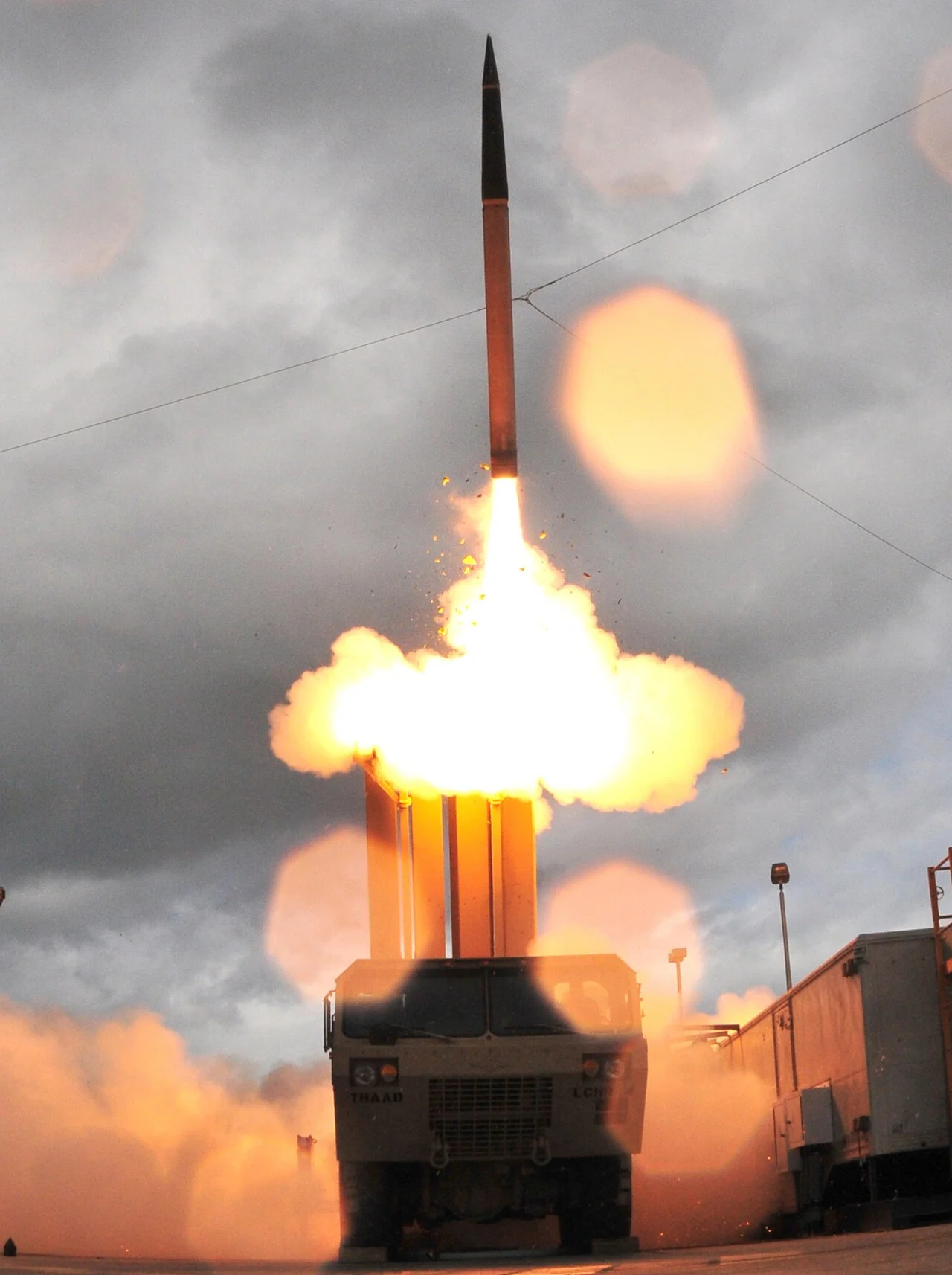
Photo: A THAAD interceptor launches during a Missile Defense Agency flight test. Credit: U.S. Missile Defense Agency / U.S. Army, public domain.
THAAD at a glance
- Maker: Lockheed Martin Space (prime contractor since 1992), with Raytheon supplying the AN/TPY-2 radar, under U.S. Missile Defense Agency (MDA) and U.S. Army programme management
- Class: Mobile, ground-based, hit-to-kill terminal-phase ballistic missile defense system
- First equipped (U.S. Army): 2008
- Battery composition: 6 truck-mounted launchers, 48 interceptors (8 per launcher), 1 AN/TPY-2 radar, fire control and communications, roughly 90 soldiers to operate (U.S. Army figures)
- MENA operators: United Arab Emirates (OPERATIONAL, 2 batteries), Saudi Arabia (CONTRACTED for 7 batteries, 1 OPERATIONAL)
- African operators: None publicly documented
What is THAAD, and who builds it?
THAAD is a theater-level missile defense system designed to destroy incoming ballistic missiles by direct impact (“hit-to-kill,” no explosive warhead) during the terminal phase of flight, either just inside the atmosphere (endo-atmospheric) or just above it (exo-atmospheric). It sits above lower-tier systems such as Patriot PAC-3 in a layered air and missile defense architecture, intended to engage threats that lower-tier interceptors might miss. Lockheed Martin Space, based in Dallas, Texas, has been the prime contractor since being selected in September 1992, then under the U.S. Army Strategic Defense Command; the programme passed to the Missile Defense Agency, which still manages it jointly with the U.S. Army today. Raytheon builds the system’s AN/TPY-2 X-band radar. The U.S. Army fielded its first THAAD battery in 2008 and now operates eight: three at Fort Bliss, Texas; two at Fort Cavazos, Texas; one at Seongju, South Korea (since 2016); one in Guam; and an eighth battery whose production Lockheed Martin was contracted to begin in April 2022, with the minimum engagement package delivered to the U.S. government in June 2025.
Specifications
Lockheed Martin and the Missile Defense Agency do not publish a single, complete official spec sheet with interceptor range and radar detection range together; the figures below combine U.S. Army battery-composition data with commonly cited interceptor dimensions, flagged where they are open-source estimates rather than official MDA figures.
| Item | Figure | Source / note |
|---|---|---|
| Interceptor type | Single-stage, solid-fuel, hit-to-kill (kinetic, no warhead) | Official (U.S. Army, Missile Defense Agency) |
| Interceptor length / booster diameter / launch mass | ~6.17 m / ~340 mm / ~900 kg | Open-source estimate (not an official MDA figure); treat as approximate |
| Interceptor range | Commonly cited at roughly 200 km | Open-source estimate; MDA has not published a single official range figure |
| AN/TPY-2 radar band | X-band, forward-based or terminal mode | Official (Raytheon, MDA) |
| AN/TPY-2 detection range | Reported variously between roughly 1,000 and 3,000 km depending on mode | Open-source estimate; figures vary by source and are not confirmed by a single official release |
| Launchers per battery | 6, truck-mounted (M1075 palletized load system) | Official (U.S. Army) |
| Interceptors per battery | 48 (8 per launcher) | Official (U.S. Army) |
| Crew | ~90 soldiers per battery (U.S. Army figure) | Official (U.S. Army / Congressional Research Service) |
| Transportability | C-17/C-5 air-transportable launchers and radar | Official (U.S. Army, Lockheed Martin) |
Combat record
THAAD’s only confirmed combat intercepts in the MENA region are by the UAE’s own batteries: U.S. Central Command’s commander confirmed in February 2022 that the UAE had twice used THAAD to intercept Houthi ballistic missiles fired from Yemen. Separately, U.S. Army-operated THAAD batteries (not sold to any Gulf state) have supported regional air defense during recent Iran-related escalations: a U.S. battery was deployed to Israel in October 2024, and six U.S. Forces Korea launchers deployed to the Middle East for “Operation Epic Fury” between March and June 2026. Reporting on the June 2025 Iran-Israel conflict said THAAD, alongside Patriot and other systems, contributed to a combined interception rate above 90% defending the UAE and other partners, though a THAAD-specific intercept rate was not disclosed; the same reporting said 92 THAAD interceptors were expended against an estimated global stockpile of 632, with replenishment estimated at three to eight years. These U.S.-operated deployments defend partner states but do not make those states THAAD operators in the ownership sense used in the table below.
Who operates THAAD in the Middle East?
Two Gulf states have bought and own THAAD batteries. No African state has.
| Country | Batteries | Status | Notes | Source |
|---|---|---|---|---|
| United Arab Emirates | 2 (96 interceptors, 2 AN/TPY-2 radars) | OPERATIONAL | First foreign THAAD customer; original FMS case valued at $3.48bn (scope cut from an initial 2008 proposal of 144 interceptors/4 radars to 96 interceptors/2 radars by 2010-11). First battery arrived Abu Dhabi Oct 2015; declared operational 2016. Used in combat twice by Feb 2022, intercepting Houthi ballistic missiles (CENTCOM commander, confirmed via Janes). A ~$2bn interceptor-production contract followed in 2025, and a sustainment contract extending support for both batteries was signed Jan 2026. | Lockheed Martin, Janes |
| Saudi Arabia | 7 contracted (44 launchers, 360 THAAD-ER interceptors, 16 fire control stations, 7 AN/TPY-2 radars); 1 declared operational | CONTRACTED (programme); OPERATIONAL (first battery only) | DSCA notified Congress of a possible $15bn sale in Oct 2017; Letter of Offer and Acceptance signed Nov 2018. First down-payment contract (MDA, $945.9m) awarded March 2019; a July 2019 contract modification brought the cumulative value to about $5.36bn. First battery activated into Royal Saudi Air Defense Forces service 2 July 2025 at the Air Defense Forces Institute, Jeddah, after crew training at Fort Bliss. A 2022 USACE solicitation put the first fixed site (Ras al-Ghar) on schedule for Feb 2026 and all seven sites complete by April 2028; this page found no public update confirming whether that schedule is being met. Lockheed Martin and Saudi Arabia also signed a 2022 agreement for in-kingdom production of interceptor launchers and storage canisters; no production timeline has been disclosed. | Bloomberg, Army Recognition |
Separately, the U.S. Army itself operates a THAAD battery at Seongju, South Korea (since 2016, under a 2016 bilateral agreement where Seoul provided the land and Washington the hardware) and has temporarily deployed U.S.-crewed batteries to defend partners such as Israel during periods of heightened Iranian missile activity. These are United States-owned and United States-operated deployments, not foreign military sales, so they are not listed as “operators” above.
THAAD in Africa
No African state has a confirmed or reported THAAD acquisition, evaluation or deployment. This page will add an entry if credible evidence emerges.
Saudi Arabia’s parallel S-400 talks
The same month Washington notified Congress of the possible Saudi THAAD sale (October 2017), Saudi Arabia and Russia announced a preliminary agreement covering the Russian S-400 air defense system, following King Salman’s visit to Moscow. Talks continued into at least 2019, with Russian officials describing the S-400 component as “under consideration,” while U.S. officials publicly warned Riyadh against proceeding given the sanctions risk under the Countering America’s Adversaries Through Sanctions Act (CAATSA). No source reviewed for this page confirms a signed, binding S-400 contract or any S-400 delivery to Saudi Arabia; the Kingdom’s THAAD programme, by contrast, has a confirmed contract, confirmed deliveries, and one battery in operational service as of mid-2025. This page states only what is documented and does not speculate on why the S-400 talks did not result in a confirmed sale.
Systems in the same class
THAAD is one of a small number of systems worldwide that intercept ballistic missiles near or above the edge of the atmosphere. The comparison below lists systems in the same general class without declaring a winner; no head-to-head MENA procurement competition between THAAD and these systems has been documented beyond the Saudi S-400 talks described above.
| System (maker, country) | Intercept zone | MENA/Africa status |
|---|---|---|
| THAAD (Lockheed Martin, USA) | Endo- and exo-atmospheric, terminal phase | Operational in UAE; contracted/partly operational in Saudi Arabia |
| Arrow 3 (IAI/Boeing, Israel/USA) | Exo-atmospheric | Operational in Israel; used operationally against Houthi and Iranian missiles since 2023-24 |
| S-400 Triumf (Almaz-Antey, Russia) | Primarily endo-atmospheric air defense; longest-range variants claim limited ballistic-missile capability | No confirmed MENA/African THAAD-tier sale; Saudi talks did not result in a confirmed contract (see above); Türkiye operates S-400 in a NATO-controversy context unrelated to this page’s MENA missile-defense comparison |
| Patriot PAC-3/MSE (Lockheed Martin/RTX, USA) | Endo-atmospheric, lower tier | Widely operated across the Gulf, including by both UAE and Saudi Arabia, typically layered beneath THAAD rather than replacing it |
FAQ
Who makes THAAD?
Lockheed Martin Space is the prime contractor, building the system under U.S. Missile Defense Agency and U.S. Army management since 1992. Raytheon builds the system’s AN/TPY-2 radar.
Which Middle Eastern countries operate THAAD?
The United Arab Emirates and Saudi Arabia. The UAE has operated two batteries since 2015-16 and has used them in combat. Saudi Arabia contracted for seven batteries in 2017 and activated its first into service in July 2025, with the rest scheduled for delivery through 2028.
Does any African country operate THAAD?
No African state has a confirmed or reported THAAD programme as of this page’s verification date.
Has THAAD intercepted missiles in combat?
Yes. U.S. Central Command’s commander confirmed in February 2022 that the UAE’s THAAD batteries had twice intercepted Houthi ballistic missiles launched from Yemen.
Is THAAD the same as Patriot?
No. Patriot PAC-3/MSE is a lower-tier, shorter-range interceptor that both the UAE and Saudi Arabia already operate; THAAD sits above it in a layered defense architecture, intended for longer-range, higher-altitude intercepts.
Did Saudi Arabia also buy the Russian S-400?
Saudi Arabia and Russia announced preliminary S-400 talks in October 2017, the same month the U.S. notified Congress of the possible Saudi THAAD sale. No publicly available source confirms a signed S-400 contract or delivery to Saudi Arabia.
Sources
- Lockheed Martin – Ten Years of THAAD in the UAE
- Janes – CENTCOM commander confirms UAE successfully used THAAD
- Bloomberg – U.S. approves $15 billion THAAD package for Saudi Arabia
- Army Recognition – Saudi Arabia fields first THAAD unit
- The Defense Post – Lockheed Martin Saudi Arabia THAAD contract
- Congressional Research Service – THAAD system overview (IF12645)
- Bellingcat – UAE THAAD site reaches milestone
- Asharq Al-Awsat – Kremlin on S-400 talks with Saudi Arabia
Last updated: 24 Oct 2026. This page is updated in place when new contracts, deliveries or variants appear.