Offshore Patrol Vessels and Coastal Security in African Navies



Offshore patrol vessels and inshore patrol craft have become the main tool African navies use to police exclusive economic zones, counter piracy and illegal fishing, and patrol coastlines that stretch for thousands of kilometres. This gallery explains how the technology works and surveys eight fleets currently in service or on order across the continent, data as of October 2026.
DEFENCE AFRICA | Technology explainer gallery | Data as of October 2026
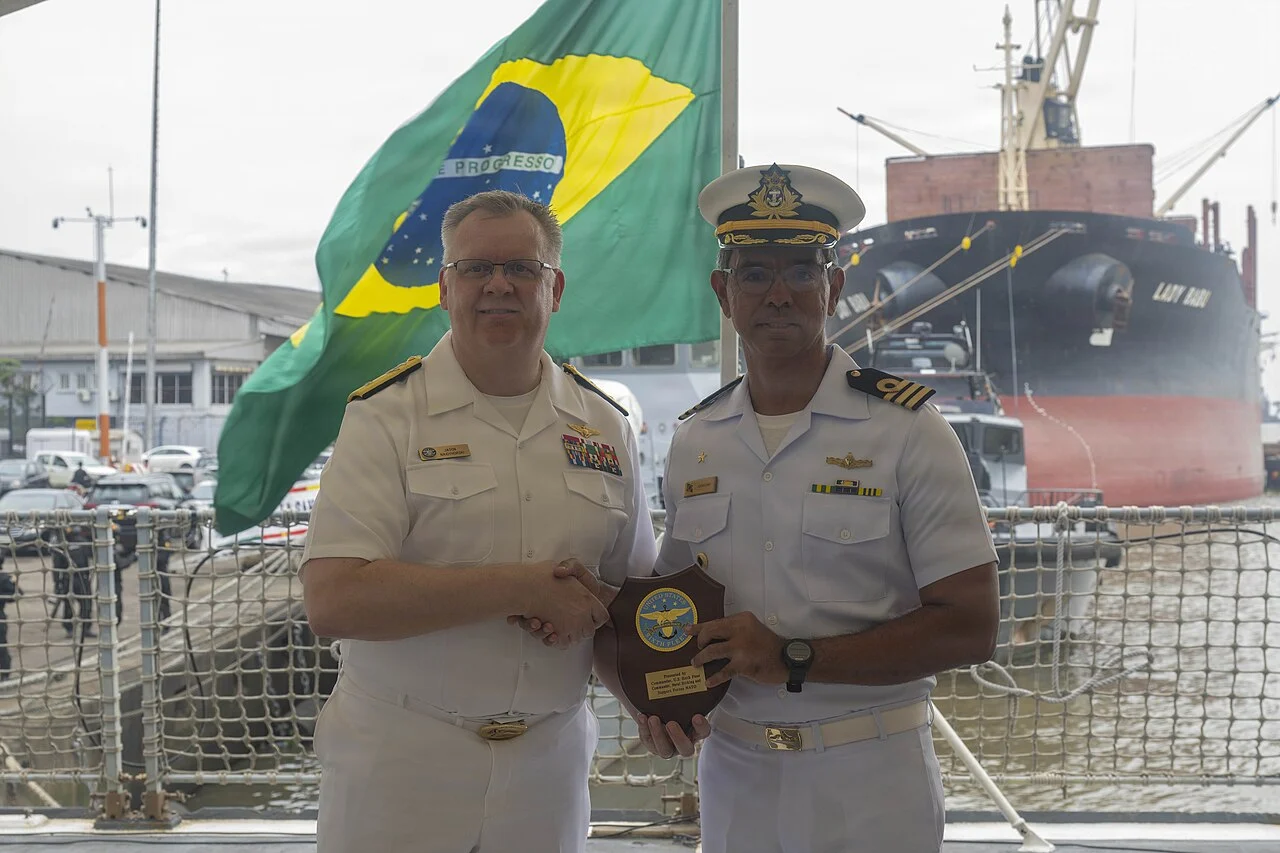
Photo: A Brazilian Navy Amazonas-class offshore patrol vessel hosts the opening ceremony of Exercise Obangame Express 2026 in Douala, Cameroon. Credit: U.S. Navy photo by Petty Officer 2nd Class Merissa Daley, public domain, via Wikimedia Commons
An offshore patrol vessel (OPV) is built around a simple trade-off: a hull large enough to stay at sea for one to three weeks in moderate ocean swell, but far cheaper to build and run than a frigate or corvette. Most African OPVs displace 500-1,800 tonnes, carry a single medium-calibre gun or none at all, and rely on radar, electro-optic sensors and a small boarding team rather than missiles. Inshore patrol vessels are a smaller, lighter variant built for territorial waters and port approaches rather than the full 200-nautical-mile exclusive economic zone (EEZ).
The mission set driving African OPV purchases is maritime law enforcement rather than warfighting: illegal, unreported and unregulated (IUU) fishing, oil-bunkering and crude-theft rackets in the Gulf of Guinea, narcotics trafficking along the West African coast, and a resurgence of piracy risk flagged by a researcher at the Accra maritime security forum in 2026. Multinational exercises such as Obangame Express in the Gulf of Guinea, Cutlass Express in the Indian Ocean and Saharan Express off the Sahel coast are built around these vessels, and often give African crews their first chance to operate alongside the US Navy, French Navy or other partners.
Procurement has followed three main routes: established Western yards (France’s CMN/Kership/Piriou, the Netherlands’ Damen), lower-cost Chinese-built vessels, and a newer wave of Gulf-industry exports led by the UAE’s EDGE Group, competing on financing and offset packages. Each entry below gives one vessel class per country, with manufacturer, year and status confirmed against official statements, shipbuilder releases or specialist naval publications.
Key facts
- Nigeria’s two P18N-class offshore patrol vessels were built in China and commissioned in 2014 and 2016 (Army Recognition, 2016).
- Senegal ordered three OPV 58 S vessels from France’s Kership/CMN in November 2019; the second was delivered in 2023 (Janes, 2019; Naval News, 2023).
- South Africa’s Project Biro delivered three Damen-built multi-mission inshore patrol vessels between 2022 and 2025 (Damen, 2025).
- Angola’s first EDGE-built Mandume-class corvette was launched in March 2026 under a reported €1 billion contract, with delivery not yet confirmed (WAM, 2023; EDR Magazine, 2026).
- Ghana’s navy was, as of December 2024, reportedly in talks for two new 72-metre OPVs after a multi-year contest among Ocea, Lürssen and Babcock (Military Africa, 2022).
1. Nigeria — P18N-class OPVs anchor a Gulf of Guinea patrol fleet
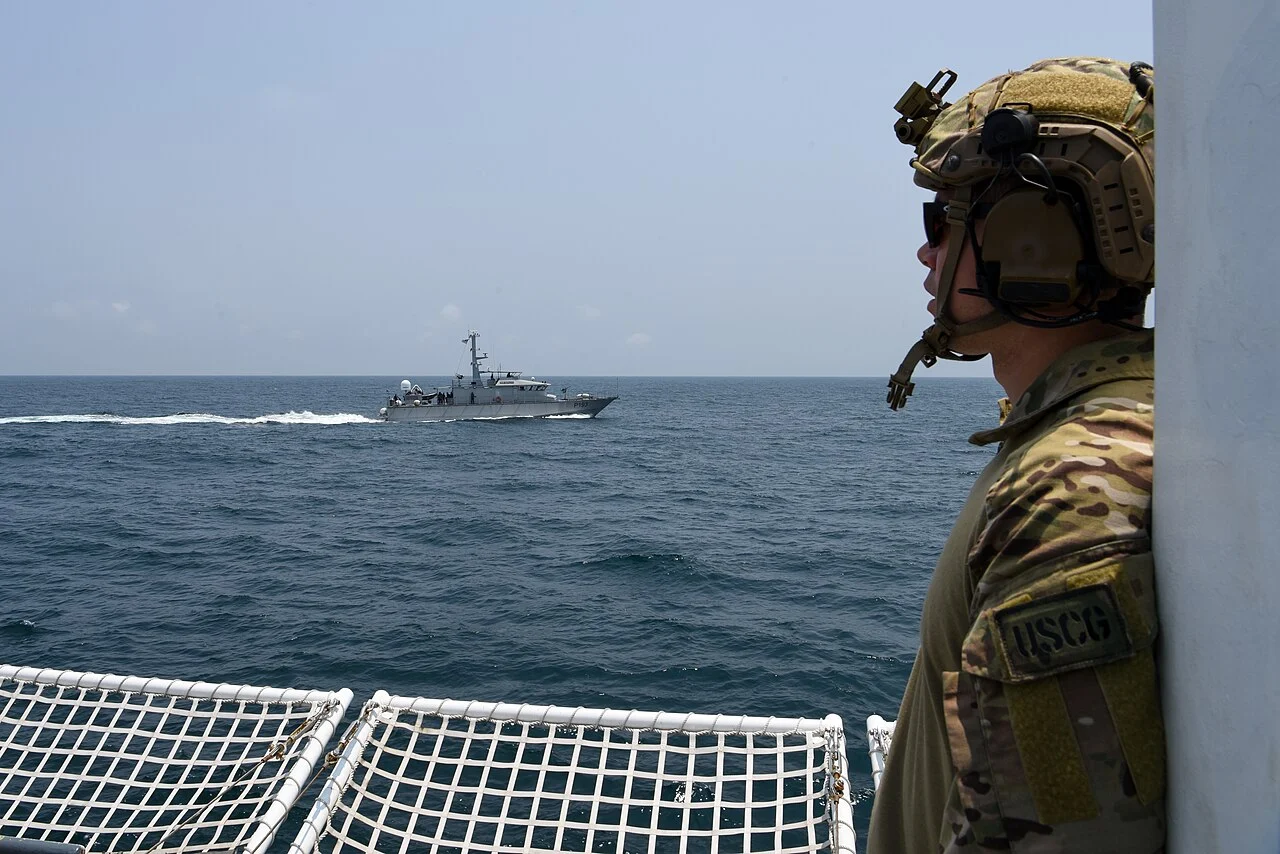
The Nigerian Navy’s largest dedicated patrol vessels are its two P18N-class ships, NNS Thunder and NNS Unity, built by China Shipbuilding & Offshore International Company (CSOC) at Wuchang Shipyard under a contract signed in 2012. NNS Unity was commissioned in Lagos in December 2016 (operational), according to Army Recognition. The class is reported at roughly 95 metres long and 1,700-1,800 tonnes displacement, published figures vary, with a top speed of about 21 knots and endurance of around 20 days at sea (Army Recognition, 2016). Nigeria supplements the P18N ships with smaller French-built OCEA FPB-series patrol boats and locally built craft, including the indigenous NNS Oji seaward-defence boat (operational). Facing the heaviest Gulf of Guinea piracy and crude-oil theft exposure of any West African state, Nigeria treats its OPV fleet as the backbone of its anti-piracy patrols, working alongside the Deep Blue maritime security project and partner navies during Obangame Express.
2. Senegal — OPV 58 S brings a French-built, missile-capable patrol class
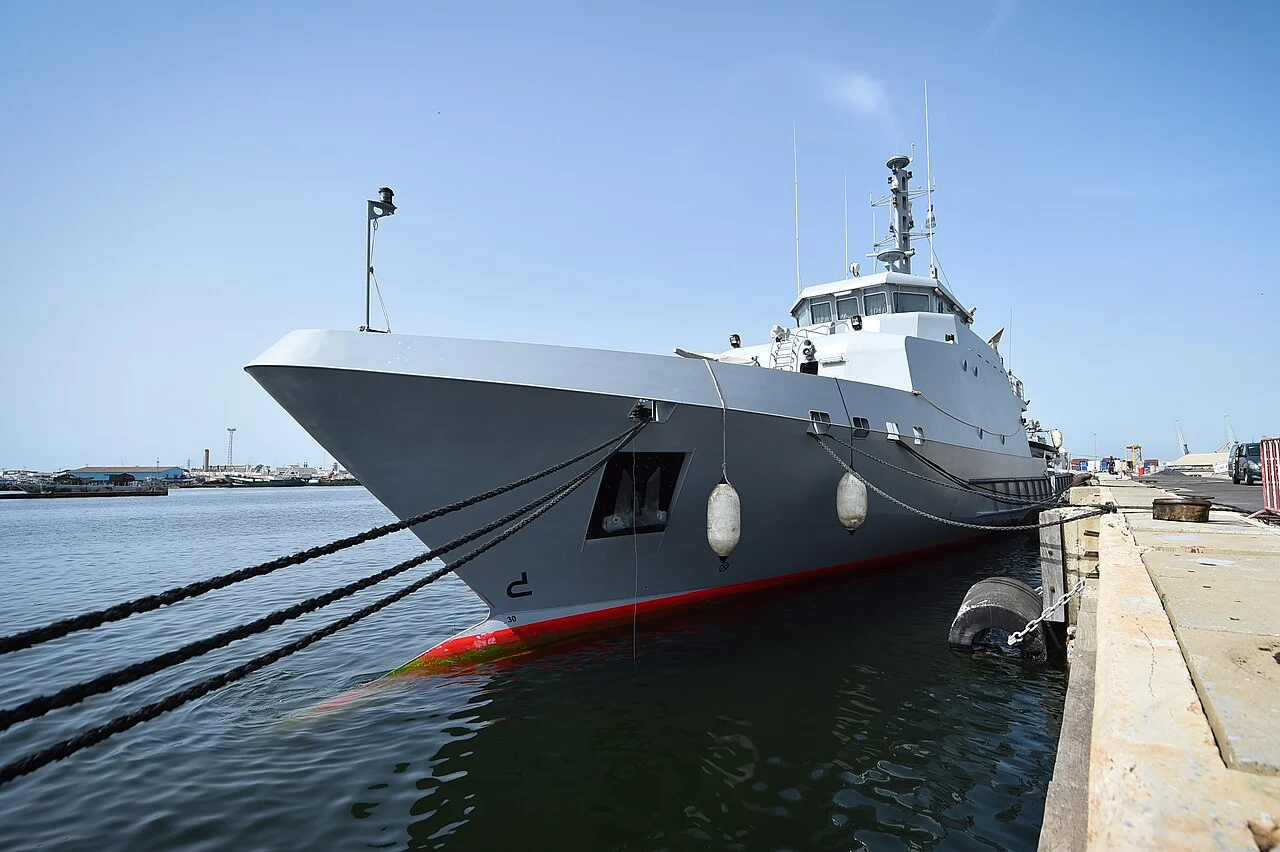
Senegal’s navy has long relied on older patrol ships such as Fouladou, pictured here on a joint US-Senegalese maritime law enforcement exercise in 2017 (operational), while its newest capability is being delivered separately. In November 2019 Dakar signed a contract with France’s Kership/CMN consortium for three OPV 58 S vessels, a 62-metre, roughly 550-tonne design armed with a 76mm Leonardo gun, Marte anti-ship missiles and SIMBAD-RC point defence, though Naval News notes the exact weapons fit is a design overview rather than a confirmed final sheet (Janes, 2019; Naval News, 2022). The first ship was launched in 2022 and the second delivered by November 2023, with the third, Cayor, reported still fitting out at that date (first two hulls delivered, third contracted) (Naval News, 2023). The OPV 58 S gives Senegal a long-range, 21-knot vessel with a reported 4,500 nautical mile range at 12 knots, aimed squarely at EEZ patrol and counter-trafficking missions off West Africa’s Atlantic coast.
3. South Africa — Project Biro delivers three Damen-built inshore patrol vessels
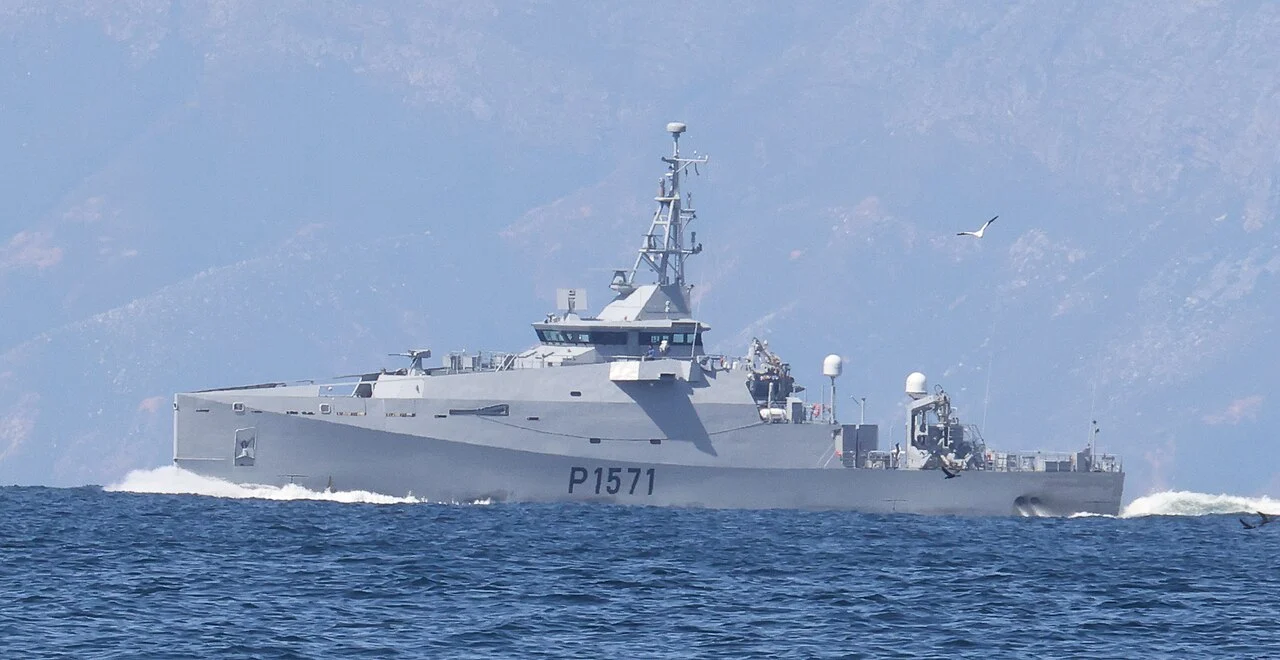
South Africa’s Project Biro, managed by state procurement agency Armscor, contracted Damen Shipyards Cape Town in February 2018 to build three Multi-Mission Inshore Patrol Vessels based on Damen’s Stan Patrol 6211 design, 62 metres long with an axe-bow hull. The first, SAS Sekhukhune (sometimes rendered King Sekhukhune I), was delivered to the navy on 18 May 2022; the third vessel was delivered at Durban in May 2025 (delivered) (Damen, 2025). Each ship is armed with a 20mm gun and fitted with a Found surveillance suite, plus 7-7.5 metre interceptor boats for boarding operations, and is rated for 26 knots with a 4,000 nautical mile range. Project Biro originally envisaged both inshore and offshore vessels, but the programme as executed delivered only the smaller inshore class, leaving the South African Navy without a dedicated new-build offshore patrol vessel even as its older frigates and support ships face sustainment pressure.
4. Morocco — the OPV-64 Rais Bargach class, three decades in service
The Royal Moroccan Navy’s oldest dedicated patrol class is the French-built OPV-64, also known as the Rais Bargach class after its lead ship, launched at Lorient in October 1995 and comprising five vessels delivered between 1994 and 1997. At 64 metres long and reported at 580-650 tonnes, figures vary, the class carries a 40mm Bofors gun, 20mm cannon and twin 14.5mm mounts added in later modernisation, powered by Wartsila Nohab diesels for a 25-knot top speed (operational) (navypedia.org). Piriou completed a major refit of lead ship Rais Bargach in 2017, covering engines and steering gear (Army Recognition, 2017). Morocco pairs these ageing OPVs with larger Sigma-class frigates for blue-water missions, while the OPV-64s handle coastal surveillance, search and rescue and fisheries protection.
5. Angola — EDGE’s Mandume-class corvette moves from contract to first launch
Angola is the clearest example of the newer Gulf-industry export route into African coastal fleets. In February 2023 the UAE’s EDGE Group signed a reported €1 billion contract through its subsidiary Abu Dhabi Ship Building (ADSB) to build a class of 71-metre corvettes, based on ADSB’s BR71 Mk II design, for the Angolan Navy (WAM, 2023). The first-of-class, NRA Ekuikui II, was launched on 10 March 2026, with sea trials and delivery expected later in the year and not yet confirmed (contracted) (EDR Magazine, 2026). The design is an enlarged derivative of the Baynunah-class corvettes CMN built for the UAE Navy, armed with MBDA Exocet MM40 missiles, VL Mica air-defence missiles, a 76mm Leonardo gun and two embarked HT-100 naval unmanned aerial systems. For Angola, whose Atlantic coastline covers its offshore oil infrastructure, the programme marks a shift from ex-Soviet and Spanish-built patrol craft toward a heavier, corvette-type vessel.
6. Ghana — an established Boundary-class fleet, with larger OPVs reportedly under negotiation
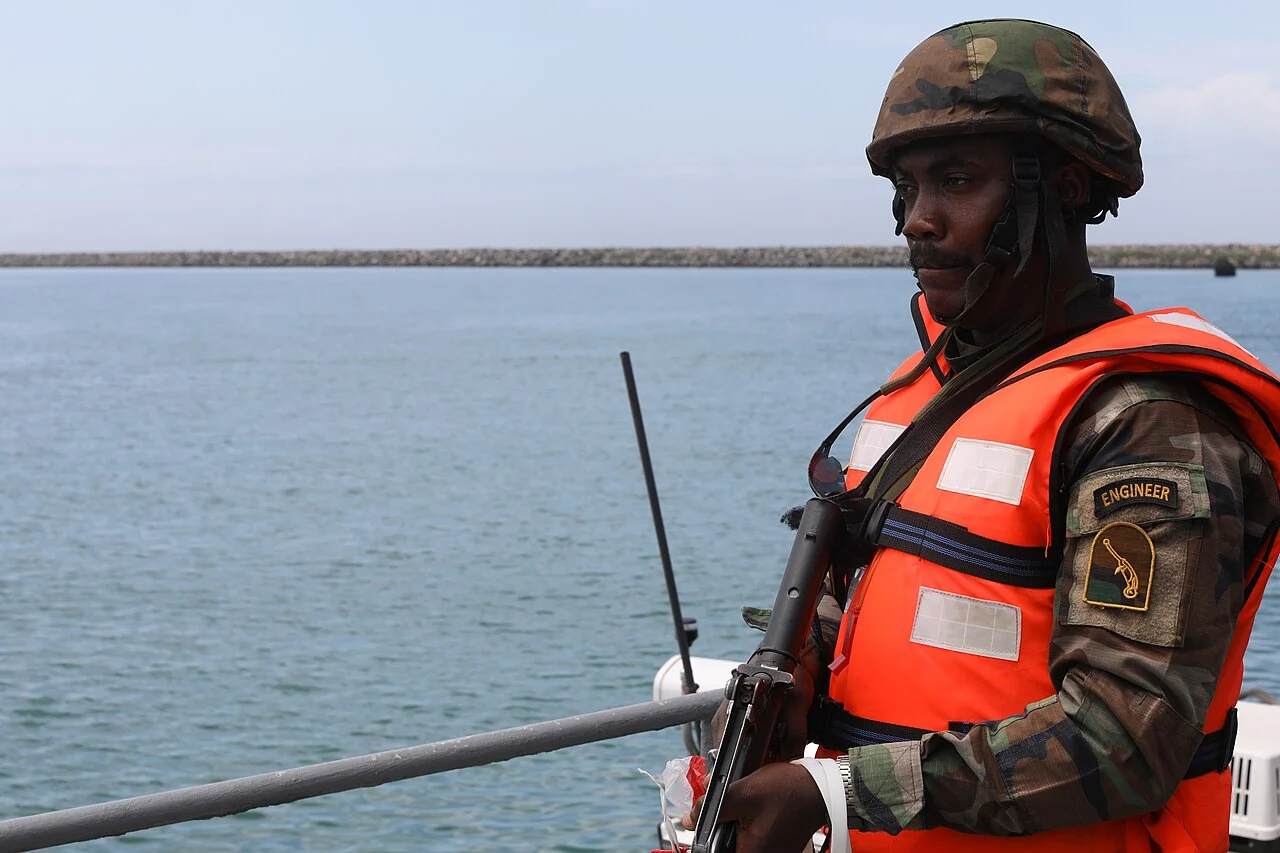
Ghana’s navy currently operates its Boundary-class coastal patrol vessels, including GNS Half Assini, pictured here boarded during Obangame Express 2024 at the navy’s Western Naval Headquarters in Sekondi (operational) (Shephard Media). Looking to expand beyond this class, Ghana has for several years run a competition for larger OPVs: a 2022 report named France’s Ocea, Germany’s Lürssen and the UK’s Babcock International as contenders, and by December 2024 the president said efforts were continuing to acquire two 72-metre OPVs, with no contract confirmed (reportedly under negotiation) (Military Africa, 2022). The push follows directly from Ghana’s exposure to Gulf of Guinea piracy and its hosting of the inaugural African Maritime Security Forum in 2026.
7. Kenya — KNS Jasiri gives the navy its only true offshore patrol vessel
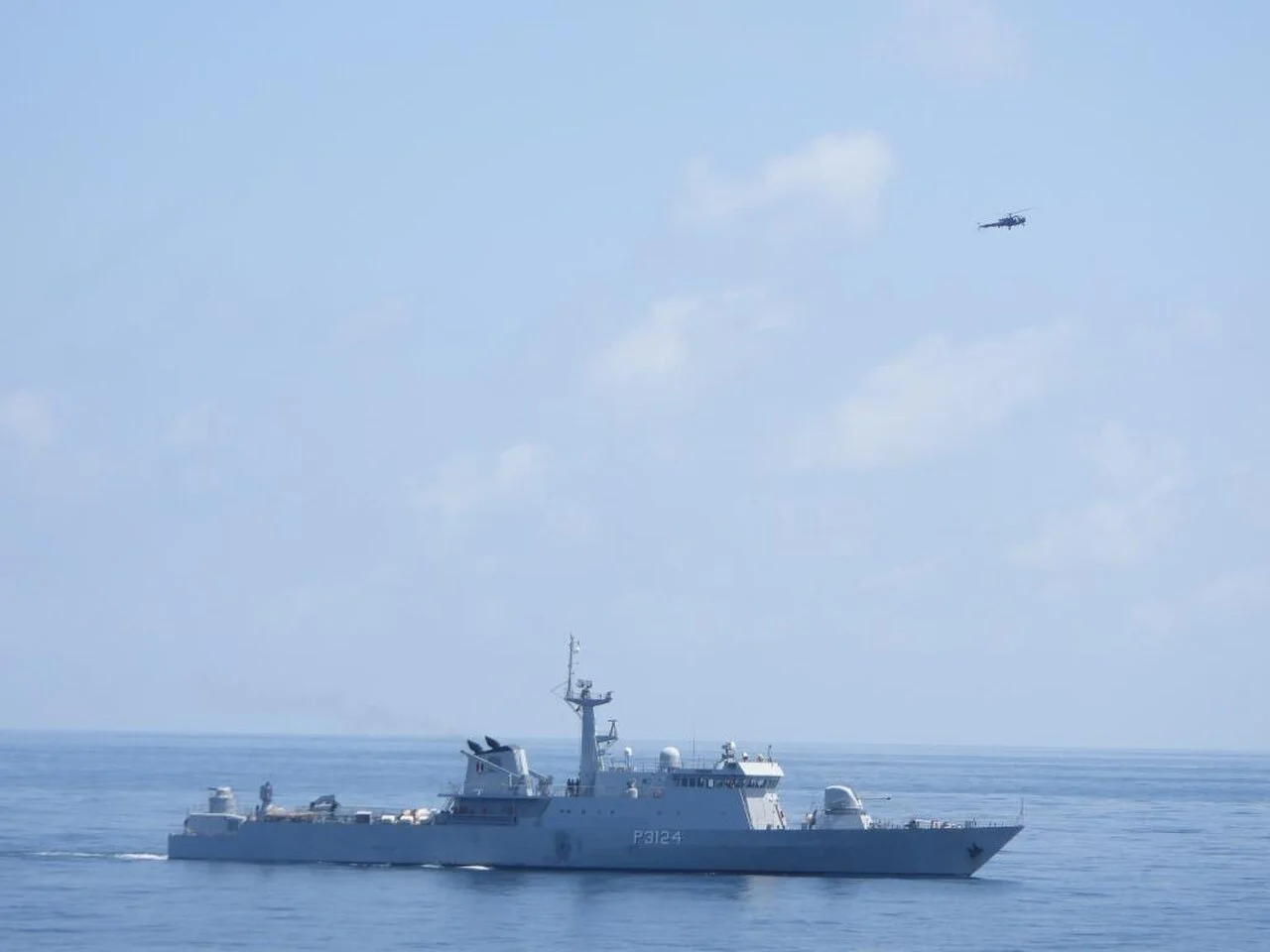
KNS Jasiri, built by Spain’s Gondan shipyard under a contract originally placed in 2003, is Kenya’s largest warship and its only dedicated offshore patrol vessel, commissioned in August 2012 after a lengthy delay tied to a contractual dispute, according to navypedia.org and contemporary reporting in Nation Africa. The ship is reported at roughly 84-85 metres long and 1,000-1,400 tonnes, published figures vary, and was fitted from build with 25mm and 12.7mm guns, with a 57mm SAK-57 gun and 30mm AK-630 added in a 2016 modernisation (operational) (navypedia.org, 2026; Nation Africa). Jasiri conducts joint EEZ patrols with partner navies, including a December 2023 exercise with India’s INS Sumedha off Lamu. Kenya’s remaining patrol force is smaller 1990s-era Shupavu-class boats and donated US and UK craft; Nairobi has been named a recipient of Japan’s Official Security Assistance programme, which may add patrol boats, not yet confirmed (Kenyans.co.ke, 2026).
8. Cameroon — the Bakassi-class, a four-decade-old missile-armed patrol ship
Cameroon’s Bakassi (P-104) was commissioned in 1983 by French builder SFCN at Villeneuve-la-Garenne, an enlarged derivative of the P-48S design, and remains the most heavily armed patrol vessel in Cameroonian service (operational) (Military Periscope). A 1999 refit at Lorient added two quadruple MM40 Exocet anti-ship missile launchers along with updated Decca radars and an electronic countermeasures suite, giving the vessel a strike capability well beyond its original coastal-patrol role. Cameroon has since added smaller Chinese-built patrol craft, including vessels delivered via Qingdao shipyard in 2014, to supplement coastal and riverine surveillance in the Gulf of Guinea and around the Bakassi peninsula. Douala’s naval base hosted the opening ceremony of Exercise Obangame Express 2026, underscoring Cameroon’s role as a regional hub for Gulf of Guinea maritime security cooperation even as its own patrol fleet remains small and ageing.
| Country | Class / vessel | Builder | Status | Source / year |
|---|---|---|---|---|
| Nigeria | P18N (NNS Unity, NNS Thunder) | CSOC, China | Operational | Army Recognition, 2016 |
| Senegal | OPV 58 S (2 of 3 delivered) | Kership/CMN, France | Delivered / contracted | Naval News, 2023 |
| South Africa | Project Biro MMIPV (3 vessels) | Damen Cape Town | Delivered | Damen, 2025 |
| Morocco | OPV-64 / Rais Bargach class (5 vessels) | Lorient, France | Operational | navypedia.org; Army Recognition, 2017 |
| Angola | Mandume-class corvette (first of class launched) | EDGE/ADSB, UAE | Contracted | WAM, 2023; EDR Magazine, 2026 |
| Ghana | Boundary-class (in service); 72m OPVs (planned) | n/a; Ocea/Lürssen/Babcock contest | Operational / reportedly under negotiation | Shephard Media; Military Africa, 2022 |
| Kenya | KNS Jasiri | Gondan, Spain | Operational | navypedia.org; Nation Africa |
| Cameroon | Bakassi (P-104) | SFCN, France | Operational | Military Periscope |
Why it matters for Africa
Offshore and inshore patrol vessels are the most affordable way for African navies to assert control over waters that, in aggregate, cover millions of square kilometres of exclusive economic zone. Unlike frigates, they can be built, crewed and sustained on defence budgets that rarely exceed a few hundred million dollars a year, and some of the classes above, Nigeria’s OCEA craft and South Africa’s Damen vessels, carried local industrial participation. The mix of suppliers matters as much as the hulls: Chinese, French and Spanish-built vessels remain the installed base, but EDGE’s Angola contract shows Gulf shipbuilders now competing directly for African coastal-security budgets, often bundling financing and training that Western yards have been slower to offer. Sustainment is the harder problem. Kenya’s Jasiri, Morocco’s OPV-64s and Cameroon’s Bakassi are now 15 to 40 years old, and keeping ageing hulls and weapons serviceable with limited local shipyard capacity will likely shape procurement in the Gulf of Guinea and Indian Ocean littoral as much as the next round of new orders does.
Sources
- Army Recognition — China delivered NNS Unity, second P18N OPV, to Nigerian Navy
- Naval News — PIRIOU delivers second OPV to the Senegalese Navy
- Janes — Senegal orders three 62m OPVs from Kership
- Damen — Damen Cape Town has delivered the third vessel to the SA Navy
- navypedia.org — Rais Bargach class (Morocco)
- Army Recognition — Piriou completes major refit of Royal Moroccan Navy patrol vessel Rais Bargach
- WAM — EDGE signs major €1 billion milestone deal with Angolan Navy
- EDR Magazine — EDGE announces launch of first-of-class corvette for the Angolan Navy
- Military Africa — Ghana awaits two OPVs, commissions Flex Fighter boats
- Shephard Media — Ghana Navy commissions new patrol craft
- navypedia.org — KNS Jasiri (Kenya)
- Nation Africa — Fanfare as Sh4 billion warship arrives
- Kenyans.co.ke — Japan to equip Kenya Navy with patrol boats in new security push
- Military Periscope — Bakassi (P-104) class
Related reading: Why Did Senegal Buy the OPV 58 S?, Why Did Angola Buy Corvettes from the UAE?, South African Navy Ships List (2026), and Nigerian Navy Ships List (2026).