The UAE fields roughly 63,000–65,000 active personnel, a small number for a country that has bought some of the most expensive air and missile defence in the world, a Block 60 F-16 fleet of roughly 80 aircraft, 80 Rafale F4 fighters on contract and a state-owned arms group, EDGE, that booked US$7.96 billion of new orders in 2025. This profile sets out what the Emirati forces operate in 2026, what is still on order, who supplied it, and where the open-source numbers should be treated with care.
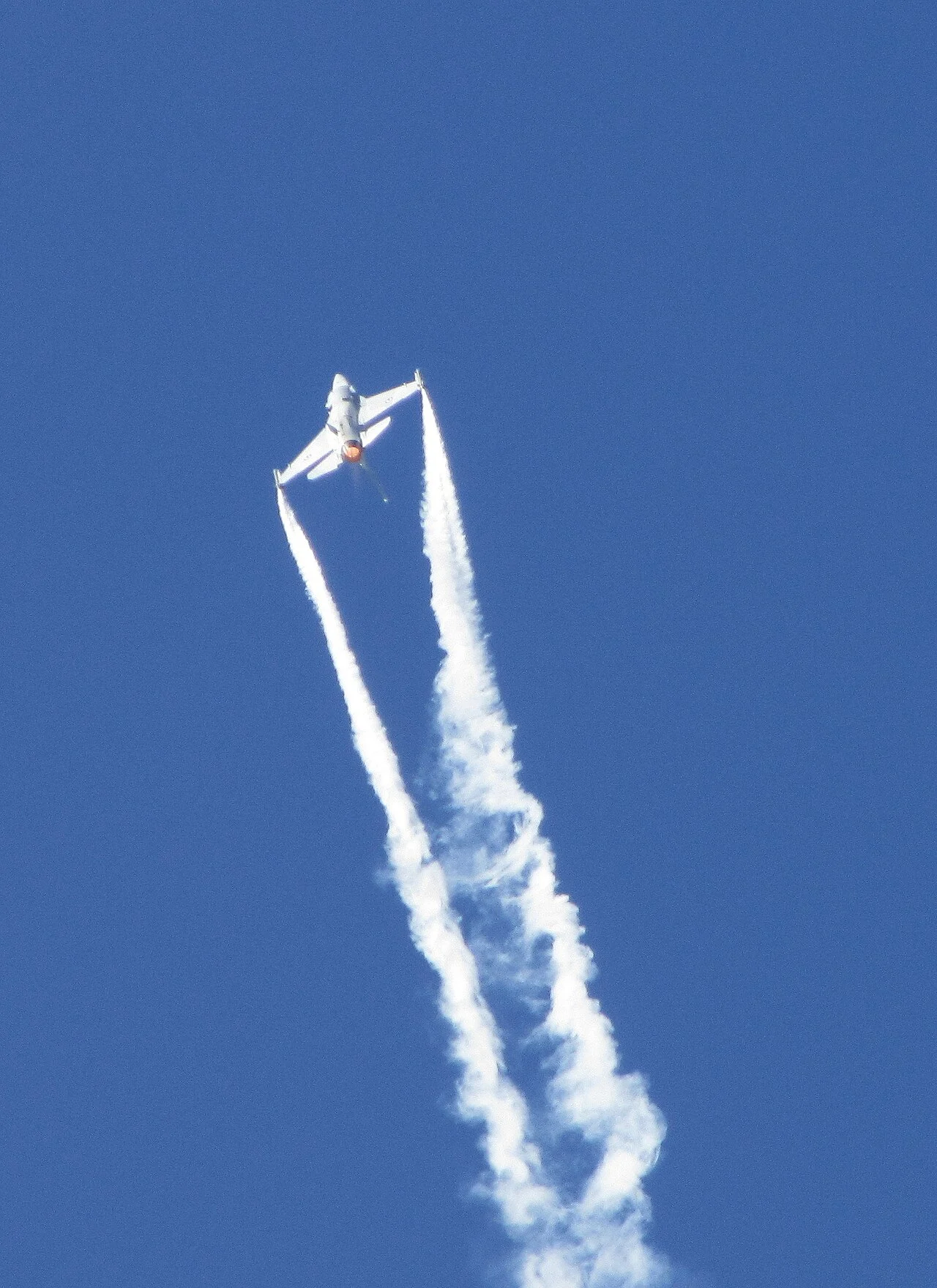
Photo: A UAE Air Force F-16E Block 60 Desert Falcon at the Dubai Airshow. Credit: Kurush Pawar, CC BY-SA 2.0, via Wikimedia Commons
The short answer to how strong the UAE’s military is depends on what is being measured. On headcount and armour it is a mid-sized Gulf force. On air power, missile defence and industrial depth it punches well above that. Composite rankings such as Global Firepower are indicative only and not an inventory count. The more useful picture comes from procurement: the UAE spent the 2010s and early 2020s buying quality over quantity, split its suppliers between Washington, Paris, Seoul and Moscow, and since 2019 has pushed a growing share of the work into Abu Dhabi through EDGE and the Tawazun Council. Then came the events of 2026, when Iranian missiles and drones fell on the country and its air defences were tested at a scale few Gulf militaries have seen.
Every line below carries a status label: In service, Under delivery, Contracted, Ordered, Planned, Reported (unconfirmed), Status unclear or Retired. An order is not a delivery, and a delivery is not an operational unit. For Gulf states in particular, exact holdings are rarely published, so quantities are marked Estimated where sources disagree.
| Indicator | Figure | Year / source |
|---|---|---|
| Active personnel | About 63,000–65,000 | IISS-derived figures reproduced by open-source trackers (Estimated) |
| Reserves | About 130,000 (Estimated); national service for adult male citizens since 2014 | Open-source compilation, 2024 |
| Military expenditure | No official line-item budget. Trackers estimate US$22–28 billion for 2025–26 | Estimated, low confidence; SIPRI has no series after 2014 |
| Arms imports rank | 11th in the world in 2021–25 (2.7% of global imports, down 15% on 2016–20) | SIPRI, March 2026 |
| Largest supplier | United States, 42% of 2021–25 imports; France second | SIPRI, via The National, March 2026 |
| Fighter aircraft | About 78–80 F-16E/F Block 60 and about 62 Mirage 2000-9; 80 Rafale F4 contracted | Estimated; Dassault (Rafale), 2025 |
| Main battle tanks | About 354 Leclerc | Open-source compilation (Estimated) |
| Ballistic missile defence | 2 THAAD systems; Patriot PAC-2/PAC-3; Cheongung-II (10 batteries ordered) | US and Korean sources, 2011–2026 |
| Navy | 2 Gowind corvettes, 6 Baynunah, 1 Abu Dhabi-class, plus patrol and fast attack craft | Open-source compilations, 2024–25 |
| Home industry | EDGE: US$5.06 billion revenue and US$20.4 billion backlog | EDGE, FY2025 (announced April 2026) |
Current military overview and security environment
The UAE Armed Forces were unified in 1976 out of the separate emirate forces, and the legacy still shows. Six components are usually listed: the Land Forces, the Navy, the Air Force and Air Defence, the Presidential Guard, the Joint Aviation Command and the National Guard. Abu Dhabi holds most of the procurement authority; Dubai historically kept its own units, which is why open-source lists split some vehicle fleets between the two emirates, such as BMP-3s counted as 250 for Abu Dhabi and 402 for Dubai.
The security picture the forces plan against is documented rather than speculative. The UAE’s first operational THAAD interception came on 17 January 2022 against a Houthi ballistic missile, according to Army Recognition’s summary of the US contract record. Far larger was the exchange that began on 28 February 2026, when Iran struck targets across the Gulf after US and Israeli attacks. By 8 April 2026, the UAE Ministry of Defence reported that its air defences had engaged 537 ballistic missiles, 26 cruise missiles and 2,256 drones since the start of the attacks; a ceasefire was announced the same day. Those are Emirati government figures and have not been audited independently. They matter here because they explain a large share of what the country bought in the following six months.
For the UAE’s own air-defence lineage, from the HAWK of 1989 to the current layers, see our evolution of the UAE’s integrated air and missile defence.
Defence budget: what the numbers do and do not show
The UAE does not publish a disaggregated defence budget. SIPRI’s Military Expenditure Database carries no Emirati figure after 2014, when the last reported total was about AED 83.6 billion. Every current number is therefore an outside estimate. Trackers that draw on IISS assessments and disclosed contract values put annual defence and security spending at roughly US$22–28 billion for 2025–26, or around 4–5% of GDP, but these are Estimated and low-confidence figures, not official ones.
Contract announcements give firmer floors. At IDEX and NAVDEX in February 2025 the Tawazun Council announced 40 deals worth AED 23.72 billion in four days. At UMEX and SimTEX in January 2026 it concluded eight contracts worth AED 2.36 billion in two days. Foreign military sales are visible through US notifications: the March 2026 package alone was valued at US$8.46 billion. None of these adds up to a budget, because many payments are spread over years and some deals are never announced.
Personnel and force structure
The IISS-derived figure of about 63,000–65,000 active personnel is small next to Saudi Arabia’s or Egypt’s, and the UAE has long compensated with technology, foreign contract staff and a selective conscription system. Compulsory national service for adult male Emiratis was introduced in 2014, feeding a reserve that open-source trackers place near 130,000. The Navy is the smallest service at roughly 3,000 personnel and the Air Force and Air Defence roughly 4,000 by older counts; both figures are dated and should be read as orders of magnitude.
The Presidential Guard Command deserves separate mention. It was formed in 2011 by merging the Emiri Guard, the Special Operations Command and a marine battalion from the Navy, and combines the guard and special-operations functions. It sits outside the usual Land Forces order of battle, which is one reason headline army numbers may understate the ground force. Detailed organisation and inventory of the Guard are not published, so this article does not attempt to count it.
Army
The land inventory is dominated by French and Russian equipment bought in the 1990s and supplemented since by US, South African, Finnish and locally produced systems. The Leclerc, bought from 1993, remains the main battle tank, and the BMP-3 the main infantry fighting vehicle. For how those numbers compare with other Arab armies, see our survey of main battle tanks in Arab armies.
| System | Origin | Quantity | Status | Source |
|---|---|---|---|---|
| Leclerc main battle tank | France | About 354 (older lists give up to 436) | In service | Open-source compilation, Wikipedia equipment list |
| BMP-3 infantry fighting vehicle | Russia | About 652 (delivered 1992–97) | In service | Open-source compilation; Bellingcat on combat use in Yemen |
| Patria AMV 8×8 | Finland | 45 ordered 2016, option for 50 more | Delivered (Estimated) | Open-source compilation |
| Rabdan 8×8 | UAE / Türkiye (Otokar design, UAE assembly) | 700 planned; about 400 delivered by 2017 | Under delivery (Reported) | Open-source compilation |
| Nimr 4×4 (Hafeet, Ajban) | UAE (EDGE) | Several hundred | In service | Open-source compilation |
| G6 Rhino 155 mm self-propelled howitzer | South Africa | About 78 | In service | Open-source compilation |
| M109 self-propelled howitzer | United States (ex-Netherlands) | About 87 | In service | Open-source compilation |
| M142 HIMARS | United States | 12 ordered 2014 | In service (Estimated) | Open-source compilation |
| K239 Chunmoo | South Korea | 12 reported purchased 2021 | Reported (unconfirmed) | Open-source compilation |
Air Force and Air Defence
The UAE Air Force and Air Defence is the country’s most significant service. Its core is the F-16E/F Block 60 “Desert Falcon”, a variant developed for the UAE with an AN/APG-80 AESA radar and conformal fuel tanks. The UAE ordered 55 F-16Es and 25 F-16Fs, delivered between 2003 and 2006; open-source lists count 78 in service after losses and attrition. Alongside them sit the French-built Mirage 2000-9, a fleet of about 62 aircraft in three sub-variants, upgraded since 2019 through contracts with Dassault, Thales and MBDA to stay in service into the 2030s.
| System | Origin | Quantity | Status | Source |
|---|---|---|---|---|
| F-16E/F Block 60 | United States | 78–80 (55 E and 25 F ordered) | In service | DSCA/US State Department; F-16.net; European Security & Defence, Nov 2025 |
| Mirage 2000-9 (DAD/EAD/RAD) | France | About 62 | In service | European Security & Defence; Army Recognition |
| Rafale F4 | France | 80 | Contracted (Dec 2021); first aircraft accepted Jan 2025, in flight test; deliveries to the Air Force scheduled end of 2026 | Dassault Aviation |
| Hongdu L-15 trainer/light attack | China | 6 in service, 42 on order (open-source count) | Reported (unconfirmed) | Open-source compilation |
| Calidus B-250 light attack | UAE (EDGE) | 24 reported on order | Reported (unconfirmed) | Open-source compilation |
| Saab GlobalEye AEW&C | Sweden | About 5 | In service (support contracted by Tawazun, 2025) | ADNEC/Tawazun IDEX 2025; open-source count |
| Airbus A330 MRTT tanker | Europe | About 5 | In service (Estimated) | Open-source compilation |
| AH-64D/E Apache | United States | 28 remanufactured plus 9 new, approved 2016; first AH-64E delivered Aug 2023 | Under delivery | DSCA 2016; Helis, 2023 |
| CH-47F Chinook | United States | Approved May 2025, US$1.32 billion | Planned (US approval; contract not confirmed) | US State Department / DSCA, 12 May 2025 |
The Rafale order and the F-35 question
The UAE signed for 80 Rafale F4 fighters on 3 December 2021 in the presence of President Macron and Abu Dhabi’s Crown Prince. The programme is reported at about US$16.6 billion (roughly €16 billion), including about €2 billion of weapons, and was described by Dassault’s chairman as the largest export order in French combat-aircraft history. The first UAE aircraft, a two-seater with serial 1101, was presented at Istres on 29 January 2025 and stays at Dassault’s flight-test centre; first deliveries to the Air Force are scheduled for the end of 2026. Until that happens, the correct label is contracted, not in service, a distinction some aggregator sites blur. The Rafales are intended to replace the Mirage 2000-9. Reports in January 2025, sourced to Moroccan media, said up to 30 Mirage 2000-9E could pass to Morocco after Rafale deliveries, subject to French consent; that transfer is Reported (unconfirmed). For the Egyptian Rafale comparison see Egypt’s request for 24 more Rafales.
The F-35 is unresolved. The United States authorised a package including 50 F-35As in January 2021; the UAE suspended negotiations in December 2021 amid disputes over technology-security conditions, including concerns about Chinese telecommunications equipment. According to Amwaj.media (June 2025), a senior Emirati official said in January 2025 there were no immediate plans to resume talks. No public source reviewed shows a live request today. Meanwhile, on 18 September 2026 the State Department approved the sale of 48 F-35s to Saudi Arabia, as reported by Stars and Stripes, which changes the regional context but not the UAE’s status: Status unclear. No Eurofighter Typhoon order has been reported for the UAE. The same Amwaj article reports Abu Dhabi exploring partnerships with South Korea (KF-21) and Türkiye (KAAN); nothing has been contracted.
Weapons
The US State Department approved two F-16 weapons packages on 19 March 2026 under an emergency determination that waived congressional review: up to 400 AIM-120C-7/C-8 AMRAAM for US$1.22 billion, and 1,500 GBU-39/B Small Diameter Bombs plus 1,200 JDAM guidance sets, with mission-planning elements, for US$644 million. A further US$147.6 million approval on 4 May 2026 covered 1,500 APKWS guidance sections. These are approvals to sell, not deliveries.
Navy
The Navy is a coastal and offshore force built around corvettes and patrol craft, with the shipbuilding done increasingly at Abu Dhabi Shipbuilding (ADSB), now part of EDGE. Its principal surface combatants are two Bani Yas-class Gowind corvettes (Naval Group design, built with ADSB, the first delivered by Naval Group and ADSB), six Baynunah-class corvettes (built for about US$820 million) and one Abu Dhabi-class corvette. Four Falaj 3-class offshore patrol vessels were ordered from ADSB in May 2021. Open-source trackers put the total fleet at about 79 active vessels, which includes small craft. EDGE and Fincantieri announced a naval joint venture, MAESTRAL, in May 2024.
| System | Origin | Quantity | Status | Source |
|---|---|---|---|---|
| Bani Yas (Gowind 2500) corvette | France / UAE (ADSB) | 2 | In service | Naval Technology; AGSI |
| Baynunah-class corvette | UAE (ADSB, French design) | 6 | In service | Shephard; open-source compilation |
| Abu Dhabi-class corvette | Italy / UAE | 1 | In service | Open-source compilation |
| Muray Jib-class corvette | Germany | 2 | In service (ageing) | Open-source compilation |
| Falaj 3 offshore patrol vessel | UAE (ADSB) | 4 ordered May 2021 | Under delivery (Status unclear) | Shephard Defence Insight |
Air and missile defence
This is the layer where the UAE has invested most heavily, and where its record in 2026 is best documented. The country was the first international customer for THAAD, in a 2011 agreement worth US$3.48 billion, and now operates two systems. Patriot units in both PAC-2 and PAC-3 configuration are reported at 12 batteries (Estimated). Lower tiers include Russian Pantsir-S1 (from 2004) and the MIM-23 Hawk. The most recent layer is the South Korean Cheongung-II (KM-SAM Block II), for which the UAE was the first export customer. For alternatives to Patriot across the region see our guide to five alternatives.
| System | Origin | Quantity | Status | Source |
|---|---|---|---|---|
| THAAD (with AN/TPY-2 radar) | United States | 2 systems | In service; 2011 launch order US$3.48 billion | Army Recognition (DoD contract notice); DefenceMENA |
| THAAD launcher modification (Configuration 3) | United States | Value US$211.4 million; work Aug 2026 to Jan 2031 | Contracted (US contract notice, 13 Aug 2026) | Army Recognition citing Missile Defense Agency notice |
| Long-Range Discrimination Radar with THAAD integration | United States | 1 radar, 12 Sentinel A4 uplinkers, US$4.5 billion | Planned (US approval 19 Mar 2026) | US State Department |
| Patriot PAC-2 / PAC-3 | United States | About 12 batteries | In service (Estimated) | Open-source compilation |
| PAC-3 MSE interceptors | United States | 452, US$2.728 billion | Planned (notified Dec 2024; contract not confirmed) | DSCA, Dec 2024 |
| Cheongung-II (KM-SAM Block II) | South Korea | 10 batteries, about US$3.5 billion (2022) | Under delivery; earlier batteries confirmed, accelerated delivery in 2026 (Reported) | Janes (launcher displayed May 2025); Global Defense Corp, Mar 2026 |
| Pantsir-S1 | Russia | About 50 | In service (Estimated) | Open-source compilation |
| FS-LIDS counter-drone system with Coyote Block 2 | United States | 10 systems, 240 Coyote, US$2.1 billion | Planned (US approval 19 Mar 2026) | US State Department; Defaiya |
Two points help read that table. First, the THAAD, Patriot and Cheongung units are supplied under different national rules, so the UAE’s reliance on the American stack is partly hedged by the Korean one. Second, Seoul reportedly airlifted about 30 Cheongung-II interceptors to Abu Dhabi around 8–9 March 2026 and brought forward remaining deliveries; that account rests on South Korean reporting and secondary outlets, so it is labelled Reported (unconfirmed). The Aviationist separately reported Emirati AH-64 Apaches engaging Shahed-type drones with their 30 mm cannon in March 2026, an example of the counter-drone layer that the FS-LIDS approval is meant to extend.
Drones and unmanned systems
The UAE flies a mixed unmanned fleet. Chinese Wing Loong II and Wing Loong I armed drones are in Emirati service according to open sources. Twenty Bayraktar TB2 were delivered on 21 September 2022, according to Reuters reporting confirmed by a senior Turkish official, out of a request that had originally been for 120 as part of a package worth about US$2 billion; further deliveries are unconfirmed. American MQ-1 Predator XP and South African Seeker types are also listed. Indigenous programmes are led by EDGE, including the REACH-S medium-altitude long-endurance drone and the QX unmanned aerial system, for which Tawazun awarded a development contract worth AED 45.1 million in January 2026. In the same round Tawazun awarded EDGE AED 1.396 billion for ANAVIA HT-750 aircraft, the largest single UMEX and SimTEX contract of the year, and AED 10.6 million for an autonomous Nimr vehicle. These are contracts; deliveries are not confirmed.
Missiles and long-range strike
The UAE does not publish an order of battle for surface-to-surface missiles, and this article does not infer one. What is documented is a growing domestic and partner-supplied weapons line. Turkish supply here goes back further than the drone fleet: Tawazun contracted ROKETSAN in 2001 for 122mm rockets and a weapon system, then in 2013 for the CIRIT 2.75″ laser-guided missile in a deal worth an estimated US$196 million, with co-production and technology transfer through local firm Burkan Munitions Systems (see DefenceMENA’s ROKETSAN in the Middle East page). At IDEX 2025 Tawazun contracted Calidus for phase one of the HEDA missile system at AED 3.76 billion. MBDA announced an Emirati thermal-battery plant at the Tawazun Industrial Park, aimed at localising a component used in missile production. The imported inventory is visible in the US approvals above: AMRAAM, Small Diameter Bombs, JDAM and APKWS. Artillery rockets include 12 HIMARS launchers. Details of stocks and ranges are not available from open sources.
Defence industry and localisation
EDGE was formed on 5 November 2019 by merging Emirates Defence Industries Company, Emirates Advanced Investments Group and Tawazun Holding; it is owned by the Government of Abu Dhabi and chaired by Faisal Al Bannai. The group reported US$5.06 billion of revenue for fiscal year 2025, new orders of US$7.96 billion and a backlog of US$20.4 billion, according to figures published in April 2026, when it also said more than 80% of its systems are now produced locally and that local added value came to AED 596 million. These are EDGE’s own figures.
The Tawazun Council for Defence Enablement is the procurement and industrial-policy body: it awards the contracts, and drives localisation of defence technology; MBDA’s planned thermal-battery plant is sited at the Tawazun Industrial Park. In 2026 it announced a partnership with AD Ports Group to develop the Al Selmiyyah defence industrial free zone, and signed localisation projects with MBDA and other foreign firms. Localisation in practice means two things in the UAE: EDGE subsidiaries taking on domestic design and assembly (Nimr vehicles, ADSB ships, drones) and foreign OEMs building parts locally (thermal batteries, Gowind construction). For a comparison with a large African importer, see our Egypt profile.
Main foreign suppliers
SIPRI ranks the UAE 11th among world arms importers for 2021–25, with 2.7% of the global total, down 15% from 2016–20. The United States supplied 42% of the total, and France ranked second, though the French percentage was not retrievable from the sources used here. The pattern is a two-anchor supply base, US and French, with a third layer of Korean, Russian, Chinese, South African, Swedish and Italian systems. For the French line in full, including the 2021 Rafale contract’s actual delivery status, the Caracal helicopter order the UAE reportedly cancelled in 2023, and the basing arrangement that put French Rafales over Emirati skies during the March 2026 Iran war, see DefenceMENA’s France’s arms deals with the UAE.
| Supplier | Principal systems | Status | Source |
|---|---|---|---|
| United States | F-16E/F Block 60, THAAD, Patriot, Apache, Chinook, HIMARS; 42% of 2021–25 imports | In service; new approvals 2025–26 | SIPRI via The National; DSCA |
| France | Mirage 2000-9, Rafale F4 (80), Leclerc, Gowind corvettes, Caracal helicopters | In service; Rafale contracted | Dassault; Naval Technology |
| South Korea | Cheongung-II air defence, K239 Chunmoo (Reported) | Under delivery | Janes; Global Defense Corp |
| Russia | BMP-3, Pantsir-S1 | In service (1990s–2000s deliveries) | Bellingcat; open-source compilation |
| China | Wing Loong II, L-15 (Reported) | In service / Reported | Open-source compilation |
| Sweden | GlobalEye | In service | ADNEC/Tawazun; open-source count |
| South Africa | G6 howitzer, Seeker drone | In service | Open-source compilation |
| Türkiye | Bayraktar TB2 (20 delivered Sept 2022) | Delivered; further deliveries unconfirmed | Atlantic Council, citing Reuters |
The UAE’s neighbours make very different choices. Saudi Arabia’s procurement is covered in our review of its biggest defence deals and will get its own profile at Saudi Arabia’s military strength; Qatar follows at Qatar’s military strength, and Oman’s smaller force is covered at Oman’s military strength, and Kuwait’s build-up around Typhoon and Patriot at Kuwait’s military strength. Recent UAE buying is also tracked on our UAE desk, the EDGE Group desk and the Rafale and THAAD tags, with regional coverage in the Middle East category.
Recent procurement timeline
| Date | Event | Value | Status |
|---|---|---|---|
| Dec 2024 | US notifies possible sale of 452 PAC-3 MSE interceptors | US$2.728 billion | Planned (contract not confirmed) |
| Jan 2025 | First Rafale F4 presented at Istres and accepted; stays for flight tests | 80 aircraft, about US$16.6 billion (2021) | Contracted |
| Feb 2025 | IDEX and NAVDEX: Tawazun announces 40 deals, including HEDA phase one and Saab GlobalEye support | AED 23.72 billion | Contracted |
| 12 May 2025 | US approves CH-47F Chinook helicopters and F-16 sustainment | US$1.32 billion and US$130 million | Planned |
| Jan 2026 | UMEX and SimTEX: eight Tawazun contracts including ANAVIA HT-750 and QX UAS | AED 2.36 billion | Contracted |
| 28 Feb–8 Apr 2026 | Iranian missile and drone attacks; UAE MoD reports 537 ballistic missiles, 26 cruise missiles and 2,256 drones engaged | Not applicable | Official figures, unaudited |
| 8–9 Mar 2026 | South Korea reportedly airlifts about 30 Cheongung-II interceptors to the UAE | Not stated | Reported (unconfirmed) |
| 19 Mar 2026 | US emergency approval of four sales: LRDR with THAAD, FS-LIDS, AMRAAM, F-16 munitions | US$8.46 billion | Planned |
| 4 May 2026 | US approves 1,500 APKWS guidance sections | US$147.6 million | Planned |
| 13 Aug 2026 | US contract modification for new THAAD launchers (Configuration 3) | US$211.4 million | Contracted |
| End 2026 | First Rafale F4 deliveries to UAE Air Force scheduled | Not stated | Planned |
Modernisation priorities
Three priorities are visible in the documents rather than in speculation. The first is replenishing and thickening air and missile defence: the THAAD launcher upgrade, the radar package, more Cheongung batteries and counter-drone systems all point in that direction. The second is the fighter transition: Rafale F4 arrives from the end of 2026, the Mirage 2000-9 is being kept to the 2030s, and Lockheed Martin has reportedly proposed upgrades to keep the Block 60s flying to 2030–40, though no upgrade contract has been confirmed. The third is industrial: more of the value chain moves under EDGE and Tawazun, with drone, munitions and shipbuilding lines at the front.
What is changing?
The UAE’s armed forces are moving from an import-heavy model towards a hybrid one, in which foreign platforms carry Emirati weapons, sensors and support. Foreign suppliers are no longer just sellers; several are now partners in Abu Dhabi factories. The war of 2026 accelerated the air-defence and counter-drone side of that shift and produced a combat record for the THAAD, Patriot and Cheongung stack. What it did not change, on the public record, is the fighter picture: Rafale first, F-35 unresolved.
A note on the numbers
The UAE releases little. Personnel and inventory figures on this page come from IISS-derived aggregates, open-source compilations and manufacturer or US government notices; where they conflict, a range is given. Leclerc counts vary from 354 to 436 between listings, F-16 counts from 78 to 80, and the budget has no official figure at all. US approvals are permissions to negotiate, not contracts, and even signed contracts do not show delivery. Global Firepower is used only as an indicative ranking. Emirati air-defence interception totals are government figures and have not been independently verified. Arabic readers can find a parallel profile in the Arabic-language profile on DefenceArabia.
Sources
- The National, SIPRI arms transfers data 2021–25 (March 2026)
- SIPRI, Trends in International Arms Transfers, 2025
- Dassault Aviation, contract for 80 Rafale F4 for the UAE
- Dassault Aviation, presentation of the first UAE Rafale (January 2025)
- Shephard Media, UAE accepts first F4 Rafale
- FlightGlobal, Dassault unveils first Rafale for the UAE
- European Security & Defence, Middle Eastern combat aircraft (November 2025)
- Army Recognition, possible Mirage 2000-9E transfer to Morocco (January 2025)
- Amwaj.media, Is the UAE done hoping for the F-35? (June 2025)
- Stars and Stripes, State Department approves F-35 sale to Saudi Arabia (September 2026)
- US State Department, UAE Long-Range Discrimination Radar with THAAD integration
- Al Defaiya, four US sales to the UAE worth US$8.46 billion
- The National, US expedites air defence and weapons package to the UAE
- F-16.net, US approves F-16 weapons package for the UAE
- Breaking Defense, US clears US$8.6 billion in Middle East arms sales (May 2026)
- DSCA, UAE CH-47F Chinook helicopters (May 2025)
- DSCA, UAE F-16 sustainment (May 2025)
- DSCA, UAE Patriot missile system and related support
- Army Recognition, US to upgrade UAE THAAD with new launchers (August 2026)
- Janes, UAE M-SAM delivery confirmed
- Global Defense Corp, third Cheongung-II battery to the UAE (March 2026)
- Zona Militar, South Korea to send interceptors to the UAE (March 2026)
- The National, UAE Ministry of Defence interception figures (8 April 2026)
- Open-source compilation of the UAE in the 2026 Iran war (Wikipedia, with references)
- The Aviationist, UAE AH-64 Apaches counter Shahed drones (March 2026)
- Gulf News, EDGE at Make it in the Emirates 2026
- ADNEC, IDEX and NAVDEX 2025 deals reach AED 23.72 billion
- Gulf News, Tawazun awards Dh2.3 billion at UMEX and SimTEX 2026
- MBDA, Tawazun and MBDA localisation projects
- DredgeWire, Tawazun and AD Ports Al Selmiyyah free zone
- Naval Technology, UAE Navy takes delivery of its first Gowind corvette
- Arab Gulf States Institute, the UAE’s approach to naval defence
- Atlantic Council, the UAE receives twenty Bayraktar drones (2022)
- Bellingcat, the UAE’s BMP-3 in Yemen
- SIPRI Military Expenditure Database
- Open-source compilation of UAE Army equipment (Wikipedia, with references)
- Open-source overview of the UAE Armed Forces and Presidential Guard (Wikipedia, with references)
- Global Firepower, UAE profile (indicative ranking only)