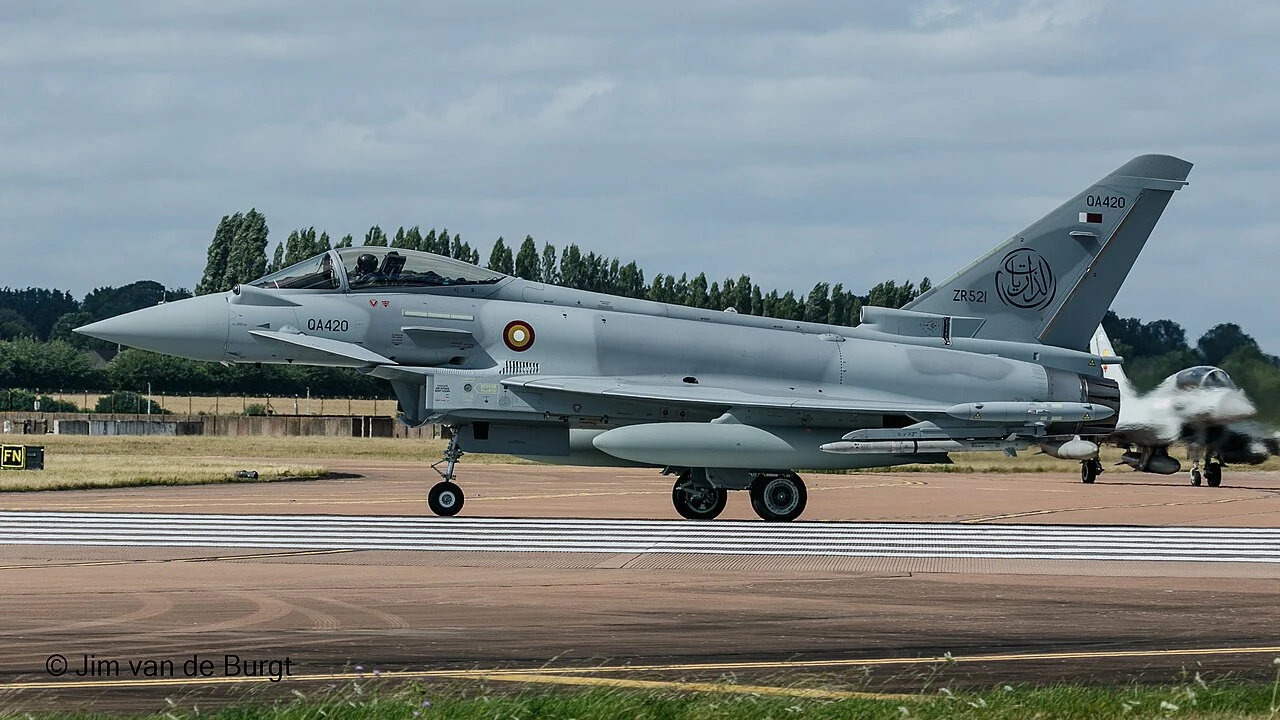
Qatar fields one of the smallest armed forces in the Gulf and one of its most expensive arsenals. Around 26,000 personnel operate 96 modern combat aircraft from three suppliers, a stacked Patriot and NASAMS air defence, German-built armour and Italian-built warships. In 2026 that inventory was used in real conditions for the first time, and this profile sets out what is in service, what is on order and where the open-source numbers are thin.
Photo: Eurofighter Typhoon QA 420 of the Qatar Emiri Air Force preparing for take-off at RIAT 2024, RAF Fairford. Credit: Jim van de Burgt, CC0, via Wikimedia Commons
The short answer to the headline question is that Qatar’s strength lies in equipment quality and in who stands behind it, not in numbers. SIPRI ranked it the world’s fourth-largest arms importer in 2021–25, with 6.4% of global imports, ahead of every other Gulf state except Saudi Arabia. The Qatar Emiri Air Force completed a fighter build-up of 36 F-15QA, 36 Rafale and 24 Typhoon aircraft in less than a decade. The land forces are a single armoured core built around 62 Leopard 2A7+ tanks. Behind all of it sits Al Udeid Air Base, which Qatar hosts but does not operate: the United States runs it, and its presence is part of Qatar’s deterrence but not part of its national inventory. Each line below carries a status label: In service, Delivered, Under delivery, Ordered, Planned, Reported (unconfirmed), Status unclear or Estimated. An order is not a delivery, and a delivery is not an operational unit.
| Indicator | Figure | Year / source |
|---|---|---|
| Active personnel | About 26,550 (Army 12,500; Navy 4,500; Air Force 5,000; Air Defence 2,650; Special Forces 1,900) plus about 4,000 reserves | IISS Military Balance 2026 as reproduced by open-source compilations (Estimated) |
| Military expenditure | No official line-item budget; third-party estimates of roughly US$17 billion for 2026 | Estimated, low confidence; SIPRI does not publish a Qatar series in its 2025 release |
| Arms imports rank | 4th in the world in 2021–25 (6.4% of global imports); 3rd in 2020–24 | SIPRI, March 2026 and March 2025 |
| Main supplier | United States, 48% of imports in 2021–25 | SIPRI, March 2026 |
| Combat aircraft | 96 modern fighters (36 F-15QA, 36 Rafale, 24 Typhoon), with 12 more F-15QA and 12 more Typhoon reported | FlightGlobal, March 2024; BAE Systems; Estimated for the extra 24 |
| Main battle tanks | 62 Leopard 2A7+ | KMW contract; open-source directories (Estimated) |
| Warships | 4 Al Zubarah-class corvettes and 2 Musherib-class OPVs, all Fincantieri | Fincantieri and Naval News, 2021–2023 |
| Foreign forces on Qatari soil | About 10,000 US personnel at Al Udeid; a Turkish contingent at Tariq bin Ziyad; RAF personnel with a joint Typhoon squadron | Open sources, 2024–2026 (Estimated) |
Current military overview and security environment
Qatar’s armed forces have two founding events. The first was the 2017–2021 blockade by Saudi Arabia, the UAE, Bahrain and Egypt, which turned a modest defence budget into a large, fast procurement programme. The second was 2025–2026. On 9 September 2025 Israel struck a residential compound in Doha’s Leqtaifiya district where Hamas leaders were meeting; Qatar’s prime minister said the weapons had not been picked up by radar. Then, after the US and Israeli strikes on Iran on 28 February 2026, Iran fired missiles and drones at Qatar.
On 2 March, according to a statement by Qatar’s foreign ministry quoted by 19FortyFive, the air force shot down two Iranian Su-24 aircraft and the country intercepted seven ballistic missiles and five drones. Some outlets attribute the Su-24 kills to F-15s; the ministry statement quoted does not name the aircraft type, and independent verification of the intercept counts remains limited. On 3 March an Iranian ballistic missile struck Al Udeid, with no casualties reported by Qatar. Later strikes hit the Ras Laffan gas complex on 18 March and, according to the same reporting, an oil tanker on 1 April. A ceasefire was listed as holding at the time of writing. These are documented events, not indicators of intent, and this profile makes no forecast from them.
Defence budget: what the numbers do and do not show
Qatar does not publish a detailed defence budget, and SIPRI’s April 2026 military expenditure release carries no Qatar entry. Third-party estimates of about US$17 billion for 2026 circulate, but they should be read as indicative. What is measurable is the import bill: Qatar’s arms imports in 2020–24 were 127% higher than in 2015–19 and roughly 13 times the 2010–14 level (SIPRI, March 2025). Two further channels sit outside any budget line: Barzan Holdings contracts, which the state announced as QAR 3.3 billion (about US$903 million) across four agreements at DIMDEX in January 2026, and burden-sharing payments for Al Udeid, described in a US-Qatar statement of intent after President Trump’s May 2025 visit.
Personnel and force structure
The IISS-derived figure of about 26,550 active personnel is the number most trackers reproduce. Qatar’s forces are organised as the Emiri Land Forces, the Emiri Navy, the Emiri Air Force and, since 2018, a separate Emiri Air Defence Forces. The small size explains the procurement pattern: Qatar buys complete systems, training and maintenance from the supplier rather than building a mass army, and it has leaned on contractor and partner support for sustainment. Foreign personnel are part of the picture. The RAF and the Qatar Emiri Air Force run a joint Typhoon squadron, No. 12 (Reserve) Squadron in the UK, and the Turkish garrison in Doha has been in place since 2015.
Army
The Emiri Land Forces are a mechanised force built in two waves. The first was German: in 2013 Krauss-Maffei Wegmann announced a contract worth €1.89 billion for 62 Leopard 2A7+ tanks and 24 PzH 2000 self-propelled howitzers, with first deliveries in 2015. The second is the current Boxer and RCH 155 generation. Turkish wheeled vehicles fill the mid-tier. Qatar is not on any reported list of Caesar howitzer customers, so the French-built artillery in its inventory is the older AMX F3.
| System | Origin | Quantity | Status | Source |
|---|---|---|---|---|
| Leopard 2A7+ main battle tank | Germany | 62 | In service | Quwa; Defense Industry Daily |
| PzH 2000 155 mm self-propelled howitzer | Germany | 24 delivered; 12 returned to Germany in September 2024, leaving about 12 | In service (reduced fleet) | Kyiv Post; Technology.org, December 2025 |
| RCH 155 wheeled 155 mm howitzer | Germany | At least 12, about €100 million | Ordered / under delivery, status unclear | KNDS; Kyiv Post |
| Boxer RCT30 infantry fighting vehicle | Germany | 10 ordered; first delivered 3 December 2025, 6 by end-January 2026 | Under delivery | Army Recognition |
| Ejder Yalçın 4×4 armoured vehicle | Türkiye | 342 | Delivered from late 2017 | Army Recognition; Defence Turkey |
| BMC Kirpi MRAP and BMC Amazon 4×4 | Türkiye | 50 Kirpi and 35 Amazon (85 in all) | Contracted 2018; delivery status unclear | Defense Mirror |
| Altay main battle tank | Türkiye | 100 reported | Reported (unconfirmed); no public activated contract found | TRT World; Defense News |
| AMX-10P and VAB (French-origin) | France | About 40 and 180 | In service (Estimated); 54 VAB modernised via Barzan/Arquus | Arquus; open-source directories |
| AMX F3 155 mm self-propelled howitzer | France | About 22 | In service (Estimated) | Open-source directories |
| M142 HIMARS with ATACMS/GMLRS | United States | About 7 | In service (Estimated) | DSCA notifications 2012–2016; directories |
Air Force
The Qatar Emiri Air Force is the centrepiece and the clearest example of the difference between an order and an operational fleet. FlightGlobal reported in March 2024 that Qatar was about to finish a fielding process that added 96 advanced combat aircraft since the late 2000s. Every one of those airframes is a different supplier’s product: Boeing, Dassault and BAE Systems, with US, French and British logistics chains.
| System | Origin | Quantity | Status | Source |
|---|---|---|---|---|
| F-15QA Ababil | United States | 36 contracted in December 2017; reports of 48 since 2020 | 36 delivered by August 2023; additional 12 status unclear | DSCA 2016; Overt Defense; Wikipedia inventory |
| Dassault Rafale EQ/DQ | France | 36 (24 from 2015 plus 12 from 2017) | Delivered | FlightGlobal; Key.Aero |
| Eurofighter Typhoon | UK | 24 under the December 2017 contract (about GBP 5 billion including training and support) | Under delivery; final aircraft expected 2025 | BAE Systems; defence-industry.eu |
| Additional Typhoon | UK | 12, announced 6–9 December 2024 | Planned; no signed contract found | defence-industry.eu; Army Recognition |
| Hawk Mk167 and M-346 trainers | UK / Italy | About 9 and 6 | In service (Estimated) | Open-source directories |
| MQ-9B SkyGuardian | United States | 8 | Approved March 2025 (US$1.96 billion); agreement signed May 2025; delivery not confirmed | DSCA / Breaking Defense |
| KC-46A tanker | United States | Quantity not confirmed | Approved by State Department, August 2026 | US Department of State |
| C-17A / C-130J | United States | About 8 and 4 | In service (Estimated) | Open-source directories |
| AH-64E Apache and NH90 | US / Europe | About 24 and 27 | In service (Estimated) | Open-source directories |
SIPRI’s own trade register shows the same shift by supplier: in 2020–24 Qatar imported 42 combat aircraft from the United States, 31 from the UK and 16 from France, and seven major warships from Italy. The combat aircraft in the Rafale, F-15QA and Typhoon fleets are not interchangeable and none shares a weapons inventory with the others, which is a cost of the diversification and an advantage in political risk.
Navy
The Emiri Navy is small and almost entirely Italian-built. Fincantieri delivered four Al Zubarah-class (also called Doha-class) corvettes between October 2021 and 2023, and two Musherib-class offshore patrol vessels, the first in February 2022 and the second in July 2022. SIPRI counts seven major warships from Italy in 2020–24, which implies a seventh hull beyond these six; no source I could read confirms its type or handover, so it is left out of the inventory. The Musherib OPV carries eight VL MICA vertical-launch air-defence missiles, four Exocet Block 3 anti-ship missiles and a 76 mm gun; the corvettes carry MM40 Block 3 Exocet as well.
Ashore, MBDA delivered the components of a mobile coastal defence system to the Qatar Emiri Naval Forces by the end of 2021 under a contract dated September 2016, using Exocet and Otomat/Teseo missiles. Kongsberg’s NSM is sometimes cited for Qatar, but no Kongsberg coastal-defence contract for Qatar appears in the sources checked, so it is not listed.
Air defence
Qatar’s air defence is layered, US-centred and now under real pressure. The long-range tier is Patriot: about 11 fire units and 246 missiles in open-source directories, expanded under a Raytheon contract of about US$2.2 billion in July 2019 that also brought NASAMS. The medium tier is NASAMS with AMRAAM-ER, about 10 fire units (Estimated). Short-range and point defence combines French Mistral, Roland and Rapier systems, US Stinger, and VL MICA on the navy’s ships. Counter-drone is the fastest-growing layer: on 14 May 2025 the US announced a US$1 billion package making Qatar the first foreign FS-LIDS customer, covering ten fixed-site installations and 200 Coyote Block 2 interceptors.
The most-reported gap is at the top of the ladder. President Trump said in May 2025 that Qatar would buy THAAD, but I found no DSCA notification, and Janes reported from DIMDEX in January 2026 that deployment was still under evaluation. THAAD is therefore Planned, not Ordered. A bilateral combined air-defence command post opened at Al Udeid in November 2025, according to Stars and Stripes, and Qatar’s January 2026 orders reportedly include new GM200 MM/A and GM400α radars.
The war showed why interceptor stock matters. In early May 2026, with an emergency waiver of Congressional review, the US approved 200 PAC-2 GEM-T and 300 PAC-3 MSE missiles for Qatar at US$4.01 billion, plus 10,000 APKWS-II rounds at US$992.4 million, US$4.99 billion in all. That is a replenishment and expansion package: it says nothing yet about deliveries.
A note on Al Udeid, which is easy to mix up with Qatari capability. It is Qatar’s territory and a US-run base, home to roughly 10,000 US personnel and the forward headquarters of US Central Command. It operates under a Defence Cooperation Agreement dated June 1992. The AN/FPS-132 Block 5 early-warning radar notified to Qatar in 2013 for US$1.1 billion is sited there. Iran claimed it destroyed the radar in March 2026, and The Aviationist published satellite imagery in April showing damage to it. That is a US-connected asset with a Qatari buyer and a mixed chain of control, and these installations should not be counted as pure Qatari forces.
Drones and unmanned systems
Qatar’s unmanned fleet is small. Open-source directories list six Turkish Bayraktar TB2 aircraft with three ground stations (Estimated). The eight MQ-9B on approval would be the largest change, and press reports describe it as the first MQ-9B sale to the Middle East. Domestic work is at an early stage: at DIMDEX in January 2026 Barzan showed a 12.7 mm-armed unmanned surface vessel and a containerised counter-UAS system with a 360-degree radar quoted at 12 km-plus detection range (Breaking Defense), and STM of Türkiye signed a memorandum with Barzan on local production of tactical UAVs.
Missiles and long-range strike
Qatar’s precision-strike tools are American and French: HIMARS with ATACMS and GMLRS, Exocet and Otomat anti-ship missiles, and the air-launched weapons on the Rafale and F-15QA. The one unusual item is the Chinese SY-400 short-range ballistic missile. A launcher believed to be an SY-400 variant appeared at the National Day parade in December 2017; CSIS and The Diplomat reported it, and Doha has never confirmed a purchase, quantity or operational status. Some directories list 12–18 launchers, but that number has no primary source. It is Reported (unconfirmed).
Defence industry and localisation
Barzan Holdings is the state’s defence-industrial vehicle. It is chaired by Sheikh Saoud bin Abdulrahman Al Thani, who is also Deputy Prime Minister and Minister of State for Defence Affairs, and Mohammad bin Bader Al-Sadah became CEO on 4 December 2025 according to Tactical Report. At DIMDEX in January 2026 it reported four agreements with the Qatari armed forces worth QAR 3.3 billion for products, MRO and support. Its chief commercial officer told Breaking Defense the aim is to focus on what is “made in Qatar”, and its acquisition model is case by case. Outside Qatar, Barzan signed a US$1 billion agreement with Turkish shipyard TAIS for two frigates for Indonesia. Arquus has a contract with Barzan for the modernisation of 54 VAB armoured vehicles. Full local manufacture of combat platforms is not on the record: the visible output is command and control, counter-UAS, maintenance and joint ventures.
Arabic readers can find related coverage on the Barzan maintenance programme at DefenceArabia.
Main defence suppliers
| Supplier | Share of Qatar’s imports | Main platforms | Source |
|---|---|---|---|
| United States | 48% in 2021–25 and 2020–24 | F-15QA, Patriot, NASAMS, HIMARS, Apache, C-17, MQ-9B, FS-LIDS | SIPRI, March 2026 and March 2025 |
| Italy | 20% in 2020–24 | Al Zubarah and Musherib ships (seven major warships), M-346 | SIPRI, March 2025 |
| United Kingdom | 15% in 2020–24 | Typhoon, Hawk, joint training | SIPRI, March 2025 |
| France | 14% in 2020–24 | Rafale, MBDA coastal defence, Exocet, VL MICA, VAB | SIPRI, March 2025 |
| Germany | Not broken out for Qatar | Leopard 2A7+, PzH 2000, Boxer, RCH 155 | KNDS; Quwa |
| Türkiye | Not broken out for Qatar | Ejder Yalçın, NMS, Kirpi, Amazon, TB2 | Army Recognition; Defense Mirror |
Each supplier holds a specific slot: the US supplies the high end and the air-defence network, Europe the aircraft and ships, and Ankara mid-tier armoured vehicles and an industrial partnership. The deals have political value as well as military value. A larger sale to any one supplier means a larger stake in Qatari security. For Egypt’s comparable supplier mix see the Egypt profile.
Türkiye in Qatar
Qatar and Türkiye signed a defence agreement in 2014, and Turkish troops arrived at the Tariq bin Ziyad base in 2015. Reported numbers range from about 300 at the start to a planned 3,000, on a site said to hold up to 5,000, and in July 2024 six Turkish F-16s were reported to have deployed there. All of that is Estimated; neither government publishes a headcount. The verified equipment sales are Ejder Yalçın (342 vehicles, 2017), BMC Kirpi and Amazon (85 in all, 2018) and the NMS 4×4. Qatari investors also hold a large stake in BMC, which is reported at 49.9%. Reports of 100 Altay tanks for Qatar have not produced a public, activated contract. Advantages that can be sourced are financing, ownership ties, local vehicle production and fast integration into an existing Turkish-Qatari industrial relationship, above all the BARQ joint venture between ASELSAN and Barzan, which was expanded at DIMDEX in January 2026. The counterweights are just as real: the US supplies interoperability with Al Udeid, Europe supplies the fighters and ships, and none of Qatar’s high-end platforms is Turkish. Qatar’s Türkiye desk follows the wider Turkish record. DefenceMENA’s full anatomy of this relationship — the BARQ joint venture, Qatar’s 49.9% stake in BMC and its role financing a Turkish frigate sale to Indonesia — is at Türkiye's Military Partnership With Qatar.
Recent procurement, 2025–2026
| Date | Event | Value | Status |
|---|---|---|---|
| 26 March 2025 | State Department approves 8 MQ-9B for Qatar | US$1.96 billion | Approved; agreement signed May 2025 |
| 14 May 2025 | FS-LIDS counter-drone package (10 sites, 200 Coyote Block 2) | About US$1 billion | Agreed |
| 14 May 2025 | Trump announces THAAD purchase intention as part of a wider package | Not specified | Planned; no DSCA notification found |
| 3 December 2025 | First Boxer RCT30 delivered | 10 vehicles ordered | Under delivery |
| 19–22 January 2026 | DIMDEX: Barzan signs four agreements with the Qatari forces; BARQ JV expanded; STM UAV MoU | QAR 3.3 billion | Contracted / MoU |
| Early May 2026 | Emergency US approval of 200 PAC-2 GEM-T, 300 PAC-3 MSE and 10,000 APKWS-II | US$4.01 billion and US$992.4 million | Approved |
| August 2026 | US approves KC-46A tankers | Not confirmed | Approved |
Modernisation priorities
Three priorities can be read from the record. The first is depth in air defence: interceptors, radars and counter-drone systems rather than more launchers. The second is finishing what has been ordered, which means the Boxer and RCH 155 land programme, the last Typhoons and the additional 12 if that contract is signed. The third is local sustainment, with Barzan’s MRO contracts and joint ventures taking work that suppliers previously held. Turkey’s role in this list is one partner among several, not the organising principle.
What is changing?
Qatar was the fourth-largest importer in 2021–25, but the composition is shifting from fighters to defensive depth. The 2026 emergency Patriot approval and the counter-drone purchases point to spending that is weighted towards missile and drone defence rather than towards more armoured formations. The fleet is also large enough that the questions are about crews, spare parts and munitions, not airframe counts. Global rankings such as Global Firepower place Qatar in the middle of the world table by composite score; they are indicative composites, not inventories, and do not capture the quality of the air fleet.
How Qatar compares in the region
Qatar has far fewer troops than Saudi Arabia or Egypt and it holds a smaller inventory than either. It does compare well on aircraft per head and on modern equipment in a single generation. For the region’s tank fleets see Main Battle Tanks of Arab Armies, for how Saudi buying compares see The Biggest Defence Deals of Saudi Arabia, and for UAE layering see Evolution of the UAE’s Integrated Air and Missile Defence. On Patriot alternatives, 5 Alternatives to Patriot for MENA sets out the options for the region. More coverage sits on the Qatar desk and the Middle East category.
A note on the numbers
Qatar publishes very little. Personnel and inventory figures come from IISS-derived compilations and directories that copy each other, so they are marked Estimated. Contract values come from manufacturers and US notifications; a US approval is a permission to negotiate, not a purchase. Two items were left out because no primary source supports them: a Caesar order and Kongsberg NSM missiles. The strike claims from March 2026 are Qatari and Iranian official statements that have not been independently audited.
Sources
- SIPRI, Trends in International Arms Transfers, 2025 (March 2026)
- SIPRI, Trends in International Arms Transfers, 2024 (March 2025)
- SIPRI, Trends in World Military Expenditure, 2025 (April 2026)
- FlightGlobal, Qatar’s air force nears completion of its fighter fleet expansion
- BAE Systems, Qatar agrees contract for Typhoon aircraft
- Defence Industry Europe, Qatar confirms purchase of 12 additional Eurofighter Typhoon jets
- Overt Defense, Boeing concludes F-15QA deliveries to Qatar
- Quwa, KMW delivers batch of new Leopard 2A7+ MBTs to Qatar
- Kyiv Post, Old guns for new: Qatar’s German howitzers headed for Ukraine
- Army Recognition, Qatar receives first Boxer RCT30 infantry fighting vehicles
- Overt Defense, first Musherib-class OPV delivered to the Qatari Emiri Navy
- Naval News, Fincantieri launches first offshore patrol vessel for Qatari Emiri Navy
- Army Technology, US approves $5bn Patriot and APKWS systems sale to Qatar
- Breaking Defense, US clears $8.6 billion arms sales to Middle East countries
- Breaking Defense, Trump and Qatar sign MQ-9B and counter-drone agreements
- Breaking Defense, US greenlights potential $1.96 billion MQ-9B drones for Qatar
- The Defense Post, Qatar becomes first foreign buyer of Raytheon FS-LIDS
- Janes, DIMDEX 2026: Qatar has THAAD battery deployment under evaluation
- US Department of State, Qatar KC-46A Aerial Refueling Aircraft (August 2026)
- Breaking Defense, Barzan exec talks new business plan (January 2026)
- Naval News, TAIS signs $1 billion frigate agreement with Barzan Holdings
- ASELSAN, ASELSAN and Barzan Holdings to expand BARQ joint venture
- Arquus, contract with Barzan Holdings for modernisation of 54 VABs
- Tactical Report, Al-Sadah drives Barzan’s shift toward defence localisation
- Army Recognition, Qatar army unveils Ejder Yalçın and NMS 4×4
- Defense Mirror, BMC to sell 85 armoured vehicles to Qatar
- Clingendael, Turkish and Qatari cooperation on security and defence
- CSIS Missile Threat, Qatar unveils SY-400 in military parade
- Overt Defense, Qatar signs deal with Raytheon for NASAMS and additional Patriots
- 19FortyFive, Qatar’s air force is now fighting Iran (March 2026)
- Open-source compilation of the 2026 Iranian strikes on Qatar (Wikipedia, with references)
- The Aviationist, imagery of damage to the AN/FPS-132 radar in Qatar
- Stars and Stripes, CENTCOM opens new air defense post with Qatari partners at Al Udeid
- CNN, Israel strikes Hamas leadership in Qatar
- Open-source compilation of Qatari equipment (Wikipedia, with references)
- Open-source overview of Al Udeid Air Base (Wikipedia, with references)