PAC-3 MSE: Which Gulf States Operate Lockheed Martin’s Patriot Interceptor?



PAC-3 MSE (Missile Segment Enhancement) is Lockheed Martin’s current-generation, hit-to-kill interceptor for the Patriot air defence system, built to destroy tactical ballistic missiles, cruise missiles and aircraft by direct body-to-body impact rather than an explosive warhead. It is the missile Lockheed Martin supplies into Raytheon (RTX)-built Patriot batteries worldwide. In the Gulf, Kuwait and Saudi Arabia have already received PAC-3 MSE stock under a shared 2018 contract, Bahrain took its first shipment in 2024, Qatar and the UAE have active, repeatedly expanded purchase cases moving through the US foreign military sales process, and Saudi Arabia has a further 730-missile replenishment approved in January 2026 that is not yet a signed contract. No African state has confirmed or taken delivery of PAC-3 MSE; Morocco is reported to be evaluating it.
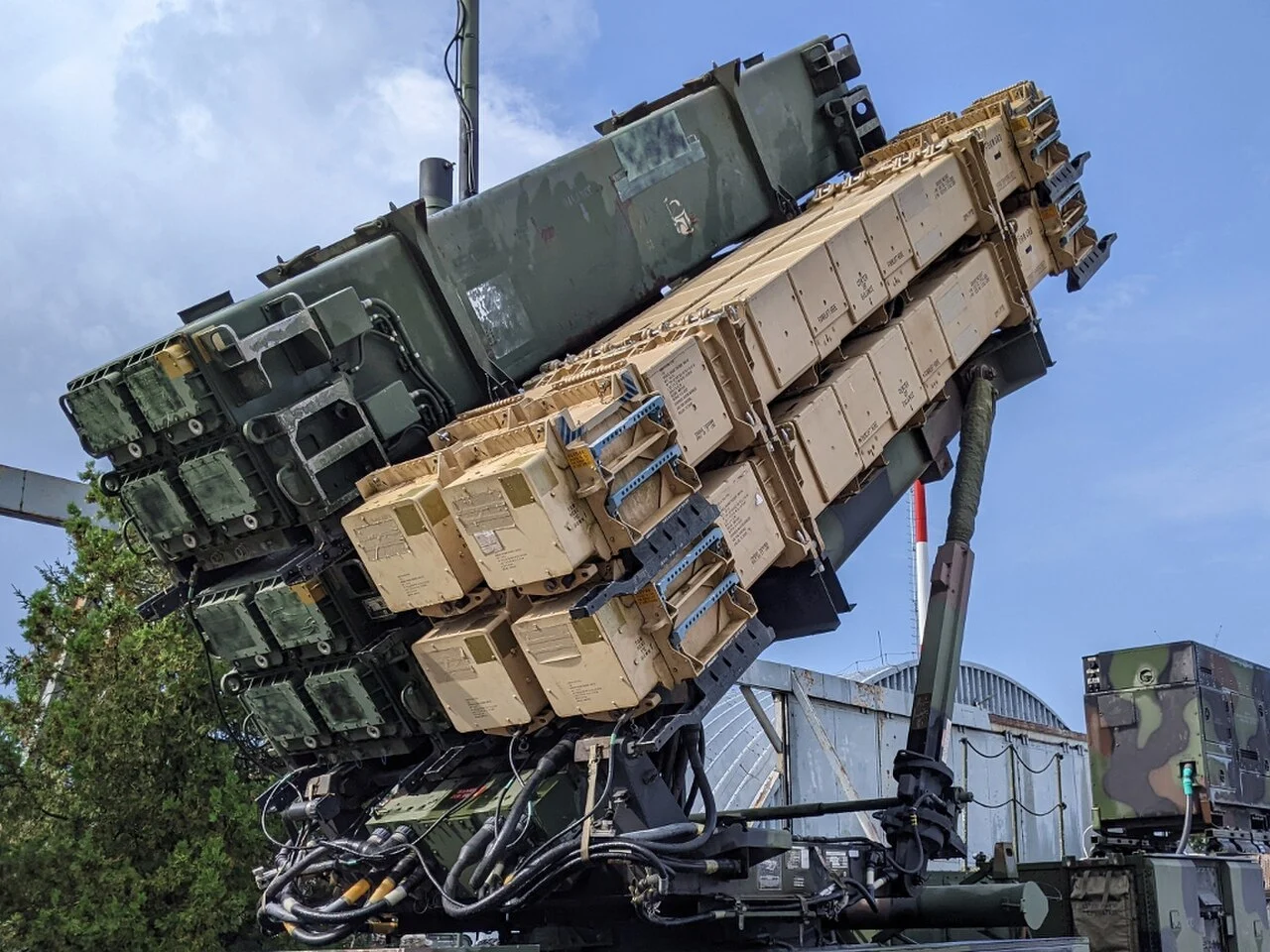
Photo: A Patriot PAC-3 MSE interceptor on display at the 2022 Seoul International Aerospace & Defense Exhibition (SIAF). Credit: Boevaya mashina, CC BY-SA 3.0, via Wikimedia Commons.
PAC-3 MSE at a glance
- Maker: Lockheed Martin Missiles and Fire Control (the interceptor); Raytheon/RTX builds the Patriot radar, launcher and fire-control system the missile fires from
- Class: Hit-to-kill, single-stage, solid-fuel surface-to-air interceptor; no explosive warhead
- In US Army service since: Baseline PAC-3 from 2001-02; PAC-3 MSE fielded from around 2015
- Loadout: Up to 12 PAC-3 MSE, or a mixed load of 6 MSE plus 8 older PAC-3 CRI rounds, on one M903 launching station (Lockheed Martin)
- Confirmed Gulf/MENA holders: Kuwait and Saudi Arabia (delivered, 2018 contract), Bahrain (delivered, first shipment 2024)
- Active Gulf/MENA purchase cases: Qatar (2026), UAE (case open since 2019, expanded 2021 and 2026), Saudi Arabia (730-missile replenishment approved Jan 2026, not yet contracted)
- African operators: None confirmed; Morocco reported evaluating
What is PAC-3 MSE, and who builds it?
PAC-3 MSE is the latest production interceptor in the Patriot Advanced Capability-3 family, developed by Lockheed Martin Missiles and Fire Control under US Army and Missile Defense Agency management. Like the baseline PAC-3 (also called PAC-3 CRI, for Cost Reduction Initiative) that it is replacing in production, PAC-3 MSE kills its target by direct kinetic impact: it carries no explosive warhead, instead homing in with an active radar seeker and destroying ballistic missiles, cruise missiles and aircraft by colliding with them. The missile fires from the same Patriot launchers, radars and fire-control systems that Raytheon (now part of RTX) builds and sells as the overall Patriot system; Lockheed Martin and RTX are therefore both prime contractors on any Patriot sale, each for a different part of the system. DefenceMENA’s separate RTX company profile and Saudi Arabia Patriot force file cover the radar/launcher/battery side of the system; this page is about the Lockheed Martin interceptor itself.
Lockheed Martin says PAC-3 MSE is in full-rate production and that the PAC-3 family (CRI and MSE combined) has been selected by fifteen nations, a count the company has given in its own product materials without naming all fifteen. The US Army has repeatedly expanded Lockheed Martin’s production contracts to meet both US and allied demand: an October 2024 contract modification raised annual maximum output from 550 to 650 missiles; the company has separately stated it delivered a record 620 PAC-3 MSE missiles in 2025; and in April 2026 the Army awarded a $4.76 billion production contract, of which the large majority was tied to foreign military sales funding rather than US Army procurement, before a July 2026 multiyear modification brought the cumulative multiyear contract value to roughly $58.6 billion.
Specifications
Lockheed Martin’s own public product materials describe the missile’s design and employment in general terms but do not publish a single official numeric table of range, altitude and speed together. The figures below combine Lockheed Martin’s own descriptions (flagged “official”) with commonly cited open-source figures, flagged where they are estimates rather than a released official number; treat the range/altitude/speed figures as approximate.
| Item | Figure | Source / note |
|---|---|---|
| Type | Single-stage, solid-fuel, hit-to-kill interceptor (no explosive warhead) | Official (Lockheed Martin) |
| Propulsion | Two-pulse solid rocket motor, larger than the baseline PAC-3/CRI motor, with upgraded actuators and thermal batteries | Official (Lockheed Martin product materials) |
| Guidance | GPS-aided inertial midcourse guidance with active Ka-band radar terminal seeker | Commonly described in open-source and US government technical literature; not a single cited Lockheed Martin figure |
| Speed | Commonly cited at above Mach 5 | Open-source estimate; Lockheed Martin has not published a single official speed figure in the materials reviewed for this page |
| Engagement range / altitude | Reports vary: a maximum altitude near 118,000 ft (36 km) and ballistic-target range near 75 miles (120 km) are widely cited; a separate Lockheed-sourced account instead gives roughly 40 km against ballistic threats and over 60 km against aircraft/cruise missiles | Open-source estimates; the two figures describe different threat types and are not official MDA/Lockheed Martin range releases |
| Loadout per launcher | Up to 12 PAC-3 MSE, or 6 MSE plus 8 PAC-3 CRI, per M903 launching station; ships in a single canister | Official (Lockheed Martin product materials) |
| Launch platform | M903 Launching Station and compatible legacy Patriot launchers | Official (Lockheed Martin, US Army) |
| Annual production capacity | Raised from 550 to 650 missiles/year (Oct 2024 contract); a January 2026 framework and 2026 multiyear modification commit to further expansion, exact new annual ceiling not disclosed in the sources reviewed | Official (US Army contract announcements) |
PAC-3 versus PAC-3 MSE
PAC-3 MSE is not a separate missile family so much as an upgraded round sharing the same canister footprint and hit-to-kill approach as the original PAC-3 (retroactively renamed PAC-3 CRI, Cost Reduction Initiative, once MSE entered production). The MSE variant uses a larger, two-pulse rocket motor, bigger fins and upgraded actuators and thermal batteries to extend its reach and improve maneuverability against faster or more agile targets; Lockheed Martin product literature describes this as the reason a launcher loaded with MSE rounds carries fewer missiles (12) than one loaded with the smaller CRI round (16, in the older all-CRI configuration), or a mixed 6 MSE / 8 CRI load. Several long-standing customers, including Taiwan and the Netherlands according to Lockheed Martin’s own customer slides, are recorded as PAC-3 CRI rather than PAC-3 MSE customers; this page covers MSE-specific sales and, where a source does not distinguish the variant, says so rather than assuming MSE.
Who operates PAC-3 MSE in the Gulf and MENA?
PAC-3 MSE has been approved for, or delivered to, several Gulf states since 2017. The cases below are US government-to-government foreign military sales; a DSCA notification is a congressional approval to proceed with a possible sale, not a signed contract, and a contract is not the same as a confirmed delivery.
| Country | Status | Detail | Source |
|---|---|---|---|
| Kuwait | DELIVERED | Supplied under a 2018 Lockheed Martin production contract shared with Saudi Arabia (reported at the time at roughly $3.3 billion for both countries combined); a separate 2020 US approval covered a further 84 PAC-3 MSE interceptors for Kuwait. | Army Recognition, Defense Daily |
| Saudi Arabia | DELIVERED (existing stock); approved, not contracted (replenishment) | Received initial PAC-3 MSE stock under the same 2018 contract as Kuwait. On 30 January 2026 the US State Department approved a further possible sale of up to 730 PAC-3 MSE missiles for an estimated $9.0 billion, intended to replenish interceptors expended against years of Houthi missile and drone attacks; as of this page’s verification date this remains an approved-for-possible-sale case, not a signed contract. DefenceMENA’s Saudi Arabia Patriot force file covers the kingdom’s overall Patriot battery count and combat record. | DSCA, The Defense Post |
| Bahrain | DELIVERED | DSCA notified Congress on 3 May 2019 of a possible sale of 60 PAC-3 MSE and 36 GEM-T missiles (with M903 launching stations and other equipment) worth an estimated $2.478 billion; Bahrain signed the purchase agreement in August 2019. Lockheed Martin delivered Bahrain’s first PAC-3 MSE shipment, reported in March 2024. | CSIS Missile Threat, Breaking Defense |
| United Arab Emirates | ORDERED (active, expanding FMS case) | DSCA notified Congress on 3 May 2019 of a possible sale of 452 PAC-3 MSE missiles worth an estimated $2.728 billion; the case was expanded on 28 September 2021 to add 510 more MSE missiles (including 10 fly-to-buy rounds), then expanded again in a 19 March 2026 cost-increase notification that raised the major-defense-equipment value by $5.532 billion to $10.96 billion (total estimated case value $11.46 billion) and added 600 more PAC-3 MSE, 150 GEM-T missiles and 25 M903 launching stations. This page found no public statement confirming PAC-3 MSE-specific deliveries to the UAE, as distinct from its long-standing legacy Patriot/PAC-2 inventory; THAAD, a separate Lockheed Martin system, is covered on DefenceMENA’s dedicated THAAD page and should not be confused with this Patriot interceptor. | CSIS Missile Threat, Federal Register arms-sales notices 2026 |
| Qatar | ORDERED (approved, emergency waiver) | On 1 May 2026 the US notified Congress, under an emergency determination that waived the standard review period, of a possible sale to Qatar of 300 PAC-3 MSE and 200 PAC-2 GEM-T missiles plus support items, with a total estimated case value of $4.01 billion. This page found no confirmation of a signed contract or delivery as of its verification date. | Federal Register arms-sales notification, June 2026 |
PAC-3 MSE in Africa
No African state is a confirmed PAC-3 or PAC-3 MSE operator. Morocco is the only African country with any documented PAC-3 MSE interest: a 2021 US clearance covered Moroccan Patriot air defence and G550 aircraft requests together, and 2025 reporting (Army Recognition, citing earlier reporting, and the Moroccan outlet Médias24) says Morocco has moved from initial interest to a detailed technical evaluation of the PAC-3 MSE variant specifically, including a Royal Armed Forces delegation inspecting a Patriot system in Germany in July 2025. No official Moroccan government confirmation, and no Morocco-specific DSCA notification for PAC-3 MSE, has been found as of this page’s verification date, so Morocco’s status here is EVALUATED, not ordered or contracted. Egypt operates the Patriot system generally (one of 19 Patriot operators worldwide according to Raytheon), but this page found no source confirming which interceptor variant — PAC-2 or PAC-3 — equips the Egyptian force, so Egypt is not listed as a confirmed PAC-3 MSE operator. This page will update if credible evidence of an African PAC-3 MSE order, contract or delivery emerges.
Contracts and production, 2017-2026
- 2017-2018: Saudi Arabia and Kuwait jointly covered by a roughly $3.3 billion Lockheed Martin PAC-3 MSE production deal.
- May 2019: DSCA notifies Congress of possible PAC-3 MSE sales to Bahrain (60 missiles, $2.478bn) and the UAE (452 missiles, $2.728bn) on the same day.
- August 2019: Bahrain signs its Patriot/PAC-3 MSE purchase agreement.
- 2020: A further approximately $800 million US approval covers 84 additional PAC-3 MSE interceptors for Kuwait.
- September 2021: The UAE’s case is expanded by 510 further PAC-3 MSE missiles.
- March 2024: Lockheed Martin delivers Bahrain’s first PAC-3 MSE shipment.
- October 2024: A US Army contract modification raises Lockheed Martin’s maximum annual PAC-3 MSE production rate from 550 to 650 missiles.
- 30 January 2026: DSCA approves a possible $9.0 billion sale of 730 PAC-3 MSE missiles to Saudi Arabia.
- 19 March 2026: The UAE’s PAC-3 MSE case is expanded again, adding 600 missiles and raising the total estimated case value to about $11.46 billion.
- 1 May 2026: The US notifies Congress, under an emergency waiver, of a possible $4.01 billion sale of 300 PAC-3 MSE and 200 PAC-2 GEM-T missiles to Qatar.
- April-July 2026: The US Army awards Lockheed Martin a $4.76 billion production contract (the large majority tied to foreign military sales funding), followed by a seven-year multiyear modification that brings the cumulative multiyear contract value to roughly $58.6 billion.
None of the dollar figures above should be read as a per-missile unit price: each case bundles interceptors with launchers, canisters, spares, training and support items in varying proportions, so dividing a case’s total value by its missile count would not produce a meaningful unit cost.
Systems in the same class
PAC-3 MSE sits in the lower, endo-atmospheric tier of layered air and missile defence, intended to intercept ballistic missiles, cruise missiles and aircraft closer to their target than upper-tier systems like THAAD. The comparison below lists systems filling a broadly similar role without declaring a winner; several Gulf states, including Saudi Arabia and the UAE, operate more than one of these systems in a layered architecture rather than choosing between them.
| System (maker, country) | Role | MENA/Africa status |
|---|---|---|
| PAC-3 MSE (Lockheed Martin, USA) | Endo-atmospheric hit-to-kill, fired from Patriot launchers | Delivered to Kuwait, Saudi Arabia and Bahrain; ordered by the UAE and Qatar; no confirmed African operator |
| Aster 30 Block 1NT (MBDA, France/Italy/UK) | Endo-atmospheric hit-to-kill, part of the SAMP/T system | No confirmed MENA or African operator found for this page; Egypt and Saudi Arabia operate earlier Aster variants in naval air defence roles, which this page does not treat as equivalent |
| Barak 8 (IAI/Rafael, Israel, with India) | Endo-atmospheric hit-to-kill, naval and land-based | Operational in Israel; this page found no confirmed MENA or African buyer beyond Israel |
| S-400 Triumf lower-tier interceptors (Almaz-Antey, Russia) | Primarily endo-atmospheric air defence within a longer-range system | No confirmed Gulf or African PAC-3 MSE-tier sale; Saudi Arabia’s 2017-2019 S-400 talks, covered on DefenceMENA’s THAAD page, did not result in a confirmed contract |
FAQ
Who makes PAC-3 MSE?
Lockheed Martin Missiles and Fire Control builds the PAC-3 MSE interceptor. It fires from Patriot launchers, radars and fire-control systems that Raytheon (RTX) builds as the rest of the Patriot system.
Is PAC-3 MSE the same as Patriot?
No. Patriot is the overall air defence system — radar, launchers, command post and several interceptor types — built mainly by Raytheon/RTX. PAC-3 MSE is one specific interceptor missile within that system, built by Lockheed Martin. DefenceMENA’s RTX company profile and Saudi Arabia Patriot force file cover the system side.
Which Gulf countries operate PAC-3 MSE?
Kuwait, Saudi Arabia and Bahrain have received PAC-3 MSE missiles. The UAE and Qatar have active, approved purchase cases moving through the US foreign military sales process but no publicly confirmed delivery found for this page. Saudi Arabia also has a further 730-missile replenishment approved in January 2026 that is not yet a signed contract.
Does any African country operate PAC-3 MSE?
No. Morocco is reported to be evaluating the system, including a 2025 technical inspection in Germany, but has no confirmed order, contract or delivery as of this page’s verification date. No other African state has documented PAC-3 MSE interest.
What is the difference between PAC-3 and PAC-3 MSE?
PAC-3 MSE is an upgraded version of the original PAC-3 (now called PAC-3 CRI) with a larger, two-pulse rocket motor, bigger fins and upgraded actuators intended to extend its reach and maneuverability. Both are hit-to-kill interceptors with no explosive warhead; MSE is the variant now in full-rate production for new orders.
Sources
- DSCA – Saudi Arabia PAC-3 MSE notification, 30 January 2026
- CSIS Missile Threat – US approves PAC-3 sales to Bahrain, UAE (2019)
- Breaking Defense – Bahrain receives first PAC-3 MSE shipment
- Army Recognition – Saudi Arabia and Kuwait PAC-3 deal (2018)
- Defense Daily – Kuwait PAC-3 MSE approval (2020)
- U.S. Army – PAC-3 MSE production contract modification (2024)
- The Defense Post – US approves $9bn Patriot/PAC-3 MSE sale to Saudi Arabia
- Army Recognition – Morocco evaluating Patriot/PAC-3 MSE (2025)
Last updated: 27 Oct 2026. This page is updated in place when new contracts, deliveries or variants appear.