RTX Company Profile: What the World’s Second-Largest Arms Maker Builds and Where Africa Fits In



RTX is the US aerospace and defence group formed in 2020 by the merger of Raytheon Company and United Technologies. It has three businesses: Raytheon, which makes the Patriot, NASAMS and Stinger air defence systems and missiles such as AMRAAM, AIM-9X and Tomahawk; Pratt & Whitney, which makes the F135 engine for the F-35 and commercial and turboprop engines; and Collins Aerospace, which makes avionics and aircraft systems. SIPRI ranks RTX second in the world by arms revenue, with $43.6 billion in 2024. In Africa its documented weapons business runs mainly through US government sales to Egypt and Morocco, most of which are still at the notification stage, while Morocco also hosts two RTX civil aerospace plants. No African country is on the public record as a Patriot operator.
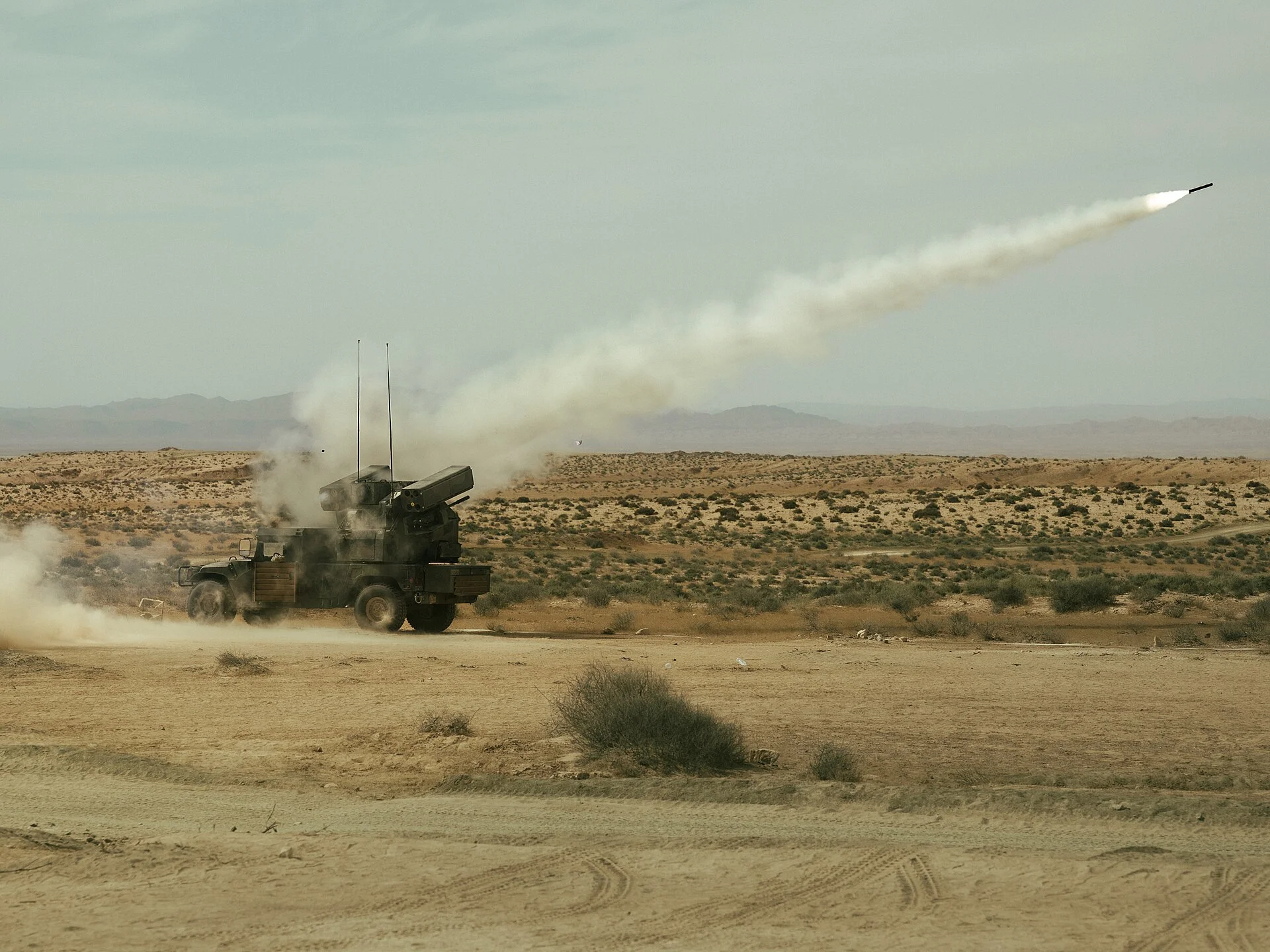
Photo: a US Army Avenger air defence system fires an FIM-92 Stinger missile, a Raytheon product, during exercise African Lion 2025 at Ben Ghilouf Training Area, Tunisia, on 25 April 2025. Credit: U.S. Army photo by Sgt. Jose Lora, via Wikimedia Commons, public domain (US government work).
This profile is part of DefenceMENA’s Global Defence Industry series, which works through the SIPRI Top 100 from an African perspective. It covers what RTX makes, where it sits in the rankings, and what is on the public record about its African and Middle Eastern customers. All figures are dated. Where a sale has only been notified to the US Congress, it is described as a proposed sale, not a contract.
Key facts (as of 25 October 2026)
- Full name: RTX Corporation (NYSE: RTX), headquartered in Arlington, Virginia. It was named Raytheon Technologies from 2020 until 17 July 2023 (SEC filing).
- Chairman and chief executive: Christopher T. Calio, chief executive since May 2024 and chairman since April 2025 (2025 Form 10-K).
- SIPRI Top 100 (2024 data, published December 2025): second, with arms revenue of $43.60 billion, up 4.1% on 2023, which was 54% of total revenue of $80.74 billion (SIPRI).
- 2025 results: sales of $88.6 billion, up 10%, and a year-end backlog of $268 billion, of which $107 billion was defence (RTX, 27 January 2026).
- Latest quarter: third-quarter 2026 sales of $25.0 billion and a record backlog of $340 billion, $164 billion of it defence (RTX, 20 October 2026).
- Workforce: about 180,000 employees in 52 countries, 69% of them in the United States (10-K).
- Africa in short: proposed US sales of NASAMS, Stinger and RAM to Egypt and of Stinger, Javelin, TOW and AMRAAM to Morocco; an AIM-9X contract with Morocco signed in 2012; Collins and Pratt & Whitney Canada plants near Casablanca.
From Raytheon and United Technologies to RTX
RTX in its present form is young. United Technologies Corporation (UTC), incorporated in Delaware in 1934, owned Pratt & Whitney and a large aircraft-systems business. In November 2018 UTC completed its purchase of Rockwell Collins and combined it with UTC Aerospace Systems to form Collins Aerospace. At the same time it announced plans to spin off its Otis lifts and Carrier building-systems businesses (UTC announcement, 26 November 2018).
On 3 April 2020 UTC completed an all-stock merger with Raytheon Company, the missile and radar maker, and renamed itself Raytheon Technologies (SEC filing). The name changed again to RTX Corporation in July 2023. The result is a group in which defence is just over half of the business: SIPRI’s 54% arms share reflects the size of the civil engine and avionics work at Pratt & Whitney and Collins.
What does RTX make?
RTX reports three segments. The 2025 figures below are segment sales before inter-segment eliminations, taken from the company’s annual report (10-K).
- Raytheon ($28.0 billion in 2025): almost entirely defence. Its products include the Patriot air and missile defence system and its new LTAMDS radar, NASAMS (with Norway’s Kongsberg), Stinger, AIM-9X Sidewinder and AMRAAM air-to-air missiles, Tomahawk cruise missiles, the Standard Missile family (SM-3, SM-6), Excalibur guided artillery shells, the SPY-6 naval radar and the AN/TPY-2 radar used with THAAD. Raytheon and Lockheed Martin jointly produce the Javelin anti-tank missile. TOW anti-tank missiles also come from Raytheon.
- Pratt & Whitney ($32.9 billion): military engines, including the F135 that powers every F-35, alongside the commercial GTF engine family and, through Pratt & Whitney Canada, turboprop and helicopter engines such as the PT6. The 10-K notes that the F135 passed one million flight hours in 2025.
- Collins Aerospace ($30.2 billion): avionics, flight controls, landing systems, cabin and power systems for civil and military aircraft, plus defence work in connected battlespace systems, test and training ranges, crew escape systems, and simulation and training.
Demand for missiles is the main source of growth. In the third quarter of 2026 RTX reported multi-year undefinitised US contracts worth about $23 billion for Tomahawk and $14.3 billion for AMRAAM, and Raytheon’s own backlog reached $130 billion (RTX Q3 2026). For an African buyer this matters mainly as a question of production slots, discussed below.
Where RTX sits in the SIPRI Top 100
SIPRI placed RTX second for 2024, behind Lockheed Martin and ahead of Northrop Grumman. It was also second in 2023. Its arms revenue of $43.60 billion compares with $41.87 billion a year earlier (SIPRI fact sheet). Two points of caution apply:
- SIPRI’s figure covers arms and military services only, for calendar 2024. The company’s $88.6 billion is total sales for 2025, a different measure and a different year. The two should not be compared as if they were the same thing.
- A ranking by revenue says nothing about the quality or suitability of any product. It measures sales, much of it to the US government.
RTX’s annual report gives sales by customer location. Sales to customers in the Middle East and North Africa were $3.62 billion in 2025, about 4% of the total, of which Raytheon accounted for $1.72 billion. Sub-Saharan Africa is not reported separately (10-K). Much of the group’s defence work with foreign states is booked as sales to the US government under the Foreign Military Sales (FMS) system, so these figures are a partial picture.
RTX in Africa: what is documented
The public record is concentrated in two countries. Most of it comes from notifications by the US Defense Security Cooperation Agency (DSCA). A DSCA notification tells Congress that the State Department has approved a possible sale; the value is a ceiling and the quantities are a maximum. A contract follows only if a Letter of Offer and Acceptance (LOA) is signed.
Egypt
- NASAMS (proposed, 2025). In July 2025 the DSCA notified a possible sale of NASAMS to Egypt with an estimated value of $4.67 billion, to be paid from US Foreign Military Financing. The package includes four AN/MPQ-64F1 Sentinel radars, 100 AMRAAM-ER and 100 AIM-120C-8 missiles, and 600 AIM-9X Block II missiles. RTX is the principal contractor (DSCA, 24 July 2025). The notification published in the Federal Register in March 2026 still describes a proposed LOA (Federal Register). We have found no public record of a signed contract.
- Stinger (proposed, 2024). In September 2024 the DSCA notified a possible sale of 720 Stinger missiles worth up to $740 million for use with Egypt’s existing Avenger launchers, with RTX in Tucson as principal contractor (DSCA notice via ASD News).
- RAM Block 2 (notified 2021, amended 2022). A 2021 notification covered up to 168 RIM-116C Rolling Airframe Missiles worth $197 million. In May 2022 it was amended to add four Mk 49 Mod 5 launchers, raising the total to $347 million. The launchers are to replace older Mk 49 Mod 3 launchers on Egypt’s ex-US Oliver Hazard Perry-class frigates (Congressional Record).
- Javelin. Egypt has also been cleared to buy Javelin, the Raytheon–Lockheed Martin joint product. See our report on the Javelin approval.
Egypt’s US-supplied equipment is covered in more detail in our overview of US arms deals with Egypt and our guide to Egypt’s armed forces.
Morocco
- AIM-9X Block II (contract, 2012). In July 2012 Raytheon announced that Morocco had signed an LOA for AIM-9X Block II missiles for its F-16s, making it the tenth international AIM-9X customer. The quantity was not disclosed (Raytheon, 8 July 2012). See our profile of Morocco’s F-16 fleet.
- AMRAAM (proposed, 2024). In December 2024 the DSCA notified a possible sale of up to 30 AIM-120C-8 AMRAAM missiles for Morocco’s F-16 fleet, with an estimated value of $88.37 million (DSCA, 20 December 2024).
- TOW 2A (proposed, 2019). A notification in 2019 covered 2,401 TOW 2A missiles and 400 launchers, with an estimated value of $776 million and Raytheon Missile Systems as prime contractor (Federal Register).
- Javelin (proposed, 2024). In March 2024 Congress was notified of a possible $260 million sale of 612 Javelin missiles and 200 Lightweight Command Launch Units, with the Javelin Joint Venture of Lockheed Martin and RTX as prime (Federal Register).
- Stinger (proposed, 2025). In April 2025 the DSCA notified a possible sale of up to 600 FIM-92K Stinger Block I missiles worth $825 million, paid with Moroccan national funds (DSCA, 15 April 2025).
- Patriot (REPORTED, not confirmed). Morocco World News reported in 2021 that Morocco had been cleared to buy Patriot, and in March 2025 that three Patriot launchers had been seen on Moroccan roads for field tests, citing a 2021 US International Trade Administration note that said Morocco had purchased the system (2021, 2025). No DSCA notification or contract has been published, and Morocco has not announced an order. These reports concern the PAC-3 MSE interceptor made by Lockheed Martin as well as the Raytheon-built system.
- Civil aerospace industry. Collins Aerospace has operated at Nouaceur, near Casablanca, since 2012. According to Morocco’s industry ministry the site assembles and tests cockpit controls such as sidesticks, throttles and rudder pedals for commercial aircraft, and employed 135 people in 2022 (Ministry of Industry and Trade). On 21 April 2026 Pratt & Whitney Canada opened a plant at Midparc in Casablanca to machine engine parts, including for the PT6 family, and expects about 200 jobs there by 2030. RTX says it employs about 250 people in Morocco (RTX, 21 April 2026). These are civil aerospace plants. They do not make weapons.
Morocco’s wider supplier mix is set out in our guide to US arms deals with Morocco.
Elsewhere in Africa
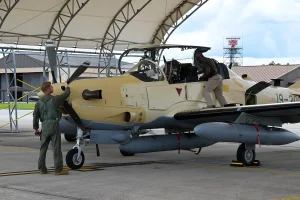
Beyond Egypt and Morocco, RTX’s presence is mostly through components in aircraft bought from other manufacturers. One example is Nigeria’s 12 A-29 Super Tucano light attack aircraft, delivered in 2021 (Reuters), which are powered by the Pratt & Whitney Canada PT6A-68C (Brazilian Air Force). We have not found a documented African operator of Patriot or NASAMS. CSIS’s list of 18 Patriot operators includes no African state (CSIS Missile Threat), and Raytheon itself says only that Patriot is used by 19 countries (Raytheon). For the air defence systems African states do field, see which African countries operate advanced air defence systems.
Middle East customers
The Gulf is one of Raytheon’s core export markets. The CSIS list of Patriot operators includes Saudi Arabia, Kuwait, the United Arab Emirates, Qatar, Bahrain and Israel. See our explainer on Saudi Arabia’s Patriot batteries. In October 2026 Raytheon announced $729 million in counter-drone contracts, including the first international sales of its Ku-band radar and Coyote interceptor (LIDS) to Qatar and Jordan; quantities and the split between customers were not given (RTX, 13 October 2026). See also our guide to Qatar’s armed forces and our guide to Jordan’s armed forces.
The region also features in the company’s compliance record. In October 2024 Raytheon Company agreed to pay more than $950 million to resolve US investigations into defective pricing on US government contracts and into bribery of a Qatar Emiri Air Force official connected to Middle East contracts, through deferred prosecution agreements and a civil settlement (US Department of Justice).
Status at a glance
| Country | Programme | Type of record | Status (public record) |
|---|---|---|---|
| Egypt | NASAMS, 4 Sentinel radars, 200 AMRAAM-type and 600 AIM-9X missiles | DSCA notification, July 2025, up to $4.67bn | Proposed; no signed contract found |
| Egypt | 720 Stinger missiles | DSCA notification, September 2024, up to $740m | Proposed |
| Egypt | RAM Block 2 and 4 Mk 49 Mod 5 launchers | Notification 2021, amended 2022, up to $347m | Proposed; delivery not reported |
| Morocco | AIM-9X Block II | Raytheon announcement, July 2012 | LOA signed |
| Morocco | Up to 30 AIM-120C-8 AMRAAM | DSCA notification, December 2024, up to $88.37m | Proposed |
| Morocco | 2,401 TOW 2A missiles | Notification 2019, up to $776m | Proposed |
| Morocco | 612 Javelin missiles | Notification March 2024, up to $260m | Proposed |
| Morocco | Up to 600 Stinger Block I | DSCA notification, April 2025, up to $825m | Proposed |
| Morocco | Patriot | Media reports, 2021 and 2025 | REPORTED; no notification or contract published |
| Morocco | Collins and Pratt & Whitney Canada plants | Government and company statements | Operating (civil aerospace) |
| Nigeria | PT6A-68C engines in 12 A-29s | Aircraft delivery, 2021 | In service |
| Qatar, Jordan | LIDS counter-drone system | Contract announcement, October 2026 | Awarded; quantities not disclosed |
Alternatives by category
The table lists systems in the same categories from other supplier countries. It is not a ranking. Price, performance and political conditions differ widely, and buyers’ choices depend on integration with what they already operate. For air defence specifically, see five alternatives to Patriot for MENA buyers.
| Category | RTX | Turkish | Chinese | European / other |
|---|---|---|---|---|
| Long-range air and missile defence | Patriot | SİPER (ASELSAN, ROKETSAN, TÜBİTAK SAGE) | HQ-9 | SAMP/T NG (Eurosam) |
| Medium-range air defence | NASAMS (with Kongsberg) | HİSAR-O | LY-80 | IRIS-T SLM (Diehl); Umkhonto (Denel Dynamics, South Africa) |
| Man-portable air defence | Stinger | SUNGUR (ROKETSAN) | FN-6 | Mistral (MBDA) |
| Anti-tank missiles | Javelin (with Lockheed Martin), TOW | KARAOK, OMTAS (ROKETSAN) | HJ-12 | Spike (Rafael); MMP (MBDA); Ingwe (Denel Dynamics) |
| Short-range air-to-air missiles | AIM-9X | Bozdoğan (TÜBİTAK SAGE) | PL-10 | IRIS-T (Diehl); A-Darter (Denel Dynamics) |
Procurement considerations for African buyers
- Notification is not a contract. Most of RTX’s African record consists of DSCA notifications. They set a maximum, and some are later reduced or never signed. Reporting that Egypt “bought” NASAMS would not match the public record as of October 2026.
- Financing. Egypt’s NASAMS and RAM packages are to be funded with US Foreign Military Financing, so they depend on the annual US aid budget. Morocco’s Stinger package is to be paid from national funds.
- Production queues. Large US multi-year orders for AMRAAM and Tomahawk, and demand for Patriot interceptors from existing operators, compete for the same production capacity. Delivery dates for smaller export customers depend on where they sit in that queue.
- Conditions of US supply. US-origin systems come with end-use monitoring and cannot be passed to a third country without US government consent. Missile software and spares remain tied to the US supply chain.
- Industrial participation. The Moroccan plants show RTX investing in African civil aerospace manufacturing. We have found no public record of African production of RTX weapons or of industrial offsets tied to the Egyptian or Moroccan sales.
- Compliance. The 2024 US settlements show that US authorities pursue bribery connected with arms contracts. Buyers can expect anti-corruption clauses and scrutiny of any agents or intermediaries.
FAQ
What does RTX make?
Through Raytheon: Patriot, NASAMS, Stinger, AMRAAM, AIM-9X, Tomahawk, Standard Missiles, TOW and, with Lockheed Martin, Javelin, plus radars such as SPY-6 and AN/TPY-2. Through Pratt & Whitney: military and commercial jet engines, including the F135 for the F-35. Through Collins Aerospace: avionics and aircraft systems.
Is Raytheon the same company as RTX?
Raytheon is now one of RTX’s three business segments. The group was called Raytheon Technologies from 2020 and became RTX Corporation in July 2023.
Does any African country operate Patriot?
Not on the public record. CSIS lists 18 Patriot operators and none is African. Moroccan media have reported a Patriot acquisition, but no US notification or contract has been published.
Has Egypt bought NASAMS?
The United States approved a possible sale worth up to $4.67 billion in July 2025. As of the March 2026 Federal Register notice it was still a proposed sale, and we have found no public record of a signed contract.
Where does RTX rank in the SIPRI Top 100?
Second for 2024, with arms revenue of $43.60 billion (SIPRI, December 2025).
Does RTX manufacture in Africa?
Yes, in civil aerospace. Collins Aerospace has a plant at Nouaceur, near Casablanca, and Pratt & Whitney Canada opened a parts plant in Casablanca in April 2026. Neither makes weapons.
Related DefenceMENA coverage
- Lockheed Martin: company profile (SIPRI first)
- General Dynamics: company profile (SIPRI fifth)
- Five alternatives to Patriot for MENA buyers
- Saudi Arabia’s Patriot batteries
- THAAD explained
- Which African countries operate advanced air defence systems?
- US arms deals with Egypt and US arms deals with Morocco
Sources
- SIPRI, The SIPRI Top 100 Arms-producing and Military Services Companies, 2024 (December 2025) and fact sheet PDF
- RTX, 2025 results and 2026 outlook (27 January 2026) and third-quarter 2026 results (20 October 2026)
- RTX, 2025 annual report on Form 10-K (SEC)
- SEC filings on the completion of the UTC–Raytheon merger (April 2020) and the name change to RTX (July 2023); UTC, completion of the Rockwell Collins acquisition (November 2018)
- DSCA: Egypt, NASAMS (24 July 2025); Morocco, FIM-92K Stinger Block I (15 April 2025); Egypt, Stinger (September 2024, via ASD News)
- Federal Register and Congressional Record: Egypt, NASAMS (6 March 2026); Morocco, Javelin (30 May 2025); Morocco, TOW 2A (19 December 2019); Egypt, RAM Block 2 (26 May 2022)
- Raytheon, Morocco becomes 10th AIM-9X international customer (8 July 2012); Global Patriot Solutions; counter-drone contracts for the US, Qatar and Jordan (13 October 2026)
- RTX, Pratt & Whitney Canada opens Casablanca facility (21 April 2026); Moroccan Ministry of Industry and Trade, Collins Aerospace marks 10 years in Morocco (2022)
- Morocco World News, US Patriot defense system arrives in Morocco for critical field tests (25 March 2025)
- US Department of Justice, Raytheon to pay over $950 million (16 October 2024)
- CSIS Missile Threat, Patriot; Reuters, Nigeria receives first six light attack planes (22 July 2021); Brazilian Air Force, A-29 Super Tucano
Last reviewed 25 October 2026. SIPRI figures are for 2024, company financials for 2025 and the third quarter of 2026. DSCA notifications are approvals of possible sales, not contracts. This profile will be updated when SIPRI publishes its next Top 100 or when a new African contract is documented.