The United States has approved a possible sale of up to 2,020 FGM-148F Javelin anti-tank missiles and 200 Lightweight Command Launch Units to Egypt, at an estimated cost of $832 million. The State Department notified Congress on 2 October 2026. This is an approval, not a signed contract: Egypt still has to accept a Letter of Offer and Acceptance, and the final quantities and price may come in below the notified ceiling.
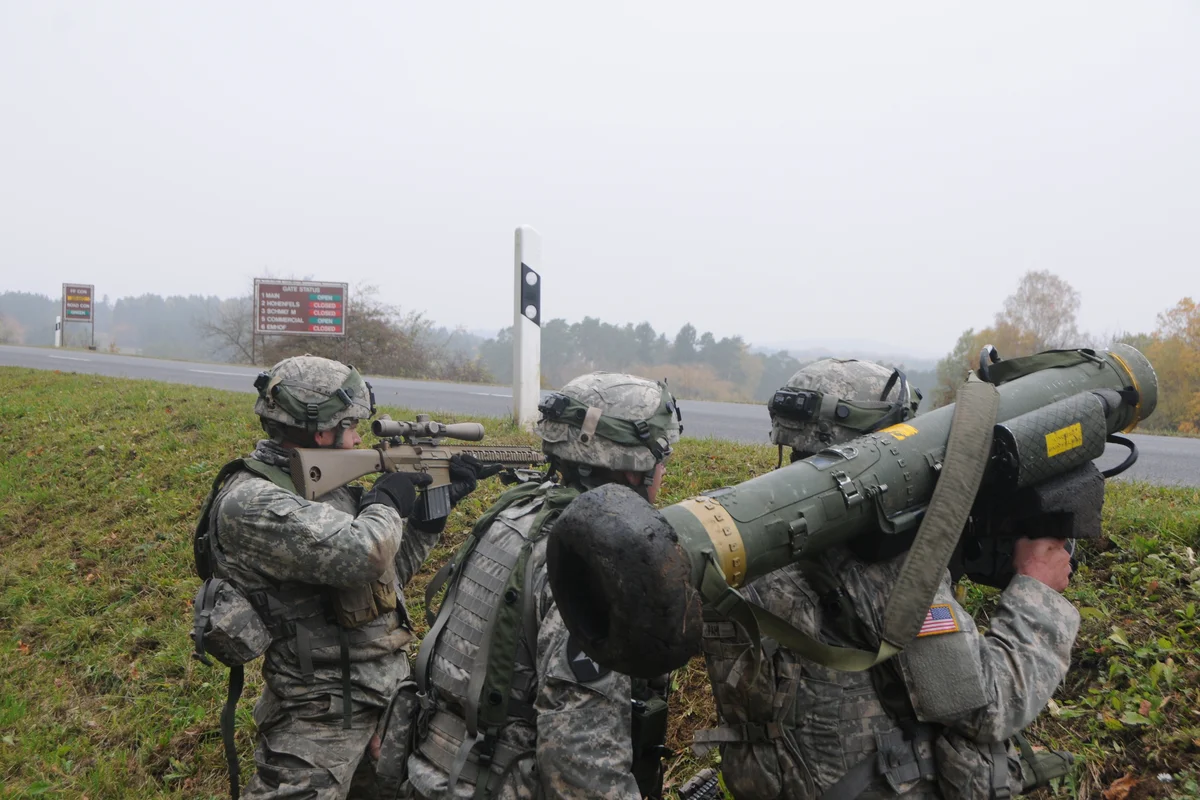
Photo: A US Army soldier with the 2nd Cavalry Regiment carries a Javelin launcher during a training exercise in Germany, 2012 (illustrative file photo; not Egyptian equipment). Credit: SGT Robert Sheets, US Army, public domain, via Wikimedia Commons
What Egypt asked for
According to the State Department notification, as published by ASDNews and reported by Breaking Defense, the Egyptian government requested:
- up to 2,020 Javelin FGM-148F missiles, including 20 “fly-to-buy” rounds used for acceptance testing;
- up to 200 Javelin Lightweight Command Launch Units (LWCLUs);
- LWCLU basic skills trainers, missile simulation rounds, battery coolant units, spare parts, system integration and check-out, technical documentation, tool kits, training and other logistics and programme support.
The principal contractors are Lockheed Martin in Orlando, Florida, and RTX Corporation in Arlington, Virginia, the two partners in the Javelin Joint Venture. The notice says Washington is not aware of any proposed offset agreement and that no additional US government or contractor personnel would need to be assigned to Egypt. The State Department said the sale “will support U.S. foreign policy and national security objectives by helping to improve the security of a friendly country that continues to be an important force for political stability and economic growth in the Middle East.”
Approval, order and delivery are separate steps
A Foreign Military Sales notification tells Congress that the executive branch is prepared to sell up to a stated amount. Congress then has a formal review period. Only after that does the buyer sign a Letter of Offer and Acceptance, which sets the real quantities and value; Defence Industry Europe notes that the final value will be fixed at that stage. No funding source, contract date or delivery schedule has been published, and Egyptian authorities have not commented publicly on the request.
What the Javelin and LWCLU are
Javelin is a man-portable, fire-and-forget anti-tank guided missile. The operator locks on to the target through the launcher’s sight before firing, and the missile guides itself, so the team can move or take cover immediately. Against armoured vehicles it is normally used in top-attack mode, striking the thinner roof armour. The FGM-148F is the current production variant and carries a multi-purpose warhead intended for use against both armour and lighter targets such as buildings and positions.
The Lightweight Command Launch Unit is the reusable sight and fire-control unit that the missile tube attaches to. It is lighter than the original launch unit and has improved digital optics for finding and identifying targets, which matters for infantry who carry the system on foot.
Reading the numbers
The request works out to about ten missiles for every launch unit. That is a high ratio. When Washington approved a Javelin sale to Morocco in March 2024, the package covered 612 missiles and 200 LWCLUs for an estimated $260 million, roughly three missiles per launcher. A deep missile stock suggests Egypt wants enough rounds for sustained training and wartime use, rather than a token capability. The published summary does not break out the cost of training devices and support, so a reliable per-missile price cannot be worked out from the $832 million total.
Javelin has not been part of Egypt’s publicly reported inventory, according to Defence Industry Europe, so a completed sale would make Egypt a new operator. Cairo’s anti-armour forces have long relied on US-supplied TOW missiles alongside systems from other suppliers. Egypt’s wider land forces and how they compare with other large African militaries are covered in DefenceMENA’s Egypt and Nigeria comparison, and readers following the anti-tank market can compare Javelin with Turkey’s competing family in our explainer on ROKETSAN’s KARAOK, OMTAS and UMTAS missiles.
Part of a three-country package
The Egyptian notice was one of three Middle East approvals released on the same day, together worth about $2.27 billion, according to The Defense Post:
- United Arab Emirates: up to 10,000 Advanced Precision Kill Weapon System II (APKWS II) guidance sections for an estimated $1.041 billion, in air-to-air and air-to-ground configurations. Breaking Defense noted that the UAE had already requested up to 1,500 APKWS systems in May. APKWS turns unguided 70 mm rockets into laser-guided weapons and has become a low-cost option against drones. More on the Emirati industrial side is in our analysis of how independent the UAE’s defence industry is.
- Kuwait: $400 million in repair and return services for Patriot missiles, with repair parts, support equipment, training and technical assistance. The notice says the work will help protect Kuwait’s oil and gas infrastructure. Kuwait’s air defence posture is covered in what Kuwait’s military looks like after the June drone attack.
For Egypt, the Javelin request sits within a long US security relationship that has supplied much of its army and air force. Whether Cairo converts this approval into a contract, and how quickly, is the next thing to watch.
RTX’s side of the Javelin partnership, and its other proposed sales to Egypt, are covered in our RTX company profile.
Sources
- US State Department notification “Egypt – Javelin Missiles”, 2 October 2026 (as published by ASDNews)
- Breaking Defense: “US OKs missile guidance kits, Patriot repairs, Javelins for Middle East partners”, 5 October 2026
- The Defense Post: “US Approves $2.27B in Arms Sales to Egypt, UAE, Kuwait”, 6 October 2026
- Defence Industry Europe: “U.S. approves potential $832 million sale of Javelin anti-tank missiles to Egypt”, 6 October 2026