Why Did Egypt Buy (and Build) the K9 Howitzer?

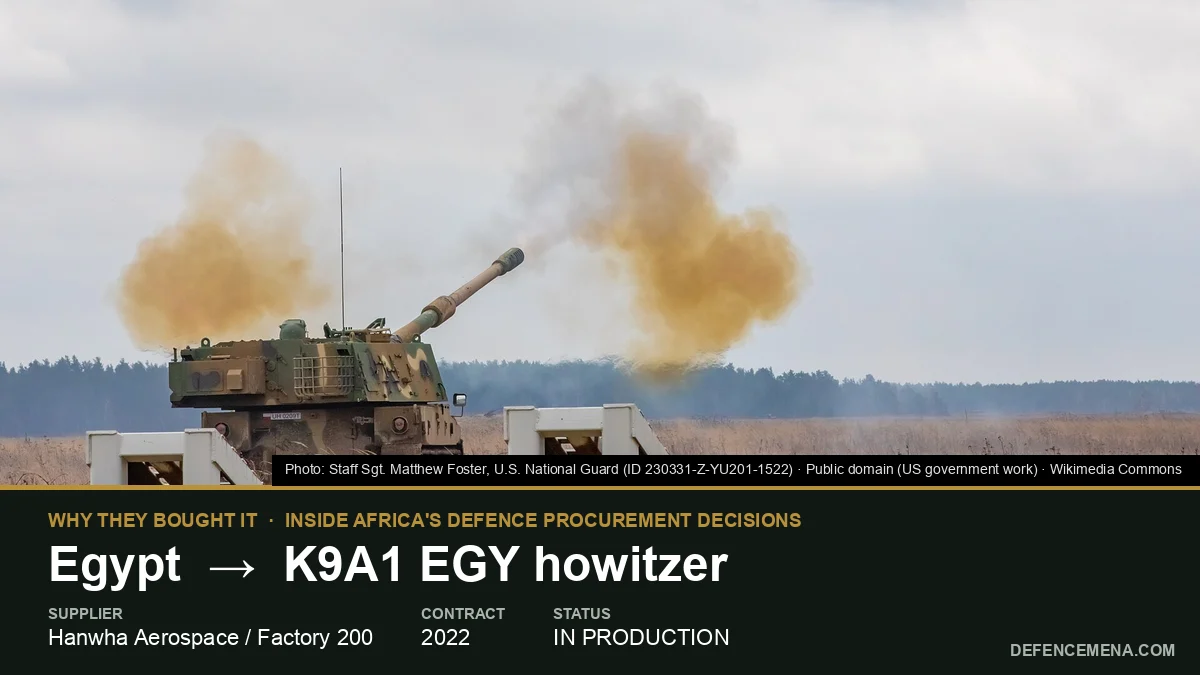


Egypt bought the K9A1 EGY because it wanted to replace an ageing fleet of American M109 howitzers with a 52-calibre gun it could build itself. The February 2022 contract with Hanwha Defense, valued by the company at around US$1.7 billion, is the largest K9 export deal ever signed and the biggest artillery purchase on the African continent. Only a first batch comes from South Korea; the rest is to be assembled and progressively manufactured at Military Factory 200 near Cairo, with the stated aim of producing two-thirds of each gun in Egypt and selling the result to Arab and African armies.
Photo: A Polish Army K9 Thunder fires at Bemowo Piskie, Poland, 31 March 2023. Egypt's K9A1 EGY is the customised version of the same Hanwha gun, built under licence at Military Factory 200. Photo: Staff Sgt. Matthew Foster / U.S. National Guard (public domain). Credit: Staff Sgt. Matthew Foster, U.S. National Guard (ID 230331-Z-YU201-1522), Public domain (US government work), via Wikimedia Commons.
- Country
- Egypt (Egyptian Army and Egyptian Navy)
- System
- K9A1 EGY 155 mm/52-cal tracked howitzer + K10A1 EGY resupply + K11 fire-direction vehicle
- Supplier
- Hanwha Aerospace, formerly Hanwha Defense (South Korea), with Military Factory 200 (Egypt)
- Quantity
- “Hundreds”; approx. 216 K9A1 and 51 K11 reported; K10 number undisclosed
- Contract year
- 2022 (signed 1 February)
- Status
- IN PRODUCTION first battery delivered Dec 2025
- Main requirement
- Replacement of M109A2/A3/A5 fleet; long-range fires for Sinai and coastal defence
- Training
- Hanwha user training plus organisational, field and depot maintenance programmes
- Localisation
- Assembly then manufacture at Factory 200; 67% local content target; fire-control system built by Arab International Optronics
- Known alternatives
- CAESAR (reported trials 2017); PLZ-45 and Koalitsiya-SV (reported); PzH 2000, M109A7 (same-class market)
What capability did Egypt need?
Egypt fields one of the largest artillery parks in Africa, but by the late 2010s most of its self-propelled guns were first- and second-generation M109s with 39-calibre barrels. Defense News, quoting Egyptian analysts at the time of the contract, described a fleet of M109A2, A3 and A5 variants in which “many first-generation systems no longer meet operational efficiency requirements”. The reach of those guns, roughly 18 km with standard ammunition and about 30 km with rocket-assisted rounds, had fallen well behind the 40 km and more that modern 52-calibre howitzers deliver.
The requirement, as far as it can be reconstructed from public sources, had three parts. The Army wanted a long-range gun with automated loading and a digital fire-control chain for its armoured and mechanised divisions, the formations that carry the burden of the Sinai counter-insurgency and of the western border with Libya. The Navy wanted a mobile coastal gun that could engage targets at sea along the Mediterranean and Red Sea shores. And the Ministry of Military Production wanted a system it could build at home, in volume, with enough transferred technology to sell abroad. No Egyptian requirement document has been published; these aims are visible in the statements made at signing and in the structure of the deal itself.
Army Recognition’s EDEX 2025 reporting adds a framing Egyptian officials have not used in those words, Sinai operations, two-coast defence and a regional hub role; we treat that as the outlet’s analysis.
What did it already operate?
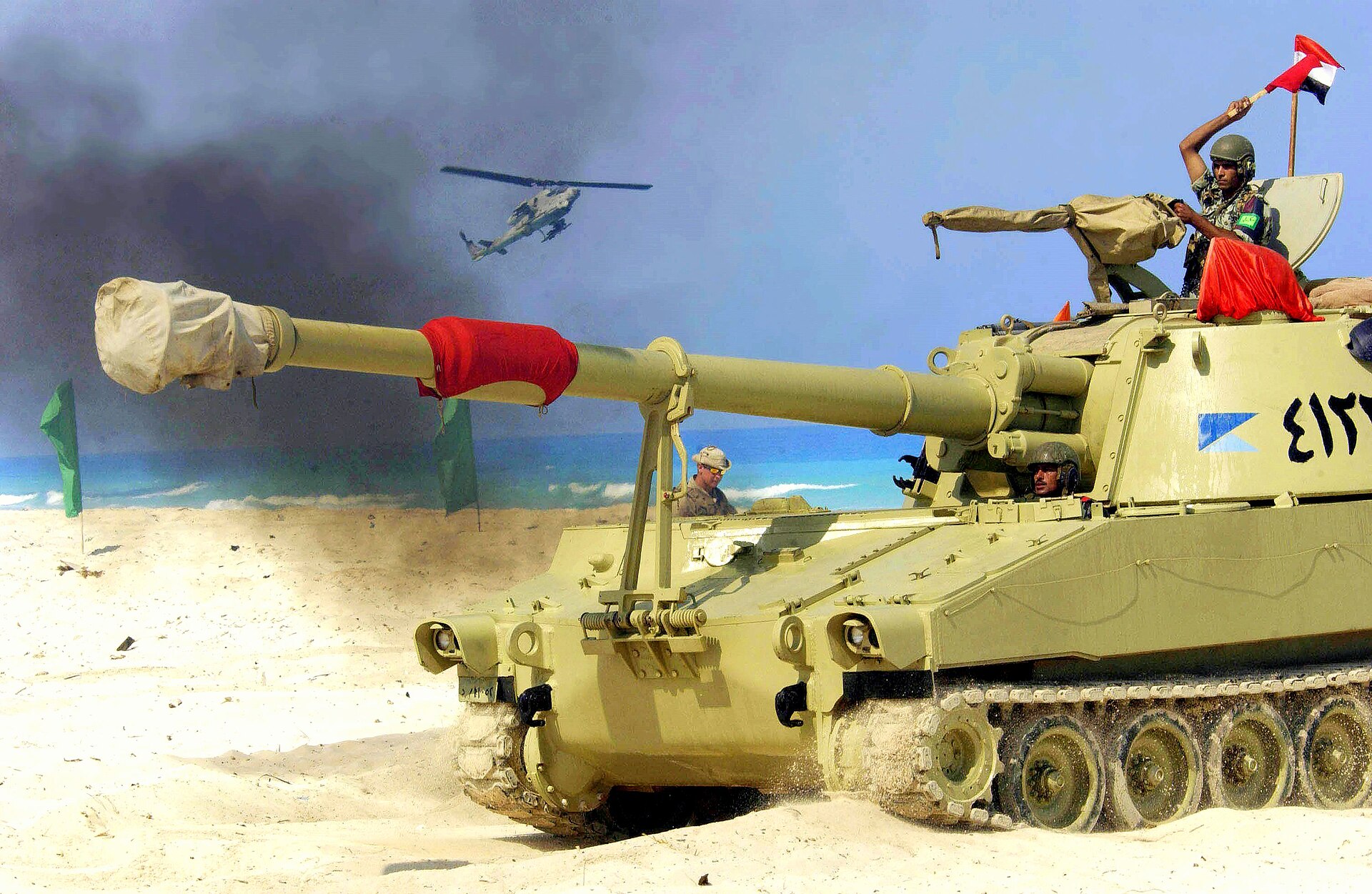
Egypt is one of the world’s largest M109 operators. Janes recorded that the Army received more than 170 M109A5s between 2006 and 2008, on top of older A2 and A3 vehicles acquired from the 1980s onward. The Army also runs the SPH-122, a locally built hybrid that mounts the Soviet-pattern D-30 122 mm gun on an M109 hull, and still has Soviet-era M-46 130 mm field guns on the books, the weapon Defense News identified as the one the K9 would displace at the long-range end.
Military Africa reported in October 2023 that Egypt “anticipates retiring its 170 M109A5 vehicles” as the K9 arrives; whether the older A2s and A3s follow is not publicly disclosed. Either way the K9 is a generational replacement, not an addition at the margin. For the wider fleet picture, see our overview of Egypt’s military strength and the regional survey of artillery in African armies.
What system was selected?
The K9 Thunder is a 47-tonne tracked howitzer with a 155 mm/52-calibre gun, a 1,000 hp diesel and a road speed of 67 km/h. Hanwha’s figures give a burst rate of three rounds in 15 seconds, a sustained rate of two to three rounds a minute and a range of about 40 km with standard projectiles, extending beyond 50 km with specialised ammunition. The K9A1 is the mid-life upgrade with an automatic fire-control system, improved driver vision and auxiliary power unit. The K9A1 EGY is Egypt’s customised variant; the SIS, Egypt’s State Information Service, says it “incorporates local subsystems and manufacturing inputs”. Hanwha has said the Egyptian guns will receive the new STX Engine 1,000 hp powerplant that completed desert durability trials, including in Egypt, in early 2025.
The package also brings two companion vehicles. The K10 ammunition resupply vehicle, on the same chassis, carries 104 rounds and transfers them automatically at roughly 10 to 12 rounds a minute. The K11 fire-direction control vehicle is a new development ordered first by Egypt: a 37-tonne command post on the K9 hull that controls up to six howitzers, fitted, according to Hanwha’s own announcement as relayed by Defense News, “in accordance with operational requirements of the Egyptian Army and Navy”. Hanwha Systems’ December 2024 subcontract disclosure confirms the K11 as the first export of a Korean artillery command-and-control vehicle.
Which alternatives were considered?
No Egyptian tender document has been published, so competition is known only from press reporting. Janes wrote in late 2021 that a photograph of a K9 apparently taken in Egypt in mid-2017 had “prompted speculation that the howitzer was being trialled”, alongside the French CAESAR wheeled gun. Defense News went further in its February 2022 analysis, citing Egyptian researchers who described a final round in 2017 between the CAESAR, the K9, Russia’s Koalitsiya-SV and China’s PLZ-45, with the K9 beating the CAESAR in trials hosted by Egypt. We have found no Egyptian or Korean official confirmation of that line-up, so all four are recorded as reported rather than confirmed competitors.
| Alternative | Class | Status of consideration | Source |
|---|---|---|---|
| Nexter CAESAR (France) | 155 mm/52 wheeled SPH | REPORTED ALTERNATIVE (trials in Egypt reported 2017) | Janes, Dec 2021; Defense News, Feb 2022 |
| Norinco PLZ-45 (China) | 155 mm/45 tracked SPH | REPORTED ALTERNATIVE (named by Egyptian analysts) | Defense News, Feb 2022 |
| 2S35 Koalitsiya-SV (Russia) | 152 mm tracked SPH | REPORTED ALTERNATIVE (named by Egyptian analysts) | Defense News, Feb 2022 |
| KNDS PzH 2000 (Germany) | 155 mm/52 tracked SPH | SAME-CLASS MARKET ALTERNATIVE (no competition documented) | Editorial comparison |
| M109A7 / M109 upgrade (United States) | 155 mm/39 tracked SPH | SAME-CLASS MARKET ALTERNATIVE (no Egyptian upgrade programme documented) | Editorial comparison |
The French option matters because Paris is Egypt’s other large Western supplier (see France–Egypt arms deals), but a wheeled CAESAR offered neither the protection nor the production package Cairo evidently prized. Nothing in the public record suggests Washington offered a modern M109 variant.
Why was the K9A1 EGY selected?
Technology transfer and local manufacture (officially stated). This is the one motive Egyptian ministers have put on the record. Mohamed Ahmed Morsi, then Minister of State for Military Production, told Egyptian media in July 2022 that local production would eventually see 67% of components made in Egypt, and that production at Factory 200 would begin in 2023. In December 2025 his successor, Mohamed Salah El-Din Mostafa, described a new machining line for K9A1 EGY components as “a strategic step toward localizing advanced defence industries”. Hanwha’s signing announcement said the bulk of the fleet would be produced at Factory 200 through technology transfer, and Ahmad Eliba of the Egyptian Center for Strategic Studies told Defense News the choice was made “in accordance with the Egyptian armed forces specifications, like the cost and technology transfer”.
Export ambition (officially stated). Morsi said in 2022 that Egypt had “already started bilateral negotiations with a number of Arab and African countries that want to get the K9”. The SIS repeated the point in 2025, listing export capacity among the goals of the production line. No export contract has been announced as of October 2026.
Replacement of the M109 fleet and longer reach (reported by Defense News, Janes and defenceWeb). All three outlets tie the purchase to the age of the M109 park and the step from a 39-calibre to a 52-calibre gun. The researcher Abdel Hamid Harfi, quoted by Defense News, also framed it as a replacement for the 130 mm M-46 at the long-range end.
Supplier diversification (reported, analysts assess). Harfi told Defense News that Egyptian doctrine prioritises “diversifying the suppliers of weapons to avoid any risk of penalties or embargo”. The pattern is consistent with Egypt’s purchases from France, Germany, Italy and Russia over the past decade, which we examine in Egypt’s supplier diversification, but no Egyptian official has said so of the K9 specifically. The K9 also sits beside an American armoured core; Egypt still builds the M1A1 Abrams at the same Factory 200 (see United States–Egypt arms deals), so this was diversification within a mixed fleet, not a break with Washington.
A naval coastal-defence role (officially stated by Hanwha). Hanwha’s own press material describes the deal as “the first export of a naval K9 variant”, sought by the Egyptian Navy as an anti-access/area denial weapon, and says the gun “successfully proved such a capability by hitting targets at sea during tests and evaluations in 2017”. Army Recognition reported in January 2025 that Hanwha had confirmed modified K11 vehicles to integrate anti-ship fire. The Egyptian Navy itself has not described the role publicly.
Trials performance (reported by Defense News). Egyptian analysts say the K9 outperformed the CAESAR in 2017 trials in Egypt. Possible but unconfirmed by official sources.
Price (not publicly disclosed). Eliba’s mention of “cost” is the only reference to price as a factor. No unit price has been released and no comparative bid figures exist in the public domain.
What was included in the contract?
Hanwha’s announcement lists K9 self-propelled howitzers, K10 ammunition resupply vehicles and K11 fire-direction control vehicles, together with technology transfer for production at Factory 200, user training, and organisational, field and depot maintenance programmes. Two follow-on agreements fill in the industrial content. In October 2022 Arab International Optronics, a Ministry of Military Production company, signed a technology-transfer agreement with Hanwha to build the automatic fire-control system and other electronics in Egypt. On 27 December 2024 Hanwha Systems disclosed subcontracts worth KRW 30.5 billion for the command-and-control suite of 51 K11s and KRW 44.3 billion for the fire-control systems of 216 K9A1s, with deliveries running from the first half of 2025 to December 2028. Ammunition, simulators and spares packages are not itemised in any public source.
How much did it cost?
The figures differ slightly by source and all describe one package value. Hanwha Defense said on 2 February 2022 that the contract was “valued around US$1.7 billion”. defenceWeb puts it at US$1.66 billion, Janes at US$1.65 billion, and Egypt’s SIS at “more than US$1.6 billion”. The Hanwha Systems subcontracts (KRW 74.8 billion in total, roughly US$50 million at the time) are internal to the programme, not additions to it. Because the contract bundles guns, two support vehicles, technology transfer, a production line, training and maintenance, dividing it by the number of guns would not give a unit price, and we do not attempt it.
How many were ordered?
Hanwha has only ever said “hundreds”. Defense News and defenceWeb reported “around 200” at signing; defenceWeb’s December 2025 delivery report and the Hanwha Systems disclosure both use 216 K9A1s, and the latter also gives 51 K11s, enough for one command vehicle per six-gun battery. The K10 number is undisclosed; Army Recognition cites a figure of 39, which no other source repeats. We treat 216 K9A1 and 51 K11 as the best-supported numbers while noting that Egypt has never published a quantity.
Training, maintenance and support
Hanwha pledged “user trainings and organisational/field/depot maintenance” as part of the contract. The depot tier matters in a local-production deal: it implies Factory 200 becomes the fleet’s overhaul centre rather than relying on returns to Korea. The December 2025 Egyptian Ministry of Defence video from EDEX, showing six guns and a K10 manoeuvring and firing in desert terrain, indicates that at least the first battery crews had completed conversion training by then. No details of training numbers, locations or simulators have been released.
Local production or technology transfer
This is the heart of the deal and the reason it stands apart from most African artillery purchases. Janes summarised Hanwha’s three-phase plan in December 2025: in phase one, hulls and turrets are made in South Korea and assembled in Egypt; in phase two, hull and turret production moves to Egypt; in phase three, “in-depth localisation of components” follows, with Egyptian industry taking on gun assembly, major armament manufacture and eventually the 52-calibre barrel itself. Hanwha told Janes that “Egyptian K9 production is proceeding gradually in several phases”.
The localisation target has been stated three ways: 67% of components (Morsi, 2022), “nearly 70% within five years” (Military Africa, citing the October 2022 optronics agreement) and “above 60%” (Army Recognition, 2025). The order of magnitude is consistent; the precise figure is not official beyond Morsi’s statement. On the ground, the SIS reported on 2 December 2025 that the ministry was “finalizing a new production line equipped with advanced machining systems” for K9A1 EGY components, and Army Recognition reported in March 2026 that production activity was under way at Factory 200 alongside the plant’s existing M1A1 Abrams line. The Korean engine adds a second strand: Hanwha said in February 2025 that the STX-built SMV1000 would be fitted to the licence-produced Egyptian guns, removing the German MTU engine and its export-approval chain from the Egyptian line.
Delivery and operational status
The first K9A1 EGY and K10 were shown on a trailer at a 4th Armoured Division inspection near Suez in October 2023, without unit markings. The first complete battery, six K9A1 EGY, one K10A1 EGY and one K11, was handed over and displayed at EDEX in Cairo on 1 to 4 December 2025, with the Ministry of Defence releasing footage of the guns firing in the desert. Hanwha Systems’ schedule runs to December 2028, and the Egyptian-built share of the fleet is only beginning to emerge from Factory 200. The programme is therefore IN PRODUCTION, with the first battery DELIVERED.
- 2010Egypt and South Korea sign a defence-cooperation memorandum; Egyptian interest in the K9 dates from this period (Janes, defenceWeb).
- Mid-2017A K9 is photographed in Egypt; trials alongside the CAESAR are reported, and Hanwha later says the gun hit targets at sea that year.
- 30 Nov 2021At EDEX 2021 Hanwha confirms Egypt is “considering acquiring a package of K9 SPHs and other supporting vehicles” with technology transfer.
- 1 Feb 2022Contract signed at Artillery House, Cairo, in the presence of Defence Minister Mohamed Zaki, Military Production Minister Mohamed Morsi, Hanwha CEO Son Jae-il and DAPA head Kang Eun-ho; Hanwha values it at about US$1.7 billion.
- Jul 2022Morsi says Factory 200 production will start in 2023 and reach 67% local content.
- Oct 2022Arab International Optronics signs a technology-transfer agreement with Hanwha for local fire-control production.
- Oct 2023First K9A1 EGY and K10 shown publicly at a 4th Armoured Division inspection near Suez.
- 27 Dec 2024Hanwha Systems discloses fire-control and C2 subcontracts for 216 K9A1 and 51 K11, deliveries to December 2028.
- 1–4 Dec 2025First battery (6 K9A1 EGY, 1 K10A1 EGY, 1 K11) delivered and displayed at EDEX 2025; SIS reports a new component production line at the Ministry of Military Production.
- Mar 2026Local production activity reported at Military Factory 200.
Has it been used operationally?
No. As of October 2026 the K9A1 EGY has appeared only in training, at exhibitions and in Ministry of Defence footage of live firing in the desert. There is no public report of its employment in the Sinai or on any other front, and the Navy’s coastal variant has not been shown in service. The only recorded engagement of targets is the 2017 sea-target trial cited by Hanwha.
Did Egypt order more?
There is no follow-on order. The 2022 contract was sized for a fleet-wide replacement, so the open question is how far Egyptian production goes and whether a first export customer appears. Morsi’s 2022 claim of talks with Arab and African countries has not produced an announced sale. Hanwha, meanwhile, said in 2025 that its home-grown engine could be “exported without foreign approval”, a line aimed at buyers whose purchases might otherwise need German consent.
What does this tell us about African procurement?
The Egyptian K9 is the largest artillery contract ever signed on the continent, and the first K9 sale to Africa or the Middle East. Its scale is only possible because Egypt combines a large standing army, a long-established state arms industry and access to financing that most African buyers lack. The lesson is not that other African armies can copy the deal; it is that when an African buyer can offer volume and an industrial base, a mid-tier Asian supplier will trade technology for market entry in a way the traditional Western suppliers rarely do. South Korea’s price for its first African foothold was a production line.
Co-production is the model to watch. Egypt has built the M1A1 Abrams at Factory 200 for three decades under American licence, but that programme never led to exports. The K9 agreement is structured differently: a phased plan that moves from assembly to hull and turret manufacture to barrel production, with an explicit Egyptian ambition to sell the result. If Factory 200 reaches its 67% target, Cairo will hold something no other African government has, a locally built 52-calibre howitzer it can offer to Gulf, Levantine and African armies. That would reshape the market we describe in who supplies Africa’s weapons.
The deal is also a reminder that supplier diversification in Africa is about access, not ideology. Egypt did not turn away from the United States; it still assembles Abrams tanks and flies F-16s. It added a Korean supplier willing to transfer the parts of the programme that matter to its industrial strategy, including, from 2025, an engine free of third-country export controls. For buyers further south, the same logic has driven Nigeria towards Turkish co-production and several Sahel states towards Chinese and Turkish systems with lighter end-use conditions.
Finally, the case shows how slowly even a well-funded African programme moves from decision to fielding: interest in 2010, trials in 2017, contract in 2022, first battery in 2025, Egyptian-built guns only emerging in 2026. Any African government signing a technology-transfer deal should expect the industrial benefits to arrive years after the political announcement.
Procurement record
| Field | Value |
|---|---|
| Country | Egypt |
| Service | Egyptian Army; Egyptian Navy (coastal-defence variant) |
| System | K9A1 EGY 155 mm/52-cal self-propelled howitzer; K10A1 EGY ammunition resupply vehicle; K11 fire-direction control vehicle |
| Manufacturer | Hanwha Aerospace (formerly Hanwha Defense); Hanwha Systems (fire control, C2); Military Factory 200 and Arab International Optronics (Egypt) |
| Origin | South Korea, with Egyptian local production |
| Category | Self-propelled artillery / local production |
| Requirement | Replacement of M109A2/A3/A5 fleet with a 52-calibre gun; naval coastal-defence role; domestic production and export base |
| Order date | Interest from 2010; negotiations confirmed 30 Nov 2021 |
| Contract date | 1 February 2022 (Artillery House, Cairo) |
| Quantity | “Hundreds” (Hanwha); approx. 216 K9A1 and 51 K11 (defenceWeb, Hanwha Systems); K10 undisclosed (39 per Army Recognition) |
| Contract value | About US$1.7 billion (Hanwha); US$1.66 billion (defenceWeb); US$1.65 billion (Janes); “more than US$1.6 billion” (SIS). Package value; no unit price disclosed |
| Delivery | First K9A1 EGY and K10 shown Oct 2023; first battery (6 K9A1 EGY, 1 K10A1 EGY, 1 K11) delivered Dec 2025; subsystem deliveries scheduled to Dec 2028 |
| Operational status | IN PRODUCTION (first battery DELIVERED) |
| Training | Hanwha user training; details not disclosed |
| Support | Organisational, field and depot maintenance programmes (Hanwha) |
| Localisation | Three-phase plan at Military Factory 200: assembly, then hull/turret manufacture, then component localisation incl. barrel; 67% target (Morsi, 2022) |
| Tech transfer | Yes: Hanwha–Factory 200 production ToT; Arab International Optronics fire-control ToT (Oct 2022); Korean STX engine for licence-built guns |
| Confirmed competitors | None documented. Reported: CAESAR (2017 trials), PLZ-45, Koalitsiya-SV |
| Follow-on order | None as of Oct 2026; export negotiations claimed by Egypt (2022), no contract announced |
| Primary source | Hanwha Defense announcement, 1–2 Feb 2022; Egyptian SIS, 2 Dec 2025; Janes, 2 Dec 2025 |
| Last verified | 5 October 2026 |
FAQ
How many K9 howitzers did Egypt buy?
Hanwha has only said “hundreds”. Press and company subcontract disclosures point to about 216 K9A1 EGY howitzers and 51 K11 fire-direction vehicles, plus an undisclosed number of K10 ammunition vehicles. Egypt has not published an official figure.
How much did Egypt pay for the K9 Thunder?
Hanwha valued the February 2022 contract at around US$1.7 billion; defenceWeb reports US$1.66 billion and Egypt’s State Information Service says “more than US$1.6 billion”. The figure covers howitzers, K10 and K11 vehicles, technology transfer, training and maintenance, so it is not a unit price.
Is the Egypt K9 howitzer built in Egypt?
Partly, and increasingly so. The first batch was built in South Korea. Later vehicles are assembled, and progressively manufactured, at Military Factory 200 near Cairo under a three-phase plan, with a stated target of 67% Egyptian content.
Has Egypt received its K9 howitzers?
The first full battery of six K9A1 EGY, one K10A1 EGY and one K11 was delivered and shown at EDEX 2025 in Cairo in December 2025. Subsystem deliveries are scheduled through December 2028 and local production is under way.
Why did Egypt choose the K9 over the CAESAR?
No official explanation exists. Egyptian analysts quoted by Defense News say the K9 beat the CAESAR in 2017 trials in Egypt and that cost and technology transfer decided the choice. The K9 package included a production line at Factory 200, which a wheeled CAESAR purchase did not offer.
Does the Egyptian Navy use the K9?
Hanwha describes the Egyptian deal as the first export of a naval K9 variant, intended as a coastal anti-access/area denial weapon, and says the gun hit targets at sea in 2017 trials. The Egyptian Navy has not publicly shown the system in service.
Which other countries operate the K9 Thunder?
At the time of the Egyptian contract Hanwha listed South Korea, Türkiye (as the licence-built T-155 Fırtına), Poland, India, Finland, Norway, Estonia and Australia. Egypt was the first operator in Africa and the Middle East.
More from Why They Bought It
- Why Did Morocco Buy the AH-64E Apache?
- Why Did Nigeria Buy the VT-4 Tank?
- Why Did Côte d'Ivoire Buy the Wing Loong II?
- Why Did Kenya Buy 118 Katmerciler HIZIR Armoured Vehicles?
- Why Did Nigeria Buy the M-346FA?
Sources
- Egyptian State Information Service – Egypt enters final phase of local K9 A1 EGY Howitzer manufacturing (2 December 2025)
- EDR Magazine (Hanwha Defense release) – Hanwha Defense signs largest deal to export K9 Self-Propelled Howitzers to Egypt (February 2022)
- Asian Military Review – Hanwha Defense signs largest deal to export K9 Self-Propelled Howitzers to Egypt (1 February 2022)
- Janes – EDEX 2025: Egypt receives first batch of K9 howitzers (2 December 2025)
- Janes – Egypt negotiating for K9 Thunder howitzers (November 2021)
- Defense News – Egypt inks $1.7 billion deal for K9 howitzers from South Korea (1 February 2022)
- Defense News – Why did Egypt choose to buy South Korea’s K9 howitzer? (1 February 2022)
- defenceWeb – Egypt receives first Hanwha K9 self-propelled howitzers (4 December 2025)
- defenceWeb – Egypt to begin K9 howitzer co-production next year (7 July 2022)
- defenceWeb – Egypt buys K9 howitzers from South Korea (February 2022)
- defenceWeb – Egypt interested in acquiring K9 self-propelled howitzers (1 December 2021)
- Military Africa – Hanwha Systems to supply K9A1 fire control systems to Egypt (5 January 2025)
- Military Africa – Egypt signs agreement for local production of K9A1 self-propelled howitzer components (22 October 2022)
- Military Africa – Egypt unveils K9 self-propelled howitzer in military parade (31 October 2023)
- The Defense Post – Hanwha completes testing of K9 howitzer domestic engine (17 February 2025)
- Asian Military Review – Hanwha Aerospace preps indigenous engine for K9 SPH (12 February 2025)
- European Security & Defence – K9 Self-Propelled Howitzers for Egypt (3 February 2022)
- Army Recognition – Egypt to become first K9 howitzer operator with anti-ship capabilities (13 January 2025)
- Army Recognition – EDEX 2025: Egypt presents new K11 fire control vehicle with first full K9A1EGY howitzer battery (1 December 2025)
- Army Recognition – Egypt launches local production of K9A1 Thunder 155mm howitzer with South Korea (16 March 2026)
Last updated: 5 October 2026. This article is updated in place when the procurement status changes.