UN Renews Darfur Arms Embargo, Rejects Sudan-Wide Expansion



The UN Security Council unanimously renewed Darfur sanctions and the arms embargo to 11 December, but rejected a US push to extend the embargo to all of Sudan, with Russia and China blocking the wider measure. The vote came as UN investigators continue to document foreign weapons networks supplying both sides of Sudan’s civil war.
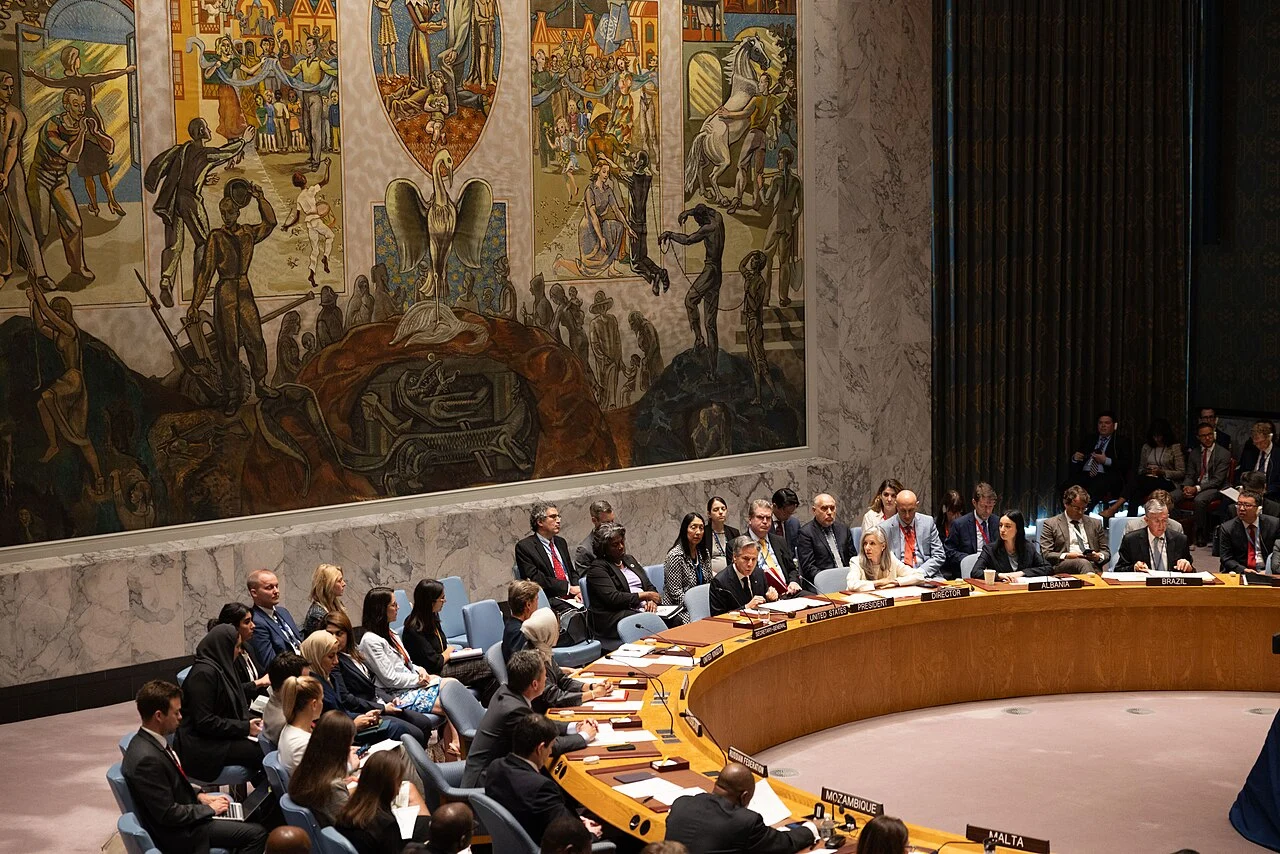
Photo: The UN Security Council chamber during a high-level meeting in New York. Credit: U.S. Department of State, Public domain, via Wikimedia Commons
The UN Security Council voted on 9 October to extend sanctions and the arms embargo on Sudan’s Darfur region for a further two months, until 11 December, and extended the mandate of the Panel of Experts monitoring compliance until 11 January 2027, The Defense Post reported, citing Al Jazeera’s coverage of the Council session. All 15 members backed the measure.
The vote keeps intact the framework set out under Resolution 1591, which restricts arms transfers to parties fighting in Darfur and imposes travel bans and asset freezes on designated individuals and entities. It follows a one-month technical extension adopted on 11 September as Resolution 2828, which had kept the sanctions regime alive while the Council negotiated a longer-term renewal.
Washington’s embargo push blocked
The United States had pushed for a nationwide arms embargo covering all of Sudan, arguing that restricting the embargo to Darfur no longer reflects a war that has spread well beyond the region since fighting began in April 2023. Russia and China opposed the expansion, and the broader measure did not advance. Sudan’s government also objected, saying a nationwide embargo would undermine its right to self-defense against the Rapid Support Forces (RSF).
The split leaves the Council’s sanctions regime unchanged in scope even as the conflict has hardened into a de facto partition, with the Sudanese Armed Forces (SAF) controlling central and eastern Sudan and the RSF holding most of Darfur and parts of the south.
A war fed by foreign networks
The renewal comes weeks after a UN-backed fact-finding mission reported in September that networks involving individuals and entities in the United Arab Emirates, Chad, Libya and Somalia had supplied the RSF with weapons, equipment, logistics, training and foreign personnel. The UAE has repeatedly denied backing the RSF militarily. The same mission said it found grounds to believe the SAF had separately expanded its own drone capabilities through foreign-supplied systems since late 2023, and that foreign-supplied drones used by both sides had struck homes, hospitals, schools and markets — strikes the mission said may amount to war crimes. DefenceMENA has previously examined the drone systems documented on both sides of the Sudan war and a disputed AKINCI-versus-CH-95 shoot-down claim from the same conflict.
The UN’s broader findings on Darfur also sit alongside a separate, lower-profile development reported on 9 October: the defection of an RSF special tasks commander to the Sudanese army, one of several recent signs of strain inside the paramilitary force’s command structure.
UN humanitarian agencies estimate the war has killed roughly 150,000 people and displaced more than 13 million, with famine conditions reported in parts of Darfur, according to figures cited by UNRIC and relayed in Council debate.
Why it matters for Africa
The vote underscores how little leverage the Security Council retains over a war that has become one of the world’s largest humanitarian and displacement crises, and how divided the Council’s permanent members remain on how to respond. For African governments and regional blocs, the outcome is also a case study in the limits of arms-control diplomacy when outside powers keep weapons flowing regardless of UN measures: the embargo on Darfur has existed since 2004 and has done little to stop foreign-sourced drones and equipment reaching both the SAF and the RSF. Neighboring states, from Chad to Libya and South Sudan, continue to absorb refugee flows and face spillover risks, while the African Union has struggled to shape a parallel mediation track that carries real weight alongside the UN process.
Sources
- The Defense Post, on the 9 October Security Council vote
- Al Jazeera, on the UN fact-finding mission’s September findings
- The National, on foreign-supplied drones used by Sudan’s armed forces