Trainer Aircraft in African Air Forces: From Turboprops to Lead-In Fighters



From a pilot’s first turboprop hours to the lead-in jet that hands them off to a fighter type, Africa’s training fleets mix cheap basic aircraft with jets that double as light-attack platforms. This gallery covers eight trainer types in current African service, with operators, status and sourced specifications as of October 2026.
DEFENCE AFRICA | Technology explainer gallery | Data as of October 2026
Every air force that wants to put pilots in a fighter cockpit moves them through stages: a basic or ab initio aircraft that teaches handling and instrument flying cheaply, an intermediate or advanced type that introduces higher speeds and weapons systems, and, for fast-jet pilots, a lead-in fighter trainer whose cockpit and flight characteristics resemble the front-line aircraft ahead. Wealthier air forces use dedicated aircraft for each stage. In Africa, budget constraints usually compress them: the same turboprop or jet that trains a pilot often also flies counter-insurgency sorties, and the lead-in fighter trainer frequently doubles as a light-attack type.
That overlap shapes which aircraft African air forces actually buy. Chinese-Pakistani co-produced jets and new-build Czech trainers have displaced some Cold War-era Western and Soviet types on price and parts availability, while a handful of states, led by Egypt and South Africa, have built local assembly or maintenance capability around the types they operate rather than simply importing them. The entries below span that range, from a Swiss piston-era replacement still flying in South Africa to Angola’s 2026 order for brand-new jets.
Key facts
- South Africa’s 60 Pilatus PC-7 Mk II trainers were delivered between 1994 and 2006, and from 2010 were progressively re-equipped with factory-standard avionics under Project Ithambo (source: SAAF, 2010-2013).
- Ethiopia became the first African Grob G120TP operator in 2019, with a 12-aircraft fleet replacing 30-year-old SF-260TPs at Dire Dawa; Kenya followed with deliveries from 2021 (sources: Military Africa, 2019 and 2021).
- Zambia’s Hongdu K-8 Karakorum fleet reached 15 aircraft after an 8-jet delivery reported in April 2012 (source: FlightGlobal, 2012).
- Angola ordered up to four new-build Aero Vodochody L-39 Skyfox jets in June 2026, becoming the type’s first African customer and starting a replacement cycle for its Cold War-era L-39 Albatros fleet (source: Aero Vodochody / The Defense Post, June 2026).
- Egypt’s Arab Organization for Industrialization has assembled the K-8E under Chinese licence since the 2000s and in September 2024 became the first AOI shop certified by Safran to overhaul the Alpha Jet’s Larzac engine (sources: Al Jazeera, 2005; AviTrader, 2024).
1. Pilatus PC-7 Mk II — South Africa’s ab initio workhorse since 1994
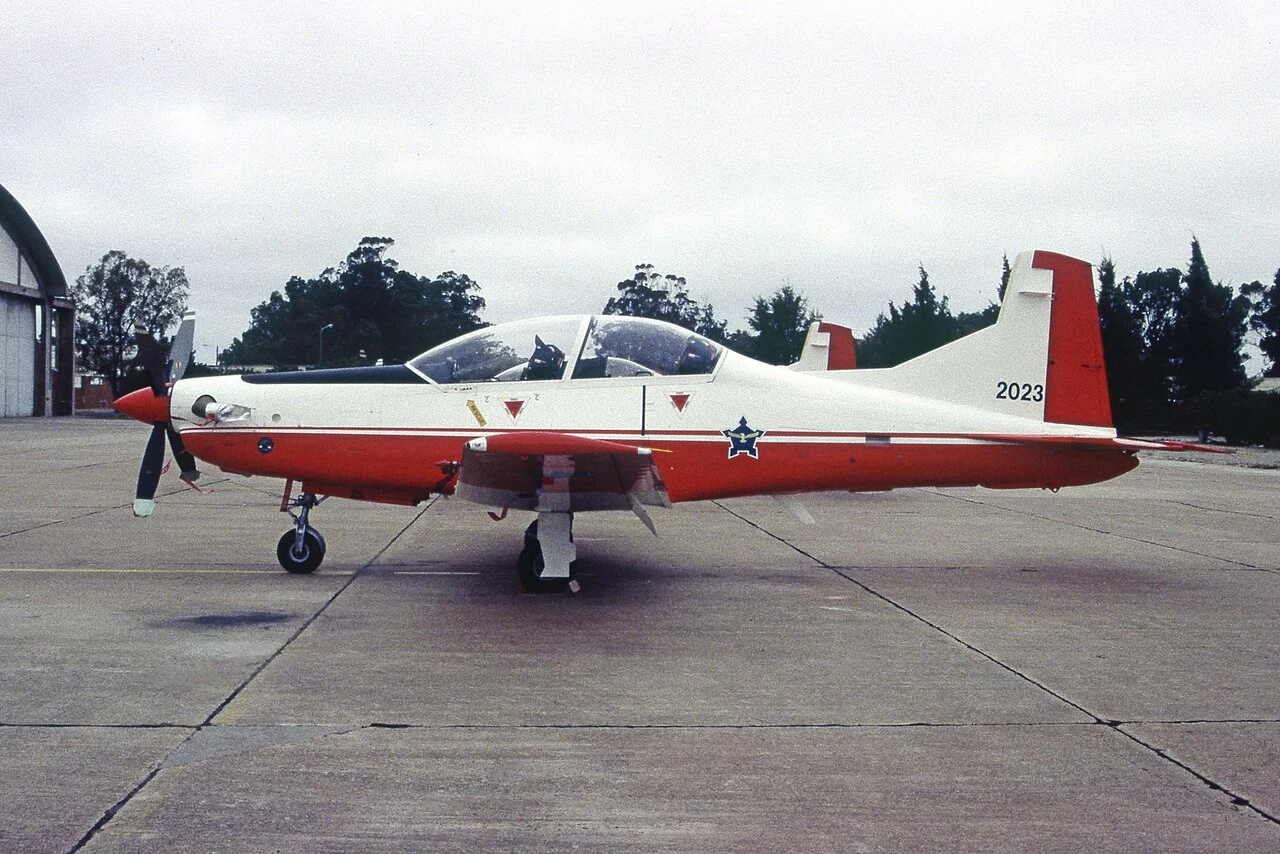
The Pilatus PC-7 Mk II is a single-turboprop ab initio and intermediate trainer built by Switzerland’s Pilatus Aircraft. South Africa (operational) ordered 60 aircraft in 1993, with deliveries running from October 1994 to 2006; they fly from the Central Flying School at Air Force Base Langebaanweg, and a five-aircraft detachment forms the Silver Falcons aerobatic team (source: SAAF, saairforce.co.za). Locally produced avionics, branded Astra, became obsolete and unsupported by the mid-2000s, barring instrument flying; Project Ithambo, contracted to Pilatus in October 2008, re-equipped 35 aircraft with factory-standard instrument-flight avionics, with the first upgraded aircraft handed over in July 2010 (source: SAAF). The PC-7 Mk II remains in production and is used by air forces on four continents as the first fixed-wing type a cadet flies, making it the opening stage of South Africa’s pilot pipeline before cadets move to the Hawk.
2. Grob G120TP — Ethiopia’s and Kenya’s turboprop replacement for the SF-260
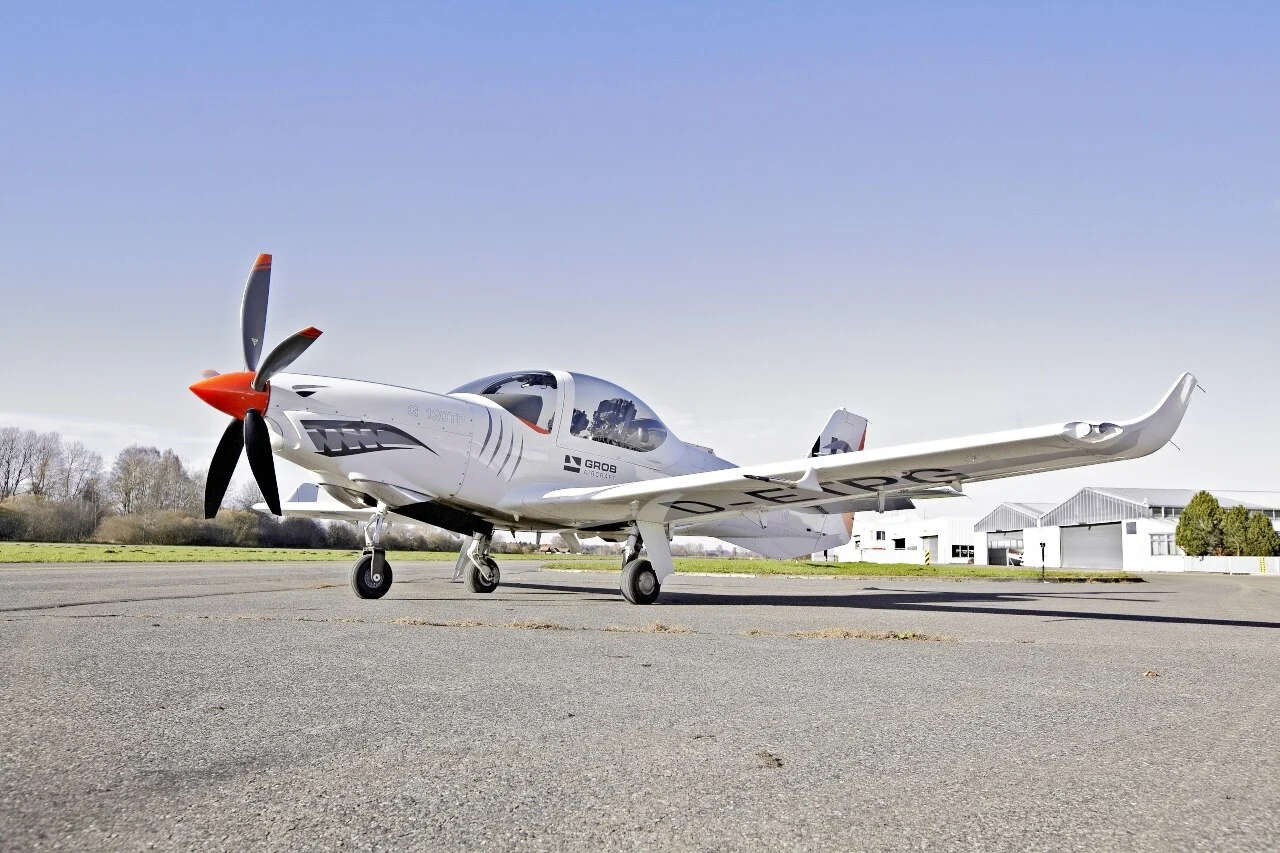
The G120TP is a single-turboprop primary trainer from Germany’s Grob Aircraft, built around a Pratt & Whitney Canada PT6A-25C and a glass cockpit. Ethiopia (operational) signed the type’s first African contract in June 2019; the initial batch arrived that August and September, and a follow-on order reported in December 2019 brought the planned fleet to 12 aircraft based at Dire Dawa, replacing 30-year-old SF-260TPs (source: Military Africa, December 2019). Kenya (operational) began receiving its own G120TPs in 2021 (source: Military Africa, September 2021). The type illustrates a broader shift: turboprop trainers with digital cockpits are replacing piston- and older turboprop-era aircraft across the continent because they cost less to operate per flight hour than jets while still teaching instrument procedures cadets will use later on jets.
3. Hongdu K-8 Karakorum — the default intermediate jet trainer from Zambia to Zimbabwe
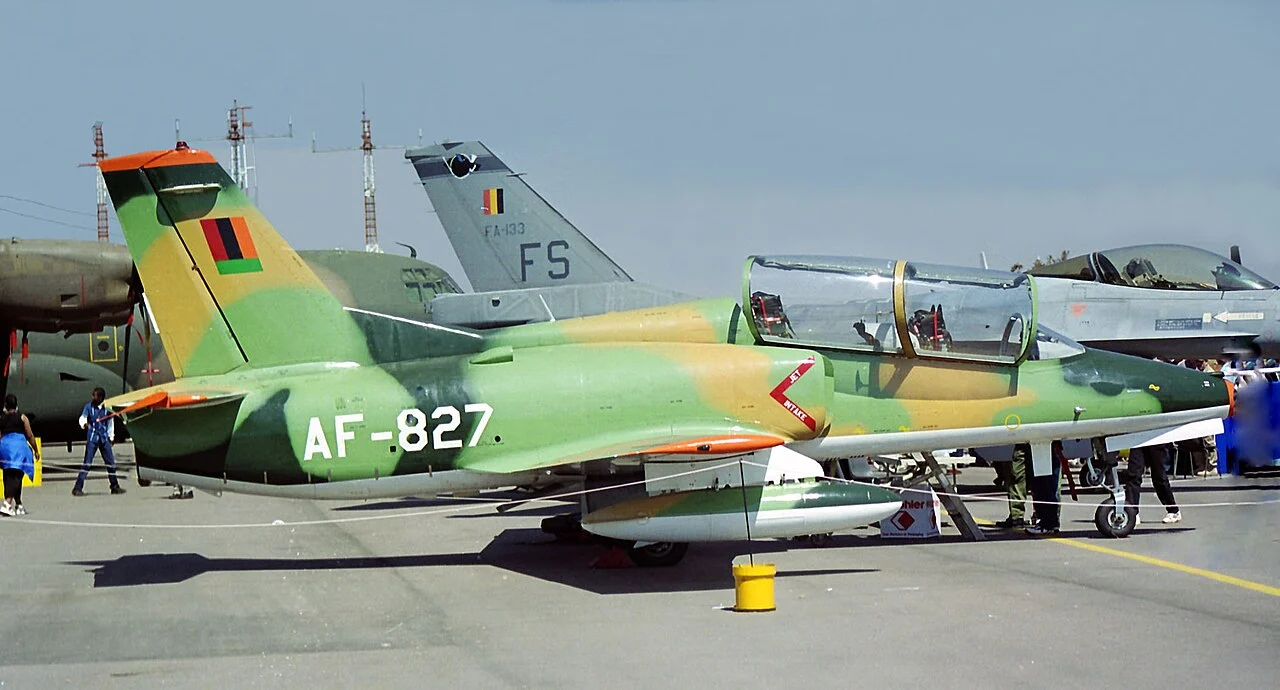
Developed jointly by China’s Hongdu Aviation Industry Corporation and the Pakistan Aeronautical Complex, the K-8 is a tandem-seat, single-turbofan intermediate jet trainer that can also carry light attack ordnance on underwing stations. Zambia (operational) operates 15 K-8s after an eight-aircraft delivery reported in April 2012 (source: FlightGlobal, April 2012). Sudan (operational) received an initial batch of six K-8s from AviChina with six more to follow, according to a 2007 report (source: Al Jazeera, May 2007); the type remains in Sudanese air force service. Angola (operational) ordered 12 K-8W Karakorum aircraft in 2018 for advanced pilot training, with the final aircraft delivered by February 2021 (source: Military Africa, February 2021). Zimbabwe (operational, limited) acquired K-8s after a 2000 United Kingdom arms embargo cut off spares for its BAE Hawk fleet, and continues to list around a dozen in inventory, flown intermittently alongside other ageing types (source: Oryx, December 2022). Across four air forces, the K-8 shows how a lower-cost, non-Western jet trainer became the practical substitute where Western types became unaffordable or embargoed.
4. Hongdu/AOI K-8E — Egypt’s licence-built intermediate trainer
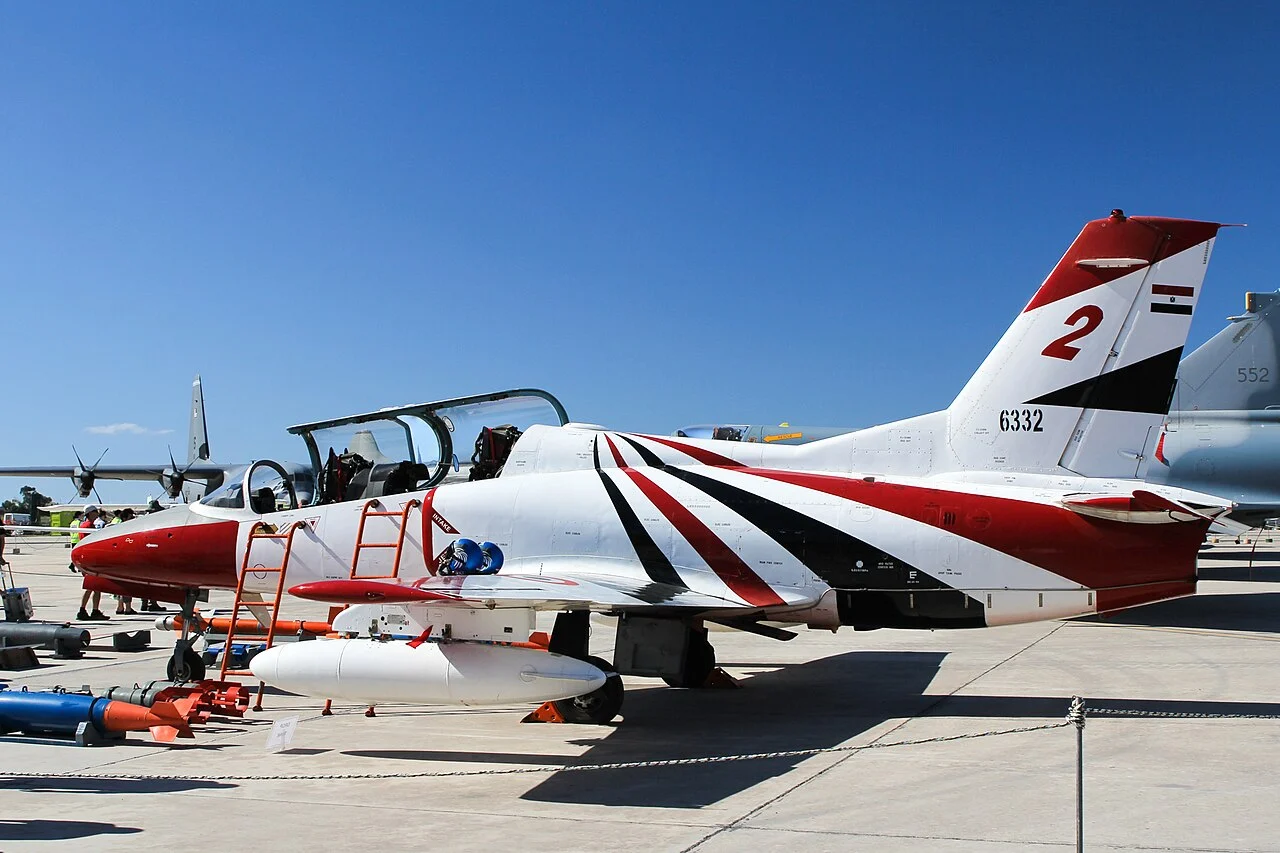
The K-8E is the Egyptian production variant of the same Hongdu/Pakistan Aeronautical Complex design, assembled locally rather than simply imported. Egypt (operational) signed a licence agreement with China’s aerospace export arm in the mid-2000s covering local production of the type at the Arab Organization for Industrialization’s Helwan complex (source: Al Jazeera, August 2005). The same Helwan facility has built up broader regional MRO standing for jet-trainer engines: in September 2024, AOI became the first shop outside France certified by Safran to overhaul the Larzac turbofan that powers the Alpha Jet, a ten-year licence covering a global fleet of up to 280 engines (source: AviTrader, September 2024). The K-8E is the clearest example on this list of the “local assembly, technology transfer” model that African governments increasingly ask suppliers for instead of straight import contracts.
5. Dassault/Dornier Alpha Jet — the long-serving advanced trainer Egypt is trying to replace
The Alpha Jet, a joint French-German design, has served as an advanced trainer and light-attack aircraft in African air forces for more than four decades. Egypt (operational) has operated and, since a 1978 licence agreement, locally assembled the type at the Arab Organization for Industrialization in Helwan (source: Al Jazeera, August 2005); the September 2024 Safran MRO certification above covers Egypt’s Alpha Jet engines specifically. Dassault’s own customer list also names Cameroon, Côte d’Ivoire and Togo among historic Alpha Jet operators, though current airworthy numbers in each air force are not independently confirmed and are not stated here. Egypt has separately explored replacing its oldest Alpha Jets: a reported 2022 arrangement between AOI and Korea Aerospace Industries would see a share of a roughly 100-aircraft KAI/Lockheed Martin T-50 Golden Eagle requirement built locally, but the deal’s final contractual status has not been confirmed by either government, so it is treated here as reportedly under negotiation rather than contracted.
6. BAE Systems Hawk Mk120/Mk60 — one lead-in fighter trainer, two very different fleets
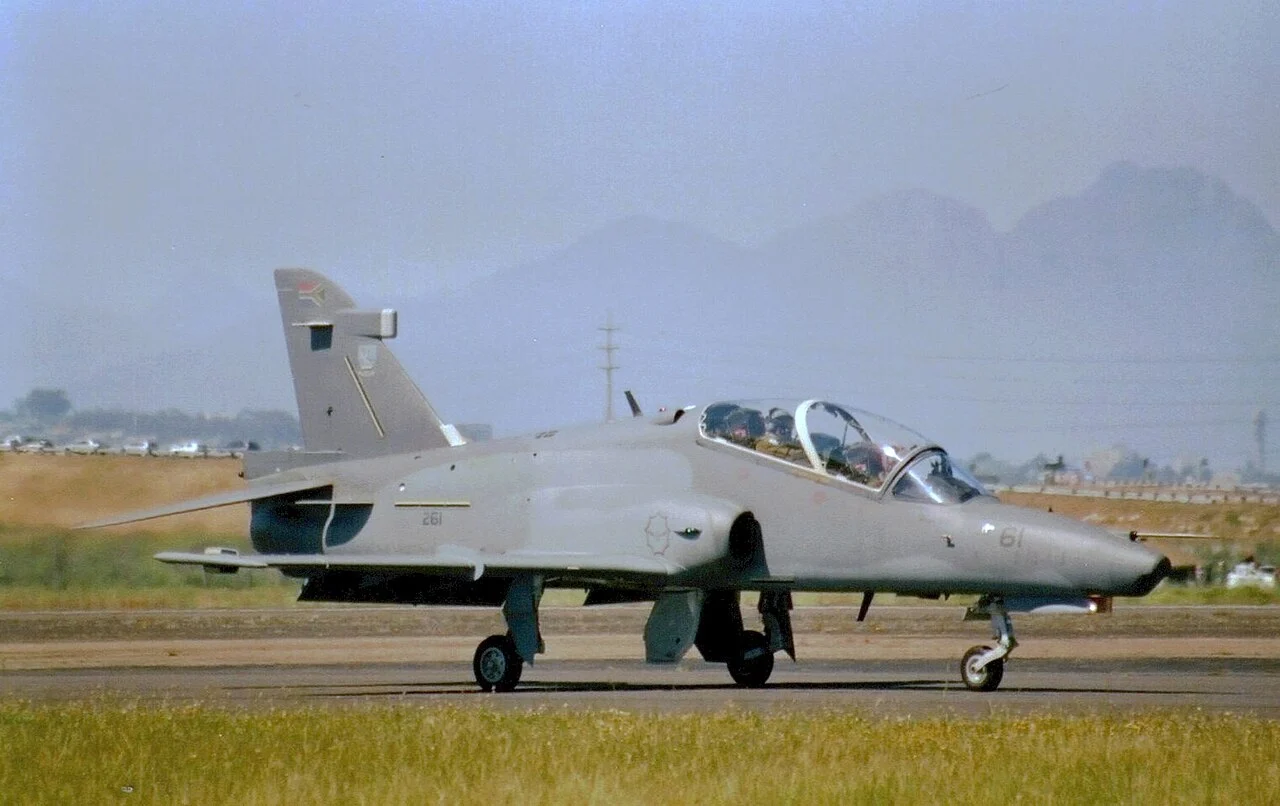
The Hawk is a British single-engine lead-in fighter trainer built by BAE Systems. South Africa (operational) ordered 24 Hawk Mk120s in 1999; the first arrived at Air Force Base Makhado in September 2005 and deliveries concluded in 2008, equipping 85 Combat Flying School, whose cockpits and systems were configured to resemble the Gripen that graduates then fly (source: SAAF, saairforce.co.za). Zimbabwe (limited, grounded then partly restored) took delivery of eight Hawk Mk60s in 1982 and five more in 1992, but a British arms embargo imposed in 2000 cut off spare parts and the fleet was effectively grounded; around four aircraft have reportedly been returned to flying condition since 2019 (source: Oryx, December 2022). The contrast between an operational SAAF fleet backed by an unbroken supplier relationship and a Zimbabwean fleet hollowed out by a parts embargo is one of the sharpest sustainment lessons in African military aviation.
7. Aero L-39 Albatros / L-39 Skyfox — Angola starts a new-build replacement cycle
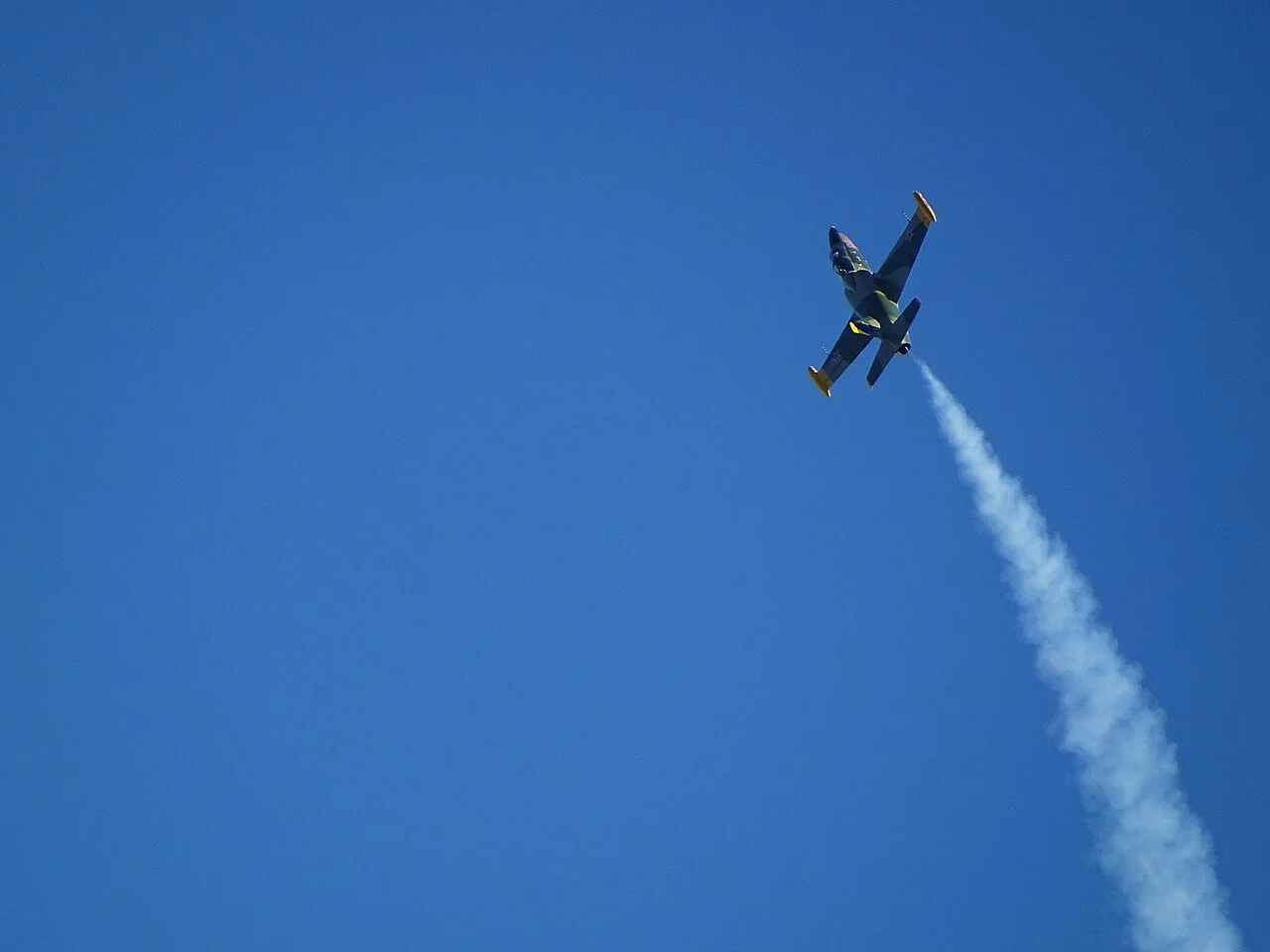
The L-39 Albatros is a Czechoslovak-designed basic/intermediate jet trainer that armed forces across the former Soviet sphere, including Angola, have operated since the Cold War. Angola (contracted for new aircraft; existing Albatros fleet operational) agreed on 18 June 2026 to buy up to four newly manufactured L-39 Skyfox jets from Czech manufacturer Aero Vodochody, becoming the type’s first African customer (source: Aero Vodochody, via The Defense Post, June 2026). The Skyfox, re-engined with a Williams FJ44-4M turbofan and fitted with a modern glass cockpit, is designed to replace the Albatros rather than merely refurbish it; Aero Vodochody’s announcement also describes a training-services arrangement in which the new jets are to be operated through the Czech Republic’s LOM PRAHA Air Training Centre rather than flown directly by the Angolan air force (source: Aero Vodochody / Military Africa, June 2026). That model, buying flying hours and aircraft availability from a contractor rather than owning and maintaining every airframe, is a format more cost-conscious African air forces are weighing as an alternative to outright ownership.
8. Leonardo M-346FA — Nigeria’s bridge between basic trainers and the JF-17
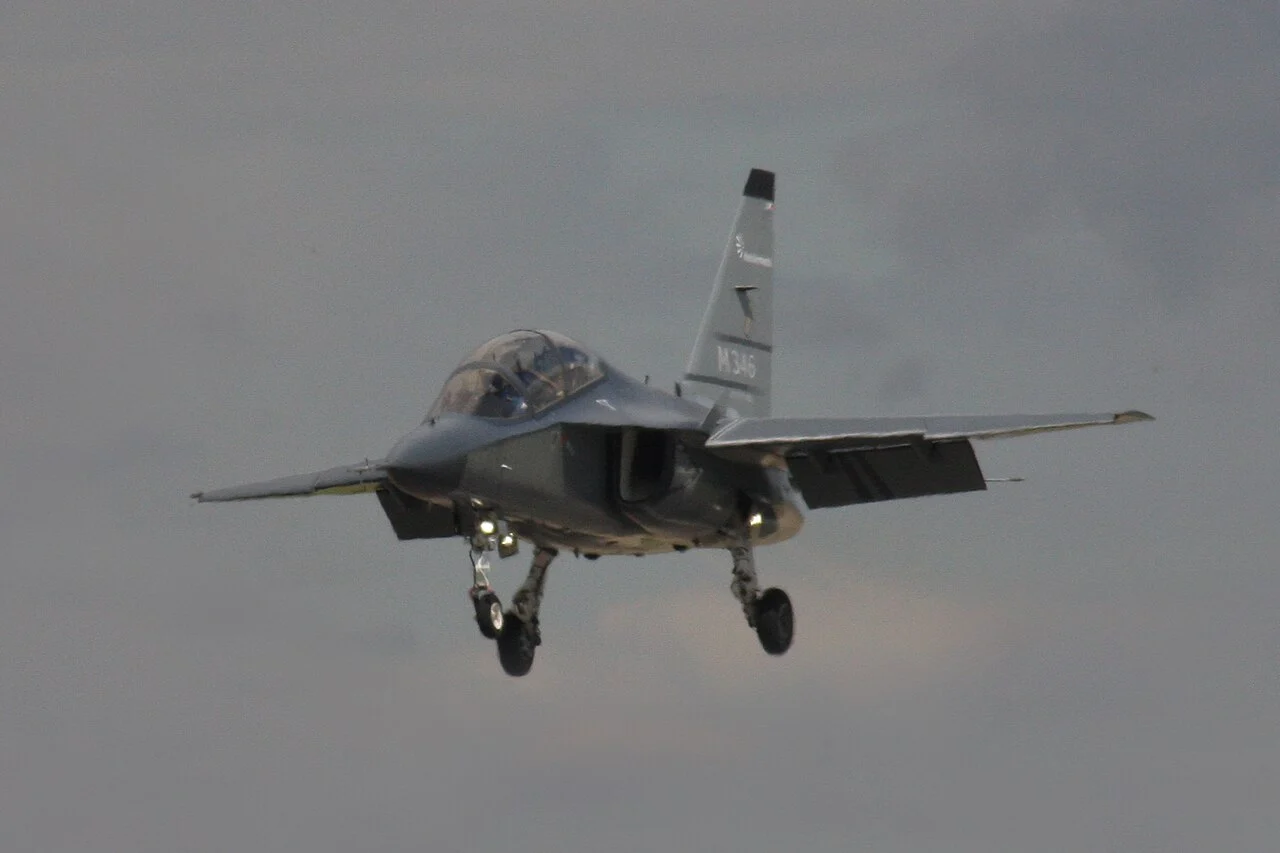
The M-346 is an Italian twin-turbofan advanced jet trainer with digital fly-by-wire controls; the FA (Fighter Attack) variant adds radar and precision-guided-munition compatibility for light-attack and lead-in fighter work. Nigeria (ordered) is acquiring the M-346FA to close the capability gap between its A-29 Super Tucano and Alpha Jet basic fleet and its JF-17 Thunder fighters; full deal terms and timeline are covered in DefenceMENA’s dedicated report, Why Did Nigeria Buy the M-346FA?. Within this gallery, the M-346FA represents the top of the African training pipeline: the stage immediately before a pilot reaches a supersonic fighter type, and one few African air forces currently operate.
Why it matters for Africa
Pilot training fleets rarely make headlines the way fighter jets do, but they decide how many qualified pilots an air force can put into cockpits each year and at what cost. The aircraft in this gallery show three patterns that recur across the continent. First, affordability drives type selection more than performance: the K-8 Karakorum’s spread from Zambia to Angola to Zimbabwe owes as much to its price and availability outside Western export-control regimes as to its handling qualities. Second, sustainment risk is a live operational issue, not an abstraction, illustrated starkly by the gap between South Africa’s intact Hawk fleet and Zimbabwe’s embargo-hollowed one. Third, a small number of states, Egypt foremost, are turning training-aircraft contracts into local assembly and maintenance capability rather than accepting pure import dependency, a path that keeps more of each contract’s value and skills inside the country. Angola’s 2026 move toward new-build jets and a training-services model, and Nigeria’s acquisition of a light-attack-capable lead-in trainer, both show procurement choices shaped as much by sustainment and dual-role flexibility as by the basic requirement to teach someone to fly.
Sources
- South African Air Force — PC-7 Mk II “Astra”
- South African Air Force — “SAAF Gets First Hawks”
- South African Air Force — “The Hawk Has Landed at AFB Makhado”
- FlightGlobal — “Zambia Receives Eight K-8P Jet Trainers” (2012)
- Al Jazeera — “China and Russia ‘Arming’ Sudan” (2007)
- Military Africa — Angola’s final K-8W delivery (2021)
- Military Africa — Angola orders L-39 Skyfox (2026)
- The Defense Post — Aero Vodochody Skyfox order for Angola (2026)
- Al Jazeera — “Egypt Gets Licence to Make China Jets” (2005)
- AviTrader — AOI and Safran Larzac engine agreement (2024)
- Military Africa — Ethiopian Air Force second Grob G120TP order (2019)
- Military Africa — Kenya receiving Grob G120TP (2021)
- Oryx — “Flying History: Zimbabwe’s Proud Aircraft” (2022)
Related reading: Light attack aircraft for African counter-insurgency air forces | Why Did Nigeria Buy the M-346FA? | Nigeria Asks Czech Republic to Help Build an Ammunition Production Line