Morocco Reportedly Asked the US to Train Pilots on the F-35A



Morocco has asked the United States to train Royal Moroccan Air Force pilots on the F-35A, according to Moroccan outlet Assahifa, a step that would precede any formal purchase of the fifth-generation fighter. Neither government has confirmed the request or announced a sale.
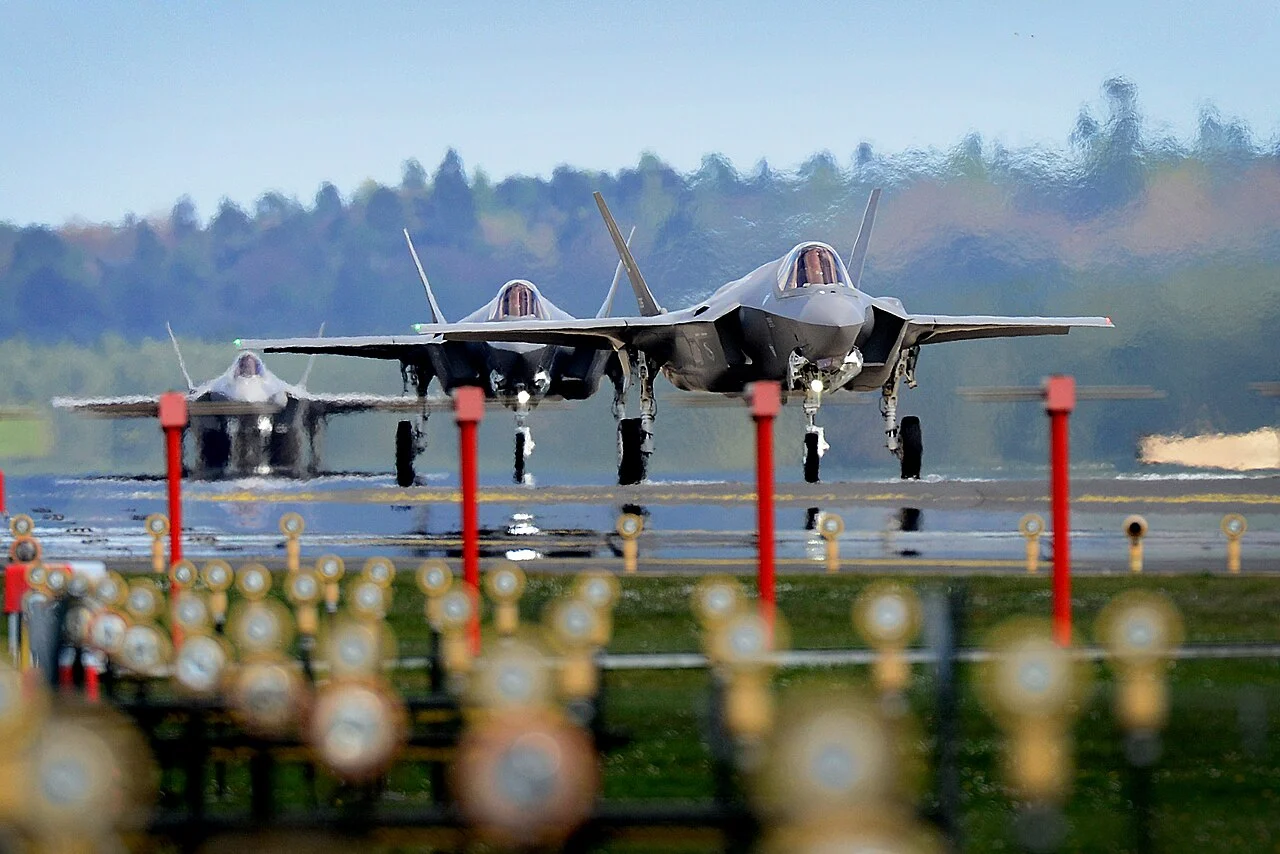
Photo: F-35A Lightning II fighters from the 48th Fighter Wing at RAF Lakenheath, the same unit that flew two F-35As over Morocco’s Marrakech Air Show. Credit: Tech. Sgt. Matthew Plew/U.S. Air Force, Public domain, via Wikimedia Commons
Morocco has submitted a formal request to the United States to train Royal Moroccan Air Force (FAR) pilots on the F-35A Lightning II, Moroccan outlet Assahifa reported on 8 October, citing its own sources. Infodefensa relayed the claim on 10 October, noting there is “no public confirmation of the request nor of a purchase” from either Rabat or Washington.
According to Assahifa, the training would run five to eight months and could take place at Luke Air Force Base in Arizona, home to the US Air Force’s main F-35A training wing. The report does not specify pilot numbers or a start date, and frames the training as preparation ahead of a possible F-35A acquisition rather than confirmation of one.
A show of force at Marrakech
The claim surfaced during the Marrakech Air Show, held 7-10 October at a Royal Moroccan Air Force base and timed to the 250th anniversary of US-Morocco relations. On the show’s opening day, two F-35As from the 48th Fighter Wing at RAF Lakenheath in the UK flew over the base, with US Africa Command confirming their participation. Around 45 US personnel took part, with an HC-130J and a KC-135 on static display.
Lockheed Martin, the F-35’s manufacturer, was the show’s main sponsor. It displayed a cockpit demonstrator and scale models of the F-35A, F-16 and C-130J, and held an industry day with Moroccan firms on supply-chain participation and local maintenance capacity — the kind of offset package Gulf and European F-35 customers have come to expect.
Built on an expanding F-16 fleet
Any F-35A sale would sit on top of Morocco’s modernization of its F-16 fleet. The FAR’s first Block 72-standard F-16 completed its maiden test flight in the US on 7 October, part of a package that includes AESA radar and modern avionics. Rabat has paired that purchase with other big-ticket US equipment, including AH-64E Apache attack helicopters and, most recently, 50 additional Oshkosh HET A1 tank transporters for its Abrams fleet. Morocco has also been deepening the planning cycle for African Lion, Africa’s largest annual military exercise, which it hosts with AFRICOM.
That buildout reflects a broader strategic pattern: the US has become Morocco’s dominant arms supplier, and Washington has used Foreign Military Sales to deepen a security relationship that dates back to the kingdom’s status as a major non-NATO ally.
F-35 versus Rafale, and the Algeria factor
Morocco’s reported interest in the F-35A is not new — Moroccan and regional press have floated a possible purchase since at least 2025, when reports put a package potentially worth billions of dollars, covering roughly three dozen aircraft with decades of sustainment, though no official figure has ever been confirmed. France has continued to pitch the Rafale as an alternative, and analysts have said Rabat is weighing the F-35’s stealth and sensor-fusion advantages against the Rafale’s more established footprint with a traditional European partner and the question of local industrial participation.
A Moroccan F-35 acquisition would also land in a tense regional context. Algeria has continued to expand its own fighter fleet, including reported interest in Russian Su-57E and Su-35 jets and Chinese J-10C aircraft alongside KJ-500 airborne early warning aircraft — all still unconfirmed by Algiers, Moscow or Beijing. Analysts have previously warned that a confirmed Moroccan F-35 deal could sharpen the arms race between the two neighbors, whose relations remain severed.
Any actual sale would still need to clear the standard US Foreign Military Sales process: a formal requirement from Morocco, State Department and Pentagon review, a congressional notification period, and negotiated terms — none of which has been reported yet. Historically, the US has restricted F-35 exports in the Middle East and North Africa to Israel, making a Moroccan sale, if it proceeds, a significant precedent for the region.
Why it matters for Africa
Morocco already operates the most capable air force in North Africa, and an F-35A buy would make it the first African country to field a fifth-generation fighter — a capability gap no other air force on the continent is close to closing. Even the training request alone signals how far Rabat is willing to go to lock in long-term alignment with Washington, at a time when Gulf and European suppliers are competing hard for African defence budgets. For African air forces more broadly, Morocco’s trajectory — stacking F-16 Block 72, Apache, and potentially F-35 purchases — is a reminder that the most consequential capability decisions in African airpower are increasingly being made in Rabat and Cairo, not in the markets usually associated with the continent’s security challenges.
Sources
- Infodefensa, citing Assahifa
- Hespress English, on regional tensions around a possible Morocco F-35 deal
- U.S. Africa Command, on F-35A participation at the Marrakech Air Show