African armies fighting Sahel insurgencies and holding contested borders are buying artillery from at least three different supplier bases at once: Chinese wheeled self-propelled guns in Burkina Faso, Mali, Nigeria and Gabon, a French light towed howitzer in Senegal, and continued South African investment in the Denel G5/G6 family, all alongside Soviet-pattern towed guns that never left service. No single system fits every African fire-support requirement, and the choice tracks the mission: fast-displacing wheeled guns for road-bound counter-insurgency columns, longer-range truck-mounted howitzers for holding ground, and towed pieces where airlift or budget rules out anything heavier.
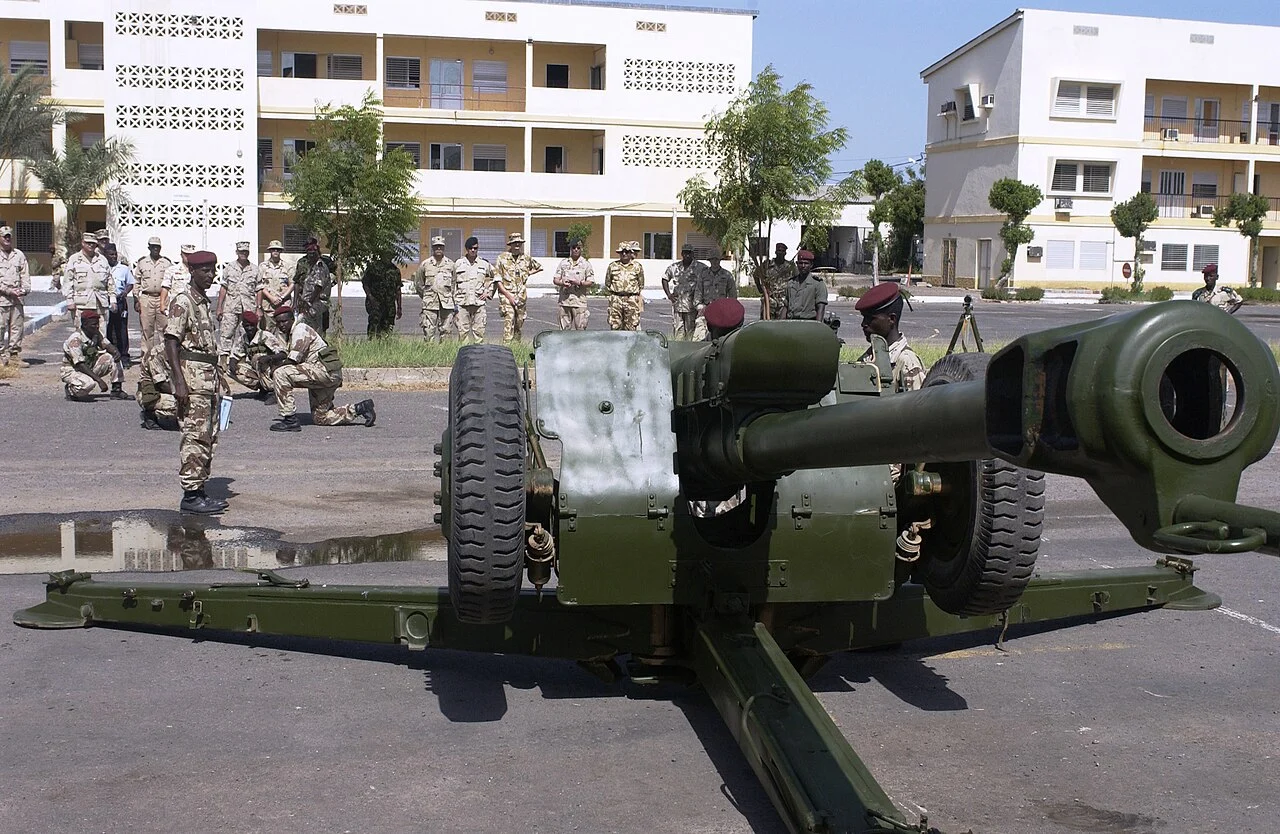
Photo: A Djiboutian army artillery team demonstrates a D-30 122 mm howitzer. Credit: Roger S. Duncan, U.S. Navy, Public domain, via Wikimedia Commons.
Direct answer
For African armies buying indirect fire support today, five families have documented recent orders or deliveries: the Norinco WMA301 105 mm wheeled fire-support gun (China), the Norinco SH-15/PCL-181 155 mm truck-mounted howitzer (China), the Nexter LG1 105 mm towed howitzer (France), the Denel G5/G6 155 mm towed and wheeled self-propelled family (South Africa), and the Soviet-pattern D-30 122 mm towed howitzer still fielded, adapted and in some cases re-mounted across the continent. No system wins on every criterion. The WMA301 has the widest recent spread of African buyers, the SH-15 gives Ethiopia the longest published range, the LG1 is the lightest and most air-portable, the G5/G6 remains the only African-designed and African-built option with an active export order book, and the D-30 is the one every other option has to be compared against because it is what most African artillery corps already operate.
| Requirement | Indirect and direct fire support for counter-insurgency columns and conventional border defence |
| Systems compared | Norinco WMA301, Norinco SH-15/PCL-181, Nexter LG1, Denel G5/G6, Soviet-pattern D-30 |
| Widest recent African uptake | WMA301: confirmed in Burkina Faso, Cameroon, Chad, Djibouti and Gabon |
| Longest published range | SH-15/PCL-181: up to 53 km with rocket-assisted ammunition (Ethiopia) |
| Turkish option | None confirmed. No African towed or self-propelled howitzer contract for MKE, Roketsan or another Turkish manufacturer is documented in sources reviewed |
| Price data | No comparable unit prices published for any of the five; only package or estimated figures exist |
The African requirement
The requirement is not one problem but two, and armies are buying different equipment for each. Sahel juntas fighting JNIM and ISGS-linked groups need fire support that moves with road-bound columns, displaces fast enough to avoid counter-battery fire and drone strikes, and does not need a dedicated tracked-vehicle maintenance line. Armies holding conventional borders or fighting larger internal conflicts, such as Ethiopia, need range and volume of fire more than speed of displacement. A third, quieter requirement runs underneath both: most African gun parks are still built around Soviet-pattern 122 mm and 130 mm towed pieces bought decades ago, and new purchases have to work alongside that legacy stock rather than replace it outright.
Operating environment
- Road-bound counter-insurgency. In the Sahel, guns move by road alongside troop convoys rather than deploying independently, which favours wheeled self-propelled platforms over towed guns that need a separate prime mover and setup time.
- Counter-battery and drone exposure. Long-range artillery-locating radar and armed drones are now present on multiple African battlefields, so how fast a gun can fire and displace matters as much as its range, though none of the sources reviewed for this article publish comparable displacement-time data for the systems below.
- Long, thin logistics. Ammunition resupply over hundreds of kilometres of poor roads is a bigger constraint on sustained fire than any single platform’s rate of fire.
- Mixed legacy fleets. Where a country already runs D-30s or similar Soviet-pattern guns, ammunition and crew training built around 122 mm rounds shapes what a new purchase has to fit around, not replace.
What capabilities matter?
The same criteria are applied to every system: calibre and range, towed versus self-propelled, weight and mobility, crew size, documented African users and their status, evidence of local support, and public price data. Where a source does not state a figure, the table says so.
Comparison table
| System | Origin | Type | Weight | Range (reported) | Crew | Documented African users | Local support / production evidence |
|---|---|---|---|---|---|---|---|
| Norinco WMA301 | China | 105 mm wheeled fire-support gun (6×6) | ~19-21 t | Not stated in sources reviewed for the 105 mm gun variant | 5 | Burkina Faso, Cameroon, Chad, Djibouti, Gabon | None found |
| Norinco SH-15 / PCL-181 | China | 155 mm truck-mounted self-propelled howitzer (6×6) | ~25 t | 20 km (conventional); 53 km (rocket-assisted) | 6 | Ethiopia (32 observed, Jan 2023) | None found |
| Nexter LG1 | France | 105 mm towed howitzer | 1,520 kg | 17 km (base-bleed rounds) | 5 | Senegal (8 ordered, 2022) | None found; EU/French-funded predecessor programmes exist for other equipment types in the region, not for the LG1 |
| Denel G5 (towed) / G6 (self-propelled) | South Africa | 155 mm towed (G5) and wheeled self-propelled (G6) | G5: 13,750 kg; G6: ~46 t | G5: up to 50 km (V-LAP); G6: up to 52.5 km (V-LAP) | G5: 8; G6: 6 | South Africa (SANDF, both types) | Designed and built in South Africa; active ammunition-integration and export-upgrade programmes as of 2025-2026 |
| D-30 (Soviet-pattern) | USSR / widely copied | 122 mm towed howitzer | 3,210 kg | 15.4 km (standard); ~21.9 km (rocket-assisted) | 7-8 | Djibouti (demonstrated 2006); Ethiopia (locally re-mounted on WZ551 chassis, 2016) | Ethiopia’s WZ551-mounted variant is the only documented local modification found |
Weight and range are the least comparable columns here: the five systems span three calibres (105 mm, 122 mm and 155 mm) and two very different roles, direct-fire support for infantry columns versus longer-range indirect fire, so a lower range or lighter weight is not automatically a weakness. No source reviewed publishes a stated range for the WMA301’s 105 mm gun specifically, only performance figures for related Norinco assault-gun designs.
Norinco WMA301
Burkina Faso’s President Ibrahim Traoré presided over the delivery of six WMA301 105 mm fire-support vehicles and a command vehicle, alongside eight Norinco 81 mm CS/SM1 self-propelled mortars, on 12 January 2024 (Jane’s). Defence minister Kassoum Coulibaly called it the first of five planned consignments; no contract value was published. The WMA301 mounts a 105 mm rifled gun on the WZ551 6×6 chassis already used elsewhere in Africa for armoured personnel carriers, shortening the logistics chain for armies that already run WZ551-family vehicles. Gabon was confirmed operating the type by August 2024 (Military Africa), and it is also reported in Cameroon, Chad and Djibouti. Status: delivered in Burkina Faso and Gabon; further Burkina Faso consignments not confirmed.
Norinco SH-15 / PCL-181
Ethiopian Prime Minister Abiy Ahmed’s visit to the Awash Arba Combat Technical School on 21 January 2023 revealed 32 SH-15 155 mm truck-mounted howitzers at Harar Meda Air Base, confirmed independently through satellite imagery (Gerjon; Military Africa). The SH-15 is the export version of the PLA’s PCL-181 and offers the longest range in this comparison, 53 km with rocket-assisted rounds. A widely cited $2.1 million unit price comes from Pakistan’s export order and is not Ethiopia’s price. Nigeria fields a related Norinco design, the SH5 105 mm wheeled self-propelled howitzer, delivered from 2020 in a $152 million package that also covered VT-4 tanks and ST1 tank destroyers; that figure cannot be divided into a per-howitzer price (Military Africa). Nigeria later deployed the SH5 in Operation Tura Takaibango in Yobe State. Status: operational in Ethiopia and Nigeria.
Nexter LG1
Nexter announced on 28 April 2022 that it would supply eight 105 mm LG1 towed howitzers to Senegal, its eighth export customer alongside Belgium, Canada, Colombia, Indonesia, Malaysia, Singapore and Thailand (Military Africa; Jane’s). At 1,520 kg it is by far the lightest system here, air-portable and towable behind a light vehicle, fitting Senegal’s peacekeeping-oriented force structure better than a heavier self-propelled gun. Nexter did not publish a contract value; press estimates of roughly $2.08 million per gun are analyst figures, not a confirmed price. Deliveries were reported to run over 18 months from the 2022 announcement, but completion is not confirmed. Status: ordered, delivery status unconfirmed.
Denel G5 / G6
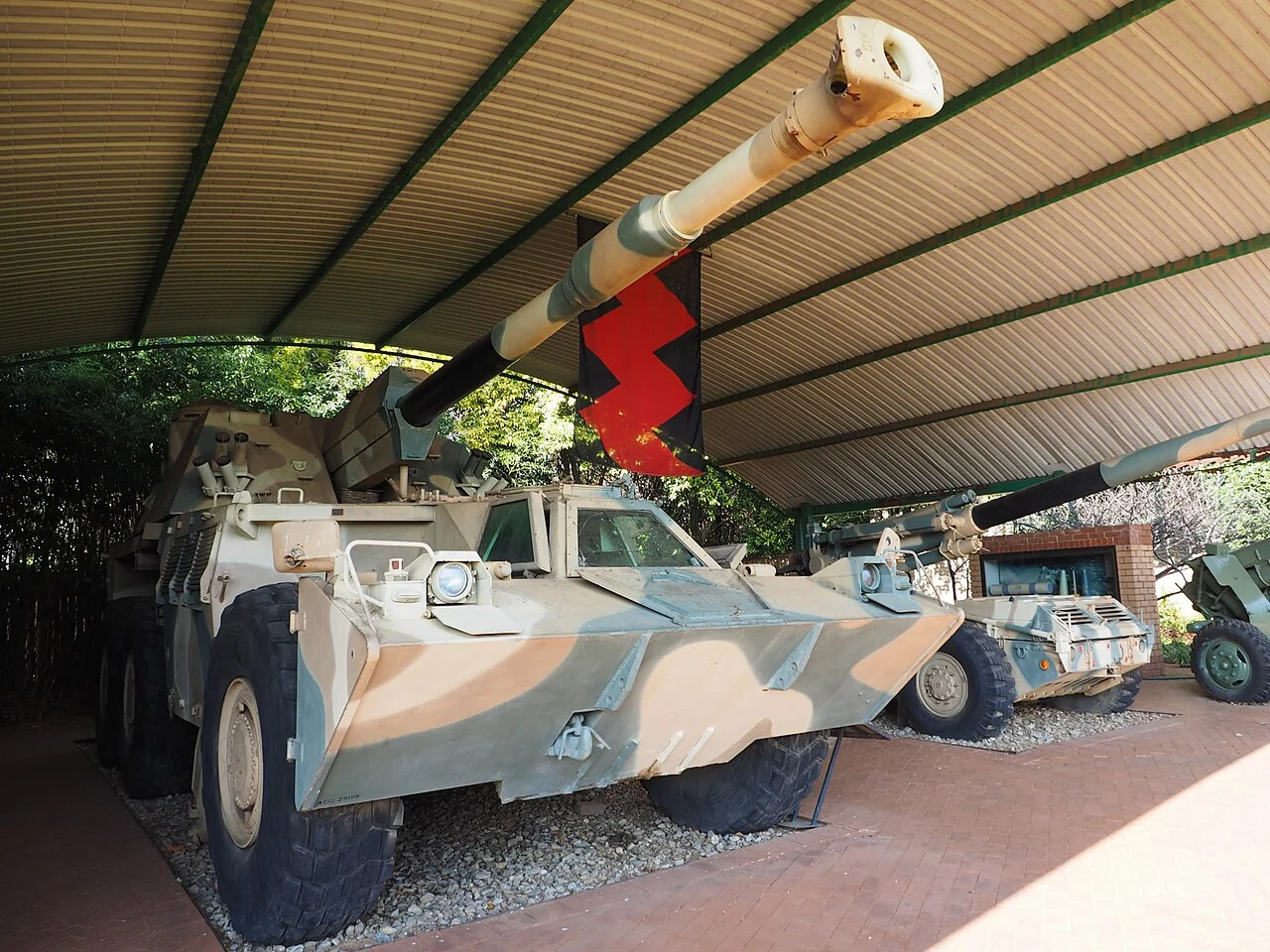
The G5 towed and G6 self-propelled 155 mm howitzers remain the only artillery family here designed and built in Africa, and the only one with a currently active export contract. Rheinmetall Denel Munition integrated its newest Assegai 155 mm ammunition suite with the SANDF’s G5 and G6 guns following verification firings at Alkantpan between 3 and 6 November 2025 (defenceWeb). Separately, Denel is delivering an R2 billion (about $105.9 million) G6 upgrade covering 18 vehicles and a locally built facility for an undisclosed Middle Eastern customer, with milestones from a facility handover in March 2027 to a third-battery delivery in June 2030 (defenceWeb). That contract is outside Africa and upgrades existing hardware, so its value cannot estimate a new G6’s price. No African country beyond South Africa is confirmed as a current G5/G6 operator. Status: operational and under modernisation in South Africa.
Turkish option: none is included here. MKE’s Boran 105 mm towed howitzer has been exported to North Macedonia and Albania, and the T-155 Fırtına/Panter 155 mm family is in Turkish Land Forces service, but no African towed or self-propelled howitzer contract for MKE, Roketsan or another Turkish manufacturer is documented in sources reviewed. Roketsan’s guided munitions and rocket systems are separately reported in African UAV programmes, a different requirement to the guns compared here.
Other artillery in African service: the D-30 baseline
Most African artillery corps did not start from zero when they bought the systems above: the Soviet-designed D-30 122 mm towed howitzer, in service since 1960 and copied or licence-built by multiple countries, is the gun most African armies already operate in some number. A Djiboutian army artillery team demonstrated a D-30 for coalition forces from Combined Joint Task Force-Horn of Africa on 16 May 2006, in an official U.S. Navy photograph that is the clearest single piece of documentary evidence used for this article. Ethiopia has gone further, locally re-mounting D-30 barrels on WZ551 wheeled chassis, a modification first reported in 2016 that converts a towed gun into a faster-displacing wheeled platform without a new purchase. Because this equipment is old and unevenly reported, this article does not attempt a country-by-country D-30 inventory count; the two cases above are the ones independently documented here.
African operators at a glance
- Burkina Faso: WMA301 and CS/SM1 (delivered, first of five planned consignments, Jan 2024)
- Mali: Norinco SH1 122 mm SP howitzer, SR5 multiple rocket launcher and CS/SM5 120 mm SP mortar (5 of each displayed at the September 2025 parade)
- Ethiopia: SH-15/PCL-181 (32 observed, Jan 2023); locally modified WZ551-mounted D-30 (2016)
- Nigeria: SH5 105 mm wheeled SP howitzer (delivered from 2020, operational in Yobe State); see DefenceMENA’s Nigerian Army weapons list and Nigeria military strength profile
- Senegal: LG1 105 mm towed howitzer (8 ordered, 2022; delivery completion unconfirmed)
- Gabon, Cameroon, Chad, Djibouti: WMA301 (confirmed operators; quantities not stated in sources reviewed for most)
- South Africa: G5 towed and G6 self-propelled 155 mm howitzers (in SANDF service, ammunition integration ongoing); see DefenceMENA’s South African Army weapons list
Procurement and price evidence
No comparable unit prices exist in public sources for any of the five systems. Available figures are either package values bundling multiple platform types (Nigeria’s $152 million contract covered VT-4 tanks and ST1 tank destroyers alongside the SH5 howitzers) or analyst estimates rather than confirmed prices (the roughly $2.08 million per-unit figure for Senegal’s LG1 order). Pakistan’s $2.1 million SH-15 unit price is that country’s export price, not Ethiopia’s. Denel’s R2 billion G6 contract is an upgrade programme for an undisclosed Middle Eastern client, not a new-build price or an African contract. No value has been published for Burkina Faso’s or Mali’s Chinese deliveries. This article does not derive a unit price by dividing a package value, and any claim that one system is cheaper is unsupported here.
Delivery speed
Timelines are too different in scope to rank. Burkina Faso received the first of five planned consignments in January 2024; the remaining four are unconfirmed. Ethiopia’s 32 SH-15s were already in place when satellite imagery identified them in January 2023, with no earlier delivery date published. Senegal’s LG1 order, announced April 2022, quoted an 18-month delivery window at the time, but completion is unconfirmed. Nigeria’s first batch of 17 vehicles, including SH5 howitzers, arrived in April 2020 under a 2019 contract, with further batches later that year. No common start date or reporting standard exists across these cases, so no supplier can be called faster on this evidence.
Training, maintenance and local production
Only the Denel G5/G6 family shows documented local production, built into South Africa’s own industrial base rather than transferred elsewhere in Africa. For the Chinese systems, no source reviewed documents assembly, licensed production or a dedicated maintenance facility inside Burkina Faso, Mali, Ethiopia or Nigeria; support so far runs through the manufacturer. Senegal’s LG1 order carries no publicly documented local-support component beyond the standard export sale. Ethiopia’s locally re-mounted D-30 is the only case here of a country modifying inherited artillery itself, showing in-country engineering capacity without a new procurement budget. Anyone evaluating a purchase should ask specifically about spares stock, crew conversion and warranty terms, since none of this is public for most systems above.
Which requirement fits which option?
| If the priority is | Options with documented African users | Evidence gap |
|---|---|---|
| Fast-displacing fire support for road-bound COIN columns | Norinco WMA301 | Range and rate-of-fire data for the 105 mm variant; contract values |
| Longest range for holding conventional ground | Norinco SH-15/PCL-181 | Ethiopia-specific price; combat-use reporting |
| Lightest, most air-portable option | Nexter LG1 | Confirmed delivery completion; contract value |
| Locally built, with an active export and upgrade programme | Denel G5/G6 | No confirmed African customer beyond South Africa |
| Compatibility with existing Soviet-pattern gun parks and ammunition | D-30 (as-is or locally modified) | Current inventory counts; independent evidence is old or limited to two countries |
See DefenceMENA’s military equipment database for country-by-country files, our comparison of Chinese VT-4 and Russian T-90 tanks in African service, and who supplies Africa’s weapons.
FAQ
What artillery systems are African armies buying now?
Documented recent orders and deliveries include the Norinco WMA301 105 mm wheeled gun (Burkina Faso, Cameroon, Chad, Djibouti, Gabon), the Norinco SH-15/PCL-181 155 mm truck-mounted howitzer (Ethiopia) and the related SH5 105 mm system (Nigeria), the Nexter LG1 105 mm towed howitzer (Senegal), and continued South African investment in the Denel G5/G6 155 mm family.
Is any Turkish artillery system in service in Africa?
No African towed or self-propelled howitzer contract for a Turkish manufacturer is documented in the sources reviewed for this article. MKE’s Boran and Turkish Land Forces’ Panter/Fırtına systems have confirmed users elsewhere, but not yet in Africa.
Which African country has bought the most artillery recently?
By platform count with independent confirmation, Ethiopia’s 32 SH-15 howitzers and Mali’s September 2025 display of 15 Chinese artillery vehicles (SH1, SR5 and CS/SM5, five of each) are the largest documented recent additions. Burkina Faso’s order covers five planned consignments, of which only the first is confirmed delivered.
How much does African artillery cost?
Comparable unit prices are not public. Available figures are either package values covering multiple vehicle types, such as Nigeria’s $152 million contract, or unofficial analyst estimates, such as the roughly $2.08 million per-gun estimate for Senegal’s LG1 order. No source reviewed publishes a confirmed African unit price for any of the five systems compared here.
Sources
- Jane’s: Burkina Faso receives new Chinese self-propelled guns and mortars
- Army Recognition: Burkina Faso receives Chinese armored vehicles
- Military Africa: Gabon operating Chinese WMA-301 armoured vehicles
- Military Africa: Senegalese Army orders Nexter 105 mm LG1 howitzer
- Jane’s: Senegal to receive LG1 105 mm towed howitzers from Nexter
- Military Africa: Ethiopia buys Chinese SH-15/PCL-181 artillery
- Gerjon: Chinese SH-15 howitzers for Ethiopia (satellite imagery analysis)
- Jane’s: Mali displays new Chinese equipment
- Military Africa: Nigerian Army receives new VT-4, ST1 and SH5 self-propelled howitzers
- defenceWeb: RDM integrates Assegai ammunition with G5 and G6 howitzers
- defenceWeb: Denel proceeding with Middle Eastern G6 upgrade contract
- Wikimedia Commons / U.S. Navy: Djiboutian army D-30 122 mm howitzer, 2006
Specifications and delivery figures are as reported by the sources named and vary between sources. SIPRI’s Arms Transfers Database and manufacturer data sheets should be checked for any procurement decision.
Related: DefenceMENA compares the MRAPs and mine-protected vehicles the same Sahel armies are fielding alongside this artillery in MRAPs Used in the Sahel, and the counter-drone systems now protecting African gun lines and convoys in Counter-Drone Systems for African Armies.
Related: DefenceMENA compares the Pantsir-S1, FN-6/FB-6A, Starstreak and Mistral short-range air defence systems protecting the same African gun lines and bases from the air in Short-Range Air Defence and MANPADS for African Armies.