The armies of the Sahel do not run one MRAP, they run several: South African Casspirs and Marauders in Mali, Chinese CS/VP14s arriving in Mali and Burkina Faso, UAE-built Streit Typhoons, and Turkish Ejder Yalçın vehicles in Chad with an order placed by Niger. What separates them is protection level, weight, fuel range and who can keep them running, and published evidence on each is uneven.
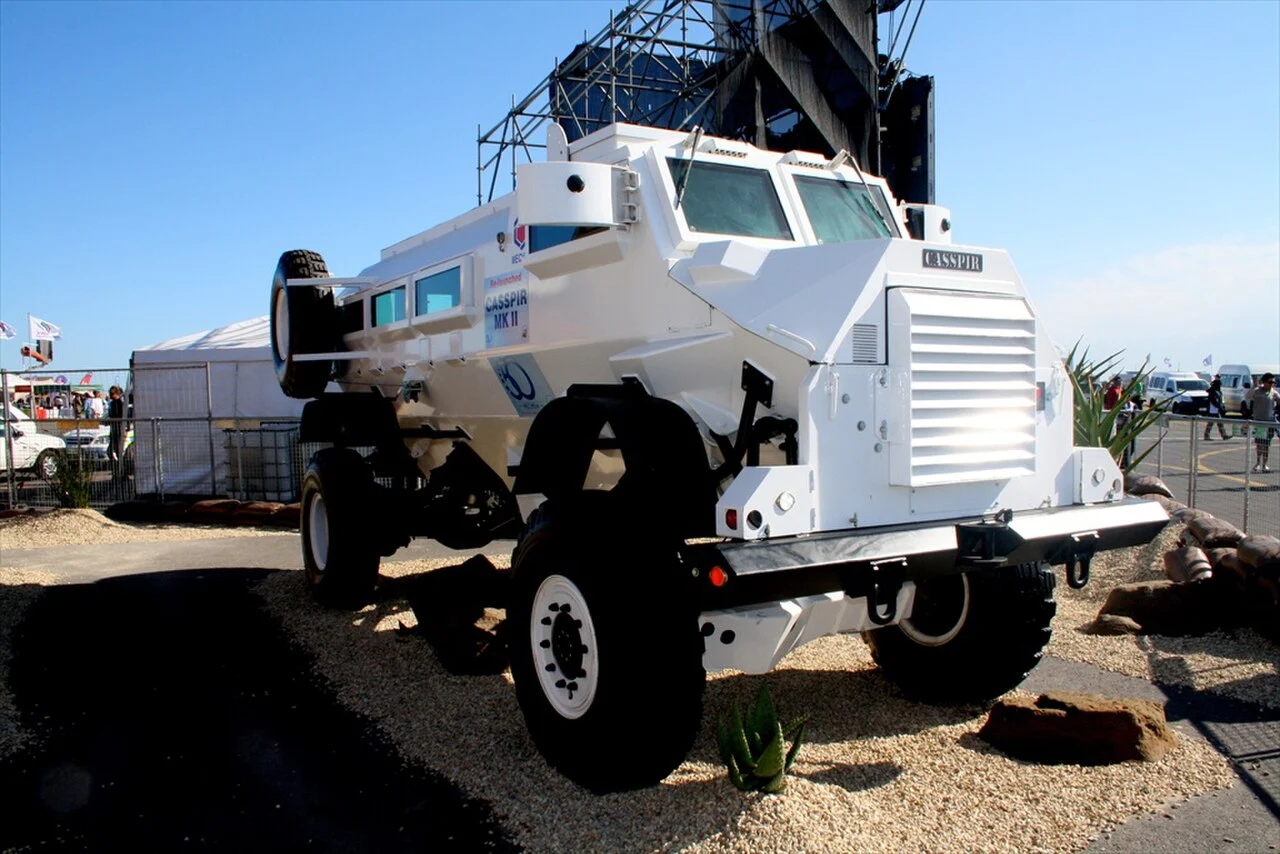
Photo: A Mechem Casspir Mk II. Credit: Bob Adams, CC BY-SA 2.0, via Wikimedia Commons.
Direct answer
For the 4×4 mine-protected patrol and troop-carrier role that defines Sahel ground operations, five families have documented users in or next to the region: the Paramount Marauder (South Africa), the Arquus Bastion (France), the Streit Typhoon (UAE/Canada), the Norinco CS/VP14 (China) and the Nurol Ejder Yalçın (Türkiye). The older South African Casspir is also in Malian service. No single vehicle wins on every criterion. The CS/VP14 has the largest recent delivery volume, the Casspir and Marauder have the longest track record in Mali, and the Ejder Yalçın has the clearest Turkish record in the region, through Chad, an order from Niger and sightings in Burkina Faso.
| Requirement | Mine- and IED-protected 4×4 troop carrier / patrol vehicle for Sahel operations |
| Vehicles compared | Paramount Marauder, Arquus Bastion (TACOM), Streit Typhoon, Norinco CS/VP14, Nurol Ejder Yalçın |
| Also in Sahel service | Casspir (Mali), Otokar Cobra (Chad, Burkina Faso, Mauritania) |
| Largest confirmed recent flow | CS/VP14: 160 ordered by Mali, 36 first batch delivered by mid-2025 (reported) |
| Price data | No comparable unit prices published for any of the five |
The African requirement
Sahel armies fight in dispersed, road-bound operations against groups that use roadside bombs, ambushes and, more recently, fuel and route interdiction. The requirement is therefore not a “best armoured vehicle” but a vehicle that can carry an infantry section over long distances, survive a buried charge, be fitted with a machine gun or remote weapon station, and be kept running by a small maintenance base.
Operating environment
- Mines and IEDs. The main threat on Sahel roads and tracks. Manufacturers quote NATO STANAG 4569 protection levels, but those are claims about test conditions, not battlefield results.
- Distance and fuel. Since September 2025 JNIM has attacked fuel convoys serving Bamako, and analysts describe a deliberate blockade strategy, with escorts now used to move convoys (Global Initiative Risk Bulletin; Janes). Fuel range and fuel efficiency matter more when supply lines are contested.
- Heat, dust and poor roads. Cooling, filtration and suspension durability are real selection issues, but none of the sources reviewed for this article publishes comparable hot-weather test data for the vehicles below. That gap is stated here rather than filled.
- Thin maintenance base. Fleets built from many origins (Mali alone operates vehicles from at least five suppliers) multiply spare-parts and training needs.
What capabilities matter?
The same criteria are applied to every vehicle: weight class, crew and troop capacity, claimed protection, stated range, documented African users, evidence of local support or assembly, and public price data. Where a source does not state a figure, the table says so.
Comparison table
| Vehicle | Origin | Weight (reported) | Capacity | Protection (manufacturer/reporting) | Range (reported) | Documented Sahel and near-Sahel users | Local support / assembly evidence |
|---|---|---|---|---|---|---|---|
| Paramount Marauder | South Africa | ~10 t to 17 t depending on source and variant | Up to 12 incl. 2 crew | STANAG Level 3; hull rated against 8 kg TNT (reported) | Not stated in sources reviewed | Mali; Nigeria (air force) | None found in Mali |
| Arquus Bastion (TACOM) | France | ~12.5 t (family) | 2 crew + 8 | Reinforced underbelly against mines and IEDs | ~1,400 km | Mali (13, EU-funded, 2020); Chad and Burkina Faso (small numbers) | Delivered under EU G5 Sahel funding; further support not documented |
| Streit Typhoon | UAE/Canada | Up to 16 t | Driver + 9 | STANAG Level 2 base, Level 3 optional with kit | 1,000+ km | Mali (130 procured, 30 reported as donated) | None found |
| Norinco CS/VP14 | China | ~9 t (one source) | Up to 11 | STANAG 4569 Level 3b; 8 kg TNT under hull | Not stated in sources reviewed | Mali (160 ordered), Burkina Faso, Kenya | None found |
| Nurol Ejder Yalçın | Türkiye | ~14 t | 2 + 9 | Up to STANAG Level 4 (manufacturer) | ~700 km | Chad (20+), Niger (ordered 2022), Burkina Faso (seen 2022) | None confirmed in Africa |
Weights are the least reliable column: sources disagree by several tonnes for the Marauder, and the CS/VP14 figure comes from a single report. Range for the CS/VP14 and Marauder was not stated in the sources reviewed.
Paramount Marauder
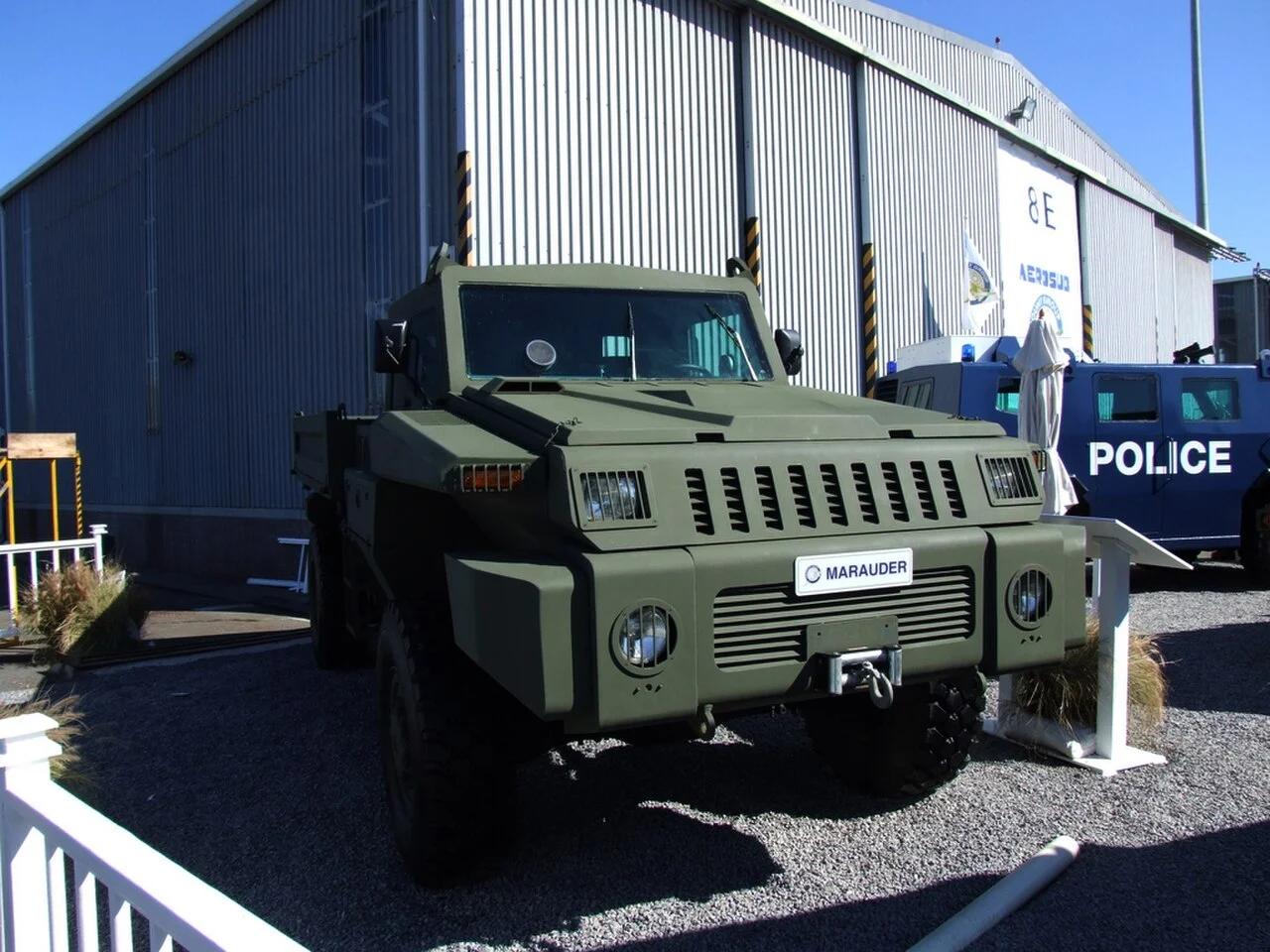
Mali showed Marauders at its September 2019 parade, and by January 2020 armed versions with 14.5 mm turrets were visible at Kati, according to defenceWeb. South Africa’s arms control committee reported the sale of 19 armoured vehicles to Mali for R55 million in 2019, but that figure covers the package and does not identify how many were Marauders, so no unit price can be derived. Nigeria’s air force also operates the type. The vehicle has a double-skinned monocoque hull, and the same source gives a Level 3 rating. Status: in service.
Arquus Bastion
The Bastion is the lightest option here and is not a heavy MRAP. Mali received 13 TACOM-variant vehicles in January 2020, funded by the European Union under its programme for the G5 Sahel Joint Force, with a total of 46 vehicles planned across member states (The Defense Post). Sources disagree on Chad’s share: the same reporting mentions three vehicles, while SIPRI data cited elsewhere lists seven delivered in 2019 and 2020. Status: delivered, small numbers.
Streit Typhoon
Mali announced in January 2020 that it was procuring 130 Typhoons, 30 of them reported as a UAE donation, and called it its largest armoured-vehicle order to date (Janes). Seven arrived by An-124 on 16 January 2020 and 35 had been received by 31 January, according to defenceWeb. The base vehicle is STANAG Level 2 with Level 3 available as an option, which is a lower default than the CS/VP14. How many of the 130 were finally delivered is not confirmed in the sources reviewed.
Norinco CS/VP14
Mali received a first batch of 36 vehicles from an order of 160 in mid-2025, landed in Guinea and moved by road, with 124 still to come (Military Africa). The same source says Kenya was the only other known operator before that delivery. Burkina Faso has since received the type: reporting cites 50 CS/VP14 with 40 VP11 in June 2024 and a further batch of about 50 in December 2024 (defenceWeb). The vehicle is certified to STANAG 4569 Level 3b, meaning protection against an 8 kg TNT charge under the hull. On volume of recent Sahel deliveries, it leads. No contract values were published for either order. Status: delivered in part, further deliveries pending.
Turkish option: Nurol Ejder Yalçın
Turkish vehicles are relevant here because the requirement, a 14-tonne class 4×4 with mine protection and a remote weapon station option, matches what Nurol builds. The Ejder Yalçın weighs about 14 t, carries 2 crew plus 9, and is offered up to STANAG Level 4 with a V-shaped hull and blast-mitigating seats. The regional record breaks down like this:
- Chad: at least 20 vehicles, recorded in the UN Register of Conventional Arms as sold in 2018, and used by the Chadian contingent in the UN mission in Mali (Military Africa). Turkish state media reports that Chadian forces took IED and ballistic attacks in these vehicles with no casualties (Anadolu Agency). That is a source-side account, not an independent evaluation.
- Niger: ordered in early 2022, with President Bazoum reported to have inspected vehicles fitted with ASELSAN Serdar weapon stations in Türkiye (Military Africa). Quantity and delivery are not confirmed in the sources reviewed.
- Burkina Faso: vehicles were seen at state media premises during the January 2022 coup. The number acquired is not stated.
- Outside the Sahel: Senegal and Tunisia also operate the type.
Türkiye’s Otokar Cobra is a lighter (~12 t) alternative with documented Sahel-adjacent users, including Chad, Burkina Faso and Mauritania, plus Nigeria’s larger fleet, per Envanter Medya’s guide to Otokar in Africa. The BMC Kirpi is a heavier 4×4 with African users in Tunisia, Somalia and Libya rather than the Sahel proper; see Envanter Medya’s explainer on the Kirpi. Kenya’s order for 118 Katmerciler Hızır vehicles is East African and outside this requirement.
What is verified for the Turkish option: established users in Chad, an order from Niger, and use in UN operations in Mali. What is not verified: lower prices, faster delivery, local assembly or technology transfer in any Sahel state, and hot-weather test data. Envanter Medya notes that no local assembly or technology transfer for the Cobra has been officially confirmed in Africa.
Other vehicles in Sahel service: Casspir
Mali received 29 Casspirs donated by Germany in 2019. The Casspir is a V-hulled 2 + 12 vehicle of about 10.9 t certified against a triple TM-57 mine blast, and it is also used by Angola, Uganda, Mozambique and others. It is the oldest design in this article and the most widely proven across African armies.
African operators at a glance
- Mali: Casspir (29), Marauder, Typhoon (up to 130 procured), Bastion (13), CS/VP14 (160 ordered, 36 delivered by mid-2025)
- Burkina Faso: CS/VP14 and VP11 (2024 deliveries), Ejder Yalçın (seen 2022), Cobra, Bastion (small numbers)
- Chad: Ejder Yalçın (20+), Cobra, Bastion (3 to 7 by source), locally built Proforce Ara
- Niger: Ejder Yalçın (order announced 2022)
- Nigeria (Lake Chad theatre): Cobra (~194 reported), Marauder. See DefenceMENA’s Nigerian Army weapons list and Nigeria military strength profile.
Procurement and price evidence
No comparable unit prices exist in public sources for the five vehicles. The only figures found are package values: R55 million for 19 armoured vehicles sold by South Africa to Mali, which is not a Marauder price, and, for East Africa, reported values for Kenya’s 118 Hızır vehicles that differ between sources, from roughly €40 million to $91 million. Dividing these totals by vehicle counts would mix armour, weapons, spares and training, so this article does not. Any claim that one vehicle is cheaper is unsupported here.
Delivery speed
The reported sequences differ in scale and cannot be ranked. Mali’s Typhoons: 35 vehicles in the first two weeks after the first delivery. Burkina Faso’s CS/VP14: two batches of about 50 within six months in 2024. Mali’s CS/VP14: 36 of 160 delivered at the time of reporting. Niger’s Ejder Yalçın order: announced March 2022, delivery undocumented. Contract dates are missing for most of these, so no faster-supplier conclusion can be drawn.
Training, maintenance and local production
No source reviewed documents assembly, licensed production or maintenance facilities for any of these vehicles inside a Sahel country. Delivery support has so far come from the supplier or, for the Bastion, from EU funding. Mixed fleets are a documented issue in Mali, which now operates vehicles of at least five origins. Anyone pricing a purchase should ask specifically about spares stock, in-country training and warranty terms, since none is public.
Which requirements does each option fit?
| If the priority is | Options with documented Sahel users | Evidence gap |
|---|---|---|
| Fast fleet growth in one delivery stream | CS/VP14 | Contract values and delivery contract dates |
| Established track record in African service | Casspir, Marauder | Marauder weight and range figures |
| Highest claimed protection class | Ejder Yalçın (up to Level 4, manufacturer claim) | Independent test data; Niger delivery status |
| Lighter patrol vehicle, longer stated range | Bastion | Lower weight class than the others |
| Larger carrier with a protection upgrade path | Typhoon (Level 2 base, Level 3 option) | Delivered numbers |
See DefenceMENA’s military equipment database for country-by-country files, and our report on who is selling defence equipment into Africa.
FAQ
Which MRAPs are used in the Sahel?
Documented types include the Casspir, Paramount Marauder, Arquus Bastion, Streit Typhoon, Norinco CS/VP14 and VP11, Nurol Ejder Yalçın and Otokar Cobra, spread across Mali, Burkina Faso, Chad and, by order, Niger.
Which Sahel country has ordered the most MRAPs recently?
Mali, with 160 CS/VP14 on order, 36 delivered by mid-2025, and up to 130 Typhoons procured in 2020. Burkina Faso received about 100 CS/VP14 in 2024.
Are Turkish armoured vehicles used in the Sahel?
Yes. Chad operates at least 20 Ejder Yalçın vehicles, Niger announced an order in 2022, and Cobras are reported in Chad, Burkina Faso and Mauritania.
How much does a Sahel MRAP cost?
Comparable unit prices are not public. Available figures are package values that also include weapons, spares and training.
Sources
- Military Africa: Mali receives Norinco CS/VP14 MRAPs
- defenceWeb: Burkina Faso acquires more armoured vehicles
- Janes: Malian Army receives new armour
- defenceWeb: Mali receives armoured vehicles from the UAE, EU
- defenceWeb: Mali operating Paramount Marauders
- The Defense Post: EU hands 13 Arquus Bastion vehicles to Mali
- Military Africa: Chad operating Nurol Ejder Yalçın
- Military Africa: Niger orders Ejder Yalçın
- Anadolu Agency: Turkish armored vehicles and peacekeeping
- Global Initiative: JNIM blockade in Mali
- Envanter Medya: Otokar in Africa
Specifications and delivery figures are as reported by the sources named and vary between sources. SIPRI’s Arms Transfers Database and manufacturer data sheets should be checked for any procurement decision.
Related: DefenceMENA compares the counter-UAS systems African armies are fielding, contracting or trialling against the drone threat now facing the same Sahel and Lake Chad Basin forces in Counter-Drone Systems for African Armies.
Related: DefenceMENA also compares the towed and self-propelled artillery the same Sahel armies are fielding alongside their MRAP fleets in Artillery for African Armies.