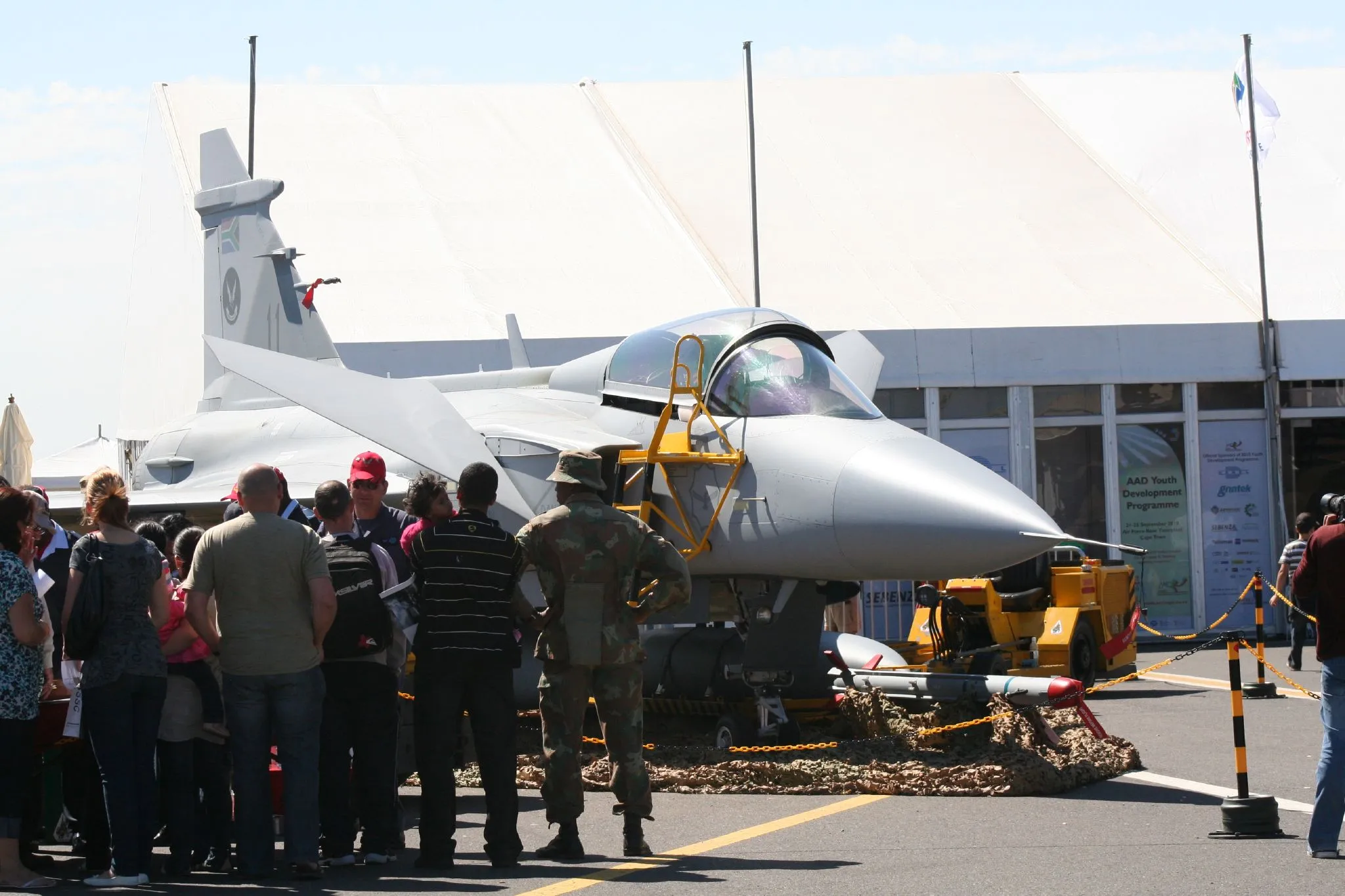
The Africa Aerospace and Defence (AAD) exhibition ran from 16 to 18 September at Air Force Base Waterkloof, near Pretoria, drawing more than 200 exhibitors from over 30 countries. Held every two years, AAD remains the continent’s largest gathering of defence manufacturers, air forces and procurement officials, and this year’s edition doubled as a snapshot of who is actually selling into African markets right now.
The South African Air Force flew its Gripen and Hawk jets during the show, according to DefenceWeb, while Defence Minister Angie Motshekga used the event to confirm dates for AAD 2028 and name the lead partner for the next edition. On the industrial side, Paramount unveiled its V-Raven VTOL drone and the Mbada light protected mobility vehicle, Safomar Aviation took delivery of another Enstrom 480B helicopter, and Bell confirmed that AH-1Z production for Nigeria has begun. Milkor and Safran signed a memorandum of understanding covering optronics and navigation integration for unmanned systems, and Hensoldt introduced its KENIS sensor while securing what it described as a major customer order.
Türkiye’s stand was one of the largest on the floor
Turkish firms sent one of the bigger delegations to Waterkloof. ASELSAN presented what it calls a layered counter-drone architecture for the show: the İHTAR modular anti-drone system, the GÖKBERK laser weapon, the EJDERHA jammer and the KORKUT 35mm anti-aircraft gun, alongside the DRAGONEYE electro-optical sensor package. MKE, STM, Sarsılmaz and Turkish Aerospace Industries also exhibited, continuing a push into African markets that has been building for several years — ASELSAN alone has been expanding its footprint in Nigeria and South Africa, detailed in an earlier profile by Envanter Media.
That Turkish presence fits a broader pattern industry analysts flagged around the show. Military Africa and DefenceWeb both pointed to a decline in Russian arms exports to the continent since 2022, which has left an opening that Turkish, Chinese, Indian, Brazilian and Emirati suppliers are competing to fill. Funding remains the constraint on the other side of that equation: African defence ministries are working with budgets that limit how much of this equipment they can actually buy, which is part of why localisation — maintenance, repair and munitions production done on the continent rather than imported — came up repeatedly in AAD panel discussions.
Not every account of the show was glowing. One industry commentator cited by DefenceWeb described AAD 2026 as “hit and miss,” a reminder that a full exhibition hall does not automatically translate into signed contracts. For African air forces and procurement offices, the more useful signal from Waterkloof is less about any single announcement and more about which suppliers showed up with money on the table and hardware ready to fly — and on that count, Ankara’s delegation was hard to miss.
Why it matters for Africa
AAD is the clearest read available on where African defence procurement is actually heading, because it puts budget holders from across the continent in the same hall as the suppliers courting them. South Africa uses the show to reinforce its position as SADC’s defence-industrial anchor — Denel, Paramount and Milkor all build hardware locally rather than simply importing it, a model several other African states are trying to replicate as they push for local assembly and maintenance clauses in new contracts. The wider pattern on display — Russian suppliers losing ground since 2022, Turkish, Chinese, Indian and Emirati firms competing to fill the gap — matters well beyond South Africa, since the same shift is playing out in West African and Sahelian procurement decisions. For finance-constrained African militaries, a supplier offering technology transfer and local production, rather than just a sale, increasingly has the edge.