Africa’s Arms Spending Hit $58bn. Who Controls What the Weapons Can Actually Do?



African governments spent a record $58.2 billion on defence in 2025, up 8.5% on the previous year, according to the Stockholm International Peace Research Institute. Yet across the continent, the hardware that spending buys keeps running into the same wall: the weapons an army owns outright are not always the weapons it can fully control.
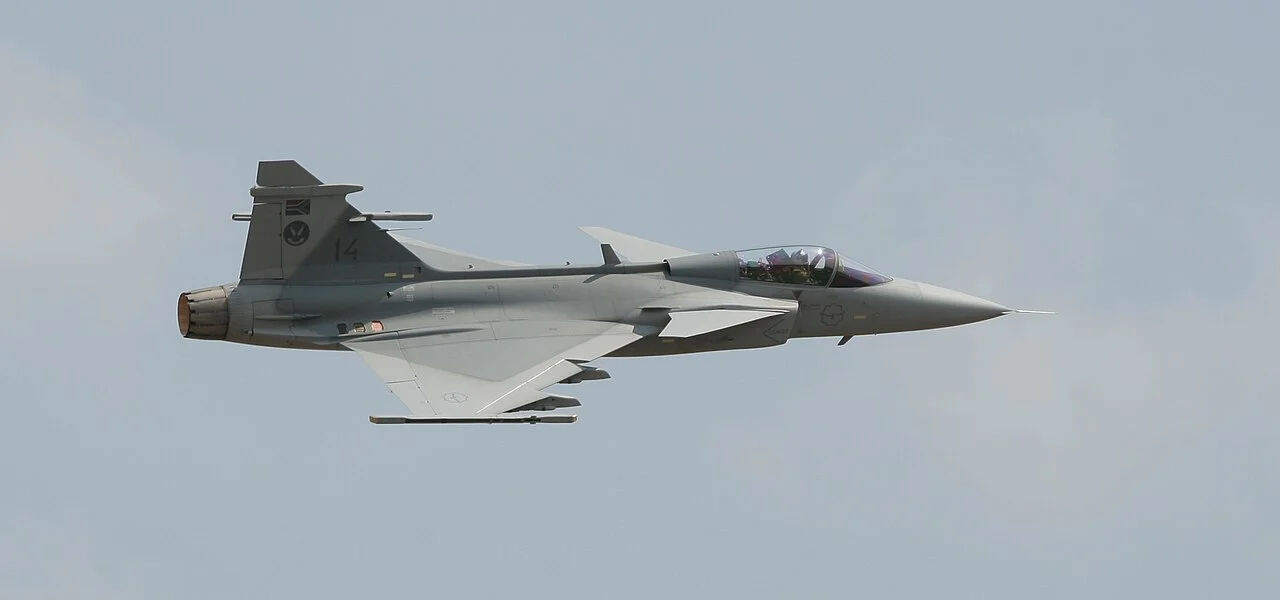
Photo: A South African Air Force Saab Gripen fighter. The fleet was grounded for over a year after maintenance and support contracts with Saab lapsed. Credit: NJR ZA, CC BY-SA 3.0, via Wikimedia Commons
The pattern recurs across the continent’s air forces, navies and depots: a government signs a contract, takes delivery of the platform, and discovers that the brake assembly, the engine, the targeting sensor or the maintenance approval still belongs, in practice, to someone else. DefenceWeb analyst Babatunde Fatai laid out the argument in a 15 October piece, Africa buys and makes weapons, but who controls them?, arguing that sovereignty over a weapons system is decided less by who signs the purchase order than by who controls the components, the software licences and the export paperwork behind it.
A record spending year, concentrated in the north
SIPRI’s 2026 edition of its annual military expenditure database put Africa’s total at $58.2 billion for 2025, 45% higher than in 2016. North Africa accounted for roughly $35 billion of that, or 60% of the continent’s spending, with Algeria alone at $25.4 billion (up 11%) and Morocco at $6.3 billion (up 6.6%). Sub-Saharan Africa spent $23.3 billion, up 7.4%, with Nigeria’s outlay rising 55% to $2.1 billion, the Democratic Republic of Congo up 20% to $1.2 billion, and Kenya up 17% to roughly $1.47 billion. South Africa was a rare outlier, its $3.2 billion budget down 1.2% on 2024.
That spending has bought a genuinely more capable continent: more fighter jets, more armed drones, more armoured vehicles and more air-defence systems than at any point in decades. DefenceMENA’s own tracking of armoured-vehicle exports shows the breadth of suppliers now active on the continent, from Turkish 4x4s to South African MRAPs. But Fatai’s point, and the evidence behind it, is that platform ownership and operational sovereignty have quietly come apart.
When the plane is yours but the brakes are not
Nigeria’s Alpha Jet fleet is the clearest domestic illustration. The light attack jets, acquired from France starting in the 1980s, have intermittently faced being grounded for want of a single component: the brake assembly. Nigerian reporting from the mid-2010s describes the Nigerian Air Force turning to Innoson Vehicle Manufacturing, a local car maker, to reverse-engineer and overhaul brake units cannibalised from a different aircraft type after foreign suppliers of the original part became difficult to access. The aircraft themselves were never seized or embargoed; a single consumable part was enough to threaten the fleet’s availability.
South Africa’s Saab Gripen fleet shows a harder version of the same problem, this time with no sanctions involved at all. From late 2021, the South African Air Force’s entire Gripen fleet was grounded after a funding dispute left maintenance and support contracts with Saab and GKN to lapse, which meant the country’s own military airworthiness board could no longer certify the jets to fly. By some industry accounts, roughly half the 26-strong fleet had already been cannibalised for spare parts to keep the rest airworthy. South Africa owns the aircraft outright. It does not, on its own, hold the certification and supply chain that keeps them flying — a dependency DefenceMENA has tracked in detail as part of the broader strain on the South African National Defence Force’s equipment readiness.
The engine clause that follows every export deal
The most explicit version of the dependency runs through engines and sensors with US-origin content, which carry US re-export control regardless of where the final platform is built. Turkey’s TAI/AgustaWestland T129 attack helicopter uses the LHTEC CTS800 engine, a joint Honeywell-Rolls-Royce product that gives Washington an effective veto over who Turkey can sell the helicopter to. That veto has already stalled a long-pursued Pakistani order and forced Turkey to develop an indigenous alternative, the TEI TS1400, precisely so a future export customer is not hostage to a third country’s licensing decision, as Defense News has reported over several years of the saga.
Canada’s Bayraktar TB2 sensor exports illustrate the same leverage from the other direction, and show how fast it can be applied or withdrawn for reasons that have nothing to do with the buyer. In October 2020, Ottawa suspended export permits for L3Harris WESCAM optical and targeting sensors fitted to Turkish-made TB2 drones after allegations that Azerbaijan had used Canadian technology against Armenian forces; the permits were formally cancelled in April 2021, as CBC reported at the time. Baykar’s response was to accelerate development of its own sensor payloads — the same sovereignty logic Fatai argues African buyers of the same drone now need to apply to themselves.
Who actually used the weapons in Sudan and the Sahel
Two documented cases from African conflicts show how little control a government or armed group can retain once a weapon changes hands through intermediaries. Amnesty International’s May 2025 investigation identified Chinese-made Norinco GB50A guided bombs and AH-4 howitzers in Rapid Support Forces attacks in Sudan’s Darfur region, including a 9 March 2025 strike near al-Malha that local reporting said killed 13 people. Amnesty assessed that the weapons were almost certainly re-exported to Sudan’s RSF by the United Arab Emirates, which SIPRI data shows is the only state to have imported AH-4 howitzers from China, in 2019 — a transfer chain that put Chinese-made ordnance into a UN-embargoed conflict without Beijing selling directly to either side.
In Burkina Faso, Human Rights Watch documented in January 2024 that Burkinabè forces had used Turkish-made Bayraktar TB2 drones, acquired in 2022, in three 2023 strikes that killed at least 60 civilians at a market in Bouro, a funeral in Bidi, and a market in Boulkessi near the Malian border. Ouagadougou’s government has not acknowledged civilian casualties in those strikes, and this article attributes those claims to HRW’s own investigation rather than treating them as independently confirmed. The episode nonetheless shows that once a platform is transferred, the exporting state retains essentially no operational control over how it is used — sovereignty over the weapon, in the fullest sense, passes entirely to the buyer the moment the contract closes, for better and for worse.
Why local manufacturing is not a shortcut
Fatai’s piece also uses South Africa’s Denel as a cautionary case on the manufacturing side: a state-owned defence group with genuine design and production capability in artillery, ammunition and armoured vehicles that has nonetheless spent years battling funding shortfalls, skills attrition and, as DefenceMENA has reported, a ninth consecutive qualified audit despite a revenue rebound. Building a system domestically secures the design and, often, the production line — but not automatically the money to keep the workforce and the supply of raw materials and sub-components flowing. Industrial sovereignty, in other words, has to be funded continuously, not declared once at a ribbon-cutting.
Why it matters for Africa
The practical lesson for African defence ministries sits below the headline procurement numbers. A $25 billion Algerian budget or a $2.1 billion Nigerian one buys hardware, but it does not automatically buy the sustainment, software updates, munitions resupply or export clearances that keep that hardware usable in a crisis — those often remain subject to a supplier government’s foreign policy, as South Africa’s Gripen grounding and Turkey’s T129 engine fight both show in different ways. For air forces and navies weighing their next acquisition, from Nigeria’s incoming Leonardo M-346FA jets to Angola’s corvettes, the question Fatai poses is increasingly the right one to ask before signing: not just who sells the platform, but who ultimately controls the parts, the code and the permissions that decide whether it flies, fires or sails on the day it is needed. Treating platform ownership as the end of the sovereignty conversation, rather than its starting point, is the gap this spending boom keeps exposing.
Sources
- defenceWeb — Africa buys and makes weapons, but who controls them?
- SIPRI — Military Expenditure Database, 2026 edition
- Defense News — TAI’s T129 export hopes hinge on US license
- CBC News — Canada suspends drone technology exports to Turkey
- Amnesty International — Sudan: Advanced Chinese weaponry provided by UAE identified in breach of arms embargo
- Human Rights Watch — Burkina Faso drone strikes on civilians
- DispatchLive — SA’s Gripen fighter jets grounded, report