Strongest Militaries in West Africa in 2026: How the Sahel Bloc Compares



Three Sahel states have spent the past three years leaving West Africa’s main security bloc, forming their own alliance, and building a joint military force from scratch. Measured by Global Firepower’s 2026 index, none of them ranks in West Africa’s top three — but a separate measure, their rising share of the region’s total defence spending, tells a different story about where power is shifting.
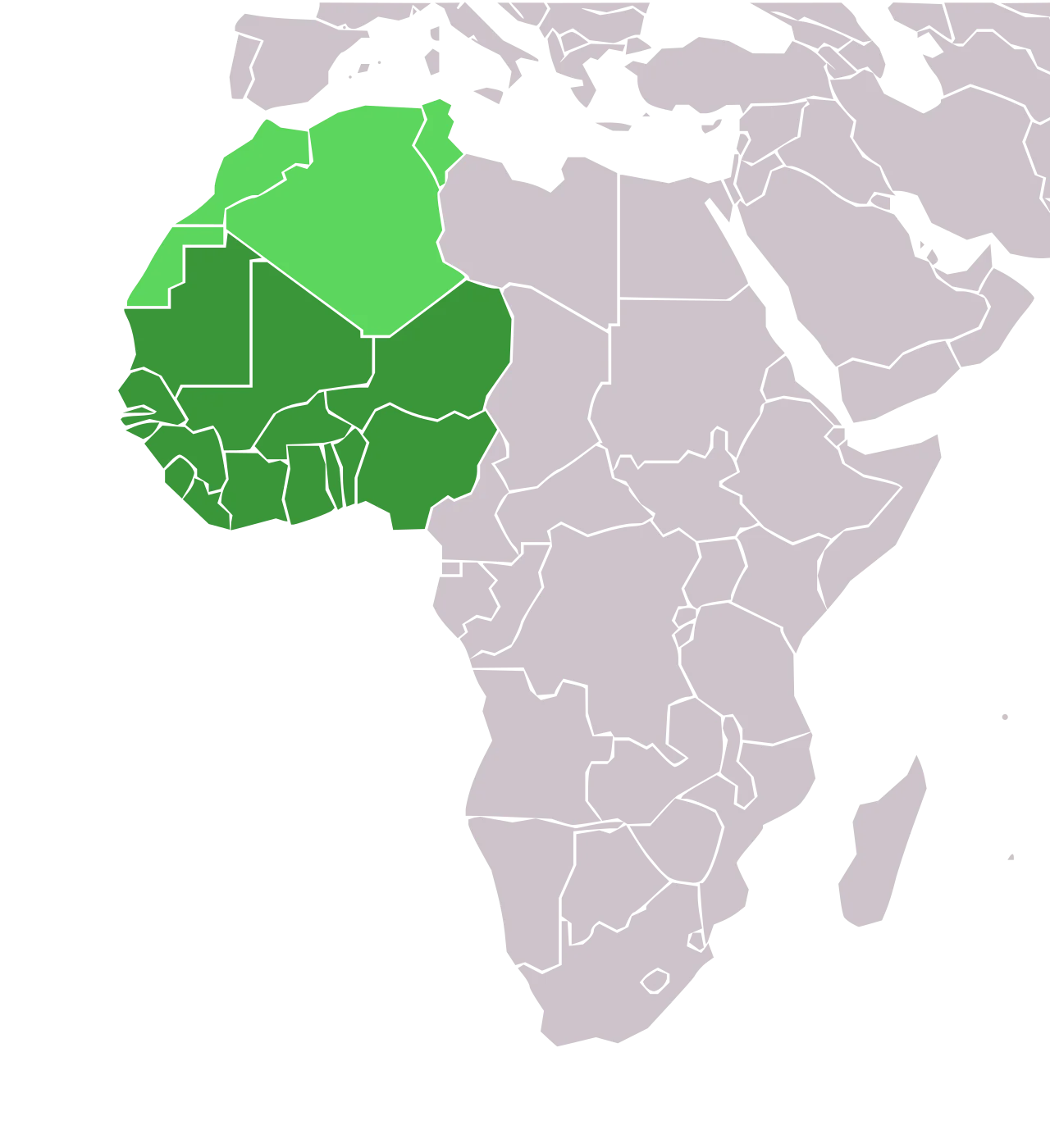
Photo: Political map of West Africa. Credit: Africa-countries-western.svg by ReneeWrites, CC BY 4.0, via Wikimedia Commons.
By Global Firepower’s own ranking methodology, Nigeria remains West Africa’s strongest military in 2026 (33rd of 145 countries worldwide), with Chad, Mali and Cote d’Ivoire the next-best-placed states in the wider region. But the more consequential shift of the past decade is not in that ranking order — it is in money. According to the International Institute for Strategic Studies (IISS), cited by Military Africa in June 2026, the three Alliance of Sahel States (AES) members — Mali, Niger and Burkina Faso — now collectively account for about 28% of West African defence expenditure, up from 14% a decade ago, while Nigeria’s own share of regional spending has fallen from roughly 45% to about 22% over the same period. This piece sets out what is confirmed about military strength, budgets, air power and the AES bloc’s new joint force across West Africa in 2026, and flags where the public record runs out.
| Country | Global rank (of 145) | Power Index | Active personnel | AES / bloc status |
|---|---|---|---|---|
| Nigeria | 33 | 0.6097 | 230,000 | ECOWAS |
| Chad | 85 | 1.8594 | 37,750 | Non-aligned Sahel state |
| Mali | 104 | 2.2598 | 40,000 | AES founding member |
| Cote d’Ivoire | 108 | 2.3884 | 22,000 | ECOWAS |
| Ghana | 112 | 2.4566 | 15,500 | ECOWAS |
| Niger | 120 | 2.6867 | 25,000 | AES founding member |
| Mauritania | 123 | Not confirmed this run | 31,540 | Non-aligned Sahel state; left G5 Sahel, not an AES member |
| Senegal | 126 | 2.8930 | 17,000 | ECOWAS |
| Burkina Faso | 127 | 2.9213 | 7,500 | AES founding member |
| Benin | 138 | Not confirmed this run | 4,750 | ECOWAS |
| Liberia | 141 | Not confirmed this run | 2,100 | ECOWAS |
| Sierra Leone | Not confirmed this run | Not confirmed this run | 13,000 | ECOWAS |
Rank, Power Index and active-personnel figures: Global Firepower 2026 country pages and active-military-manpower table, cross-checked against Ecofin Agency’s and Ouest/Seneweb’s reporting of the same edition. Guinea and Togo were not confirmed against a 2026 GFP figure this run. Global Firepower does not publish its underlying inventory data; its index uses more than 60 weighted indicators under its own methodology and should be read as an ordering tool, not as an inventory source in itself.
The AES bloc is smaller on paper, bigger in its budget share
Mali, Niger and Burkina Faso all rank in the bottom half of Global Firepower’s 2026 table, and none keeps a standing army larger than Nigeria’s, Chad’s or even Mauritania’s by GFP’s personnel count. What has changed is the direction of regional defence spending. The IISS-sourced figure cited above — a rise from 14% to 28% of West African defence expenditure for the three AES states, against a fall in Nigeria’s own share from about 45% to 22% — was checked this run against a second outlet (Military Africa, June 2026) that named IISS as the source, which clears this editorial desk’s two-source bar after a previous run could not trace the figure to a named primary report. The underlying IISS publication itself (Military Balance 2026 or a regional brief) was not directly reachable this run; readers wanting the primary dataset should consult IISS directly.
Burkina Faso’s own FY2026 budget, adopted in December 2025, allocates 707.89 billion FCFA to defence and security combined — about 24.87% of the state’s domestic resources, a slight decline in share from 2025. Mali’s National Transitional Council approved a 2026 state budget of 3,578 billion FCFA in December 2025, but, as in the previous budget cycle, the public documents found this run do not break out a standalone defence-ministry line; security is described as a priority sector without an isolated figure. Niger’s 2026 budget was initially set at 2,922.22 billion FCFA and was revised upward to 2,980.54 billion FCFA in August 2026, a rise of 58.32 billion FCFA (about 2%), which Nigerien officials and Le360’s reporting both tied partly to additional funding needs for the Forces de Defense et de Securite; again, no isolated defence-ministry total was found. Nigeria’s FY2026 defence budget, approved 31 March 2026, is set at 3.16 trillion naira (about US$2.10 billion at the SIPRI milex conversion basis), a roughly 2% nominal increase over 2025 that is eroded by an estimated 8.5% of real value lost to inflation.
| Country | FY2026 figure | Scope | Source |
|---|---|---|---|
| Nigeria | N3.16 trillion (approx. US$2.10bn) | Defence ministry budget, approved 31 Mar 2026 | Military Africa, Jun 2026 |
| Burkina Faso | FCFA 707.89bn | Combined defence and security, ~24.87% of domestic resources | AllAfrica, Dec 2025 |
| Niger | FCFA 2,980.54bn | Whole-of-state budget (revised); defence-specific line not disclosed | APA News; Le360, Aug 2026 |
| Mali | FCFA 3,578bn | Whole-of-state budget; defence-specific line not disclosed | Tchadinfos citing CNT approval, Dec 2025 |
| Senegal | FCFA 437.946bn commitment / FCFA 338.39bn payment credits | Forces armees budget line | Official Senegalese budget documents (previously verified) |
Figures are nominal, in the currency and fiscal year stated, and are not adjusted to a common basis; SIPRI’s Trends in World Military Expenditure estimates (where available) use a different methodology and should not be averaged with budget-document figures. Where a country’s public budget does not isolate a defence-ministry total, this is stated as a data gap rather than estimated.
A joint Sahel force, built around existing drone fleets
The clearest sign the AES bloc is trying to act as a bloc, not three separate armies, is the joint force it launched on 20 December 2025 at an air base in Bamako. Reported at around 5,000 troops at launch, it is commanded by Burkina Faso’s General Daouda Traore, and its stated mandate — according to Nigerien officials cited in regional reporting — is to integrate air power, intelligence-sharing and coordinated ground operations across the three states’ territory. At a meeting of AES army chiefs of staff in Ouagadougou on 16–17 April 2026, officials stated an intention to grow the force toward 15,000 troops; this target comes from a single reported source and this routine found no confirmation that it has been reached or that the joint force has conducted a named combined operation as of this run. Captain Ibrahim Traore of Burkina Faso was named the AES bloc’s rotating head at the December 2025 Bamako summit.
The “air power” the joint force would draw on is not new: Mali, Niger and Burkina Faso have built individually verified armed drone fleets over the past four years, detailed in DefenceMENA’s military drones in Africa database. Mali operates at least 17 Bayraktar TB2s by serial-number tracking (some trackers put the figure above 20) plus roughly six to eight Bayraktar Akinci under a reported ~$210 million August 2024 contract, two of which were reported lost in 2025. Niger’s six TB2s were ordered in 2021 and delivered in 2022, and Niger is separately reported (single-sourced, status: reported rather than confirmed) to have acquired TUSAS Aksungur airframes after its 2023 coup. Burkina Faso fields five TB2s from a 2022 order plus a share of a disputed ~12-airframe mixed TB2/Akinci batch delivered in April 2024, documented in DefenceMENA’s combat-record piece on TB2 and Akinci use in Mali and Burkina Faso. None of this is AES-bloc procurement as such — each system was bought bilaterally from Baykar or TUSAS by the individual government — but it means a combined AES air component would not be starting from zero.
| Country | System | Reported quantity | Status | Source |
|---|---|---|---|---|
| Mali | Bayraktar TB2 | ≥17 by serial no.; some trackers 20+ | OPERATIONAL | DefenceMENA combat-record piece; serial tracking |
| Mali | Bayraktar Akinci | 6 under ~$210m Aug 2024 contract; ~8 inferred; 2 reported lost 2025 | OPERATIONAL | DefenceMENA; Janes; trade press |
| Niger | Bayraktar TB2 | 6 | OPERATIONAL | Presidency statements; delivery reports |
| Niger | TUSAS Aksungur | Undisclosed | REPORTED (post-2023 coup acquisition, not independently confirmed) | Trade press 2024-25 |
| Burkina Faso | Bayraktar TB2 / Akinci (mixed batch) | 5 (2022) + part of ~12-airframe mixed batch (2024, Akinci split disputed) | OPERATIONAL | Janes, 10 Apr 2024; Military Africa; AIB |
Figures reproduced from DefenceMENA’s drone database (last verified 7 October 2026) rather than re-derived this run. See the database page for the full operator list, including Nigeria, Ethiopia, Chad, Djibouti, Somalia, Kenya and Cote d’Ivoire.
Russia’s role in Mali has changed hands, not ended
Mali’s security picture in 2026 cannot be read only through its own army. Wagner Group announced its formal withdrawal from Mali in June 2025; a Kremlin-controlled successor, Africa Corps, took over its positions and is reported to retain around 2,000 Russian personnel in the country. Africa Corps is reported to have a footprint in five African states overall: Mali, Burkina Faso, Niger, the Central African Republic and Libya. Reporting this run described a major 2026 jihadist and separatist offensive that rolled back Russian-backed territorial gains in northern Mali, but this comes from a single outlet and is treated here as an INDEPENDENT REPORT, not a confirmed fact; DefenceMENA did not find a second source confirming the scale of territorial loss claimed, and has therefore left out a specific casualty figure for Malian officials cited in that same report. This is a live, disputed conflict picture that this routine will revisit as better-sourced reporting becomes available, consistent with DefenceMENA’s standard of two independent sources or one primary source for combat claims.
Methodology and definitions
“West Africa” here follows the UN geographic subregion (the 16 ECOWAS states plus Mauritania, which left ECOWAS in 2000). Rankings and Power Index scores are Global Firepower’s 2026 edition, which the publisher states draws on more than 60 weighted indicators; GFP does not publish the underlying inventory assumptions behind each country score, so its ranking is used here for ordering only, never as a source for a specific equipment or personnel figure. Budget figures are nominal, local-currency, fiscal-year totals as published by each government or reported from official budget documents by named local and international outlets; they are not adjusted for inflation or converted to a common exchange-rate basis unless stated, and SIPRI’s Trends in World Military Expenditure estimates, where cited, use SIPRI’s own methodology and should not be summed with government budget-document totals. Status labels on equipment (Operational, Delivered, Contracted, Reported, Not confirmed) follow DefenceMENA’s standard taxonomy: a reported acquisition is not described as operational, and a single uncorroborated report is not treated as a confirmed contract.
Frequently asked questions
Which West African country has the strongest military in 2026?
By Global Firepower’s 2026 index, Nigeria ranks highest among West African states (33rd of 145 countries worldwide), ahead of Chad, Mali and Cote d’Ivoire. GFP’s own methodology weighs personnel, equipment counts, logistics and financial factors; it is a published ranking, not an independent assessment of combat effectiveness.
What is the Alliance of Sahel States (AES)?
The AES is a mutual-defence pact formed by the military governments of Mali, Niger and Burkina Faso after they withdrew from the G5 Sahel framework in 2023; all three states also formally left ECOWAS. The bloc launched a joint military force of roughly 5,000 troops in December 2025.
Does the AES joint force have its own drones or aircraft?
Not as bloc-owned assets confirmed this run. Mali, Niger and Burkina Faso each operate bilaterally-acquired armed drones (mainly Bayraktar TB2 and Akinci), and AES officials have said the joint force is meant to integrate air power across the three states, but DefenceMENA found no confirmation of a combined AES-flagged air component as of October 2026.
How much of West Africa’s defence spending do the AES states now account for?
According to IISS, cited by Military Africa in June 2026, Mali, Niger and Burkina Faso together account for about 28% of West African defence expenditure, up from 14% a decade ago, while Nigeria’s share fell from about 45% to about 22% over the same period.
Is Russia still active militarily in Mali?
Yes. Wagner Group withdrew in June 2025, but a Kremlin-controlled successor force, Africa Corps, took over its role and reportedly retains around 2,000 personnel in Mali, with a wider footprint reported in Burkina Faso, Niger, the Central African Republic and Libya.
Why don’t Mali and Niger publish a specific defence budget figure?
Their FY2026 state budget documents found this run disclose a whole-of-government total and describe security as a priority, but do not isolate a defence-ministry line item the way Burkina Faso and Senegal do. This is recorded here as a data gap, not estimated.
A note on the numbers
Three figures in this piece carry more uncertainty than the rest and are flagged accordingly: the AES joint force’s reported 15,000-troop target (single source, unconfirmed as reached); Niger’s reported acquisition of TUSAS Aksungur drones after 2023 (reported, not independently confirmed); and the scale of the reported 2026 territorial losses to Russian-backed forces in northern Mali (single outlet, treated as an independent report rather than confirmed fact). Troop-strength figures in the main ranking table are Global Firepower’s own 2026 active-personnel count, which can differ from IISS Military Balance figures using a different counting methodology; where this routine could not confirm a 2026 figure independently of GFP, that is stated rather than left unqualified.
Sources
- Global Firepower, African Military Strength (2026)
- Global Firepower, Active Military Manpower by Country (2026)
- Ecofin Agency, “Global Firepower Index 2026: Egypt, Algeria, Nigeria Lead Africa’s Military Rankings”
- Military Africa, “Nigeria’s defence budget hits record high but inflation eats the gains” (June 2026)
- AllAfrica, “Burkina Faso: Un budget pour la securite et le developpement” (Dec 2025)
- Tchadinfos, “Mali: plus de 3 000 milliards pour le budget de l’Etat 2026”
- APA News, “Niger: le budget 2026 revise a 2 980,5 milliards FCFA”
- Le360, “Niger: les grands gagnants de la loi de finances rectificative de 2026”
- Hespress, “L’Alliance des Etats du Sahel lance une force unifiee de 5 000 soldats”
- ModernGhana, “AES Chiefs of Army Staff Meet in Burkina Faso to Mobilize 15,000 Troops”
- IntelliNews, “Russia boosts Mali military support as Africa Corps replaces Wagner”
- Wikipedia, “Africa Corps (Russia)” (background/discovery only)
- DefenceMENA, “Military Drones in Africa” database
- DefenceMENA, “Bayraktar TB2 and Akinci in Mali and Burkina Faso: What Combat Use Has Shown”
- DefenceMENA, “African Defence Budgets Ranked”
Last updated: 14 October 2026.