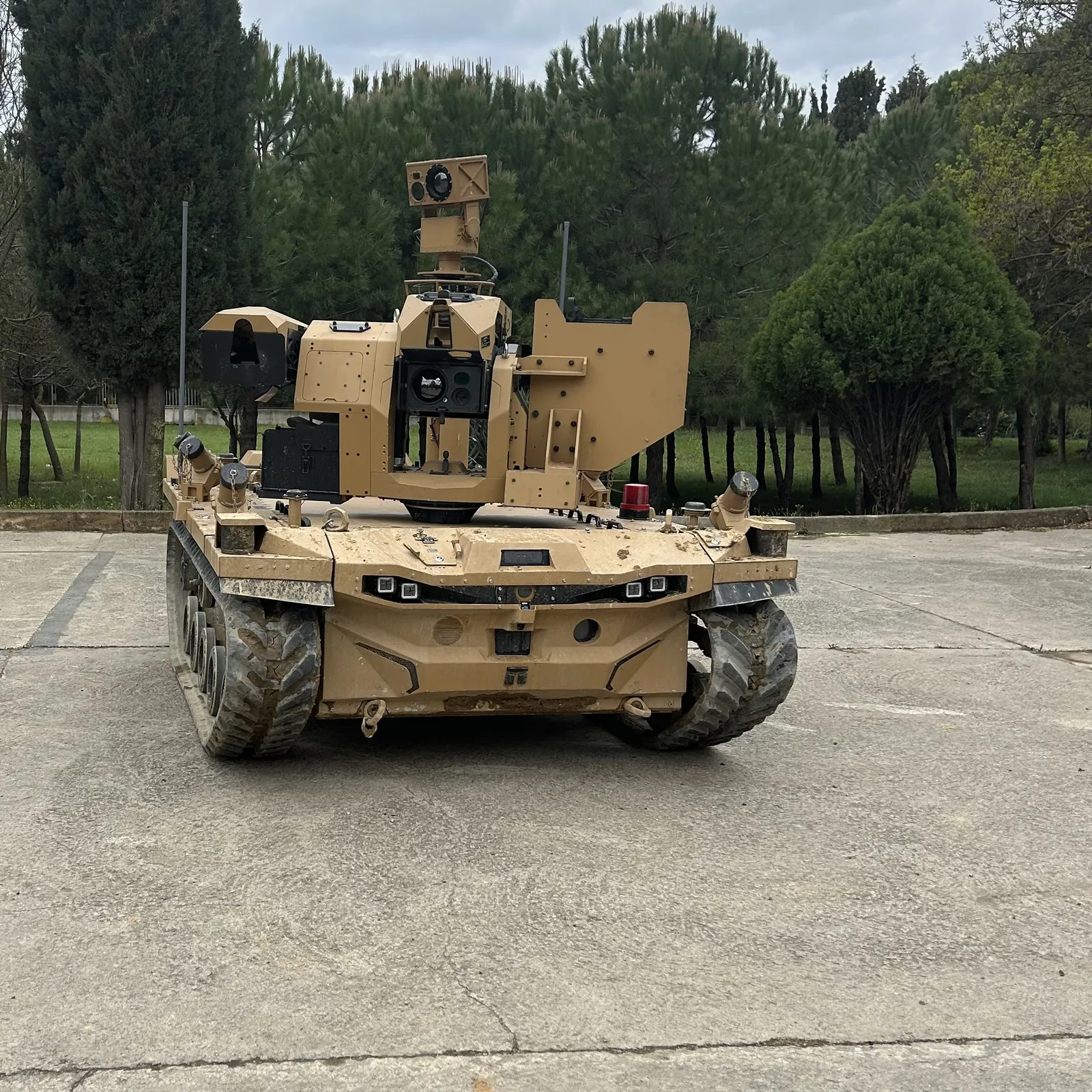
PALEM is Türkiye’s tracked, electric, modular unmanned ground vehicle, and the heaviest-armed of the country’s medium-class robots. Developed by Tekatron for the Turkish Land Forces under a programme of Türkiye’s Presidency of Defence Industries (SSB), the 2.65-tonne vehicle can mount ASELSAN’s SARP Dual remote weapon station with either a 12.7 mm machine gun or a 40 mm grenade launcher, runs for eight hours and is controlled from up to 4 km away. Six vehicles are due to be accepted by the end of 2026.
Photo: Presidency of Defence Industries (SSB), Türkiye.
What is PALEM?
The name is an acronym of the Turkish programme title, Paletli Elektrikli Modüler İKA, or Tracked Electric Modular UGV. SSB launched the development project to meet a Turkish Land Forces Command (KKK) requirement for a remotely commanded ground robot that can carry out reconnaissance, surveillance and target detection in varied terrain and weather, and that can take different weapon systems and payloads on the same chassis. Tekatron, a Turkish mechatronics and defence company, is the prime contractor.
Where lighter Level-1 robots such as BARKAN and HANÇER weigh around a tonne or less, PALEM sits in the Medium Class Level-2 category at roughly 2,650 kg including payload. That extra mass is what allows it to carry a full remote weapon station with a heavy main weapon and a secondary gun, plus enough battery capacity for a full working shift. The electric drivetrain and tracked running gear give it the low-speed control and traction needed for rough ground, and the modular design means the same vehicle can serve as an armed escort, a surveillance post or a logistics carrier.
Key specifications
| Manufacturer | Tekatron (Türkiye) |
| Procurement authority | Presidency of Defence Industries (SSB) |
| Turkish user | Turkish Land Forces Command |
| Class and weight | Medium class, Level 2; 2,650 kg including payload |
| Drive | Tracked, electric, modular |
| Armament options | ASELSAN SARP Dual RWS with 12.7 mm MG + 7.62 mm; SARP Dual with 40 mm AGL + 7.62 mm |
| Other configuration | Logistics carrier |
| Communications | RF and 4G/LTE; 4,000 m range |
| Endurance | 8 hours operating time |
| Sensors and equipment | Mast-mounted perimeter surveillance system, cargo basket |
| Status (SSB, Sept 2026) | 2 PTP-2 vehicles accepted; 1 PTP-2 in field trials; 6 vehicles to be accepted by end-2026 |
| Export operators | None announced |
The armament is what sets PALEM apart. SSB lists two weapon fits, both based on ASELSAN’s SARP Dual remote weapon station, which carries a main weapon and a coaxial 7.62 mm machine gun under one stabilised sight. In the first, the main weapon is a 12.7 mm heavy machine gun; in the second, a 40 mm automatic grenade launcher, which gives the robot area fire against infantry behind cover or in ambush positions. SARP Dual is already in wide Turkish service on armoured vehicles such as BMC’s KİRPİ II, so units receiving PALEM share sights, ammunition and maintenance know-how with their manned fleet.
For surveillance, the vehicle carries a mast-mounted perimeter surveillance system that lifts its cameras above walls, vegetation and terrain folds, and a cargo basket for supplies. SSB gives a 4,000 m communication range over RF and 4G/LTE links, and eight hours of operating time, enough to hold an observation post or escort a convoy for a full shift without recharging.
The SSB programme and Turkish service
PALEM follows the pattern SSB has used across its land robotics portfolio: develop a prototype, put it through field trials with the user, convert and refine early vehicles, then move to accepted production standard. According to SSB’s September 2026 status, field trials of one PTP-2 vehicle are continuing and acceptance of two PTP-2 vehicles, converted from the earlier PTP and OTP configurations, has been completed. Six vehicles are to be accepted by the end of 2026. Converting earlier test vehicles to the latest standard rather than retiring them is an economical approach that also gives the Land Forces trained crews earlier.
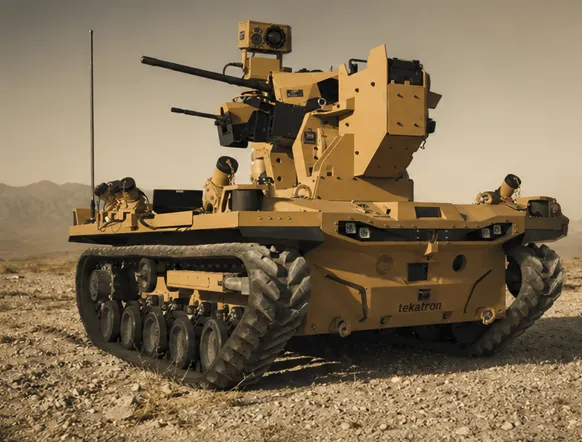
The wider Turkish defence industry is already building on the platform. At SAHA Expo 2026, Roketsan displayed a missile-armed concept named İKA-PALEM, based on Tekatron’s medium-class UGV and integrating members of its UMTAS, L-UMTAS and CİRİT missile families, according to Army Recognition. Defence Turkey has also reported that Kuartis’s KARAGÖZ project for AI-supported fire control and autonomous driving support is linked to PALEM. Together, these show the vehicle being treated as a national carrier for different Turkish payloads, which is exactly what the “modular” in its name promises.
Who operates PALEM?
The Turkish Land Forces Command is the only user. No export contract has been announced and DefenceMENA has found no foreign operator, which is expected for a vehicle still completing its first acceptance batch. That said, the building blocks are already export-proven: ASELSAN’s SARP family of remote weapon stations is sold to many countries, and ASELSAN has been expanding its footprint in Africa, as covered in DefenceMENA’s ASELSAN company profile. A buyer of PALEM would therefore be adopting a weapon station with an established international support base.
Can PALEM go to Africa?
PALEM answers a very specific African problem: how to put heavy, accurate fire where it is needed without putting soldiers in the most exposed position. Across the Sahel, the Lake Chad Basin and Somalia, convoys and small bases are hit by ambushes that start with a roadside bomb and continue with small-arms fire. An armed robot that leads or flanks a convoy, or holds a corner of a forward base, can absorb the first strike, spot attackers from its mast camera and return fire with a 12.7 mm gun or 40 mm grenades while the crew stays under armour. DefenceMENA’s survey of unmanned ground vehicles in African armies found no African force yet fielding a serial combat UGV, so the market is open for a credible first mover.
The tracks and electric drive also suit African conditions. Tracks spread the vehicle’s weight on sand, mud and laterite tracks in the rainy season, and an electric drivetrain runs quietly, which helps a robot holding an observation post at night avoid revealing itself. The eight-hour endurance covers a typical patrol or guard shift; for long border surveillance tasks a buyer would plan charging at the base or from generators, which most African forward operating bases already run. The 4 km control range and LTE link fit the way most African armies operate, from a fixed base or a vehicle column.
Likely candidates are armies that face IED-led ambushes on supply routes, particularly those already familiar with Turkish armour and ASELSAN systems, where PALEM would slot into existing training and logistics. Nigeria, fighting insurgents in the north-east, and Somalia, whose Turkish-trained units face al-Shabaab IED attacks, are obvious examples; Kenya, confronting the same threat along its border, and Egypt and Morocco, which run large border-security operations, are others. Turkish armour is already present in many of these armies, as documented in DefenceMENA’s overview of Turkish systems in African service. For first-time buyers, a mixed package of armed and logistics PALEMs would let units learn to work with robots before scaling up.
How it compares
PALEM competes in the same broad class as Estonia’s Milrem THeMIS, the most widely exported tracked UGV, and other two-to-three-tonne armed robots offered internationally. Its advantages are the SARP Dual station, which offers two weapons under one stabilised sight, the 40 mm grenade launcher option, an eight-hour electric endurance and the backing of an SSB programme with defined acceptance milestones. For African buyers that already use Turkish armour, commonality with ASELSAN systems is a practical bonus.
Frequently asked questions
What is PALEM?
PALEM stands for the Tracked Electric Modular UGV Development Project, run by Türkiye’s Presidency of Defence Industries (SSB) for the Turkish Land Forces Command with Tekatron as prime contractor. It is a medium-class, Level-2 unmanned ground vehicle of about 2,650 kg including payload, designed for reconnaissance, surveillance, target detection and weapon or cargo carriage.
What weapons can PALEM carry?
SSB lists two ASELSAN SARP Dual remote weapon station options: one with a 12.7 mm main weapon and one with a 40 mm automatic grenade launcher, each with a 7.62 mm secondary machine gun. A logistics carrier configuration is also part of the programme.
What are PALEM’s range and endurance?
SSB gives a communication range of 4,000 m and an operating time of eight hours, with RF and 4G/LTE links, a mast-mounted perimeter surveillance system and a cargo basket.
Has PALEM been exported?
No export customer has been announced. PALEM is in acceptance for the Turkish Land Forces, with six vehicles due to be accepted by the end of 2026, and is a candidate for export once Turkish deliveries mature.
Related: Unmanned ground vehicles in African armies · ASELSAN company profile · Turkish systems in African service