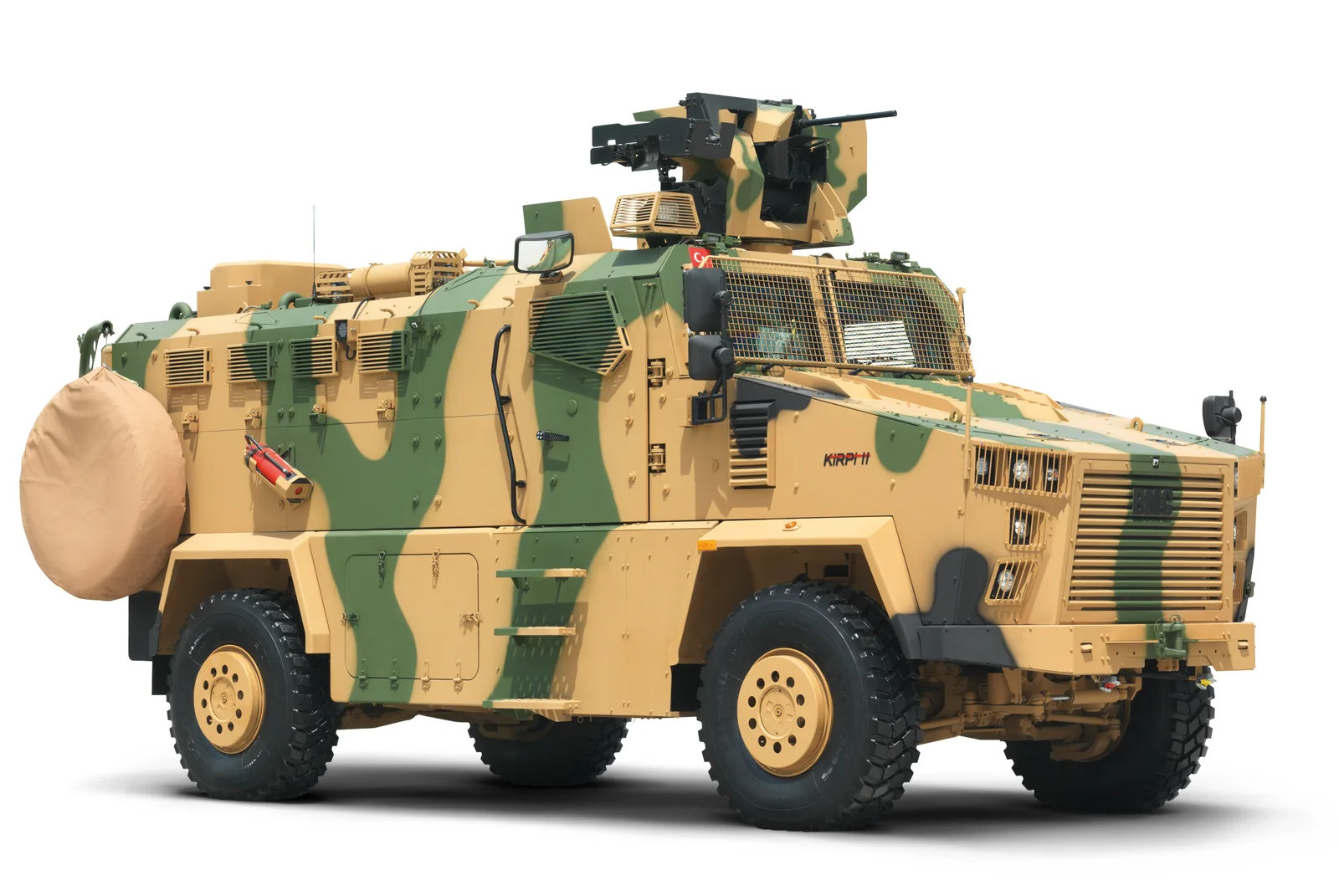
The BMC Kirpi II is the second-generation version of Türkiye’s best-known mine-resistant ambush-protected (MRAP) vehicle, and it now sits at the centre of one of the largest protected-mobility programmes run by the Presidency of Defence Industries (SSB). According to SSB data, more than 3,000 vehicles have been delivered in over 15 configurations, including the first Kirpi IIs powered by a Turkish-built engine. This file covers what the vehicle is, its key specifications, the SSB programme behind it, who operates it and where it fits in Africa.
Photo: Presidency of Defence Industries (SSB), Türkiye.
What is the BMC Kirpi II?
The Kirpi (“hedgehog” in Turkish) is a 4×4 MRAP built by BMC Otomotiv in Türkiye. The original model entered Turkish service in 2010 as a protected troop carrier for counter-terrorism operations in the country’s south-east, where buried explosives were the main threat to soldiers on the move. The Kirpi II, introduced in 2018, kept the same basic layout of a V-shaped, blast-deflecting hull with a high, protected crew compartment, but reworked almost everything around it: independent suspension, a stronger driveline, better climate control for crews working in heat, improved spall protection inside the cabin and room for heavier mission equipment.
The vehicle shown in the SSB photograph carries ASELSAN’s SARP Dual remote weapon station, which lets the crew aim and fire two weapons from inside the armoured hull using day and thermal sights. That configuration reflects how the Turkish Armed Forces now use the Kirpi II: not simply as an armoured bus that moves a section from A to B, but as a protected vehicle that can fight its way through an ambush without exposing a gunner in an open hatch.
Its mission, as defined by SSB, is broad. The Kirpi II is meant to move personnel, weapons, ammunition and supplies quickly and safely, to give manoeuvre units continuous combat service support, and to carry troops in counter-terrorism, peace-support and border missions where the mine and improvised explosive device (IED) threat is high, in addition to conventional military operations.
Key specifications
The figures below are the shareable technical data released by SSB for the programme. Detailed protection levels are classified, as is normal for MRAPs in service.
| Manufacturer | BMC Otomotiv, Türkiye |
| Type | 4×4 mine-resistant ambush-protected (MRAP) vehicle |
| Procurement authority | Presidency of Defence Industries (SSB) |
| Turkish users | Turkish Land Forces Command; Gendarmerie General Command |
| Deliveries (SSB, Sept 2026) | 3,000+ vehicles in 15+ configurations |
| Domestic-engine vehicles | 100 delivered |
| Protection | Ballistic and mine protection; automatic fire suppression system |
| Capacity | 7 to 13 personnel, depending on configuration |
| Engine | 360+ hp; domestic BMC Power TUNA engine on new-build vehicles |
| Transmission | Automatic |
| Gradient / side slope | 60% / 30% |
| Obstacles | Water fording, vertical step and trench crossing |
| Tyres | Run-flat |
| Armament | Remote weapon station (e.g. ASELSAN SARP Dual) |
| Critical subsystems | Domestic engine, domestic armour |
Two numbers stand out. A 60% gradient and a 30% side slope are demanding for a vehicle of this weight class and point to its origins in mountainous terrain. The 7-to-13 seat range, meanwhile, shows how far the family has been stretched: shorter command, ambulance and weapons-carrier layouts sit at the low end, while the full troop carrier seats a complete infantry section with its commander and gunner.
The SSB programme and Turkish service
The Kirpi is a good example of how SSB has managed land-vehicle procurement over the past fifteen years. Rather than buying a finished foreign MRAP, Türkiye ordered a domestic design, kept ordering it in successive batches and used each contract to push more of the vehicle’s critical content into Turkish hands. SSB lists two subsystems as critical to the Kirpi II: a domestic engine and domestic armour. Both were once imported or licence-built items on Turkish wheeled vehicles.
The engine milestone is the more visible one. In January 2025 the Turkish Ministry of National Defence announced the acceptance of Kirpi II vehicles fitted with the TUNA diesel developed by BMC Power, a 400 hp engine designed for tactical wheeled vehicles. SSB data confirms that 100 domestic-engine vehicles have now been delivered across the Kirpi II and related programmes, and that domestic-engine configurations are part of the current order. For a fleet of more than 3,000 vehicles, a Turkish powerpack matters well beyond national pride: it secures spare parts and overhaul capacity at home and removes a foreign component from the export licensing chain.
In Turkish service the Kirpi II is operated by the Land Forces Command and the Gendarmerie General Command. The gendarmerie uses it heavily for internal security and border work, while the army fields troop-carrier, command, ambulance, weapons-carrier and specialist variants. The breadth of the family, more than 15 configurations according to SSB, is one reason the fleet has grown so large: units can draw command posts, medical evacuation vehicles and armed escorts from the same chassis, with shared training and logistics.
Who operates the Kirpi II?
Export reporting on the Kirpi rarely separates the first and second generations, so the table below distinguishes Kirpi II deliveries from wider Kirpi-family users. Only countries with public, verifiable reporting are listed.
| Türkiye | Confirmed (SSB): Land Forces Command and Gendarmerie General Command, 3,000+ vehicles delivered |
| United Arab Emirates | Reported: licence-built Kirpi II derivative produced by International Golden Group (IGG), shown at IDEX 2023 |
| Bosnia and Herzegovina | Confirmed: first Kirpi II vehicles delivered in 2025 under a Turkish assistance package |
| Tunisia | Confirmed (Kirpi family): initial order of about 100 in 2014, follow-on order including ambulances in 2021 |
| Qatar | Confirmed (Kirpi family): 50 Kirpi announced by BMC at DIMDEX 2018 |
| Somalia | Confirmed (Kirpi family): vehicles donated by Türkiye in 2020 and 2021 |
| Ukraine | Confirmed (Kirpi family): deliveries from Türkiye from 2022 |
| Turkmenistan, Kosovo, Djibouti | Reported (Kirpi family) |
The Kirpi II’s clearest export foothold is in the Gulf. Janes reported at IDEX 2023 that the UAE’s International Golden Group had displayed a Kirpi II-based MRAP built under licence from BMC, a sign that the design has been accepted as a base for local production rather than only bought off the shelf. In the Balkans, Army Recognition reported in 2025 that Bosnia and Herzegovina had received its first Kirpi II vehicles as part of a Turkish support package.
Across the wider family, the Kirpi has been sold or donated to around ten countries. Tunisia is the longest-standing African customer, and Somalia’s army received Kirpis from Türkiye in two batches. Qatar ordered the type in 2018 alongside BMC’s Amazon. How the Kirpi has fared in African operations is covered in detail in our Kirpi combat record in Africa, which this product file does not repeat.
Can the Kirpi II go to Africa?
The short answer is that the Kirpi family is already there, and the Kirpi II is a natural next step for armies that know the first generation. The more useful question is where it fits best.
The threat picture in much of Africa matches the Kirpi II’s design brief closely. In the Sahel, around Lake Chad, in northern Mozambique and in Somalia, the main danger to troops on the road is the roadside bomb and the ambush that follows it. Those are exactly the conditions SSB wrote into the vehicle’s mission: personnel transport where the mine and IED threat is high, counter-terrorism, peace support and border duty. A high-mobility MRAP that seats a full section, carries its own remote weapon station and keeps moving on run-flat tyres after an attack answers the requirement more directly than an older armoured personnel carrier adapted for the role.
Three features make the Kirpi II easier to sustain on the continent than many competitors. The first is the automatic transmission and conventional truck-derived engineering, which keep driver training and field maintenance within reach of most African armies. The second is the domestic TUNA engine: with Turkish-made powerpacks and armour, Türkiye can export and support the vehicle with fewer third-party licensing constraints. The third is the family approach. An army that buys troop carriers can add ambulances, command vehicles and weapons carriers on the same chassis, which simplifies spares in remote theatres.
Likely candidates are best seen as opportunities rather than predictions. Existing Kirpi users such as Tunisia and Somalia are the obvious first market for a second-generation fleet. West African states that have deepened defence ties with Ankara, including Senegal, and Sahel countries facing a persistent IED threat are logical prospects. East African forces that already run Turkish MRAPs, as Kenya does with the Hızır, show that Turkish protected vehicles compete well there on price, delivery speed and through-life support. Our overview of Turkish systems in African armed forces sets out how wide that footprint has become.
How it compares
In the African market the Kirpi II is usually weighed against South African designs such as the Casspir and Mamba, and against French and Chinese 4x4s. It is larger and more protected than light 4x4s like the Otokar Cobra II or Arquus Bastion, which we compare in Cobra II vs Bastion vs VN4, and it fills a different niche: a full-section MRAP rather than a fast patrol vehicle. Its main selling points against established MRAPs are the size of the Turkish production base, the large in-service fleet that keeps spares and know-how flowing, and the option of a fully Turkish engine and armour package backed by SSB.
Frequently asked questions
Who makes the Kirpi II?
The Kirpi II is designed and built by BMC Otomotiv in Türkiye. The programme is managed by Türkiye’s Presidency of Defence Industries (SSB).
How many Kirpi vehicles has Türkiye received?
According to SSB data from September 2026, more than 3,000 vehicles have been delivered in over 15 configurations to the Turkish Land Forces Command and the Gendarmerie General Command.
Does the Kirpi II have a Turkish engine?
Yes. New-build Kirpi II vehicles can be fitted with the TUNA diesel developed by BMC Power. SSB says 100 domestic-engine vehicles have been delivered.
How many soldiers does the Kirpi II carry?
Between 7 and 13 personnel, depending on the configuration, according to SSB.
Which African countries use the Kirpi?
Tunisia and Somalia operate the Kirpi family, and Kirpi vehicles were also delivered to Libya’s Tripoli-based government forces. Djibouti has been reported as a user.
Related: BMC Kirpi in Africa: combat record · Turkish Amazon armoured vehicles in Libya · ASELSAN company profile