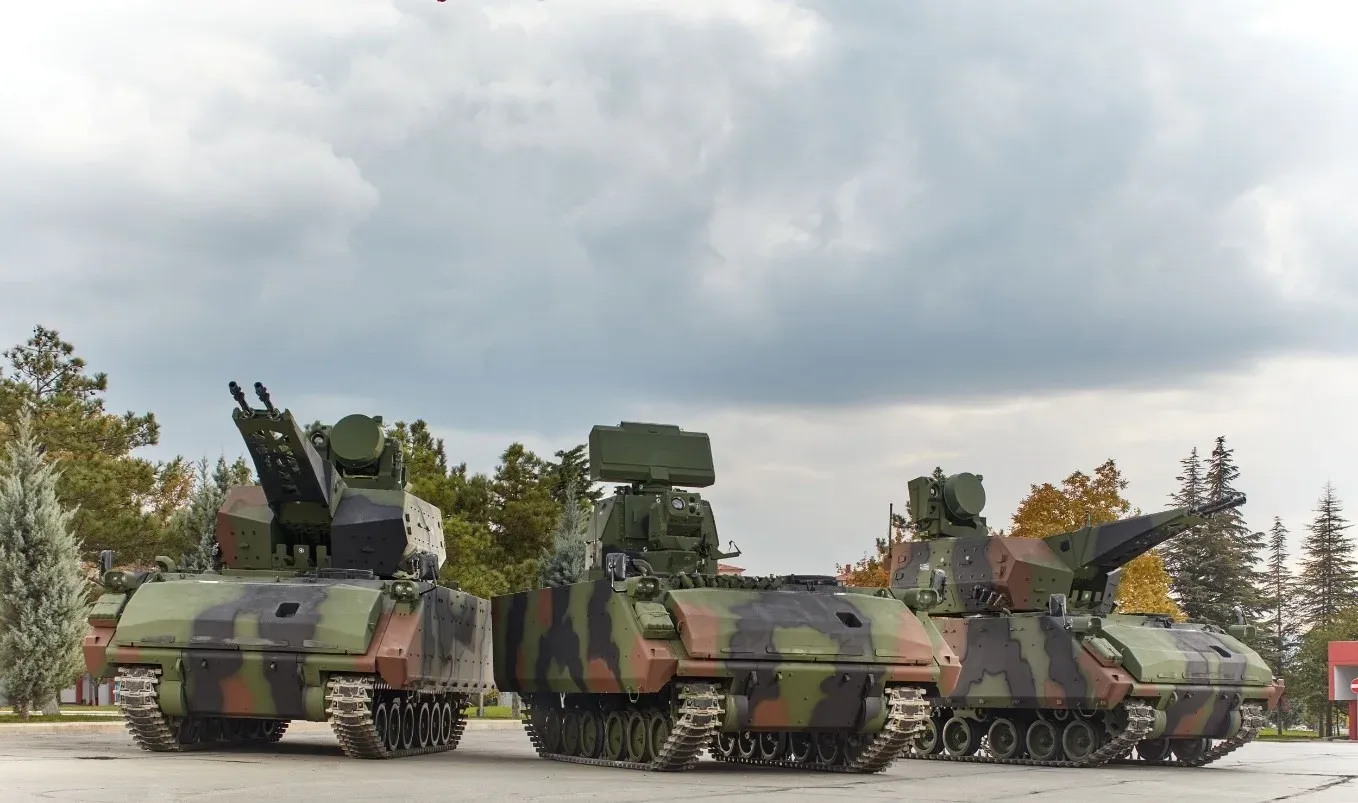
KORKUT is ASELSAN's twin 35 mm self-propelled air defense gun system. It began as a Turkish Army modernization program and has grown into a family of tracked and wheeled systems that is now sold abroad. Built around radar-cued guns that fire programmable ATOM airburst rounds, it protects maneuver forces against drones, cruise missiles and helicopters, and it sits in the low-altitude tier of Türkiye's Steel Dome architecture.
| At a glance | |
|---|---|
| Prime contractor | ASELSAN; FNSS (tracked hull); MKE (licensed 35 mm guns) |
| Operators | Turkish Land Forces; first export delivery in 2025 |
| Program | SSB program; series production contract 19 May 2016 |
| Quantity | 13 command vehicles and 40 weapon vehicles under the first contract |
| Variants | 150/35 (tracked), 140/35 (8×8), 130/35 (towed gun upgrade) |
What is the KORKUT?
KORKUT operates in teams of three weapon system vehicles and one command and control vehicle. The command vehicle carries a 3D search radar and IFF, builds the local air picture and assigns targets. Each weapon vehicle has a stabilized turret with a fire control radar and an electro-optical tracking suite, so it can fire on the move and engage independently if needed.
The key enabler is the ATOM 35 ABM, a time-programmable airburst round that creates a cloud of fragments close to small, fast targets such as drones.
Key features
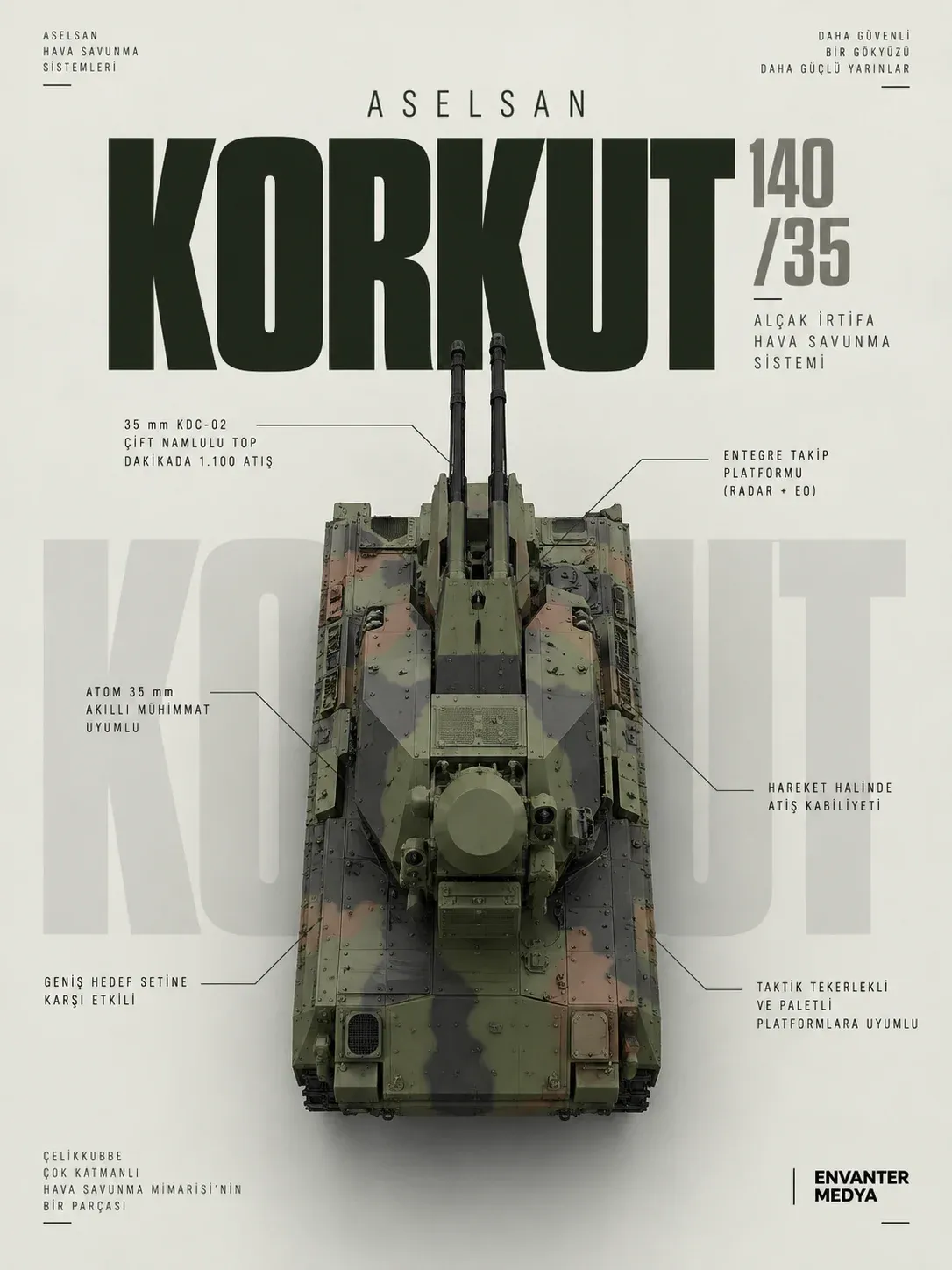
The armament is a twin 35 mm KDC-02 cannon licence-built by MKE, with a rate of fire of 1,100 rounds per minute, 200 ready rounds and an effective range of 4 km with ATOM ammunition. Fighters can be tracked at more than 35 km. The tracked 150/35 reaches 65+ km/h, and the 8×8 140/35 reaches 105+ km/h.
ASELSAN's March 2026 brochures list the tracked version as KORKUT 150/35 and the wheeled 8×8 version, tested on Otokar's ARMA II, as KORKUT 140/35, where the first number denotes the configuration and the second the gun caliber. The family also includes KORKUT 130/35, a digitized upgrade of towed 35 mm guns directed by the KORKUT 130 fire control unit.
Program, service and exports
SSB and ASELSAN signed the series production contract on 19 May 2016. ASELSAN subcontracted the ACV-30-based tracked hulls to FNSS in December 2016. A first team was accepted on 31 October 2016 and serial deliveries began in March 2019. ASELSAN's 2025 annual report adds a new domestic contract that covers a further variant.
KORKUT is in service with the Turkish Land Forces and has been reported in operational use in Syria and Libya. It was part of the 47-vehicle Steel Dome package handed over on 27 August 2025. On the export side, ASELSAN reported that the first export delivery of KORKUT 150/35 took place in 2025 without naming the customer, and that a KORKUT 141/35 configuration has been integrated on a Middle Eastern platform. Indian media reported in September 2026 that Pakistan had acquired KORKUT systems, with no quantities disclosed. In Europe, the Czech group CSG and ASELSAN formed an EU-based joint venture on 4 February 2026.
KORKUT's closest relative is Germany's Gepard, with newer peers in Rheinmetall's Skyranger, Russia's Pantsir and the U.S. Army's M-SHORAD. Its distinguishing features are an airburst-centered counter-drone approach, a team-level command vehicle and a turret that moves between tracked and wheeled hulls.
Source: Envanter Medya