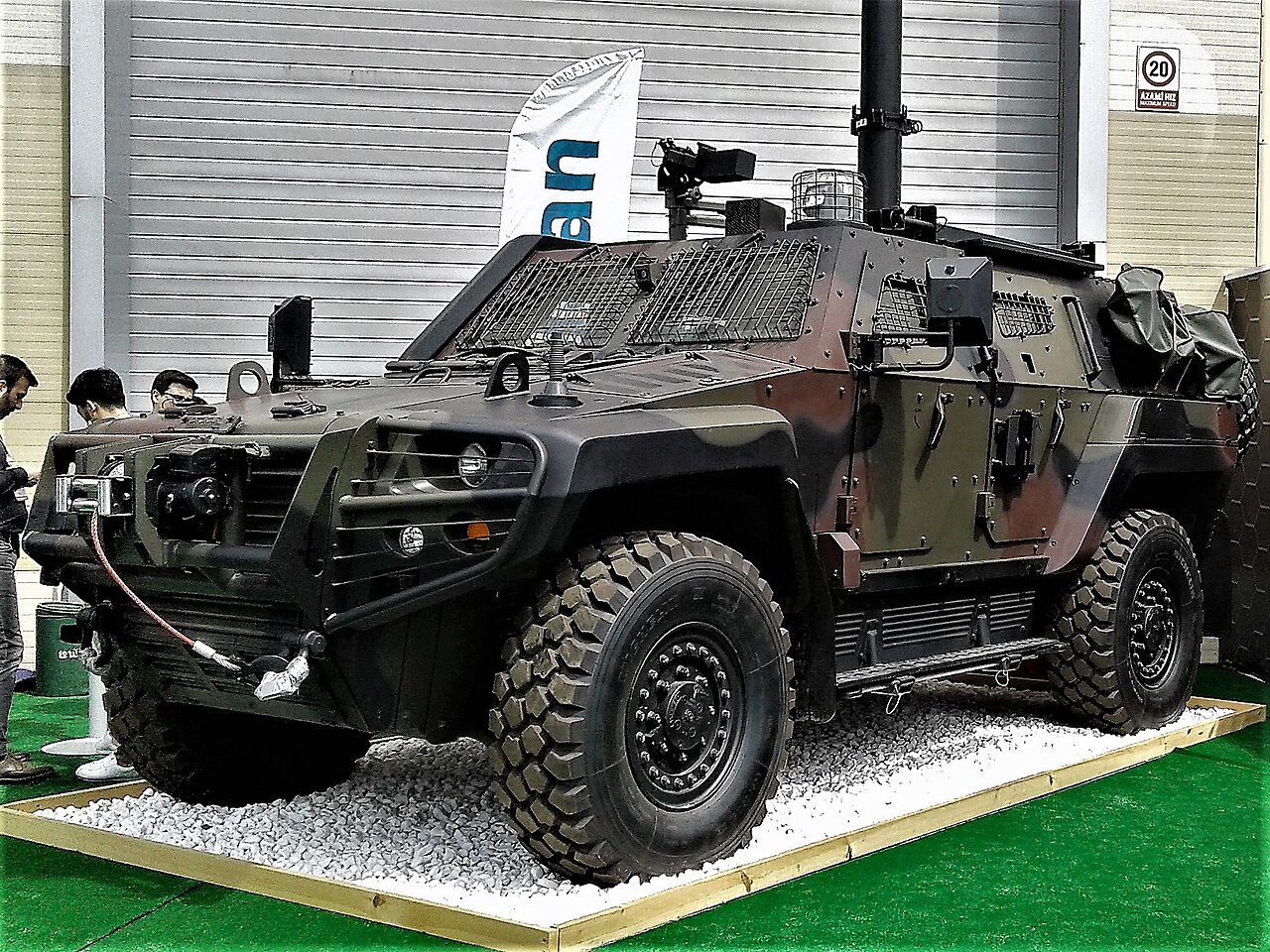
This Otokar company profile sets out who owns the Turkish armoured-vehicle maker, what it builds and which African and Middle Eastern customers can actually be documented. Otokar Otomotiv ve Savunma Sanayi A.Ş. started as a bus builder in 1963 and now earns more than a quarter of its revenue from military vehicles, almost all of them exported. The company publishes very few customer names, so this profile keeps confirmed facts apart from press reports. Figures come from Otokar’s own annual reports and investor pages, with defence press added where stated.
Otokar company profile: ownership and history
Otokar was established in 1963 to produce Türkiye’s first intercity buses, according to its annual report for 2023. It joined the Koç Group in 1976 and entered the defence industry in 1987. The company has two business lines: commercial vehicles, meaning buses and Atlas light trucks, and defence, meaning wheeled and tracked armoured vehicles and turret systems.
At the end of the latest reporting year, Koç Holding held 47.38 per cent of the shares, Ünver Holding 24.81 per cent and the free float 27.81 per cent, on an issued capital of TL 120 million. The investor page describes Koç Holding and Ünver Holding as controlled by the Koç and Ünver families respectively. That makes Otokar a privately controlled prime contractor, which sets it apart from other Turkish groups profiled by DefenceMENA, such as ASELSAN and Roketsan.
Its main plant is in Arifiye, Sakarya, with 552,000 square metres of production area, and the head office is in Istanbul. Sales and support subsidiaries operate in France, the United Arab Emirates, Romania, Kazakhstan and Italy.
Key products and programmes
Otokar’s defence catalogue spans light 4×4 vehicles, 6×6 and 8×8 armoured carriers and tracked platforms. The table summarises the main families named in the company’s reports and news releases.
| Platform | Type | Status and notes |
|---|---|---|
| Cobra II | 4×4 tactical wheeled armoured vehicle | In production; a 1,059-vehicle contract with Romania is under way |
| Arma 6×6 | Armoured personnel carrier | Delivered to the Estonian defence ministry |
| Arma 8×8 and Arma II 8×8 | Armoured carrier | Entered the Turkish Land Forces inventory in 2023; 400 8×8 vehicles delivered to the UAE |
| Tulpar and Tulpar S | Tracked platform, 28 to 45 tonnes | Integration and live-firing tests with a 120 mm turret completed |
| Altay | Main battle tank | Otokar was prime contractor for design, development and qualification |
The original Cobra, described by Army Technology, weighs 4,800 kg empty, has a 190 hp turbocharged diesel, reaches 115 km/h and carries four to twelve people depending on the variant. Cobra II is the second-generation vehicle, and the company has not published a matching specification sheet in the documents reviewed.
On the tracked side, Otokar and Leonardo announced on 18 September that Tulpar had completed integration and live firing with the HITFACT MkII turret, which can carry a 105/52 mm rifled gun or a 120/45 mm smoothbore gun. The Mızrak turret is also named in the latest annual report. On commercial lines the company builds urban and intercity buses, the Atlas truck and the autonomous e-Centro bus.
Contracts and customers in Africa and the Middle East
Otokar says its military vehicles serve nearly 60 clients in more than 40 countries, and that its annual report for 2023 recorded new orders from Europe, South America, Africa and the Gulf. The company does not break those users down by country. The documented African and Middle Eastern picture is therefore patchy, and each entry below carries a status label.
| Country | What is documented | Status |
|---|---|---|
| United Arab Emirates | 400 Arma 8×8 vehicles delivered; Al Jasoor joint venture set up on 28 May 2017 with Otokar Land Systems holding 49 per cent | Company-stated, delivered |
| Unnamed African buyer | “First defense industry order from Africa” appears in the milestones list, without buyer, quantity or year | Company-stated, details undisclosed |
| The Gambia | Two Cobra armoured personnel carriers handed over by the Turkish embassy in Banjul as a donation | Delivered, reported by defenceWeb |
| Tunisia | Cobra and Cobra 2 photographed in Tunisian colours; quantity not given | Reported by MENADEFENSE on 24 July 2016 |
| Algeria, Bahrain, Nigeria, Pakistan | Listed as Cobra export customers by Army Technology | Reported, unconfirmed |
Other reference works citing Jane’s coverage also place Cobras with armies in Ghana, Burkina Faso and Mauritania, and with Nigeria and Rwanda. Otokar has not confirmed quantities for these, and readers should treat them as unverified. The company’s report for 2024 lists defence-fair appearances in Bahrain, the UAE, Saudi Arabia and South Africa, which shows where it markets, not who has bought.
For how Turkish vehicles compare with other suppliers on the continent, see arms suppliers to Africa.
Partnerships and local production
The most detailed localisation story is in Romania. The latest annual report records a contract with the Romanian ministry-owned company Romtehnica for 1,059 Cobra II vehicles, of which 278 were produced in the first phase and 194 delivered to the Romanian Army. Production runs through Otokar Land Systems S.R.L. and the SAROM joint venture. In August, Romania’s defence minister visited the Automecanica Mediaș facility, the first high-level visit since the takeover and full activation of its production lines, and Otokar says it has signed an acquisition agreement there.
In the Gulf, the Al Jasoor joint venture and the Abu Dhabi subsidiary handle sales and marketing. In Asia-Pacific the company announced a strategic expansion with Boustead, and a Kazakhstan subsidiary covers Central Asia. For tracked vehicles, Leonardo supplies the HITFACT MkII turret.
No Africa-based assembly or licensed production appears in the company documents reviewed. African deliveries, where documented, are direct sales or donations from Türkiye. Other Turkish suppliers active on the continent include Baykar and Turkish Aerospace.
Financial snapshot and workforce
The financial section of this Otokar company profile draws on the annual report for 2025. The report restates the previous year’s figures, so comparisons below use the restated values.
| Indicator | Latest annual report | Comparison |
|---|---|---|
| Total revenue | TL 51,962 million (USD 1,212 million) | Up 18 per cent from TL 44,112 million |
| Defence revenue | TL 13,921 million, 27 per cent of the total | TL 7,249 million, 16 per cent |
| Export value | USD 798 million, 66 per cent of revenue | USD 666 million, 65 per cent |
| Military vehicle exports | 97 per cent of military vehicle revenue | Not compared |
| Employees at year end | 3,659 | 3,772 a year earlier |
| Net result | Net loss of TL 1,459 million | Loss of TL 4,063 million |
| Confirmed defence orders | About EUR 720 million over five years | Not compared |
EBITDA was TL 2.2 billion, which differs from net profit. Research and development spending was 5 per cent of turnover in 2024, according to the company website. Otokar also says it exports defence products to about 50 countries.
Strengths, challenges and outlook
Three points stand out in the documents. First, the defence share of revenue rose from 16 to 27 per cent in a single year, and nearly all military vehicle sales go abroad. Second, the order book of about EUR 720 million gives visibility, and the named large programmes, Romania and Estonia, are European. Third, the Tulpar and Leonardo turret tests widen the offer to medium-tank firepower.
The challenges are equally visible. The company reported a net loss in both years shown, even though EBITDA in the latest year was TL 2.2 billion, and its African customer base is thinly documented: the clearest delivery found is a donation of two vehicles to the Gambia. Whether the “first order from Africa” turns into a repeat sale is not stated in public documents.
Anyone following the Otokar company profile over the coming years should watch the Tulpar programme, the pace of Cobra II output in Romania and any named African contract in future annual reports.
Frequently asked questions
Who owns Otokar?
Koç Holding is the largest shareholder with 47.38 per cent, followed by Ünver Holding with 24.81 per cent. The remaining 27.81 per cent is free float. The investor page says both holding companies are family-controlled, so Otokar is privately controlled rather than state-owned.
What does Otokar make?
Otokar makes buses and Atlas light trucks, plus defence vehicles. The defence range includes Cobra II 4×4 vehicles, Arma 6×6 and 8×8 carriers, the tracked Tulpar family and turret systems. It was also prime contractor for the design and qualification phase of the Altay main battle tank.
Which African countries use Otokar vehicles?
Only a few are publicly documented. The Gambia received two Cobra carriers as a Turkish donation, and Tunisia was reported in 2016 to have Cobras. Algeria and Nigeria are listed as reported customers. Otokar itself mentions a first defence order from Africa without naming the buyer.
Sources
- Otokar, annual report for 2025
- Otokar, annual report for 2023
- Otokar, annual report for 2022
- Otokar, annual report for 2024
- Otokar, shareholding structure
- Otokar, corporate website and news
- Otokar and Leonardo, Tulpar HITFACT MkII tests
- defenceWeb, Turkey donates Otokar Cobras to Gambia
- MENADEFENSE, Des Otokar Cobras pour l’armée tunisienne
- Army Technology, Cobra light armoured vehicle