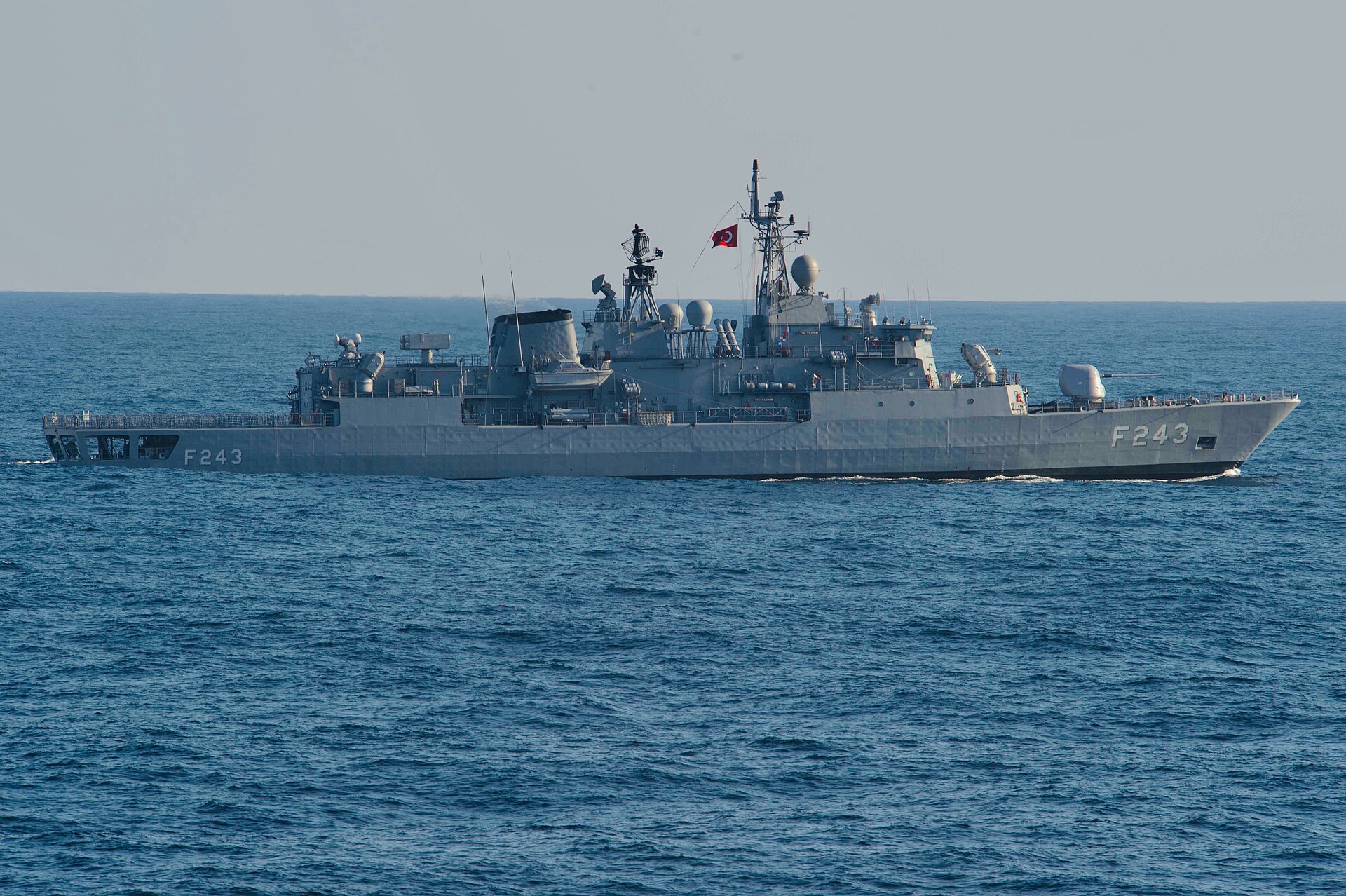
Two Turkish Navy frigates are escorting a Turkish fishing vessel towards Somalia for exploratory and trial fishing in the country’s exclusive economic zone (EEZ), Türkiye’s Ministry of National Defence (MSB) said. The ministry has publicly tied a naval deployment off Somalia to a commercial fishing operation. It follows a December 2025 deal that gave a Turkish-Somali joint company, SOMTURK, a central role in licensing foreign fishing in Somali waters.
What the Turkish defence ministry said
In a post on X on 4 November, the MSB said the frigates TCG Gökçeada and TCG Yıldırım were escorting and protecting the fishing vessel Mustafa Korkmaz A. It said the vessel was planned to carry out “exploratory and trial fishing” in Somalia’s EEZ. The ministry said the frigates were also transiting to Mogadishu to rotate Türkiye’s Somalia Naval Task Group. TCG Yıldırım is a MEKO 200 Yavuz-class frigate. TCG Gökçeada is a G-class frigate, a modernised former US Oliver Hazard Perry-class ship.
The ministry gave no details of the vessel’s licence, the fishing areas, how long the operation will last or the commercial terms. Garowe Online and Somali Report also noted that these details were missing.
Djibouti stop and a coming announcement: reported, not confirmed
The Somalia-focused X account Somali Eye reported on 8 November that “Turkish warships and fishing vessels” had arrived in Djibouti that day and were expected to continue to Mogadishu. It said Somalia and Türkiye were preparing to announce the implementation of a bilateral fisheries cooperation agreement. The website Inside Somalia published the same text on 9 November.
DefenceMENA could not find official confirmation of the Djibouti port call or of a planned announcement from the MSB, the Somali government or the Djiboutian authorities. Both points should be treated as reported claims for now. The same applies to the post’s figure that the initiative could generate “up to $1 billion annually”. The post itself says the target and its details “remain to be clarified”, and no official source reviewed gives that number.
What SOMTURK is
SOMTURK was set up on 11 December 2025 by OYAK, the Turkish Armed Forces’ pension fund and industrial group, together with the Somali National Fishing Company, OYAK said. OYAK and Somalia’s Ministry of Fisheries and Blue Economy then signed a Strategic Cooperation and Service Agreement in Ankara. Turkish Defence Minister Yaşar Güler and Chief of the General Staff Gen. Selçuk Bayraktaroğlu attended the signing.
According to OYAK, SOMTURK will support the Somali ministry in managing licensing for fishing in Somalia’s EEZ, and the deal will give the Turkish fisheries sector access to Somali waters. Turkish state news agency Anadolu reported that permits would be issued “exclusively” through SOMTURK. SOMTURK’s own website describes it as the sole entity the ministry has authorised to provide technical services for foreign licence applications in the zone between 24 and 200 nautical miles from the coast. In both OYAK’s and SOMTURK’s descriptions, the ministry remains the licensing authority.
In March 2026, OYAK announced that the Turkish-flagged Ergun Reis A had received the first international fishing licence issued under the arrangement, at a ceremony in Mogadishu.
The legal and military framework
The escort rests on two documents. The first is the Defence and Economic Cooperation Framework Agreement that Türkiye and Somalia signed on 8 February 2024. Among its stated aims are protecting Somalia’s maritime jurisdiction, combating illegal fishing and piracy, and helping Somalia use its marine resources. The second is the Turkish parliament’s two-year extension of the authorisation for Turkish forces in Somalia, approved on 21 July 2026. According to Baird Maritime, it covers Somali maritime jurisdiction and lists protecting Somalia’s economic resources among its purposes.
Somalia’s 2023 fisheries law requires a licence or authorisation for test fishing. It also reserves waters within 24 nautical miles of the baseline for Somali-owned vessels and bans trawl nets, Baird Maritime and Horseed Media reported. Whether Mustafa Korkmaz A holds such a licence has not been made public.
Analysis: navy protection for a commercial venture
Turkish warships have operated off Somalia for years, through the Somalia Naval Task Group and earlier counter-piracy missions. Ships of the task group have recently been used to test Turkish-made systems, including the Kalkan VTOL drone. What is new is that the MSB has publicly tied a frigate deployment to a Turkish commercial fishing operation that runs through a company owned in part by the armed forces’ own pension fund. This moves Türkiye’s naval role in Somalia from capacity-building and security towards protecting economic interests, which the July 2026 parliamentary mandate explicitly allows.
There are practical reasons for an escort. Piracy off Somalia has picked up again in 2026, and foreign trawlers operating illegally in Somali waters have long been a grievance on the coast. Not everyone welcomes the move politically. Somali opposition figures have criticised Turkey’s growing role as lacking consultation and transparency, Garowe Online reported. Anti-Turkey protests have taken place in parts of the south-west, including Diinsoor. In Türkiye, retired admiral Yankı Bağcıoğlu said protecting the fishing fleet is a core navy task. He questioned whether exporting frigates and offshore patrol vessels fits with the Turkish Navy’s rising workload, Yeniçağ reported.
The deployment also adds to Ankara’s position as Mogadishu’s most important security partner, at a time when the African Union mission’s future is uncertain. That is covered in DefenceMENA’s analysis of Somalia’s foreign backers.
What is not known
- Whether the ships called at Djibouti, and when they will reach Mogadishu.
- The licence terms, fishing areas and duration of Mustafa Korkmaz A‘s operations.
- Whether, and when, Somalia and Türkiye will formally announce the implementation of the fisheries arrangement.
- The basis for the reported “up to $1 billion a year” revenue figure.
- How the escort will interact with Somalia’s own naval and coast guard forces.
Sources
- T.C. Millî Savunma Bakanlığı (@tcsavunma), X post, 4 November 2026: x.com
- OYAK, “Another international investment by OYAK: SOMTURK”, December 2025: oyak.com.tr
- OYAK, “First International Fishing License in Somalia Granted to a Turkish Vessel”, 29 March 2026: oyak.com.tr
- SOMTURK, About: somturk.com
- Anadolu Agency, “Türkiye, Somalia to cooperate in fisheries sector”: aa.com.tr
- Baird Maritime, 5 November 2026: bairdmaritime.com
- Garowe Online, 6 November 2026: garoweonline.com
- Somali Report, 5 November 2026: somalireport.com
- Horseed Media, 5 November 2026: horseedmedia.net
- Somali Eye (@somalieye_), X post, 8 November 2026 (claim; not an official source): x.com
- Inside Somalia, 9 November 2026: insidesomalia.net
- Yeniçağ, on Yankı Bağcıoğlu’s comments: yenicaggazetesi.com
Method: the escort is confirmed by the Turkish defence ministry’s own statement. The SOMTURK arrangement is confirmed by OYAK and Anadolu. The Djibouti arrival, the planned announcement and the $1 billion figure come from Somali Eye and Inside Somalia only, and are attributed as unconfirmed.