


BMC Kirpi in Africa: What Is Publicly Known About Its Mine and IED Protection Record



The BMC Kirpi MRAP is the Turkish vehicle African armies have used longest in real counter-insurgency work, from Tunisia’s mountains to Tripoli’s front lines and Mogadishu. Yet a decade of service has produced remarkably little official data on how the Kirpi performs when a mine or improvised explosive device (IED) actually detonates beneath it.
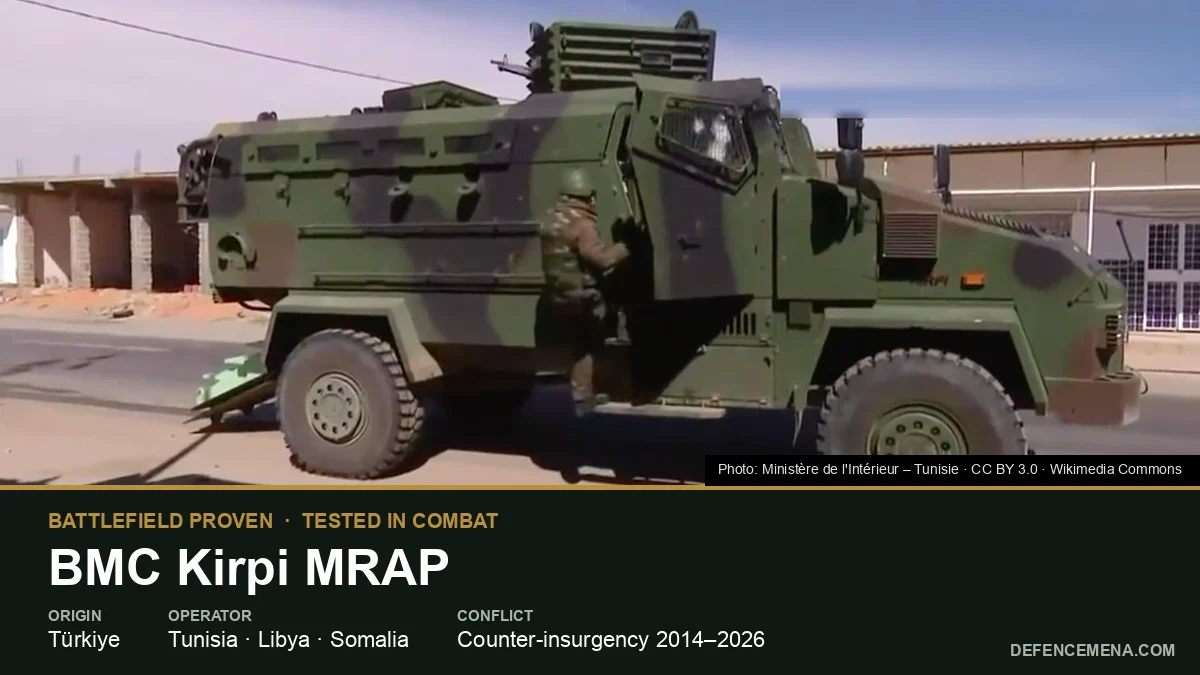
Photo: A Tunisian BMC Kirpi in Ben Guerdane during the March 2016 fighting. Credit: Tunisian Interior Ministry, CC BY 3.0, via Wikimedia Commons (on-screen title removed). Credit: Ministère de l'Intérieur – Tunisie, CC BY 3.0, via Wikimedia Commons.
Direct answer
The BMC Kirpi is confirmed in African service with Tunisia (purchased), the Tripoli-based Libyan government’s forces (delivered in 2019 in breach of the UN arms embargo, according to the UN Panel of Experts) and Somalia (donated by Türkiye). Its African record is one of confirmed deployment rather than documented outcomes: no African government has published an account of how Kirpi crews fared in blasts. The only specific claim of a Kirpi being destroyed by an IED in Africa came from an al-Qaeda-linked group in Tunisia in 2019 and has not been confirmed by the Tunisian Ministry of Defence.
| System | Kirpi 4×4 mine-resistant ambush-protected (MRAP) vehicle; Kirpi II second generation from 2018 |
| Manufacturer | BMC Otomotiv Sanayi ve Ticaret A.Ş. |
| Origin | Türkiye |
| Operator(s) in this file | Tunisian Armed Forces; GNA-aligned forces in western Libya; Somali National Army (incl. Gorgor commandos) |
| Period | 2014 to September 2026 |
| Evidence level summary | Deliveries confirmed (UN, government and manufacturer statements); combat use visually documented in Tunisia; blast survivability data not publicly disclosed |
Where was it used?
Tunisia is the largest African operator. Army Recognition reported in 2017 that Türkiye delivered 100 Kirpi vehicles to Tunisia between 2014 and 2016, and defenceWeb put the original order at 100 vehicles placed in 2014. The Kirpi entered service as the Tunisian Army was fighting jihadist groups in the western mountains along the Algerian border, including Chaambi and Mghila, and it appeared in Tunisian government footage of the March 2016 battle of Ben Guerdane, when Islamic State fighters crossing from Libya attacked the southern border town. Tunisian Interior Ministry video from those clashes, now archived on Wikimedia Commons, shows a green-camouflaged Kirpi with its model badge visible.
Libya received the Kirpi during the 2019–2020 war for Tripoli. The UN Panel of Experts on Libya reported that on 18 May 2019 “a large consignment” of BMC Kirpi vehicles was offloaded in Tripoli from the MV Amazon, which had sailed from Samsun. The Panel identified at least 27 vehicles from open-source imagery, adding that confidential sources put the true number closer to 50 to 80. The Government of National Accord’s (GNA) “Volcano of Anger” operation publicised the arrival, The National reported.
Somalia received 12 Kirpi vehicles donated by Türkiye in August 2020 and a further eight in August 2021, according to Anadolu Agency and defenceWeb. The first batch was assigned to the Somali National Army’s 3rd “Eagle” infantry battalion; the second was linked to the Turkish-trained Gorgor commandos. The regional equipment picture is covered in our survey of MRAPs used in the Sahel, which this file does not repeat.
What was the mission?
In all three countries the Kirpi was bought or donated as a protected troop carrier for counter-insurgency: moving infantry sections through areas where the main threat is buried or roadside explosives and small-arms ambushes. In Tunisia that meant sweeps in closed military zones in Kasserine and border security in the south. In Somalia, the Somali defence minister said in 2020 that the vehicles would support operations against al-Shabaab. In Libya the mission was different: urban and peri-urban fighting on the southern edges of Tripoli against the Libyan National Army (LNA), where artillery, drones and anti-tank weapons mattered more than mines.
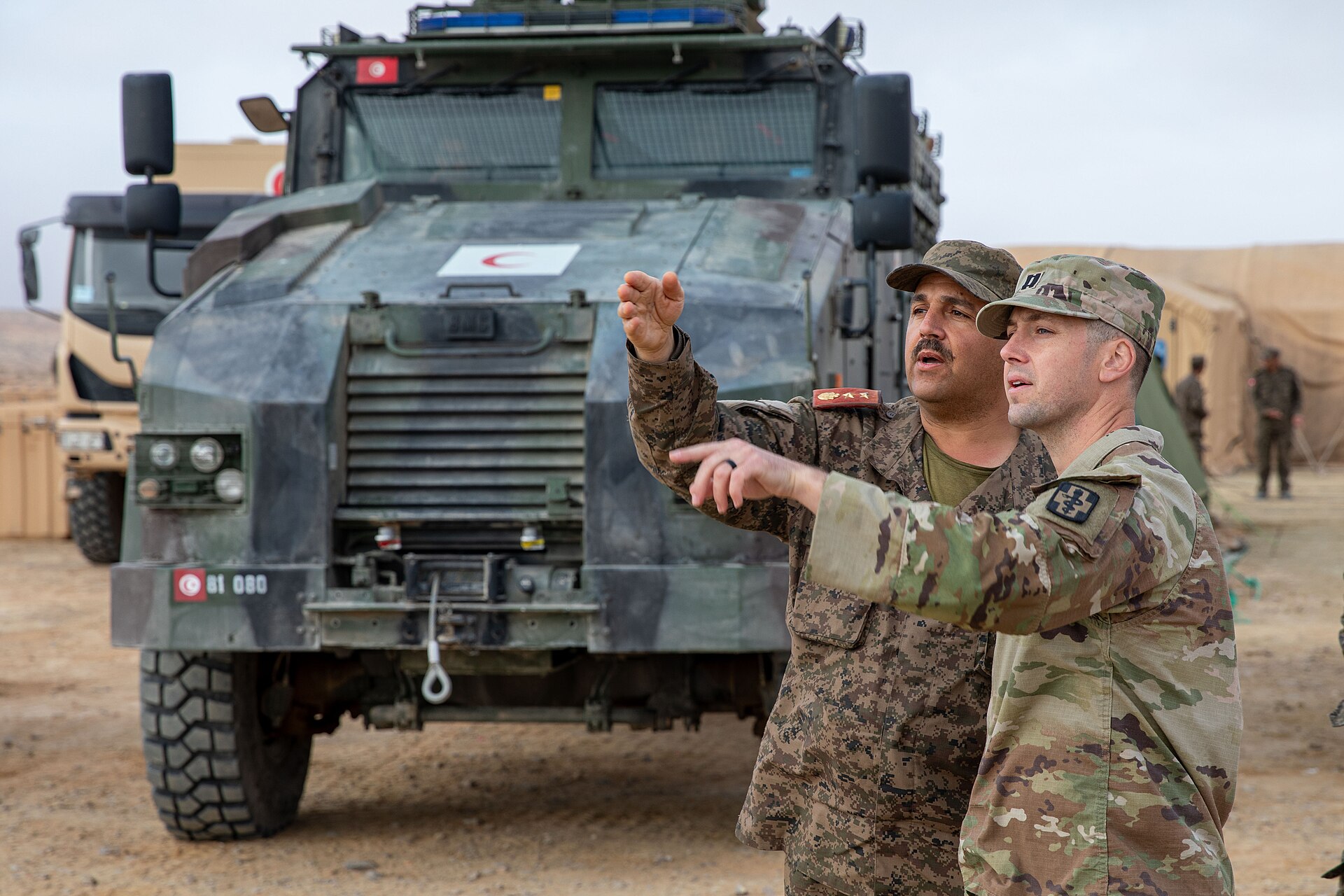
Army Recognition’s report on Tunisia’s 2017 parade described Kirpi carriers with remotely operated 12.7 mm weapon stations and a surveillance variant with a mast. Tunisia later became the first export customer for the Kirpi ambulance.
What does the public evidence show?
The evidence is strongest on deliveries and weakest on outcomes.
| Claim / event | Date | Evidence level | Source |
|---|---|---|---|
| Around 100 Kirpi delivered to Tunisia | 2014–2016 | Independently reported (figures vary) | Army Recognition; defenceWeb |
| Kirpi used by Tunisian forces during Ben Guerdane fighting | March 2016 | Visually documented | Tunisian Interior Ministry video via Wikimedia Commons |
| IED destroyed a Kirpi on Mount Chambi; one soldier killed, three wounded | 26 April 2019 | Casualties officially stated; vehicle type claimed only by militants | Tunisian MoD via AFP/Arab News; militant claim via The Defense Post |
| Kirpi consignment offloaded in Tripoli for GNA-aligned forces | 18 May 2019 | Confirmed (UN Panel of Experts) | UN S/2019/914 |
| Libyan interior and defence minister confirmed procurement from Türkiye | 31 July 2019 | Officially stated | UN S/2019/914 |
| Kirpi had little effect on Tripoli battle outcomes | 2019 | Independently reported (single official, anonymous) | New America (Wehrey) |
| 12 Kirpi donated to Somali National Army | August 2020 | Officially stated | Anadolu Agency; defenceWeb |
| Tunisia orders 41 Kirpi and 5 Kirpi ambulances | June 2021 | Officially stated (manufacturer) | Anadolu Agency |
| 8 more Kirpi donated to Somalia, linked to Gorgor commandos | August 2021 | Officially stated | Anadolu Agency; Military Africa |
| New batch of Kirpi handed to Somalia’s 21st Gorgor Brigade | September 2026 | Unverified (single local outlet, no official naming of vehicle type) | FTL Somalia |
The Tunisian incident of April 2019 illustrates the gap. The Ministry of Defence said a soldier was killed and three wounded in a mine blast on Mount Chambi in Kasserine. It did not name the vehicle. The claim that “a roadside bomb struck and completely destroyed” a Kirpi comes from the propaganda outlet of Okba Ibn Nafaa, the local al-Qaeda affiliate, as summarised by The Defense Post. It cannot be independently verified. Similarly, when four soldiers were killed in a mine explosion in the Mghila mountains on 3 February 2021, the ministry’s spokesman referred only to a “military vehicle”.
What worked?
The clearest evidence of satisfaction is procurement behaviour rather than battlefield reporting. Tunisia, which had operated the Kirpi through years of mine and IED attacks in its western mountains, came back to BMC in June 2021 for 41 more vehicles and five ambulances. BMC said at the time that the order would make Tunisia the largest Kirpi operator after Türkiye. Repeat orders also reflect price, delivery speed and political ties, so this is an indicator, not proof.
In Somalia, the Turkish embassy described the 2020 batch as the first fully armoured vehicles owned by the Somali National Army. Ankara followed with a second donation a year later.
What problems appeared?
Libya provides the clearest documented limitation, and it is about role rather than armour. Frederic Wehrey’s study for New America quoted a senior GNA official describing the Kirpi’s value as mostly a “morale booster”, with no appreciable effect on battlefield outcomes. That is not a verdict on blast protection. In a war shaped by drones, artillery and foreign fighters, a mine-protected carrier did not address the main threats.
Weight is the other recurring issue. defenceWeb gave a gross weight of 19 tonnes for the Somali vehicles, and Army Recognition reported a combat weight of about 20.8 tonnes for the Kirpi II shown in 2024. That mass restricts usable bridges and soft tracks and raises fuel and tyre consumption. No African operator has published data on the Kirpi’s performance in deep sand or on steep mountain tracks, so claims either way are speculative.
Sustainment is a quieter concern. The first-generation Kirpi used a Cummins diesel, according to defenceWeb, which ties spares to a non-Turkish supply chain. Donated fleets such as Somalia’s depend on continued Turkish support; no public record shows a Somali depot for major repairs.
Confirmed losses and limitations
There is no reliable, publicly documented count of Kirpi losses in any African country. Specifically:
- Tunisia: the Ministry of Defence has reported multiple mine and IED casualties among soldiers in vehicles since 2013 but, in the statements reviewed for this article, has not identified the vehicle type. The single Kirpi-specific destruction claim (April 2019) comes from the attacking group.
- Libya: no Kirpi loss list from the Tripoli war was found in UN reports or reputable visual-documentation projects. The number of vehicles delivered is itself uncertain (at least 27 seen; 50 to 80 estimated by UN sources).
- Somalia: al-Shabaab has repeatedly attacked Gorgor convoys with IEDs, but no public report reviewed for this article specifies that a Kirpi was involved or describes crew outcomes.
Kirpi losses recorded in other theatres involve different variants, threats and operators and are not treated as evidence for African conditions. The absence of an African loss record is not proof of invulnerability; it reflects how little African governments disclose.
What is still disputed?
Tunisia’s fleet size. Army Recognition reported 100 vehicles delivered by 2016, while Anadolu Agency reported in 2021, citing BMC, that the new order would take Tunisia’s Kirpi fleet to 92. Higher totals circulating online lack primary sourcing.
The Libyan variant. The UN Panel of Experts described the Tripoli delivery as Kirpi 4×4 MRAPs. Oryx’s catalogue of Turkish transfers lists them as Kirpi II. BMC told the Panel it had exported the Kirpi directly only to Qatar, Tunisia and Turkmenistan, with other vehicles sold to Türkiye’s Presidency of Defence Industries, so the route and variant remain unclear.
Somalia’s latest batch. A Somali outlet reported in September 2026 that Kirpi vehicles were handed to the 21st Gorgor Brigade. It cited no official naming of the type or quantity, so this is treated as unverified.
Other African users. Social-media imagery has been used to suggest Djibouti operates Kirpi with Aselsan remote weapon stations; no government or manufacturer confirmation was found. No evidence was found of Kirpi in Ghana, Mauritania or Senegal, which operates other Turkish vehicles.
Did the manufacturer or operator change anything?
BMC introduced the Kirpi II in 2018 with independent suspension, composite add-on armour intended to save weight, and improved cooling. Army Recognition’s 2024 report described Kirpi II mine protection at STANAG 4569 Level 4 and ballistic protection at Level 3 with a spall liner. Secondary sources say the changes followed user feedback, but no BMC or African operator statement reviewed here links the Kirpi II to African experience.
On the operator side, Tunisia’s documented change was diversification: it added the Nurol Ejder Yalçın and, from 2020, BMC’s lighter Vuran. How these three Turkish 4x4s differ is covered in Ejder Yalçın vs Kirpi vs Cobra II. Tunisia’s armed Kirpi carry remotely operated 12.7 mm weapon stations, a class of equipment described in our guide to ASELSAN remote weapon stations; no public source links any change in that fit to combat experience.
Did other countries buy it afterwards?
Follow-on orders in Africa are limited to existing users; no new African buyer has been confirmed since 2020.
| Country | Year | Transaction | Source |
|---|---|---|---|
| Tunisia | 2014 | Initial order, about 100 vehicles (figures vary) | defenceWeb; Army Recognition |
| Libya (GNA-aligned forces) | 2019 | At least 27 seen, 50–80 estimated; embargo violation per UN | UN S/2019/914 |
| Somalia | 2020 | 12 donated by Türkiye | Anadolu Agency |
| Tunisia | 2021 | Repeat order: 41 Kirpi + 5 Kirpi ambulances | Anadolu Agency (citing BMC) |
| Somalia | 2021 | 8 donated, linked to Gorgor commandos | Anadolu Agency |
| Somalia | 2026 | New batch reported for 21st Gorgor Brigade (unverified) | FTL Somalia |
The wider trend is that African buyers of Turkish protected vehicles have spread across several manufacturers rather than consolidating on the Kirpi. The Otokar Cobra and Cobra II and Nurol’s vehicles have found new African customers in recent years, as tracked in Turkish defence systems in African military service and our overview of Turkish defence companies active in Africa.
What does this mean for African procurement?
Protection is only one input. The Kirpi’s heavy V-hull design is built for the threat Tunisia and Somalia actually face. The Libyan experience shows that the same vehicle adds little where the decisive threats come from the air or from artillery. Buyers should match the vehicle to the dominant threat and pair it with route clearance and counter-drone protection.
Donations need a support plan. Somalia’s fleet came as a gift, but tyres, engines, suspension parts and trained mechanics do not. Any donated MRAP fleet needs a funded spares and maintenance package. Somalia’s changing security arrangements, including the planned Ugandan withdrawal, make this more pressing.
Ask for data. African ministries rarely disclose how their protected vehicles perform in blasts. Buyers can still demand certified test results and share incident data confidentially with partner armies.
Weight and terrain matter. A 19 to 21 tonne vehicle suits some road networks poorly. Lighter options, including those in our file on African-made armoured vehicles, may suit some missions better. Specifications for comparison are in the DefenceMENA military equipment database.
Battlefield file: 7 cards
BMC’s Kirpi carries up to 13 personnel in a V-shaped armoured hull; the Kirpi II followed in 2018.
Tunisian mountain and border operations since 2014, the 2019–2020 Tripoli war, and Somali operations against al-Shabaab since 2020.
Moving infantry through areas threatened by mines, IEDs and small-arms ambushes in counter-insurgency campaigns.
UN, government and manufacturer records confirm deliveries; no African government has published Kirpi blast-survivability data.
A 2019 Tunisian destruction claim came only from militants; in Libya a GNA official called its impact mostly morale.
Tunisia reordered in 2021 and added the Vuran and Ejder Yalçın; Somalia received a second batch in 2021.
Heavy MRAPs suit IED-driven insurgencies but need spares, route clearance and air-threat protection to stay useful.
FAQ
Is the BMC Kirpi an MRAP?
Yes. The BMC Kirpi is a 4×4 mine-resistant ambush-protected (MRAP) vehicle with a V-shaped hull, made in Türkiye by BMC. The Kirpi II, introduced in 2018, added independent suspension and composite armour.
Does Somalia use the BMC Kirpi?
Yes. Türkiye donated 12 Kirpi vehicles to the Somali National Army in August 2020 and eight more in August 2021, the latter linked to the Gorgor commandos. A further batch reported in September 2026 has not been officially confirmed.
Which African countries use the Kirpi?
Tunisia, Libya’s Tripoli-based forces and Somalia are confirmed African users. Reports of Djibouti operating the Kirpi rest on social-media imagery and are unconfirmed.
Is there public data on Kirpi IED incidents in Africa?
An al-Qaeda-linked group claimed a Kirpi was destroyed on Mount Chambi, Tunisia, in April 2019. The Tunisian Ministry of Defence confirmed one soldier killed and three wounded in a mine blast but did not name the vehicle, so the claim is unverified.
Did the Kirpi make a difference in Libya?
According to a senior GNA official quoted by researcher Frederic Wehrey, the Kirpi had no appreciable effect on the outcome of the 2019 Tripoli fighting and served mainly as a morale booster.
Sources
- UN Panel of Experts on Libya, S/2019/914
- Anadolu Agency: Kirpi export to Tunisia (2021)
- Army Recognition: Tunisian parade (2017)
- defenceWeb: Tunisia and Turkish hardware (2021)
- Military Africa: Tunisia’s Vuran (2022)
- Arab News/AFP: Mount Chambi mine blast (2019)
- The Defense Post: Mount Chambi IED (2019)
- Anadolu Agency: Mghila mine blast (2021, French)
- Wikimedia Commons: Ben Guerdane footage (2016)
- VOA: Ben Guerdane context (2016)
- The National: Tripoli shipment (2019)
- New America: Wehrey on the 2019 Tripoli battle
- Anadolu Agency: Somalia donation (2020)
- defenceWeb: Kirpi for Somalia (2020)
- Anadolu Agency: Somalia donation (2021)
- Military Africa: Kirpi for Somalia (2021)
- FTL Somalia: Gorgor vehicles (2026)
- Oryx: Turkish military donations catalogue
- Army Recognition: Kirpi II at WDS 2024
- Envanter Media: Turkish MRAPs in Africa
Evidence note: African governments rarely identify vehicle types in casualty statements, and no operator has released Kirpi survivability or availability data. This file therefore relies on delivery records, official casualty statements, visual documentation and a small number of attributed assessments, and treats militant claims as unverified. This article will be updated at the same URL if significant new evidence appears.
More from Battlefield Proven
- Bayraktar TB2 in Libya: What Did Its Combat Use Actually Show?
- Sudan War Drones: What the Evidence Shows on SAF and RSF Since 2023
- Pantsir-S1 in Libya: What the Battlefield Record Revealed
- Drones in the Ethiopia War: What Is Confirmed and What Remains Unverified
- Wing Loong II in Libya: How Did China's Armed Drone Perform in Combat?
- Bayraktar TB2 and Akinci in Mali and Burkina Faso: What Combat Use Has Shown
- Nigeria Super Tucano: What Five Years of Combat Use Have Shown


