Nigeria Super Tucano: What Five Years of Combat Use Have Shown


The Nigeria Super Tucano fleet has been at war for five years. Since twelve A-29s arrived in 2021, the Nigerian Air Force has flown them against Boko Haram and ISWAP in the North-East and, after early US-imposed limits, against bandit groups in the North-West. The record shows heavy use, no reported losses and many officially claimed strike results, but little that can be independently verified.
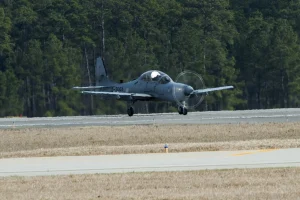
Photo: An A-29 Super Tucano from Nigeria's order taxis at Moody Air Force Base, Georgia, before the September 2021 ferry flight. Credit: U.S. Air Force / Senior Airman Rebeckah Medeiros, public domain, via Wikimedia Commons. Credit: U.S. Air Force photo by Senior Airman Rebeckah Medeiros (per Commons description), Public domain (US Government work), via Wikimedia Commons.
Direct answer
Nigeria’s A-29s have flown continuously since late 2021, mainly armed reconnaissance and precision strikes supporting ground troops. The Nigerian Air Force (NAF) said the fleet logged 10,000 flight hours by August 2024, over 8,500 of them operational, without a major incident. Kill claims come from the military and are unverified. No loss has been reported, and Nigeria has bought more US munitions but no more A-29s.
| System | A-29 Super Tucano light-attack turboprop (12 aircraft, six with a FLIR sensor turret) |
| Manufacturer | Embraer design; Sierra Nevada Corporation (SNC) US prime contractor, built in Jacksonville, Florida |
| Origin | Brazil / United States (supplied through US Foreign Military Sales) |
| Operator in this conflict | Nigerian Air Force, based at Kainji Air Force Base, Niger State |
| Period | Delivered July–September 2021; inducted 31 August 2021; in operational use to date |
| Evidence level summary | Delivery, training and flight hours: confirmed or officially stated. Strike results: officially claimed. Losses: none reported. Civilian harm linked specifically to the A-29: no public attribution found |
This article covers what happened after delivery; the procurement story is in our explainer on why Nigeria bought the A-29 Super Tucano. In short, Nigeria wanted a precision light-attack aircraft to replace ageing Alpha Jets, and Washington released it with weapons, training and base works attached.
Where was it used?
The first theatre was the North-East, where Operation Hadin Kai replaced Operation Lafiya Dole in April 2021 as the campaign against Boko Haram (JAS) and Islamic State West Africa Province (ISWAP). NAF statements reported by defenceWeb place A-29 strikes around Lake Chad, Gajiram, Kirta Wulgo and the Sambisa Forest in 2021–2022.
The second is the North-West and North-Central belt, where armed bandit groups operate from forest bases. Nigerian media reported in 2021 that the sale terms limited the aircraft to terrorist targets, and Sahara Reporters quoted US officials saying Washington had made its expectations “very clear”. In January 2022, after bandit groups were designated as terrorists, Attorney-General Abubakar Malami said Nigeria had obtained US clearance to use the A-29s against them. Africa Defense Forum, a US Africa Command publication, now describes the fleet as used against “bandits and other violent actors” as well as Boko Haram.
The aircraft fly from Kainji, where US-funded facilities were completed in 2023. Other types in the same campaigns are listed in our Nigerian Air Force aircraft inventory.

What was the mission?
The A-29 fills the gap between helicopters and fast jets: it can stay over a target area for hours, find targets with its own sensor and deliver guided weapons close to friendly troops. The US package included laser-guided APKWS rockets, Paveway II bomb kits, unguided munitions and .50-calibre guns.
NAF statements describe three tasks: armed reconnaissance over insurgent camps, interdiction of logistics (vehicles, fuel dumps, armouries) and close air support, including at night. Chief of Air Staff Air Marshal Isiaka Oladayo Amao was quoted by The Defense Post in 2022 as saying the aircraft could not end the insurgency without ground forces.
What does the public evidence show?
Most of what is known comes from the operator, and NAF statements after 2022 rarely name the aircraft used in a raid. The table lists events where a source names the Super Tucano.
| Claim / event | Date | Evidence level | Source |
|---|---|---|---|
| 12 aircraft delivered; 64 Nigerian pilots and maintainers trained at Moody AFB, Georgia | Jul–Sep 2021 | Confirmed | AFRICOM; Defense News |
| US civilian-harm mitigation seminar for NAF commanders, delivered as part of the A-29 case | 13–17 Sep 2021 | Confirmed (US Embassy) | BusinessDay |
| US officials state expectations on where the aircraft may be used | Oct 2021 | Independently reported | Sahara Reporters |
| ISWAP commander Abou Sufyan and “dozens” of fighters killed at Kusuma and Sigir, armoury and fuel dump destroyed | 5 Dec 2021 | Officially claimed | NAF, via defenceWeb |
| Senior ISWAP figures Malam Ari and Malam Buba Danfulani killed in separate strikes | Jan–Feb 2022 | Officially claimed | NAF, via The Defense Post and defenceWeb |
| Nigerian government says it obtained US clearance to use the A-29 against bandits | 4 Jan 2022 | Officially claimed (Nigerian government) | Sahara Reporters |
| Two A-29s hit Boko Haram camps in the Sambisa area, 49 fighters said killed at Gargash | 30–31 Aug 2022 | Officially claimed | NAF, via Vanguard and Africa Defense Forum |
| Fleet passes 10,000 flight hours, over 8,500 on operational day and night sorties, “without any major incident” | Aug 2024 | Officially claimed | NAF, via Africa Defense Forum and defenceWeb |
| US notifies Congress of $346m sale of 5,000 APKWS II rockets and Paveway II kits | 13 Aug 2025 | Confirmed (US notification); A-29 link is analysts’ assessment | defenceWeb |
| Loss of a Nigerian A-29 | — | None reported | No public report found |
Casualty numbers are the NAF’s; none has been confirmed by an independent body. The flight-hour figure is the most useful indicator: roughly 3,300 hours a year across twelve airframes means the fleet was flown hard.
What worked?
Availability. The strongest evidence of success is the flying record, not a kill claim. Sustaining 10,000 hours in three years with no reported loss indicates that the US maintenance model, contractor support and Kainji infrastructure worked, something many African air forces struggle to achieve with small new fleets.
Precision options. defenceWeb has written that the aircraft’s night and precision-delivery capability “enhanced NAF’s versatility”, and the 2025 request for 5,000 more APKWS II rockets suggests the weapons are being used and replaced.
Running cost. defenceWeb has cited about $1,000 per flight hour. That is not an official NAF figure, but it explains why turboprops suit long patrols.
What problems appeared?
Too few aircraft for two theatres. Twelve airframes, six with a FLIR sensor, must cover the Lake Chad basin and a North-West zone hundreds of kilometres away. ISWAP and bandit groups remain active in 2026, and the NAF has kept buying other strike platforms.
Conditions on use. The early limits on where the aircraft could fly, and US officers’ visits to evaluate use under the terms of sale reported by Sahara Reporters in January 2022, show that an FMS platform comes with political strings.
Civilian harm in the wider air campaign. Nigeria’s air campaign has a documented record of civilian deaths, but the best-known incidents do not involve the A-29:
- The January 2017 bombing of a displaced-persons camp at Rann, Borno, which killed dozens according to MSF, was carried out by an NAF jet before the A-29 arrived; it led the Obama administration to hold the sale.
- The December 2023 strike at Tudun Biri, Kaduna State, which killed at least 85 people according to Nigeria’s emergency agency, was described by Defence Headquarters as an army drone operation.
- In April 2026 an NAF strike hit Jilli market near the Borno–Yobe border, and in May 2026 a military strike hit Tumfa market in Zamfara; Amnesty International said at least 100 people were killed in each. The military denied civilian casualties at Tumfa. Reporting does not identify the aircraft type in either case.
DefenceMENA found no UN, Amnesty, HRW or major wire report attributing a specific civilian-harm incident to a Nigerian A-29, partly because the military seldom says which aircraft flew a strike. AP has counted more than 500 civilian deaths from Nigerian military air strikes since 2017.
Confirmed losses and limitations
No Nigerian A-29 has been reported lost to enemy fire or accident up to 30 September 2026. The NAF said in August 2024 that the fleet had flown 10,000 hours “without any major incident”, and DefenceMENA found no later credible report of a crash. That is an absence of public evidence, not proof of a perfect record.
The threat is real: in July 2021 bandits in Zamfara shot down an NAF Alpha Jet, whose pilot survived. Elsewhere, a Malian A-29 crashed near Sévaré on 7 April 2020, killing both pilots, in what Mali’s air force described as a loss of control on approach; that says nothing specific about combat survivability.
Structural limits remain: a small fleet, US-dependent weapons resupply and no published availability rate.
What is still disputed?
- Kill counts. Figures such as “49 terrorists” are NAF battle-damage claims that cannot be independently verified.
- Which aircraft flew which strike. Most NAF statements since 2022 do not name the type; social-media attributions to the Super Tucano are usually unsourced.
- US end-use terms. The wording is not public; accounts of the restriction and of the 2022 “clearance” come from Nigerian officials and press.
- Impact on the insurgency. Officials credit air power with driving insurgents from fixed camps and encouraging surrenders; no public study isolates the A-29’s contribution.
Did the manufacturer or operator change anything?
No Nigeria-specific hardware change has been published; the changes are around the aircraft. In August 2025 the US approved a possible $346 million sale of 5,000 APKWS II rockets, 1,002 GBU-12 bombs and 515 Paveway II kits; the notification names no platform, but defenceWeb assessed they are likely for the A-29 fleet. A US C-17 delivered undisclosed FMS cargo to Kainji and Lagos in September 2026, as we reported.
The human-rights debate moved to Nigeria’s next US purchase: in July 2021 Senators Jim Risch and Bob Menendez held a proposed AH-1Z sale over human-rights concerns, Foreign Policy reported. The sale later went ahead, and Bell has begun production of Nigeria’s AH-1Z Vipers.
Did other countries buy it afterwards?
Nigeria did not reorder the A-29. It bought twelve AH-1Z helicopters (see why Nigeria bought the AH-1Z Viper), ordered 24 Leonardo M-346FA jets, acquired ex-French Alpha Jets and T129 helicopters, and expanded its fleet of Chinese and Turkish armed drones. The overall picture is in Nigeria’s military strength in 2026.
Elsewhere, the only new African customer since 2021 is Togo; Africa Defense Forum cites the Nigerian fleet as context, but no source shows Nigeria’s experience caused the order. See also which African countries fly the A-29 Super Tucano.
| Country | A-29 order / delivery | Year | Source |
|---|---|---|---|
| Burkina Faso | 3 delivered; first African operator; flew joint strikes with French jets in 2019 | 2011 | defenceWeb; The Defense Post |
| Mauritania | First aircraft handed over; three expected | 2012 | defenceWeb |
| Angola | 6 ordered, first three delivered | 2013 | defenceWeb |
| Mali | 6 ordered (2015), 4 delivered; one lost in a 2020 accident | 2018 | defenceWeb |
| Nigeria | 12 delivered via US FMS | 2021 | AFRICOM |
| Undisclosed African customer | 4 ordered, announced by Embraer 31 Dec 2024 | 2024 | defenceWeb |
| Togo | 4 aircraft, reported at $82m (ADF) or €70m (Military Africa); believed to be the 2024 order | 2026 | Africa Defense Forum; Military Africa |
| Ghana | 2015 contract for 5 never took effect; 2024 demonstration, no contract | — | defenceWeb; Military Africa |
Embraer expects Africa to take about 28 percent of future A-29 sales, Military Africa reported in 2026. For alternatives, see light attack aircraft for African counter-insurgency air forces.
What does this mean for African procurement?
The package matters more than the airframe. Nigeria’s fleet flies because the purchase bundled training, spares, contractor support, guided weapons and base works. Buying the aircraft alone will not deliver the same availability.
Munitions are a supply chain. The 2025 request for thousands more guided rockets shows that precision strike consumes stock, and each US resupply passes through an approval process that can include congressional review.
End-use conditions shape operations. Every supplier, Western, Chinese, Turkish or Russian, attaches some conditions; Nigeria’s early limits show they can affect where a new asset is used.
Targeting discipline decides outcomes. A precision aircraft is only as accurate as the intelligence behind the target, so ISR, air-ground coordination and post-strike review matter as much as weapons.
Small fleets need complements. Nigeria’s later buys show one light-attack type cannot cover a country-sized counter-insurgency. Compare platforms in our military equipment database.
Battlefield file: 7 cards
Embraer-designed, SNC-built turboprops, six with FLIR, delivered July–September 2021.
Operation Hadin Kai from 2021; against bandit groups after the announced US clearance of January 2022.
Armed reconnaissance, interdiction and close air support with guided rockets and bombs.
High tempo is officially stated; individual kill claims remain unverified.
No Nigerian A-29 crash or shoot-down reported; small fleet, US-dependent resupply.
$346m US guided-weapons approval in 2025; diversification into AH-1Z, M-346FA and drones.
Training, spares, contractor support and base works explain the availability record.
FAQ
How many Super Tucanos does Nigeria have?
Twelve, delivered between July and September 2021. No loss or further order has been reported.
Is the Nigeria Super Tucano a jet?
No. The A-29 is a single-engine turboprop, often called a “jet” in Nigerian media. The propeller engine gives it long endurance and low running costs.
Where does Nigeria use the Super Tucano?
Mainly in Borno State and the Lake Chad area under Operation Hadin Kai, and in the North-West against armed bandit groups. The aircraft are based at Kainji Air Force Base in Niger State.
Can Nigeria use the Super Tucano against bandits?
According to Nigerian officials, yes. The government said in January 2022 that it had obtained US clearance after bandit groups were designated as terrorists. The exact US end-use terms have not been published.
Has Nigeria lost a Super Tucano?
No loss has been publicly reported up to 30 September 2026. The NAF said in August 2024 that the fleet had flown 10,000 hours without a major incident.
Sources
- AFRICOM, A-29 Super Tucano inducted into Nigerian Air Force (2021)
- Defense News, Nigerian Super Tucanos ready to fight (Aug 2021)
- BusinessDay, US guides NAF on civilian harm mitigation (2021)
- Sahara Reporters, US expectations on Super Tucano use (Oct 2021)
- Sahara Reporters, clearance to use Tucanos against bandits (Jan 2022)
- Foreign Policy, Congress pauses Nigeria arms sale (Jul 2021)
- The Defense Post, Is the Tucano a game changer? (Mar 2022)
- Vanguard, Super Tucano strikes in Sambisa (Sep 2022)
- defenceWeb, Insurgents scatter as Nigeria rules the air (Jan 2024)
- Africa Defense Forum, Super Tucanos reach flight-hour milestone (May 2025)
- defenceWeb, Nigeria requests \$346m of guided weapons (Aug 2025)
- CFR, Bandits shoot down Alpha Jet (2021)
- NPR, Strike hits displaced persons camp in Rann (Jan 2017)
- AP via PBS, Drone attack at Tudun Biri (Dec 2023)
- Euronews/AP, Air force strike on Jilli market (Apr 2026)
- GBC, Zamfara market air strike, Amnesty figures (May 2026)
- defenceWeb, Two dead in Mali Super Tucano crash (Apr 2020)
- The Defense Post, Burkina Faso A-29 joint operation (Jan 2020)
- defenceWeb, African customer orders four Super Tucanos (Jan 2025)
- Africa Defense Forum, Super Tucanos for Togo (May 2026)
Evidence note: strike results cited here are official Nigerian military claims; access to strike areas is very limited and the NAF rarely names the aircraft used. The absence of a reported A-29 loss or A-29-specific civilian-harm finding reflects the public record to 30 September 2026, not a verified clean record. This article will be updated at the same URL if significant new evidence appears.
More from Battlefield Proven
- Bayraktar TB2 in Libya: What Did Its Combat Use Actually Show?
- Sudan War Drones: What the Evidence Shows on SAF and RSF Since 2023
- Pantsir-S1 in Libya: What the Battlefield Record Revealed
- Drones in the Ethiopia War: What Is Confirmed and What Remains Unverified
- Wing Loong II in Libya: How Did China's Armed Drone Perform in Combat?
- Bayraktar TB2 and Akinci in Mali and Burkina Faso: What Combat Use Has Shown