Bell Textron has cut metal on the first of 12 AH-1Z Viper attack helicopters ordered by Nigeria, marking the start of a manufacturing phase worth $455 million inside a Foreign Military Sales package the United States approved in 2022. Delivery of the Vipers, originally targeted for July 2028, is now expected in early 2029.
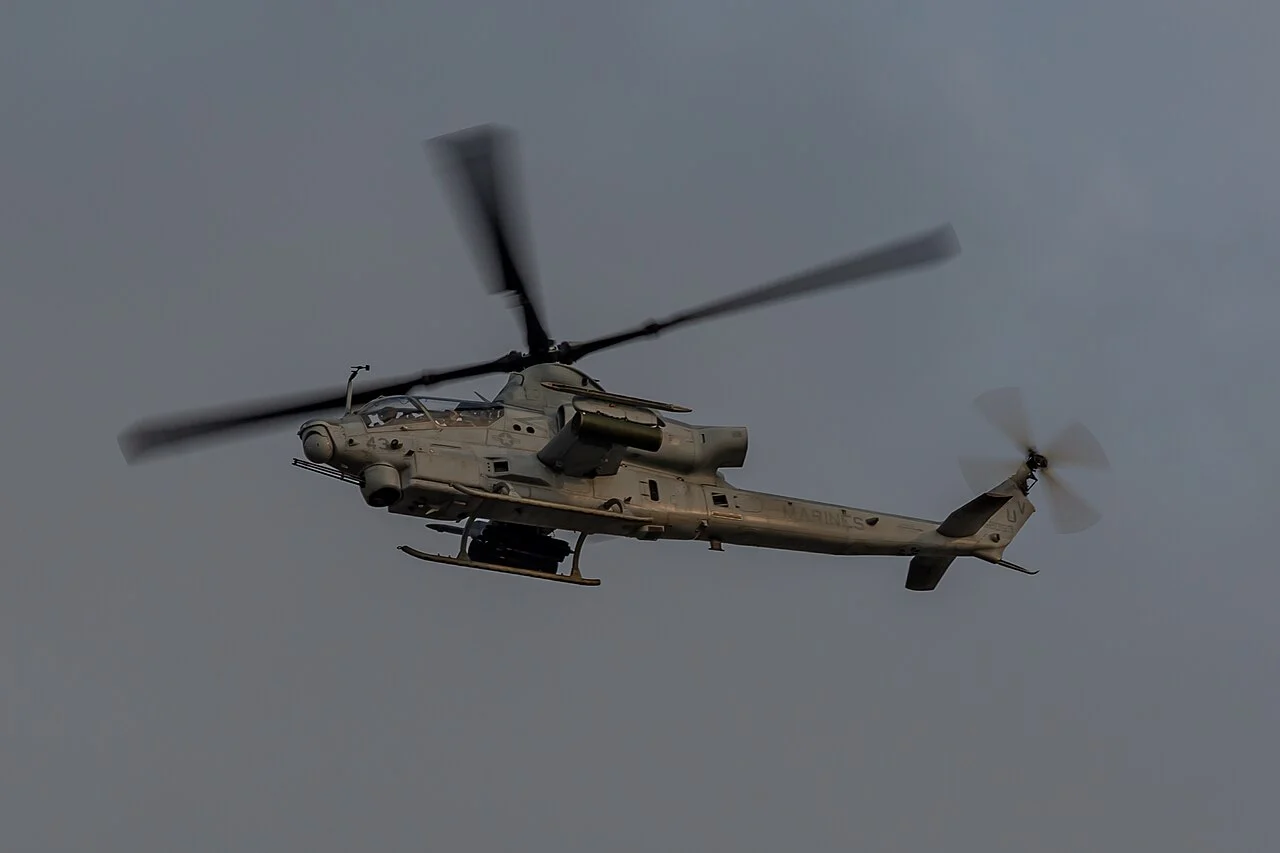
Photo: A US Marine Corps AH-1Z Viper in flight near Kadena Air Base. Credit: Balon Greyjoy, CC0, via Wikimedia Commons
Nigerian defence delegates travelled to Bell’s Amarillo Assembly Center in Texas on 16 September for a ceremonial signing of the first airframe, according to defenceWeb, which reported the milestone based on Bell and US programme office material. The visit formally opened production on a contract that has been years in the making: Washington cleared a possible sale of AH-1Z Vipers to Nigeria in April 2022, and the manufacturing phase itself was approved in 2024 under the FMS programme.
What the contract covers
The $455 million manufacturing award is a slice of a larger package once valued at close to $1 billion when first proposed. Beyond the 12 helicopter airframes, the Nigerian Air Force is receiving 28 T700-GE-401C engines, roughly 2,000 Advanced Precision Kill Weapon System (APKWS) laser-guided rocket kits, M197 20mm gun systems, sighting and night-vision equipment, plus engineering, programme management and logistics support from Bell. In August 2026, Bell separately received an $18 million award covering a flight-training device and initial spare parts, work due for completion by January 2029.
The AH-1Z is the latest-generation member of the Cobra/Viper family flown by the US Marine Corps, built around a four-blade rotor system, twin T700-series turboshafts and a sensor suite that lets it fire APKWS rockets, Hellfire and Joint Air-to-Ground Missiles. For Nigeria, it represents a jump in avionics and precision-strike capability over the Soviet-era gunships that have carried much of the Nigerian Air Force’s close air support burden for two decades.
Nigeria’s existing gunship fleet
The Nigerian Air Force currently flies a mixed fleet of roughly two dozen Mi-24V/P and Mi-35M/P Hind-series attack helicopters, workhorses of the long-running campaign against Boko Haram and the Islamic State West Africa Province (ISWAP) in the northeast, as well as banditry in the northwest. That fleet has been reinforced in the past two years by Turkish Aerospace’s T-129 ATAK, with the first pair delivered in late 2023 and additional airframes flown by the 115th Special Operations Group at Port Harcourt — coverage detailed in DefenceMENA’s Nigerian Air Force inventory review.
The AH-1Z order sits alongside, rather than replaces, those platforms. Nigeria has also been procuring MD 530F Cayuse Warrior light attack helicopters for the Army and A-29 Super Tucano light attack aircraft for the Air Force, part of a deliberate strategy of running US, Turkish and Brazilian-designed platforms in parallel rather than committing to a single supplier — a pattern DefenceMENA has tracked with the Super Tucano buy and set out in its broader assessment of Nigeria’s military strength.
A slow-moving but symbolically important sale
The AH-1Z case illustrates how long a major African FMS sale can take to move from approval to hardware. Congress cleared the possible sale in 2022; the manufacturing contract followed only in 2024; and airframes will not reach Nigeria until 2029 at the earliest — a seven-year span from first approval to delivery. That timeline reflects both Bell’s production backlog for the US Marine Corps and export customers, and the multi-stage nature of FMS contracting, where separate awards cover training devices, spares and the aircraft themselves.
For Washington, the sale reinforces a security relationship with Abuja that has also included recent equipment deliveries: a US Air Force C-17 flew FMS equipment into Lagos and Kainji for the Nigerian Air Force in September, part of the same broader counterterrorism support relationship.
Why it matters for Africa
Nigeria’s incremental build-up of a modern attack helicopter fleet is one of the clearest examples on the continent of a multi-supplier procurement strategy applied to rotary-wing airpower. Where many African air forces depend on a single legacy supplier for gunships — typically Russian Mi-24/Mi-35 variants acquired decades ago — Nigeria is now running Russian, Turkish and, from 2029, American attack helicopters side by side, each procured for a distinct role and budget line rather than as a wholesale fleet replacement.
The AH-1Z’s precision-strike sensors and APKWS rocket kits also point to a broader shift among African militaries fighting insurgencies in populated areas: a premium on standoff, precision-guided ordnance over the unguided rockets and cannon fire that dominate older Hind-series operations, in part to reduce civilian casualties during close air support missions over towns and villages in the Lake Chad Basin and northwest Nigeria. Other regional air forces weighing gunship modernisation — from Chad to Cameroon — are likely to watch how Nigeria absorbs three distinct attack helicopter types into one air force’s maintenance and training pipeline.