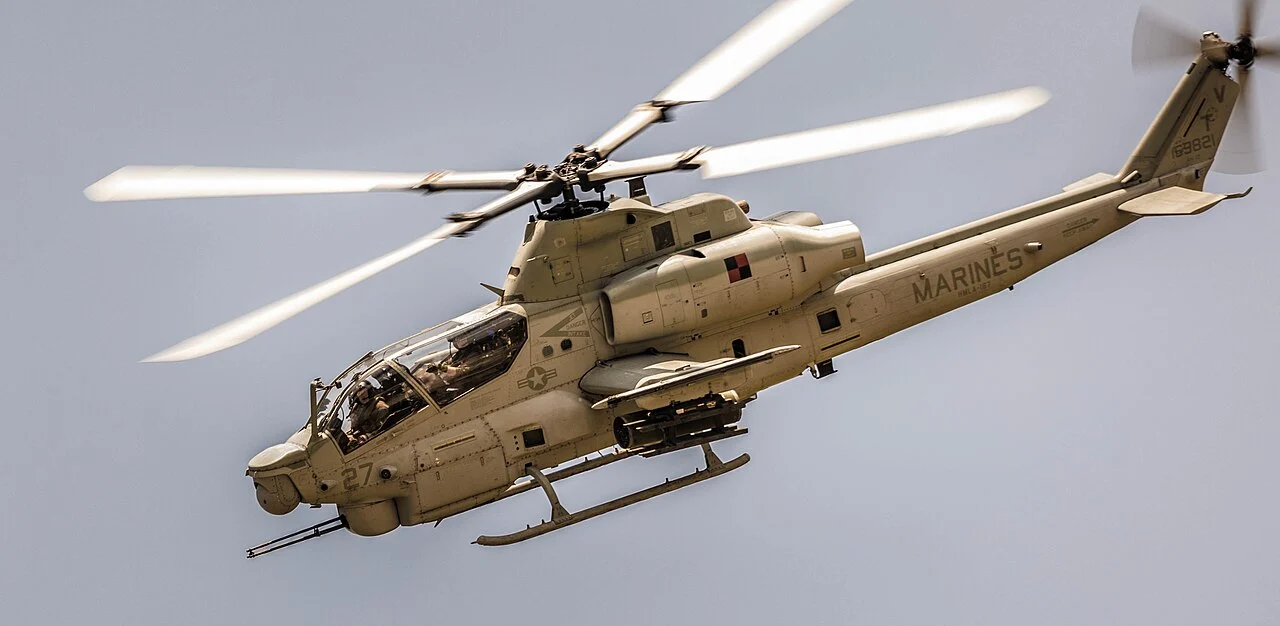
Nigeria bought twelve AH-1Z Vipers because its air force wanted a US-standard, precision-capable attack helicopter for counter-terrorism and counter-insurgency operations, and because Washington, after a hold in 2021, approved a Foreign Military Sale in April 2022 that bundled the aircraft with guided rockets, night-vision and electronic-warfare equipment and targeting-process training. The route was a government-to-government FMS case, not an open competition. The US notification carried a ceiling of $997 million; Bell received a $455 million contract for the aircraft in March 2024; production began in September 2026. No helicopter has yet been delivered, so there is no operational record to assess.
Photo: A US Marine Corps AH-1Z Viper in flight (the type Nigeria has ordered; no Nigerian-marked aircraft has been photographed in service). Credit: Cpl. Ethan R. Jones, U.S. Marine Corps (public domain).
This explainer follows one question: why did this African customer choose this system? The answer below comes from US government notifications, contract announcements, Bell statements, Nigerian Air Force statements and named reporting. Where the record is silent, this article says so rather than filling the gap with a plausible motive.
| Item | What the record shows | Status |
|---|---|---|
| Customer | Nigerian Air Force (NAF) | Confirmed |
| System | Bell AH-1Z Viper twin-engine attack helicopter | Confirmed |
| Quantity | 12 aircraft, 28 T700-GE-401C engines (24 installed, 4 spare) | In production |
| Route | US Foreign Military Sales (FMS), government to government | Confirmed |
| US approval ceiling | $997 million (notified 14 April 2022) | Ceiling, not price paid |
| Aircraft contract | $455 million to Bell Textron, announced 12 March 2024 | US DoD announcement |
| Production start | 16 September 2026, Amarillo, Texas | Bell statement |
| Scheduled completion | Early 2029 (the March 2024 announcement said July 2028) | Bell projection |
| Deliveries to Nigeria | None reported | Not yet |
| Local production | None documented | — |
What capability did Nigeria need?
Nigerian and US statements point to the same requirement: armed reconnaissance, close air support and escort for operations against jihadist groups and armed gangs. After the beam-signing ceremony at Bell’s plant in September 2026, Air Commodore Ehimen Ejodame, the NAF spokesperson, said the AH-1Z “will play an important role in strengthening our counterterrorism and counterinsurgency operations” (as reported by defenceWeb). Chief of the Air Staff Air Marshal Sunday Aneke called the acquisition “an important milestone” toward a “more capable, professional and mission-ready” air force (BusinessDay).
The US notification framed the sale as supporting “the foreign policy goals and national security objectives of the United States by improving the security of a strategic partner in Sub-Saharan Africa” (as quoted by ICIR). That is Washington’s stated rationale. Nigeria has not published a requirements document or an explanation of why an attack helicopter of this type, rather than another, met the need.
What did the Air Force operate before?
According to defenceWeb, the NAF already flies Russian-built Mi-24 and Mi-35 gunships and received six Turkish Aerospace T129 ATAK helicopters, the first two in November 2023 and the batch by February 2024. The Nigerian Army separately ordered twelve MD 530F Cayuse Warrior light helicopters from MD Helicopters. The AH-1Z therefore does not replace a single retiring type in the record; it joins existing attack and armed-reconnaissance fleets. See our Nigerian Air Force aircraft inventory for the current fleet, and our Nigerian Army weapons list for the MD 530F.
Procurement timeline
| Stage | Date | What happened | Source |
|---|---|---|---|
| Requirement | Unknown | Date and content of the NAF requirement not published | Unknown |
| Talks and hold | 2021 | US lawmakers halted the proposed sale, citing human rights concerns | ICIR |
| Selection / approval | 14 Apr 2022 | DSCA notifies Congress of a possible $997 million sale of 12 AH-1Zs plus equipment, weapons, training and support | Defense Daily; ICIR; Janes |
| Payment | Aug 2023 (one report says Jan 2024) | Nigeria makes its first payment; US sources cited by defenceWeb give August 2023, The Defense Post reports January 2024 | defenceWeb; The Defense Post |
| Mission computers | 19 Dec 2023 | Northrop Grumman awarded a $7.7 million contract for 32 H-1 mission computers supporting Nigerian aircraft | defenceWeb; The Defense Post |
| Contract | 12 Mar 2024 | US Navy contracting awards Bell $455 million for 12 AH-1Z, with engineering, programme management and logistics support | defenceWeb; Airforce Technology |
| Training device | 26 Aug 2026 | Bell awarded about $18 million for one AH-1Z flight training device and an initial spares kit, completion January 2029 | The Defense Post |
| Production start | 16 Sep 2026 | Beam-signing ceremony at Amarillo with an NAF delegation led by Air Marshal Aneke | Bell; defenceWeb; BusinessDay |
| Delivery | Early 2029 (projected) | Production completion date; no handover date announced | defenceWeb; Bell |
| Service entry | Unknown | Not scheduled in public sources | Unknown |
| Additional order | — | None found | Unknown |
The gap between approval (April 2022) and contract (March 2024) was nearly two years, and the gap to first delivery will be close to seven years from notification if the 2029 projection holds. The record does not say how much of that reflects US clearance, Nigerian payment timing or production sequencing.
What was purchased?
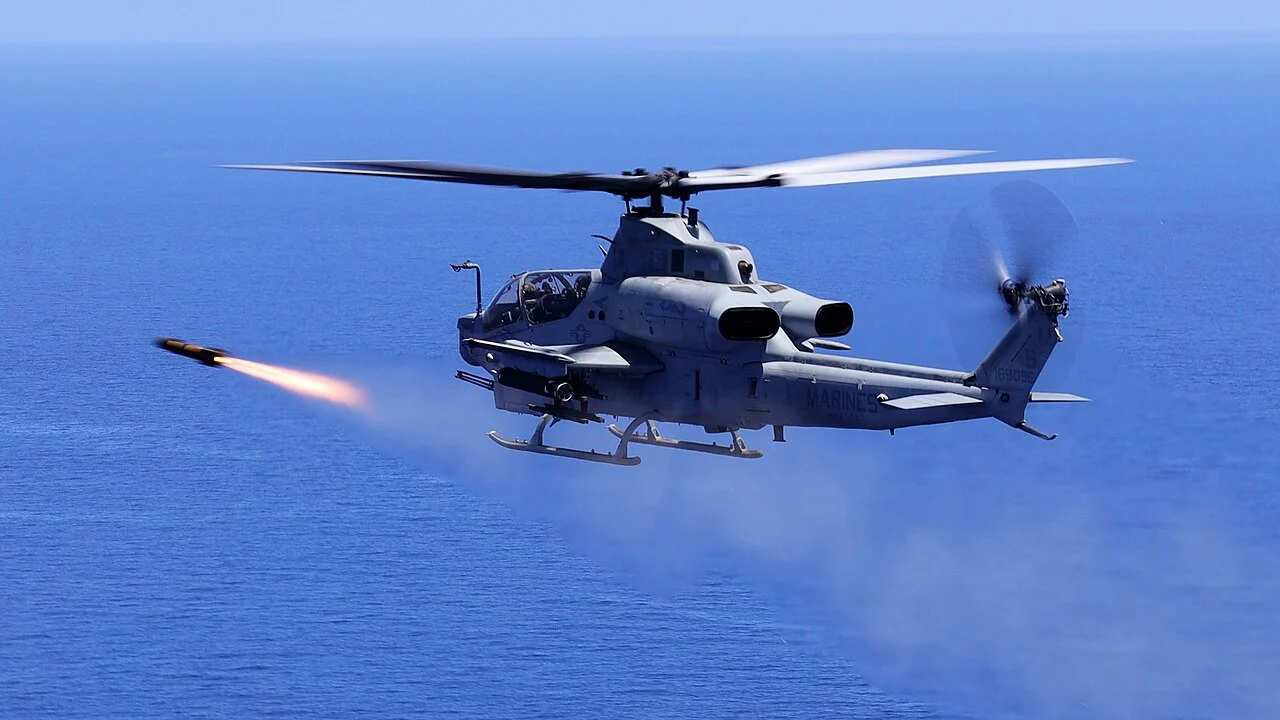
According to Defense Daily and Janes, the notified package is 12 AH-1Z helicopters; 28 T700-GE-401C engines (24 installed, 4 spare); 2,000 BAE Systems APKWS guidance sections (which turn unguided 70 mm rockets into laser-guided ones); night vision cueing displays; AN/AVS-9 night-vision goggles; communication equipment; electronic warfare systems; commercial-variant GPS; M197 20 mm cannons; Target Sight Systems; spare engine containers; spares, tools, test equipment, technical data and logistics support. The FMS case also carries $25 million for institutional and technical assistance to help develop targeting processes compliant with international humanitarian law. Bell’s description of the type adds that it can operate from forward facilities with a small logistical footprint. Hellfire or JAGM missiles are not listed in the notified package as reported.
What did it cost?
| Figure | What it is | Source |
|---|---|---|
| $997 million | Estimated maximum programme value in the April 2022 notification: aircraft, engines, weapons, equipment, training, spares and support | Defense Daily; ICIR |
| $455 million | US DoD contract to Bell (12 March 2024) for production and delivery of the 12 aircraft, engineering, programme management and logistics support | defenceWeb; Airforce Technology |
| $7.7 million | Northrop Grumman contract, December 2023, for 32 mission computers | The Defense Post |
| About $18 million | Bell contract, August 2026, for one flight training device and an initial spares kit | The Defense Post |
| $25 million | Funding inside the FMS case for targeting-process assistance | Janes; defenceWeb |
| Amount Nigeria has paid | Not disclosed; a first payment is reported | Unknown |
These figures measure different things and should not be added together or divided by twelve. The $455 million contract covers only part of the $997 million ceiling, and the remainder is not itemised publicly, so no reliable unit price for a single helicopter can be derived. How Nigeria is financing the purchase is not stated in the sources reviewed.
Why was the system selected?
| Factor | Evidence | Strength |
|---|---|---|
| Counter-terrorism and counter-insurgency mission | NAF spokesperson and Chief of the Air Staff statements, September 2026 | Official Nigerian statement |
| Precision weapons | 2,000 APKWS guidance sections and a Target Sight System in the package; $25 million targeting-process assistance | Documented package content; motive is an inference |
| US strategic partnership and interoperability | DSCA language on regional stability and interoperability with Western partners | Official, but the US government’s framing |
| Ability to absorb the system | DSCA said Nigeria would have “no difficulty absorbing the equipment and services” (as quoted by ICIR) | Official US assessment |
| Price | No published comparison with other helicopters | Unknown |
| Local production or technology transfer | None documented | Not a factor on the record |
| Why the Viper rather than another type | No Nigerian evaluation published | Unknown |
The record establishes the mission and the package. It does not establish why Nigeria preferred this helicopter to other types, and this article does not supply a motive that the sources do not.
Were alternatives considered?
| Category | Aircraft | Evidence |
|---|---|---|
| Confirmed competitor | None found | No public tender or head-to-head evaluation located |
| Reported alternative | Unspecified other helicopter types | Janes wrote in April 2022 that Nigeria “may be considering other helicopter types” to fulfil the requirement; it named none |
| Parallel purchases, not competitors | Turkish Aerospace T129 ATAK (six delivered), Mi-35 gunships already in service, MD 530F for the Army (12 ordered) | Bought or operated alongside the AH-1Z; no source presents them as rivals in one evaluation |
| Theoretical same-class alternatives | Other Western or non-Western attack helicopters | Same broad role; no evidence Nigeria evaluated them for this requirement |
It would be wrong to say Nigeria “chose the AH-1Z over” any named helicopter. The T129 and the Viper were procured in the same period, which suggests complementary buying rather than a contest, but the sources do not state Nigeria’s reasoning.
Training and support
The August 2026 Bell contract provides one AH-1Z flight training device and an initial spares kit, to be completed by January 2029 (The Defense Post). The notified package includes training and support, but the sources reviewed do not say where or when Nigerian pilots and maintainers will train, how many will be trained, or whether US field service representatives will be based in Nigeria. The Nigerian Air Force has no prior experience of the AH-1Z, and the training pipeline is therefore an open item to watch. The separate $25 million assistance line addresses targeting processes and international humanitarian law compliance rather than flying training.
Delivery and operational service
| Claim | Who made it | Grade |
|---|---|---|
| Production began 16 September 2026 at Amarillo | Bell | Manufacturer |
| Production completes in early 2029 | Bell, via defenceWeb | Manufacturer projection |
| Contract completion July 2028 (March 2024 announcement) | US DoD, via defenceWeb | Official; since revised by Bell |
| Aircraft will strengthen counter-terrorism operations | NAF spokesperson | Official statement of intent |
| Delivery, service entry, combat use | — | None reported |
No aircraft has been handed over, so there are no flight-hour, availability or combat figures. Any claim about the Viper’s performance in Nigerian service would be unverified.
Industrial cooperation
None is documented. The aircraft are built at Bell’s Amarillo Assembly Center in Texas under a US Navy-managed contract, and the training device is built in Broken Arrow, Oklahoma, and Fort Worth, Texas. No Nigerian assembly line, local content commitment or in-country maintenance-repair-overhaul centre appears in the notification, the contract announcements or Bell’s statements. Any claim that Nigeria will “produce” or “maintain” the AH-1Z domestically goes beyond the record.
Was it a good fit? Documented trade-offs
| Dimension | Evidence in favour | Trade-off or open question |
|---|---|---|
| Mission | Multi-mission attack helicopter for close air support, escort and reconnaissance; matches the stated counter-insurgency requirement | Twelve airframes is a small fleet for operations across several regions |
| Precision | APKWS-guided rockets, 20 mm cannon and a target sight system | Effect on civilian harm in Nigerian use cannot be assessed before delivery |
| Environment | Bell cites operation from forward facilities with a minimal logistical footprint | Performance in Nigerian heat, dust and rainy season is not documented |
| Support | Engineering, logistics and spares are in the contract; a training device is on order | Long-term sustainment and munitions resupply arrangements are not public; the NAF will run several attack-helicopter types with separate support chains |
| Political | US approval and a $25 million targeting-assistance line | The sale was held in 2021 over human rights concerns; further US conditions, if any, are not public |
How it compares with same-class alternatives
A specification comparison would mislead, because Nigeria published none and the aircraft serve different niches. The Defense Post lists the AH-1Z at a maximum speed of about 411 km/h, a range of about 685 km and a two-person crew, armed with the M197 cannon, Hydra 70 rockets, Hellfire and JAGM missiles and Sidewinder missiles in the wider US configuration. The Mi-35 is the Russian gunship long in NAF service; the T129 is Turkish Aerospace’s attack helicopter, now in NAF service; the MD 530F is a light armed helicopter ordered for the Army. What can be said from the record is that the NAF will operate helicopters from three different suppliers, and that the AH-1Z is the only one of these built to US Marine Corps standard. Operating-cost and availability comparisons are not established in public sources.
Africa-wide consequence
The sources reviewed identify no other African AH-1Z order, but none of them claims Nigeria is the first or only African customer, so that point should be treated as unverified. Nothing in the available evidence shows that Nigeria’s purchase has influenced other African buyers. The wider context is that Nigeria is buying across suppliers at the same time: The Nigerian Voice reports September 2026 deliveries of AW109 Trekker and H125 helicopters, and the country inventory and comparison with South Africa place these buys in regional context.
What happened next
The next observable steps are the first flight of a Nigerian-configured Viper, the delivery of the training device, the start of crew training and the first handover, none of which has a public date. Our production report is at Nigeria’s first AH-1Z enters production, and the rest of the helicopter buildup is covered in the NAF’s Leonardo and Airbus helicopter expansion. For an earlier US-sourced purchase with a full delivery record, see why Nigeria bought the Super Tucano.
FAQ
Why did Nigeria buy the AH-1Z Viper?
To strengthen counter-terrorism and counter-insurgency operations, according to the Nigerian Air Force. The US notification adds regional stability and interoperability with Western partners. Nigeria has not published why it preferred this type to others.
How much did the Nigeria AH-1Z deal cost?
The US approval ceiling is $997 million; Bell’s aircraft contract is $455 million; further contracts cover mission computers ($7.7 million) and a training device (about $18 million). These figures cover different scopes and no unit price is public.
When will Nigeria receive the Vipers?
Production began in September 2026 and is projected to finish in early 2029. No delivery date has been announced.
Was there a competition?
No public competition or named competitor has been found.
Does Nigeria assemble or maintain the AH-1Z locally?
No such arrangement is documented.
How many AH-1Zs is Nigeria buying?
Twelve helicopters and 28 engines, of which 24 are to be installed and four kept as spares.
Related reading
- Nigeria’s military strength in 2026 (country inventory)
- Nigerian Air Force aircraft inventory (operator page)
- Nigeria vs South Africa military power (comparison)
- Military equipment database
- Why Nigeria bought the Super Tucano (another US procurement)
- AH-1Z production start
Sources
- Defense Daily, State Department approves potential $997 million deal with Nigeria for 12 AH-1Z helicopters (14 April 2022)
- ICIR, US State Dept approves sale of AH-1Z attack helicopter to Nigeria (15 April 2022)
- Janes, Nigeria eyes Viper attack helos (19 April 2022)
- The Defense Post, US confirms $1 billion Viper attack helicopter sale to Nigeria (1 February 2024)
- defenceWeb, Bell awarded Nigerian AH-1Z Viper contract (March 2024)
- Airforce Technology, Bell Textron to provide 12 attack helicopters to Nigeria in $455m deal (March 2024)
- Africa Defense Forum, Nigeria to buy attack helicopters (October 2024)
- The Defense Post, US taps Bell for $18M Nigeria AH-1Z training deal (28 August 2026)
- Bell, Bell commemorates first production AH-1Z aircraft for Nigeria (16 September 2026)
- The Defense Post, Bell Textron starts Viper helicopter build for Nigeria (18 September 2026)
- defenceWeb, Bell begins Nigerian AH-1Z production (September 2026)
- BusinessDay, NAF moves to acquire 12 AH-1Z Viper attack helicopters from the US (September 2026)
- The Nigerian Voice, FG seals deal to acquire 12 US attack helicopters (22 September 2026)