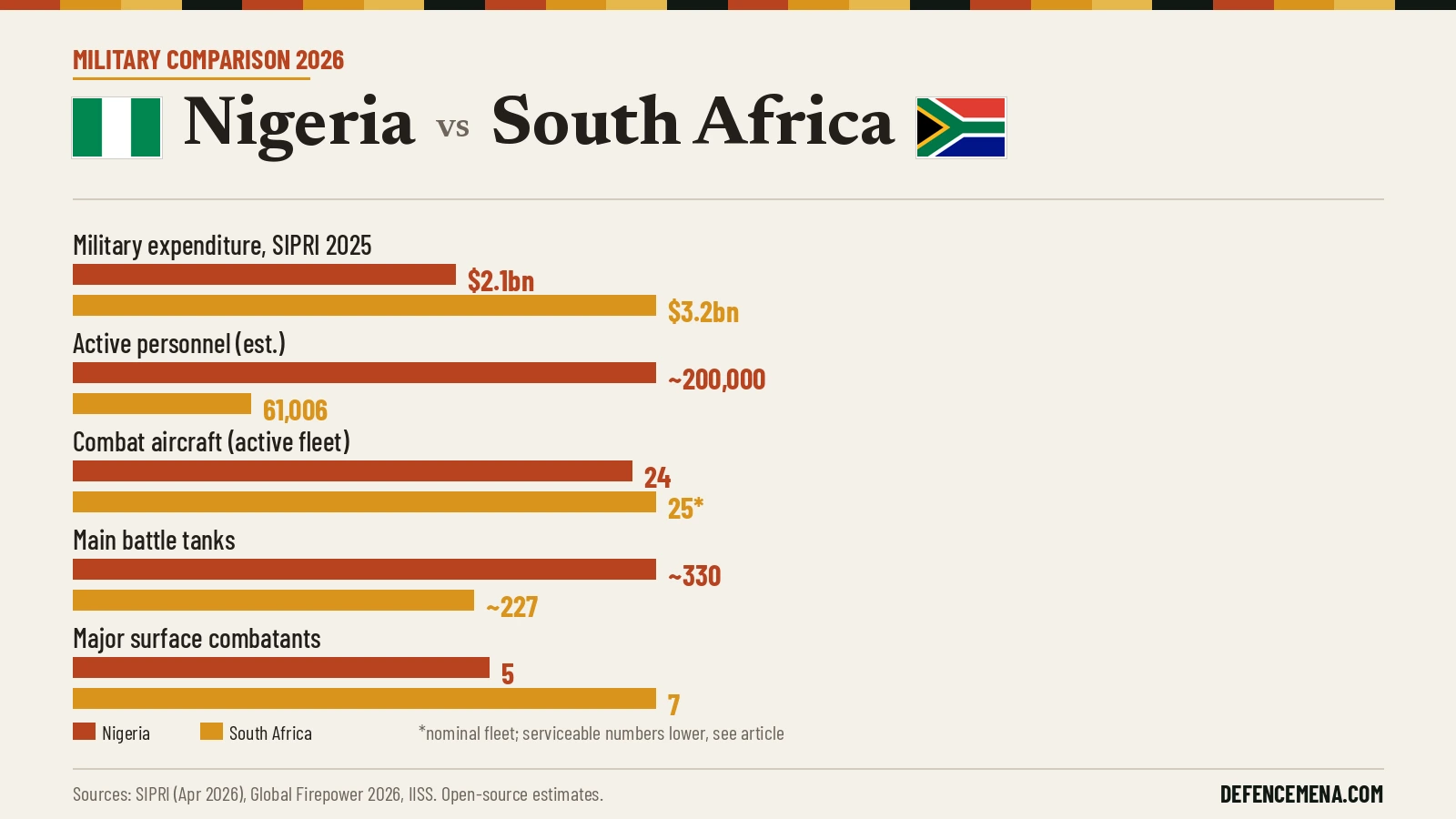
Africa’s two largest economies field very different armed forces: Nigeria’s is larger, older and built around a live counter-insurgency campaign, while South Africa’s is smaller, more advanced on paper, and hobbled by a well-documented maintenance crisis. This comparison sets budgets, personnel, air, land, naval and air-defence capability, drones, industry and suppliers side by side, using SIPRI’s 2025 data and official budgets wherever the two can be matched on the same basis.
DefenceMENA tracks both forces on dedicated Nigeria and South Africa desks, within our West Africa and Southern Africa coverage; country-strength profiles for both are in preparation and will be linked here once published.
Nigeria vs South Africa at a glance
| Metric | Nigeria | South Africa | Source / year |
|---|---|---|---|
| Military expenditure (SIPRI) | $2.1bn (+55% real, 2025) | $3.2bn (−1.2% real, 2025) | SIPRI, Apr 2026 |
| Official defence budget | ₦3.16 trillion (2026) | R57.2bn (2025/26 ENE) / ~R59bn revised | MoD / National Treasury |
| Active personnel | ~143,000–230,000 (estimated) | 61,006 Regular Force | IISS-derived / SANDF, Jun 2025 |
| Reserve / paramilitary | ~80,000 trained reserve; NSCDC ~63,000 | 8,386 Reserve Force; no paramilitary | Estimated / SANDF, 2025 |
| Main battle tanks | ~330 (Vickers Mk3, T-72, T-55, VT-4) | ~227 (Olifant Mk1A/1B/Mk2) | Estimated, open-source |
| Combat aircraft (active) | ~24–33 (JF-17, F-7Ni, Alpha Jet, A-29) | 25 Gripen C/D nominal; 13 serviceable | FlightGlobal 2026 / defenceWeb, Mar 2025 |
| Attack helicopters | ~15 Mi-35; 4–6 of 6 T129 ATAK delivered | 11 Rooivalk; ~2 operational | Estimated / defenceWeb, Mar 2025 |
| UAV/UCAV capability | Armed MALE (TB2, Wing Loong II, CH-3/4) | ISR only (Seeker family), no armed tier | Open-source, 2026 |
| Major naval vessels | 1 frigate, 2 corvettes, 2 large OPVs | 4 frigates, 3 submarines | Open-source, 2026 |
| Submarines | None | 3 Heroine-class (Type 209); typically 0–1 serviceable | defenceWeb, 2023–2025 |
| Air defence | Fragmented, point-defence, no long-range layer | Layered domestic GBADS programme, no long-range layer | Open-source, 2026 |
| Defence industry | DICON, nascent local assembly | Denel, Paramount, RDM, Hensoldt SA — most developed in Sub-Saharan Africa | Open-source, 2026 |
| GFP rank (auxiliary) | 33rd globally, 3rd in Africa | Not separately verified here | Global Firepower, 2026 |
Defence budgets
SIPRI’s Military Expenditure Database puts Nigeria’s 2025 spending at $2.1 billion, up 55% in real terms — the steepest rise in sub-Saharan Africa, driven by worsening insurgent and bandit violence. South Africa’s fell 1.2% to $3.2 billion, still the region’s largest single defence budget; SIPRI separately notes South Africa’s Auditor-General is investigating roughly $900 million in historical irregular Department of Defence spending. Neither SIPRI figure is identical to the country’s own budget line. Nigeria’s National Assembly approved a ₦3.16 trillion defence and special-operations vote for 2026 — up 2% nominally but down about 8.5% in real terms — with personnel costs alone consuming 76% of the total. Converted at the rate implied by the budget documents (~₦1,505/$1) that is close to $2.1 billion; at the government’s own planning rate (~₦1,400/$1) it is nearer $2.3 billion, a gap DefenceMENA flags rather than resolves.
South Africa’s National Treasury set Vote 23 (Defence) at R57.2 billion for 2025/26, later reported near R59 billion after an in-year revision tied to the DRC withdrawal’s cost; at a 24 September 2026 spot rate of roughly R16.41/$1, that is $3.5–3.6 billion. Compensation of employees (R36.7 billion) consumes most of the vote, leaving little for equipment or maintenance — a pattern recurring throughout this article’s serviceability figures. Treasury puts spending at 0.70% of GDP in 2025/26, down from 0.86% in 2021/22.
Personnel
Nigeria’s active tri-service strength is genuinely contested, ranging from roughly 143,000 to 230,000 depending on source; a commonly used IISS-derived figure sums to about 198,000 (army ~160,000, air force ~18,000, navy ~20,000). Reserve estimates diverge even more sharply — 80,000 trained reservists versus a theoretical mobilisation base of 1.8 million — and should not be treated as interchangeable. The paramilitary Nigeria Security and Civil Defence Corps self-reports over 63,000 personnel, unverified independently.
South Africa’s figures are better documented: SANDF reported a Regular Force of 61,006 and a Reserve Force of 8,386 as of 30 June 2025. Global Firepower’s 2026 index cites higher numbers (65,350 active, 15,050 reserve) that diverge notably, especially on reserves; treat GFP as auxiliary only. South Africa has no distinct paramilitary force — the Commando System was disbanded by 2008, its role absorbed into SAPS policing.
Air power
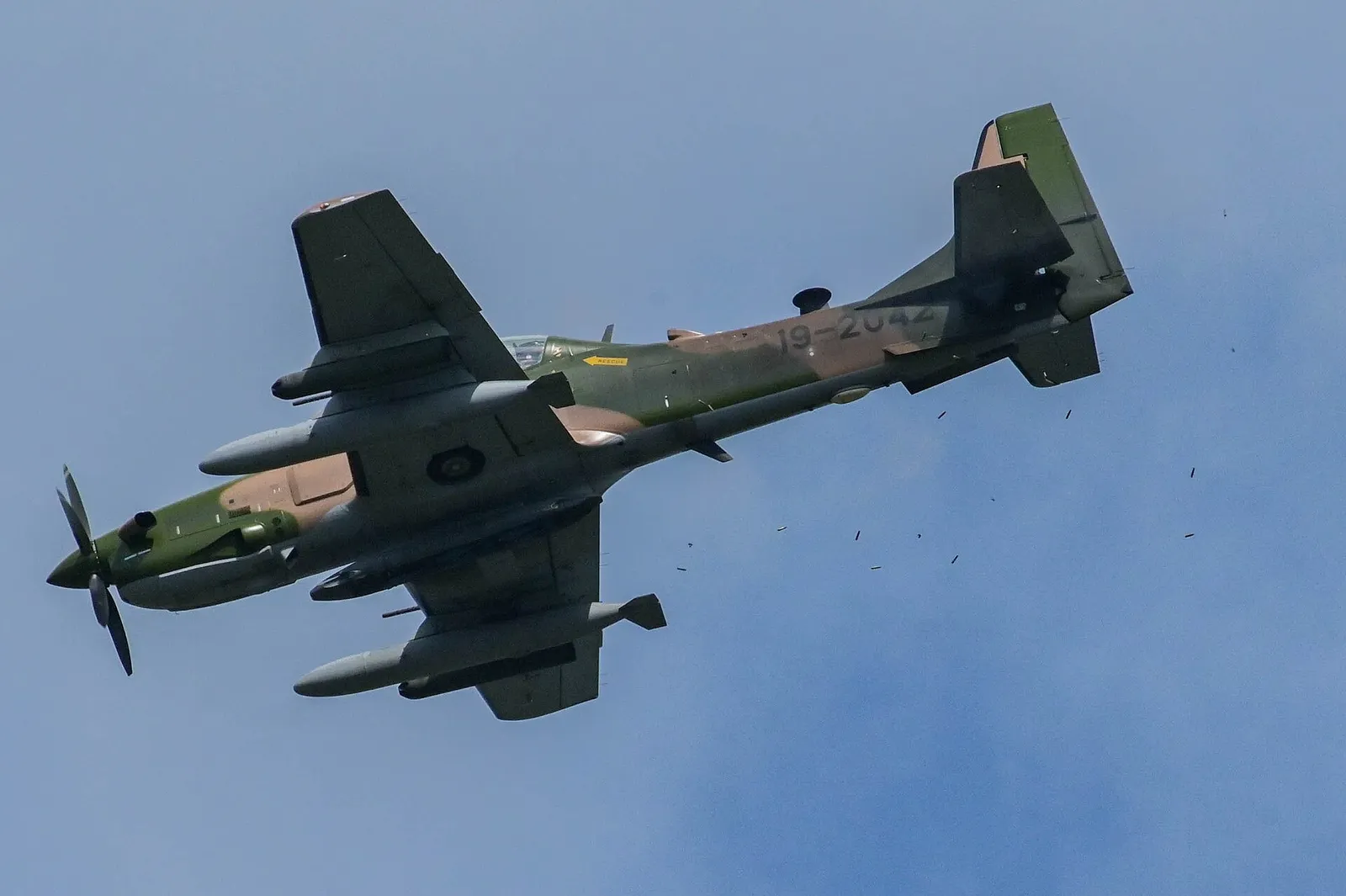
Nigeria’s combat fleet is larger but older and mixed in origin: 3 JF-17 Thunder, 5 F-7Ni, roughly 13 Alpha Jets flown in a light-attack role, and 12 A-29 Super Tucanos, plus the first of 24 M-346FA light combat aircraft (23 more on order). FlightGlobal’s 2026 directory rounds this to 24 “combat aircraft,” below a type-by-type tally of around 33, depending on whether dual-role trainers like the Alpha Jet count. Nigeria has no AEW&C or tankers. Its attack-helicopter fleet mixes roughly 15 ageing Mi-35s with a Turkish T129 ATAK order of 6 (4–6 delivered since 2023) and 12 Bell AH-1Z Vipers on order that only entered production in September 2026.
South Africa’s Saab Gripen C/D is more capable aircraft-for-aircraft but far less available: of 26 airframes (one written off), only 13 were covered by the Saab support contract that ran to August 2025, with serviceability at roughly half of that subset. The Hawk Mk120 trainer fleet fared better at ~71% availability. The indigenous Rooivalk numbers 11 airframes but only about 2 were operationally available in the latest reporting period, mainly for aircrew-currency reasons; three Rooivalks deployed to the DRC for years only returned home in 2025. C-130BZ transports showed 0% availability in the same window, and the C-47TP maritime-patrol Dakota has been grounded for three years. South Africa fields no AEW&C or tankers either.
Land forces
Nigeria’s tank park is larger and more varied: an estimated 172 Vickers Mk3 “Eagle” tanks — reported by Army Recognition as more reliable in the field than the country’s newer T-72s — alongside roughly 41 T-72 variants, 100 ageing T-55s and 17 Chinese VT-4s, its most modern type. Supporting armour includes BMP-1/2 IFVs, Streit Group and Saurer 4K4FA vehicles, mixed artillery, and light MLRS (APR-40, RM-70, BM-21). Ground-based air defence relies on ageing French Roland missiles, Strela-2 MANPADS and ZSU-23-4 guns.
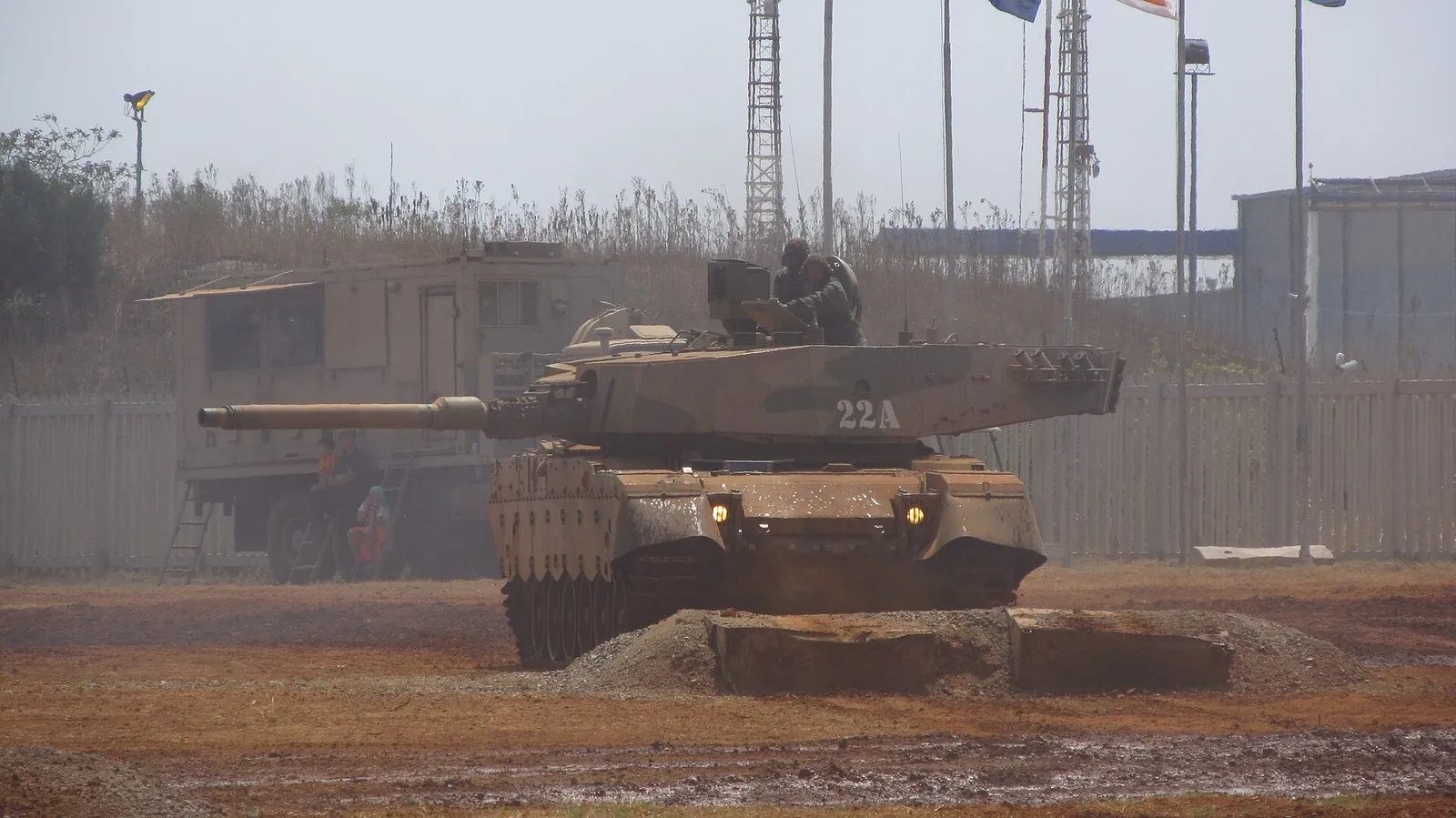
South Africa’s roughly 227 Olifant Mk1A/1B/Mk2 tanks are a heavily indigenised upgrade of an older British design. Its Ratel IFVs (estimated 434 active plus ~666 in reserve, though other reporting cites “500-plus”) and Rooikat — a wheeled fire-support vehicle, not a classic IFV — remain in service alongside Casspir and Mamba mine-protected vehicles. The real standout is indigenous artillery: the G5 towed and G6 self-propelled 155mm howitzers, combat-proven to 76km with rocket-assisted munitions, rank among the best in class, alongside the Valkiri/Bateleur MLRS and the locally developed ZT3 Ingwe anti-tank missile.
Naval power
Both countries have coastlines and active navies with very different profiles. Nigeria operates a single frigate, NNS Aradu, two China-built Centenary-class corvettes and two ex-US Coast Guard Thunder-class cutters, backed by roughly 31 smaller patrol and missile boats oriented toward Gulf of Guinea anti-piracy work; it has no submarines. Two Turkish-built DEARSAN OPV-76 patrol vessels are under construction.
South Africa’s fleet looks more capable on paper — four Valour-class (MEKO A-200) frigates and three Heroine-class (Type 209) submarines — but its serviceability record is one of the most consistently documented problems in African defence reporting. Parliamentary testimony in 2023 found only one of four frigates operational and no submarines serviceable; reporting through 2025 shows the same pattern, with refits on three of the four frigates overdue since 2012–15 and none of the submarines’ scheduled mid-life refits completed. The Navy says it needs R4.2 billion to clear the refit backlog and has received R1.4 billion; a submarine-survey contract was only awarded in October 2025. Project Biro, its patrol-vessel programme, was cut from six inshore and six offshore vessels to three inshore vessels only; one is delivered, two remain under construction.
Air defence
Neither country fields a long-range or strategic air-defence layer. Nigeria’s is fragmented, reliant on ageing 1980s-era French Roland missiles, Soviet-legacy MANPADS and guns, and a 36D6 surveillance radar, with no integrated national system; Nigerian Air Force leadership held talks with Turkey’s ASELSAN in September 2025 on radar upgrades and counter-drone measures, though this remains at the discussion stage, not a signed contract.
South Africa’s is smaller but more coherent: a phased, domestically designed programme combining a UK-sourced Starstreak short-range missile layer with Reutech’s Thutlwa mobile radar, an Oerlikon 35mm upgrade to Rheinmetall’s Skyshield standard, and eventual integration of the indigenous Umkhonto SAM, which today serves mainly aboard the Valour-class frigates rather than on land. Both amount to point-defence layers around key installations, not nationwide shields.
Drones and loitering munitions
Nigeria has moved decisively into armed drone warfare, procuring around 43 Turkish Bayraktar TB2s under “Project Guardian” alongside smaller numbers of Chinese Wing Loong II and CH-3/CH-4 armed drones. Domestic programmes — the Gulma, its Tsaigumi successor, and the DICON/UNICCON UNIKAM loitering-munition series — remain at prototype stage, so its operational drone fleet is overwhelmingly imported.
South Africa’s drone capability runs the other way: entirely domestic, built around Denel Dynamics’ Seeker family of tactical ISR platforms, with no confirmed armed or MALE-class UAV in service. The contrast reflects different threat environments — Nigeria fighting active insurgencies, South Africa facing no comparable internal conflict.
Turkish systems in the two inventories
Turkish equipment features prominently in Nigeria’s force but not at all, on current evidence, in South Africa’s — Nigeria has become the largest African buyer of Turkish arms in recent years, driven mainly by attack-helicopter purchases.
| System | Manufacturer | Quantity | Status | Role |
|---|---|---|---|---|
| Bayraktar TB2 | Baykar | 43 ordered | In delivery pipeline | Armed MALE UAV, ISR/strike |
| T129 ATAK | Turkish Aerospace | 6 ordered | 4–6 delivered since 2023 | Attack helicopter |
| OPV-76 patrol vessel | DEARSAN | 2 ordered | Under construction | Offshore patrol vessel |
| Radar / counter-UAS package | ASELSAN | Under discussion | Talks held Sept 2025, not signed | Air defence / C-UAS |
The appeal of Turkish equipment in Nigeria’s case is less about inherent superiority than about fit: shorter delivery timelines than some Western alternatives, price points suited to a stretched budget, and a growing regional support ecosystem as more African air forces adopt the same platforms. Nigeria’s Chinese Wing Loong II and CH-series drones perform a comparable role — the choice has tended to reflect financing and availability, not a clear capability gap. South Africa shows no meaningful procurement relationship with Turkish suppliers: Turkish firms exhibited prominently at the 2026 AAD show, but that is commercial interest, not a sale. For a fuller equipment breakdown, Turkish outlet Envanter Medya maintains an inventory tracker for the Nigerian armed forces.
Defence industry
Nigeria’s Defence Industries Corporation (DICON) is still rebuilding basic capacity: it resumed ammunition production in 2025, delivering 4 million rounds of 7.62mm to the army, and entered a joint venture with D7G/Gray Insignia for local assembly of armoured vehicles (BR6, several MRAP-Buffalo variants, a planned BMP-2 line) alongside a counter-drone system demonstrated with UNICCON. This is a genuine restart of domestic capability, not an established manufacturing base.
South Africa’s defence-industrial base is the most developed in Sub-Saharan Africa, though its flagship manufacturer has struggled. Armscor is the state procurement agency, not a manufacturer, and should not be confused with Denel, which has spent years in financial distress: revenue reached R1.4 billion in 2025/26 and its stake in Rheinmetall Denel Munition earned R716 million, but Denel’s workforce has collapsed from over 5,000 a decade ago to around 1,600. Alongside Denel sit Paramount Group, a private exporter of the Mbombe ICV and Marauder MRAP with licensed production in Kazakhstan and Azerbaijan; Reutech, the Stellenbosch radar house behind the Thutlwa air-defence radar; and HENSOLDT South Africa, the German sensor group’s largest manufacturing base outside Europe. Indigenous artillery (G5/G6), an indigenous SAM (Umkhonto) and an indigenous UAV (Seeker) give South Africa design depth Nigeria does not yet have.
Main suppliers
SIPRI’s arms-transfers data captures the two countries very differently. Nigeria does not appear among the 40 largest global arms recipients for 2021–25, but within sub-Saharan Africa it was the largest single recipient, taking 16% of subregional imports — ahead of Senegal (8.8%) and Mali (8.0%). China was the subregion’s leading supplier, delivering to 23 states with a 22% share, followed by Russia (12%) and Turkey (11%); Nigeria’s own supplier base spans China, Turkey, Pakistan, Italy and the United States.
| Sub-Saharan Africa arms imports, 2021–25 | Share |
|---|---|
| Nigeria (largest recipient in subregion) | 16% of subregional imports |
| Leading supplier: China | 22% (23 recipient states) |
| Russia | 12% |
| Turkey | 11% |
South Africa also falls outside SIPRI’s top-40 recipients list, but for a different reason: domestic production keeps its major-arms import volumes low. SIPRI instead lists it among the world’s arms exporters, ranked 18th globally with a 0.4% share (down 7.2% in volume against the previous five years). Its top export markets in 2021–25 were the UAE (39%), Singapore (19%) and the DRC (9.1%).
Modernisation and orders not yet in service
Nigeria’s pipeline includes 12 Bell AH-1Z Viper attack helicopters under a roughly $997 million US foreign military sale, production only starting in September 2026 with deliveries expected from late 2026 into 2029; 23 more M-346FAs beyond the single airframe delivered; two DEARSAN OPV-76 patrol vessels; and the remainder of its 43-aircraft TB2 order. A widely speculated JF-17 Block III order could not be corroborated.
South Africa’s near-term programme favours restoration over expansion: two of three Project Biro patrol vessels remain under construction, SAS Isandlwana’s frigate refit targets March 2026, and a submarine-refit contract from October 2025 reaches a second phase in December 2026. The Gripen fleet faces a 2026 inflection point as its GKN engine-support contract expires in July with no sustainment plan confirmed. No major new foreign procurement contract was identified as pending.
Geography and doctrine
Nigeria borders Benin, Niger, Chad and Cameroon and has an 853km Gulf of Guinea coastline encompassing the Niger Delta. Its force posture is shaped by ongoing internal conflict: Boko Haram/ISWAP in the northeast, banditry and the newly proscribed Lakurawa group in the northwest and north-central states, Niger Delta militancy, and Gulf of Guinea piracy driving the navy’s patrol focus. Human Rights Watch recorded more than 6,000 conflict-linked deaths in 2025. Recent procurement — light-attack aircraft, armed drones, attack helicopters, patrol vessels — reflects a force built for counter-insurgency and maritime constabulary duties, not conventional deterrence.
South Africa is a two-ocean state with roughly 2,800km of coastline and no land-border conflict. Its recent commitments have been regional peacekeeping: SANDF ended a 27-year UN mission contribution in the DRC with final withdrawal on 2 July 2026, a deployment that saw 14 soldiers killed by M23 and allied Rwandan-backed forces in January 2025 — one of the heaviest single losses of the democratic era, intensifying scrutiny of equipment readiness. South Africa also contributed to the SADC mission against Islamist insurgents in Mozambique’s Cabo Delgado until 2024. Its doctrine centres on territorial defence, regional peacekeeping under AU/SADC/UN mandates, and a growing domestic role backing police against illegal mining and organised crime.
What the numbers show
South Africa outspends Nigeria on SIPRI’s measure, but the trend lines run in opposite directions — Nigeria’s budget up 55% in a year against a worsening security picture, South Africa’s down 1.2% and under domestic scrutiny for historical irregular spending. South Africa fields the more sophisticated platforms on paper — a 4.5-generation fighter, MEKO-class frigates, Type 209 submarines — but a well-documented, multi-year funding shortfall means only a fraction is typically available at any time. Nigeria’s larger, older, more mixed-origin force trades sophistication for numbers and is built for the counter-insurgency and anti-piracy missions it is actually fighting, including an armed-drone capability South Africa has not pursued. South Africa, in turn, keeps the deeper defence-industrial base, with an internationally competitive exporter in Paramount Group and indigenous design (artillery, SAM, UAV) Nigeria’s still-nascent DICON has not matched.
Methodology and data notes
- Figures are drawn from Nigerian and South African official budget documents, SIPRI’s Military Expenditure and Arms Transfers fact sheets (April and March 2026), FlightGlobal’s World Air Forces directory, and defence-trade reporting including defenceWeb, Military Africa, IISS Military Balance analysis, and Army Recognition.
- SIPRI military expenditure and each government’s own official defence budget measure different things — SIPRI’s methodology is broader and includes items some national budgets classify elsewhere — and are reported separately rather than merged.
- Active, reserve and paramilitary personnel are kept separate. Where sources disagree by a wide margin, a range is given rather than a single figure.
- Equipment on order or announced but not yet delivered is listed under modernisation, not counted in active-inventory figures.
- Trainer aircraft are excluded from combat-aircraft totals even where a type, such as Nigeria’s Alpha Jet, also performs a light-attack role in practice.
- Global Firepower’s 2026 index is used only as an auxiliary, secondary data point and never as the primary or sole source for any figure in this article.
- “Major naval vessels” refers to frigates, corvettes, OPVs and submarines; smaller patrol and missile boats are counted separately and are not treated as a stand-alone measure of naval strength.
Sources
- SIPRI, “Trends in World Military Expenditure, 2025” (April 2026)
- SIPRI, “Trends in International Arms Transfers, 2025” (March 2026)
- National Treasury of South Africa, 2025 Estimates of National Expenditure, Vote 23 Defence
- Military Africa, “Nigeria’s defence budget hits record high but inflation eats the gains”
- Vanguard, “Defence, Special Operations get N3.15trn in 2026 budget”
- Nairametrics, “Nigeria’s military spending jumps 55% to $2.1 billion amid worsening insecurity”
- defenceWeb, “SA’s defence budget continues to shrink despite pledges and plans”
- Military Africa, “South African defence budget shrinks despite govt’s promises”
- TimesLive, “Average age of uniformed regular SANDF personnel is 39”
- Wikipedia, “List of equipment of the Nigerian Air Force”
- Wikipedia, “List of equipment of the Nigerian Army”
- Military Africa, “Nigeria takes delivery of second batch of T-129 ATAK”
- Army Recognition, “Baykar trains Nigerian drone pilots ahead of delivery of Bayraktar TB2 UCAVs”
- Army Recognition, “Nigeria AH-1Z Viper attack helicopter production begins at Bell”
- FlightGlobal, “Nigeria set to receive first three M-346FAs”
- Defence Turkey, “DEARSAN begins construction of $76m offshore patrol vessels for the Nigerian Navy”
- defenceWeb, “Nigeria’s DICON resumes ammunition production as it continues expansion”
- Military Africa, “DICON partners D7G to ramp up arms production”
- Human Rights Watch, World Report 2026: Nigeria
- defenceWeb, “Setting the record straight on SAAF aircraft availability”
- defenceWeb, “SAAF Rooivalks return from the DRC”
- defenceWeb, “Only one of SA Navy’s four frigates operational; no submarines serviceable”
- defenceWeb, “SAS Isandlwana refit due for completion next year; submarine refit a way off”
- GlobalSecurity.org, “Project Biro OPV/IPV”
- defenceWeb, “Further money for GBADS 2”
- Military Africa, “Denel unveils rotary-wing drone”