Measuring Kenya and Uganda’s Military Strength in 2026



Kenya and Uganda sit on opposite banks of Lake Victoria and both send large troop contingents abroad, into Somalia and the eastern DRC. Their armed forces have grown in different directions: Kenya leans on a US “major non-NATO ally” relationship and a first Israeli air-defence battery, while Uganda has built around Russian-supplied armour and jets plus a home-grown vehicle-manufacturing programme. This piece sets out what the Kenya Defence Forces (KDF) and the Uganda People’s Defence Force (UPDF) actually operate in 2026, and where the open-source numbers disagree.
Both countries have dedicated Kenya and Uganda desks on DefenceMENA, part of our wider East Africa coverage. Kenya’s force structure is covered in our Kenya military strength profile; a standalone Uganda profile is in production. Kenya has already featured in comparisons against Ethiopia and Tanzania, and both countries appear in our look at which African country has the biggest army.
Kenya vs Uganda at a glance
| Metric | Kenya | Uganda | Source / year |
|---|---|---|---|
| Official defence budget | Ksh252.15bn (~$1.95bn), FY2026/27 | UGX4.6tn (~$1.3bn) FY2026/27; regional press cites ~$1.9bn | Kenya MoD; Afridex / Defence24 (2026) |
| Military expenditure (SIPRI) | Not broken out at country level | Not broken out at country level | SIPRI Military Expenditure Database, Apr 2026 fact sheet (regional aggregates only) |
| Active personnel | ~24,000 (estimated) | ~45,000 (estimated) | Open-source trackers, 2025-26 |
| Reserve / paramilitary | ~10,000 reserve / ~5,000 paramilitary (estimated) | ~10,000 (reported as reserve or paramilitary; sources disagree) | GlobalMilitary.net, Global Firepower-style aggregators, 2026 |
| Main battle tanks | ~78 Vickers Mk3 operational; ~110 T-72 of uncertain status | ~239 (estimated), T-90S, T-72, T-55, Type 85-IIM | DefenceMENA Kenya data store; GlobalMilitary.net, Shephard Media (2026) |
| Combat aircraft | 17-23 F-5E/F Tiger II (sole fighter type) | ~6 Su-30MK2 | migflug.com fleet compilation; Daily Monitor (2026) |
| Attack helicopters | Up to 12 armed MD-530F Cayuse Warrior; ~2 AH-1F Cobra | 3+ Mi-28N/NE Havoc; legacy Mi-24s | Kenya MoD / Military Times; Wikipedia, Russian MoD reporting (2022-26) |
| UAV / UCAV | 6 Bayraktar TB2 (armed) + 3 Anka-S | One unnamed MALE-type UAV reported operational; no armed type confirmed | Military Africa, ADF Magazine; Janes (2024-26) |
| Major naval vessels | ~25 total craft (estimated); no frigates | Landlocked; Lake Victoria marine unit only | GlobalMilitary.net; globalsecurity.org (2026) |
| Submarines | None | None | – |
| Air defence | 1 SPYDER medium-range battery (2025) + legacy guns | Unspecified “modern” systems commissioned; legacy SA-3/MANPADS reported, unconfirmed | Military Africa, Army Recognition; New Vision (2025-26) |
| Defence industry | Kenya Ordnance Factories Corp.; Small Arms Factory, Ruiru | National Enterprise Corporation / Luwero Industries; Chui IFV line | mod.go.ke; nec.go.ug (2026) |
| Global Firepower rank (auxiliary) | ~12th in Africa (2026, secondary reproduction of GFP index) | 107th of 145 globally (2026) | Global Firepower 2026, via secondary reproductions |
All figures are open-source estimates unless marked “official.” Trackers disagree on several lines; see the methodology section below.
Defence budgets
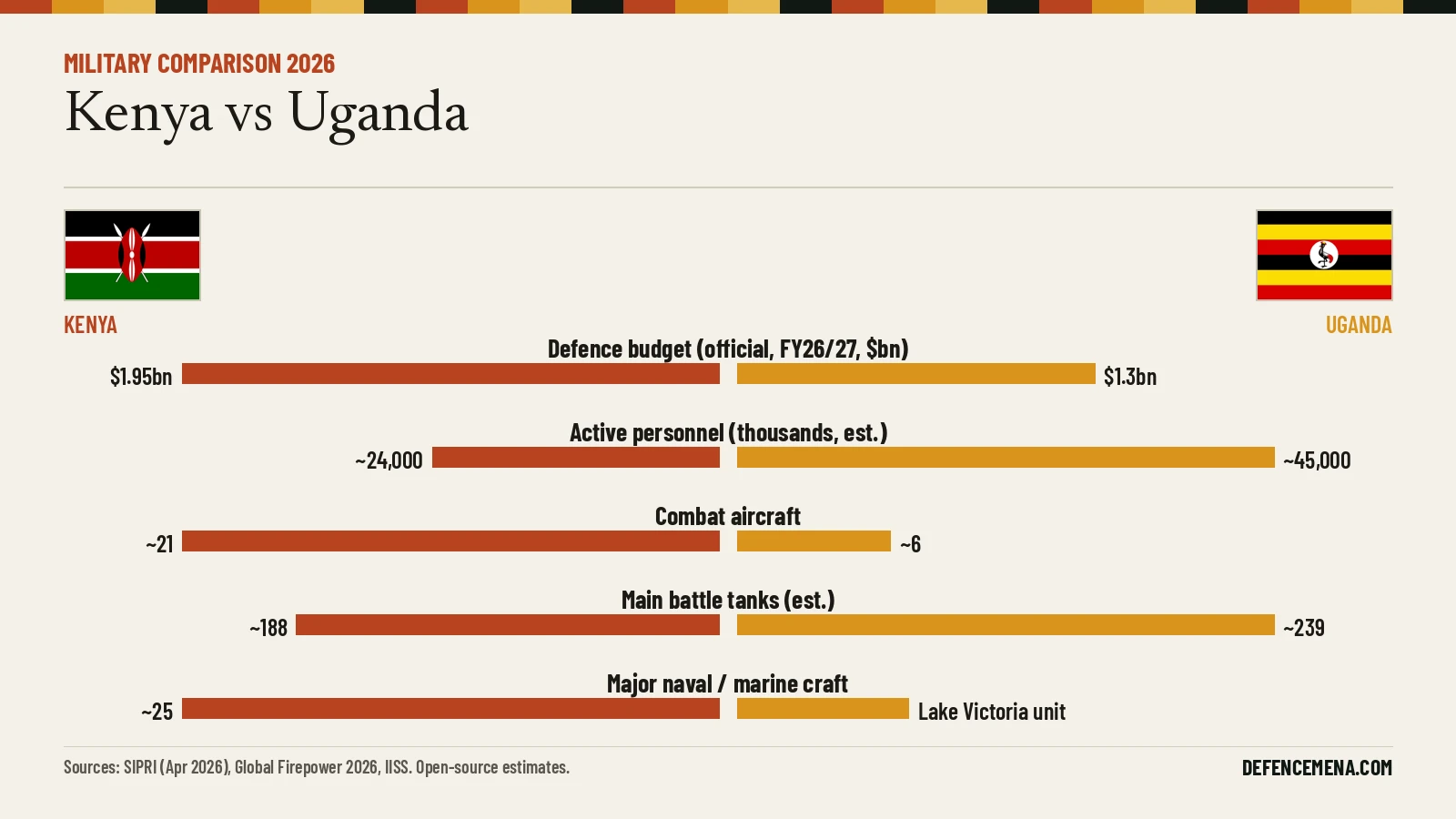
Kenya’s Ministry of Defence presented a FY2026/27 budget estimate of Ksh252.15bn, split between a Ksh235.5bn defence programme and a Ksh13.14bn defence-industrialisation line, equivalent to roughly $1.95bn – an official figure from the Defence Principal Secretary’s own presentation, not a SIPRI or Global Firepower estimate. Uganda’s position is murkier: Afridex reported a FY2026/27 allocation of UGX4.6 trillion for the Ministry of Defence and Veteran Affairs, about $1.3bn, out of an UGX84.39tn national budget, while regional press put total Ugandan defence spending closer to $1.9bn, up roughly 14% year-on-year. The gap likely reflects different scopes – the core ministry vote versus total security-sector spending, including NEC commercial activity – rather than a real disagreement over Uganda’s defence effort. Neither country has its own line in SIPRI’s Apr 2026 Military Expenditure Database fact sheet, which publishes regional rather than individual sub-Saharan African totals; the official national budget figures used above are a different, generally more complete measure than SIPRI’s own-sourced estimate, and the two should not be read as interchangeable.
Personnel
Open-source trackers put Kenya’s active force at around 24,000 and Uganda’s at roughly 45,000, nearly double, though neither government publishes an official order of battle and the figures have stayed “essentially unchanged for a decade” across IISS- and CIA-style compilations, per DefenceMENA’s own cross-country army-size research. Reserve and paramilitary numbers are reported inconsistently: Kenya is usually split into a reserve component of around 10,000 and a paramilitary (General Service Unit-type) component of around 5,000, while Uganda’s roughly 10,000 additional personnel are called reserves by some trackers and paramilitary by others, with no UPDF-published breakdown to settle it. Active, reserve and paramilitary totals should never be summed into one headline figure – they carry different training, equipment and legal status.
Air power
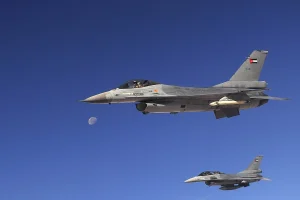
Kenya’s combat fleet is a single, ageing type: the Northrop F-5E/F Tiger II, upgraded locally to F-5EM/FM standard, with open-source counts of 17 to 23 airframes (working estimate ~21) at Laikipia Air Base. No replacement is in service. India pitched the Tejas Mk1A in January 2026 with no financing agreed, and a recycled “Sh41.8bn US attack aircraft sale” figure traces to a 2017 DSCA notification for Air Tractor AT-802Ls never confirmed delivered – not a new order. Transport includes three C-27J Spartans (2020), Dash 8s, Harbin Y-12s being retired after crashes, and PZL M28/C-145A Skytrucks. The helicopter fleet centres on roughly 40 MD-500/MD-530F Cayuse Warriors, up to 12 armed under a US IDIQ contract, plus Pumas, light Airbus types, six Chinese Z-9s and a reduced UH-1H Huey fleet. Trainers (Grob G120TP/G120A) are kept out of the combat total.
Uganda’s air arm has fewer types but a heavier core asset: six Su-30MK2 multirole fighters bought from Russia in 2011 for a reported $740m, maintained since 2022 under a memorandum with India’s HAL. Attack-helicopter capability rests on at least three Mi-28N/NE Havoc gunships delivered in June 2022 (sources differ on the exact variant name), backed by older Mi-24s and Mi-17 transports. A Let 410 transport was reported commissioned in July 2026, airframe count unstated. Neither air force fields airborne early warning or a dedicated tanker.
Land forces
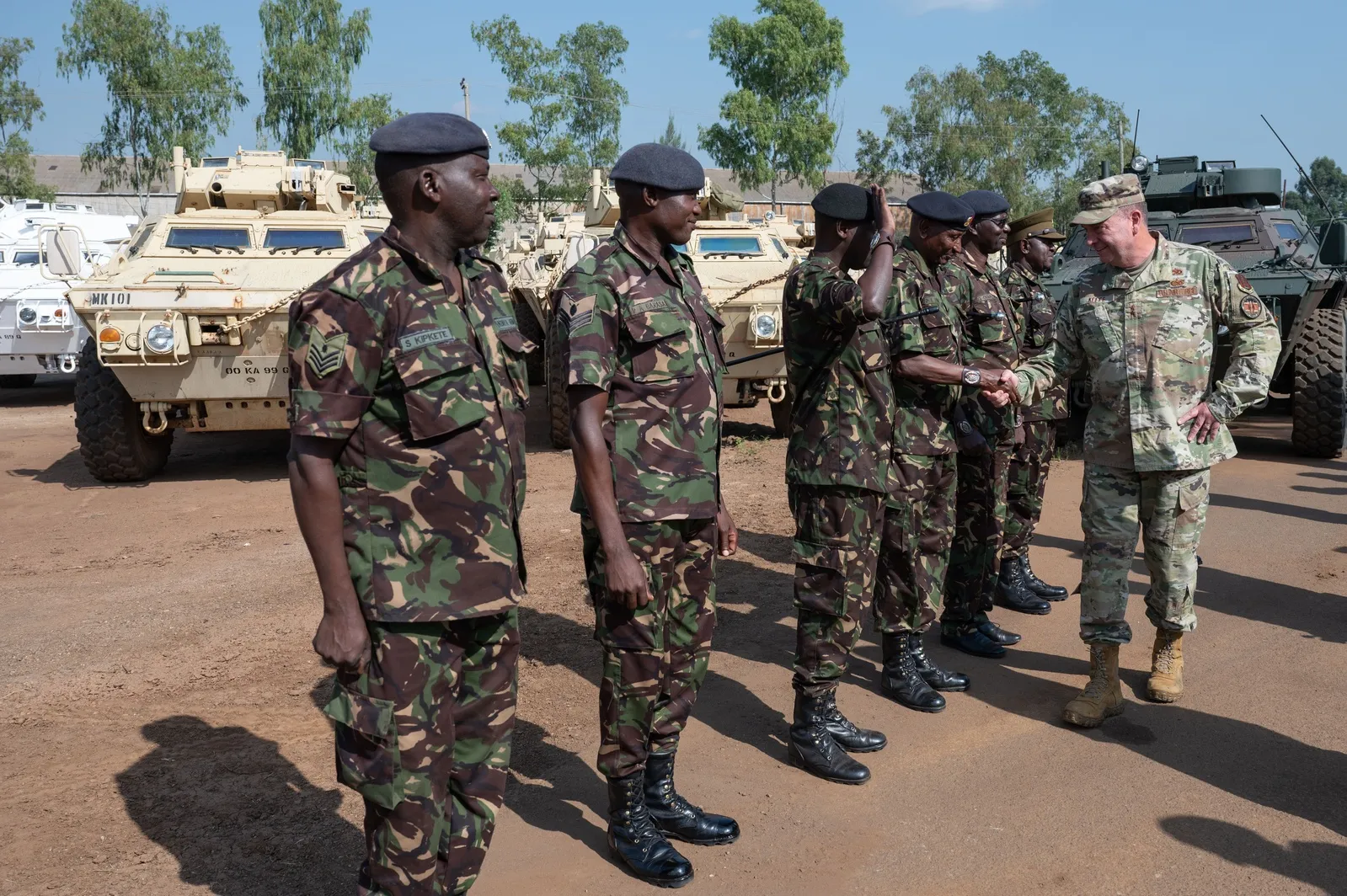
Kenya’s armour is split between 78 British Vickers Mk3 tanks, the KDF’s most reliable heavy armour, and around 110 Soviet-design T-72/T-72AV tanks acquired via Ukraine (including 33 delivered after the 2008 MV Faina hijacking), whose current operational status is unclear. Reconnaissance and APC fleets are a patchwork of French AML-60/90s, legacy British Ferret/Saladin/Shorland vehicles, South African Puma M26-15s and Mambas, Turkish Hizir MRAPs (2021), and roughly 144 US M1117s transferred via Excess Defense Articles and commissioned in May 2026. Artillery is mixed – Serbian Nora B-52 155mm SPGs, British L118 Light Guns, Italian OTO Melara pieces and Soviet BM-21 Grad – with Milan as the main ATGM. Army aviation runs ~46 MD-500/MD-530F helicopters plus a small Z-9 and ScanEagle/Raven UAV holding.
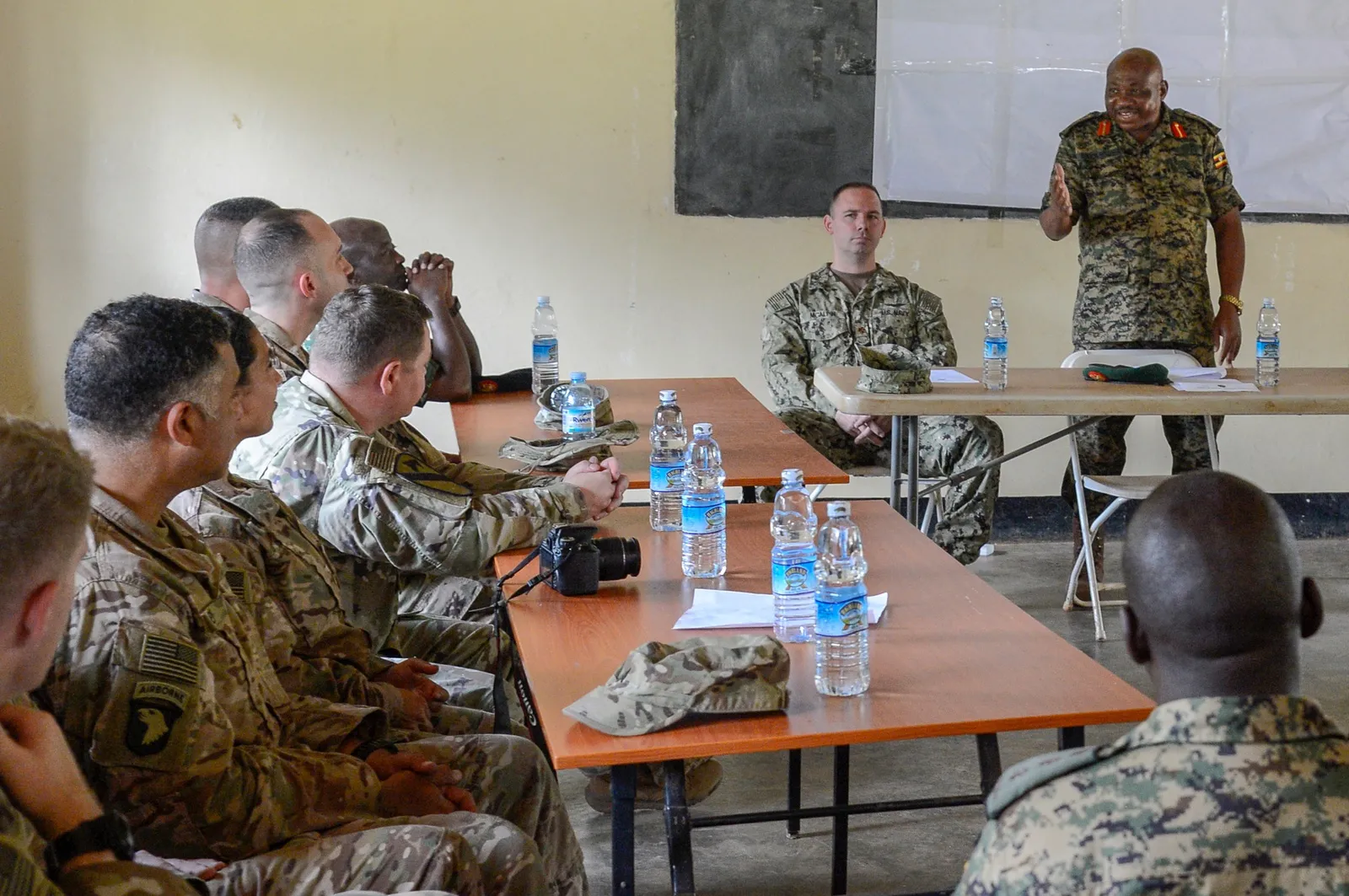
Uganda’s armoured inventory is reported considerably larger: a 2026 compilation gives roughly 239 main battle tanks (Russian T-90S, T-72, T-55, plus Chinese Type 85-IIM, the latter two independently photographed at the Karama training school as early as 2017), 72 BMP-2 IFVs, 31 BTR-60/80 APCs and roughly 288 lighter armoured vehicles, including Casspir/Mamba MRAPs and newly revealed Calidus MCAV-20 4x4s. Fire support includes BM-21 Grad and 105mm/122mm/130mm towed artillery. The standout recent development is local production: the National Enterprise Corporation unveiled the Chui (“Leopard”) IFV and Nyoka APC in 2026 through a joint showroom with the UAE’s Streit Group, built on the domestic Nyati platform – the clearest sign yet of Uganda manufacturing rather than only importing armour. As with Kenya, none of these totals include vehicles only on order, and official figures are unpublished, so all counts are estimates.
Naval power
Uganda is landlocked, so this is not a frigate-versus-frigate comparison. Its only afloat capability is the UPDF’s 155 Marine Battalion, which replaced the army’s Fisheries Protection Unit on Lake Victoria in 2025 and runs a small number of riverine patrol craft – a dated 2007 count of eight is the most recent figure available. Kenya has an Indian Ocean coastline and a modest navy: its main surface combatant is the long-delayed OPV KNS Jasiri (85m, 1,400 tonnes), supported by two 1990s Shupavu-class patrol boats. GlobalMilitary.net’s 2026 estimate of roughly 25 active craft is an aggregator figure inconsistent across its own pages, and should not be read as a strength metric: patrol boats are not frigates. Kenya has neither frigates nor submarines; naval funding is reported constrained toward personnel and maintenance, though Japan’s Official Security Assistance programme has named Kenya a possible recipient of further patrol boats.
Air defence
Kenya’s most significant recent acquisition, delivered December 2025, is a single reinforced Israeli SPYDER medium-range battery from Rafael, firing Python-5 and Derby missiles with Elta EL/M-2106 and EL/M-2084 radars – Kenya’s first genuine medium-range layer. Below it sit only towed guns (Swedish L-70, Swiss Oerlikon, TCM-20), with no long-range SAM and no documented integrated command-and-control network. Uganda’s picture is harder to verify: Museveni commissioned what state media called only “ultra modern” air-defence systems, without naming the type, alongside dozens of newly trained operators. Unverified forum commentary points to legacy Soviet SA-3 and MANPADS backed by ageing P-30 radar, and a 2026 industry overview lists air defence, with ISR and electronic warfare, as a stated UPDF priority rather than a completed capability. By layer rather than missile count, Kenya has moved from guns-only to guns-plus-one-modern-battery, while Uganda’s modernisation appears to be at an early-fielding stage open-source reporting has not pinned down.
Drones and loitering munitions
Kenya operates the more clearly documented and capable unmanned fleet: six Bayraktar TB2 armed UCAVs delivered from Turkiye in late 2024, used against al-Shabaab in areas including the Boni Forest, plus three Anka-S platforms from Turkish Aerospace Industries acquired earlier – both MALE-class systems capable of carrying guided munitions. Uganda’s drone capability is far less clear: Janes reported, via a social-media disclosure from a senior commander, that the UPDF operates a previously undocumented medium-altitude long-endurance UAV without naming its type, and a 2024 report said Turkish officials were pitching drones to Uganda, but no confirmed sale followed. Uganda Air Force College graduates have included “Raven drone” specialists as of September 2026, pointing to small hand-launched ISR systems rather than an armed capability. Neither country’s loitering-munition inventory is documented in open sources at this time.
Turkish systems in the two inventories
Kenya is the only one of the pair with confirmed Turkish-origin military equipment in service.
| System | Manufacturer | Quantity | Status | Role |
|---|---|---|---|---|
| Bayraktar TB2 | Baykar | 6 | In service (Kenya, delivered late 2024) | Armed MALE UCAV, ISR and precision strike vs al-Shabaab |
| Anka-S | Turkish Aerospace Industries | 3 | In service (Kenya) | MALE UAV, ISR/strike |
| Hizir MRAP | Katmerciler | Reported under a 2021 $69m order | In service (Kenya) | Mine-resistant troop carrier |
Uganda has no confirmed Turkish systems; the 2024 reports of Turkish drone marketing to Kampala were a sales pitch, not a completed order, so that is left out of the table. Where Turkish systems do appear, as in Kenya’s TB2 fleet, the practical case rests on checkable factors rather than assertion: lower unit and through-life costs than comparable Western platforms, delivery in months rather than years, an established munitions ecosystem (MAM-L/MAM-C), and increasingly local-assembly offers that Chinese competitors such as the Wing Loong II or CH-4 also make elsewhere in Africa. None of that is a blanket “better because Turkish” claim – operators elsewhere have chosen Chinese MALE drones for their own cost or political reasons, and the right platform depends on mission, maintenance ecosystem and financing terms.
Defence industry
Kenya’s domestic defence-industrial base is narrow but functioning: the Kenya Ordnance Factories Corporation in Eldoret is the country’s only ammunition manufacturer, mid-way through a three-phase upgrade targeted for FY2027/28 completion and a projected 35% capacity gain, while a Small Arms Factory opened in Ruiru in 2021 produces rifles with around 60% local content at roughly 12,000 units a year. Kenya’s FY2026/27 budget sets aside Ksh13.14bn for defence industrialisation. Uganda’s industrial effort is older and broader: the National Enterprise Corporation, the UPDF’s commercial arm established in 1989, oversees Luwero Industries in Nakasongola District, which repairs and manufactures armoured vehicles, ordnance and electronics. The 2026 unveiling of the domestically-designed Chui IFV and Nyoka APC, produced with the UAE’s Streit Group, is Uganda’s most visible step yet from vehicle repair toward manufacture, though Luwero’s own managers describe its budget allocation as too small relative to expected output – a reminder, echoed by a separate stalled armoured-vehicle venture reported in Kenya, that announced defence-industrial projects do not automatically translate into fielded equipment.
Main suppliers
Neither Kenya nor Uganda appears as a named line in SIPRI’s Mar 2026 Arms Transfers fact sheet, which aggregates most of sub-Saharan Africa rather than listing every importer by name – a methodological point, not a judgement on either country’s import volumes. From national and trade reporting instead: Israel, Italy and the United States are reported to have supplied roughly 90% of Kenya’s arms imports between 2020 and 2025 combined (the precise split is not published), with Turkiye (TB2, Hizir) and China (Z-9 helicopters) as smaller, more recent suppliers; one Kenyan outlet’s SIPRI-based reconstruction describes Kenya as Africa’s second-largest arms importer by value in 2025, driven by the SPYDER package. Uganda’s picture is older and messier: a 2025 US Foreign Military Studies Office analysis names Russia as Uganda’s dominant supplier, accounting for roughly half the value of its arms imports in recent years and supplying nearly all its combat aircraft; a SIPRI-based 2022 snapshot put Russian deliveries at $48m of a $55m total import bill, with Czechia, Israel, China and South Africa making up the rest. Separate customs data (OEC, 2024) instead lists Saudi Arabia, China and Turkiye as Uganda’s top sources that year – a smaller-value dataset not comparable to SIPRI’s methodology. SIPRI has separately noted Uganda has never reported its arms deals to the UN Register of Conventional Arms, an acknowledged gap in the record.
Modernisation and orders not yet in service
Kenya’s pipeline centres on building out SPYDER beyond its first battery, an unresolved Indian offer of Tejas Mk1A fighters (January 2026, no financing agreed) and the KOFC Eldoret capacity upgrade due in FY2027/28; none of this counts in Kenya’s active inventory yet. Uganda’s near-term programme is more visibly under way: the Chui IFV and Nyoka APC lines are moving toward series production, Calidus MCAV-20 4x4s were revealed in August 2026, Russia donated IMR engineering vehicles, and the unnamed “ultra-modern” air-defence systems Museveni commissioned remain unidentified in open sources. A Let 410 transport was reported commissioned in July 2026. As with Kenya, equipment only unveiled, donated in small numbers or commissioned without a confirmed in-service date stays out of the active-inventory figures used elsewhere in this article.
Geography and doctrine
Kenya’s posture is shaped by its Indian Ocean coastline at Mombasa, a long border with Somalia, and a decade and a half as a troop contributor to AMISOM, ATMIS and now AUSSOM against al-Shabaab – reinforced since 2024 by its status as the United States’ first “major non-NATO ally” in Sub-Saharan Africa, which unlocked transfers such as the M1117s. Its doctrine centres on counter-terrorism and border security rather than conventional inter-state warfare. Uganda, landlocked and bordered by the DRC, South Sudan, Kenya, Tanzania and Rwanda, has taken a more expeditionary posture: it remains a major AUSSOM contributor (organised as Battle Group 48) and has conducted repeated cross-border operations against the Allied Democratic Forces in eastern DRC. Both militaries carry a significant internal-security role; UPDF armoured units were deployed around Uganda’s 2026 presidential election, and Kenya’s KDF has periodically supported police during unrest. Neither country’s posture, as described here, extends to specific operational plans.
What the numbers show
Uganda fields the larger army by personnel and by most open-source armour counts, and has made the more visible recent push into domestic vehicle manufacturing through the Chui and Nyoka programmes. Kenya fields the more modern and better-documented air-defence and unmanned-systems capability, through its 2025 SPYDER battery and 2024 TB2 delivery, and is the only one of the two with a functioning navy, however modest. Kenya’s recent equipment decisions lean toward the United States and Israel, reinforced by its 2024 Major Non-NATO Ally designation, while Uganda’s combat aircraft and much of its heavy armour trace back to Russia, a relationship both SIPRI-based reporting and US analysis describe as still dominant. Both air forces rely on a single, ageing combat-aircraft type with no confirmed replacement in service, and both carry acknowledged gaps in their own published data – Kenya’s F-5 count varies by six aircraft across sources, and Uganda has never reported its arms transfers to the UN Register of Conventional Arms.
Methodology and data notes
- Active, reserve and paramilitary personnel are kept as separate categories throughout and are never summed into one “military size” figure.
- Vehicles, aircraft and vessels only on order, donated in unconfirmed numbers, or unveiled but not yet in series production are excluded from active-inventory totals and discussed only in the modernisation section.
- Training aircraft (Grob G120TP/G120A for Kenya) are excluded from combat-aircraft totals.
- “Total naval craft” figures from aggregator sites are reported as such and are explicitly flagged as not a strength metric; patrol boats are not equated with frigates.
- Air defence is assessed by layer (long/medium/short-range, MANPADS, radar, command-and-control) rather than by a simple missile count.
- Every figure drawn from a single reporting chain, an aggregator estimate, or an unverified forum/social-media source is labelled “estimated” or “reported” rather than presented as confirmed.
- SIPRI’s military-expenditure and arms-transfer fact sheets do not break out Kenya or Uganda individually for the current release cycle; official national budget documents and national/trade reporting are used instead and are clearly attributed as distinct from SIPRI’s own methodology.
- Global Firepower rankings are cited only as an auxiliary, always-attributed index, never as the sole or definitive source for any capability claim in this article.
- The same research methodology and sourcing hierarchy was applied to both countries.
Sources
- SIPRI Military Expenditure Database fact sheet, April 2026
- SIPRI Arms Transfers fact sheet, March 2026
- Daily Monitor: UPDF deploys armoured vehicles ahead of Uganda’s presidential election
- Afridex: Uganda accelerates defence modernisation through long-term military investment
- Army Technology: Uganda launches Chui infantry fighting vehicle
- Janes: UPDF unveils MCAV-20 vehicles
- Shephard Media: Uganda confirmed as T-90, Type 85-IIM operator
- Daily Monitor (via UgandaOnline): Understanding the UPDF’s Sukhois
- The East African: Growing influence of BRICS in East Africa through arms race
- Forum on the Arms Trade: Uganda arms-transfer reporting
- Daily Monitor: UPDF Marine Unit’s Lake Victoria anti-illegal-fishing strategy
- National Enterprise Corporation / Luwero Industries
- DefenceMENA: Kenya military strength profile
- DefenceMENA: Which African country has the biggest army?
- Global Firepower 2026 index, cited via secondary reproductions, used only as an auxiliary, attributed data point