Which African Country Has the Biggest Army?



By reported active-duty personnel, Ethiopia and Egypt field Africa’s two largest armed forces, each well above half a million and 400,000 respectively – but those are also the continent’s two most disputed personnel figures, one a probable wartime-peak hangover and the other the only one of the pair resting on a named IISS count. Personnel size and the composite Global Firepower ranking tell different stories: South Africa, fourth in GFP’s 2026 index, fields barely 69,000 people, fewer than a dozen smaller African states. This piece ranks the 15 largest reported forces, flags which figures are solid and which are not, and explains why troop count alone is a poor proxy for military strength.
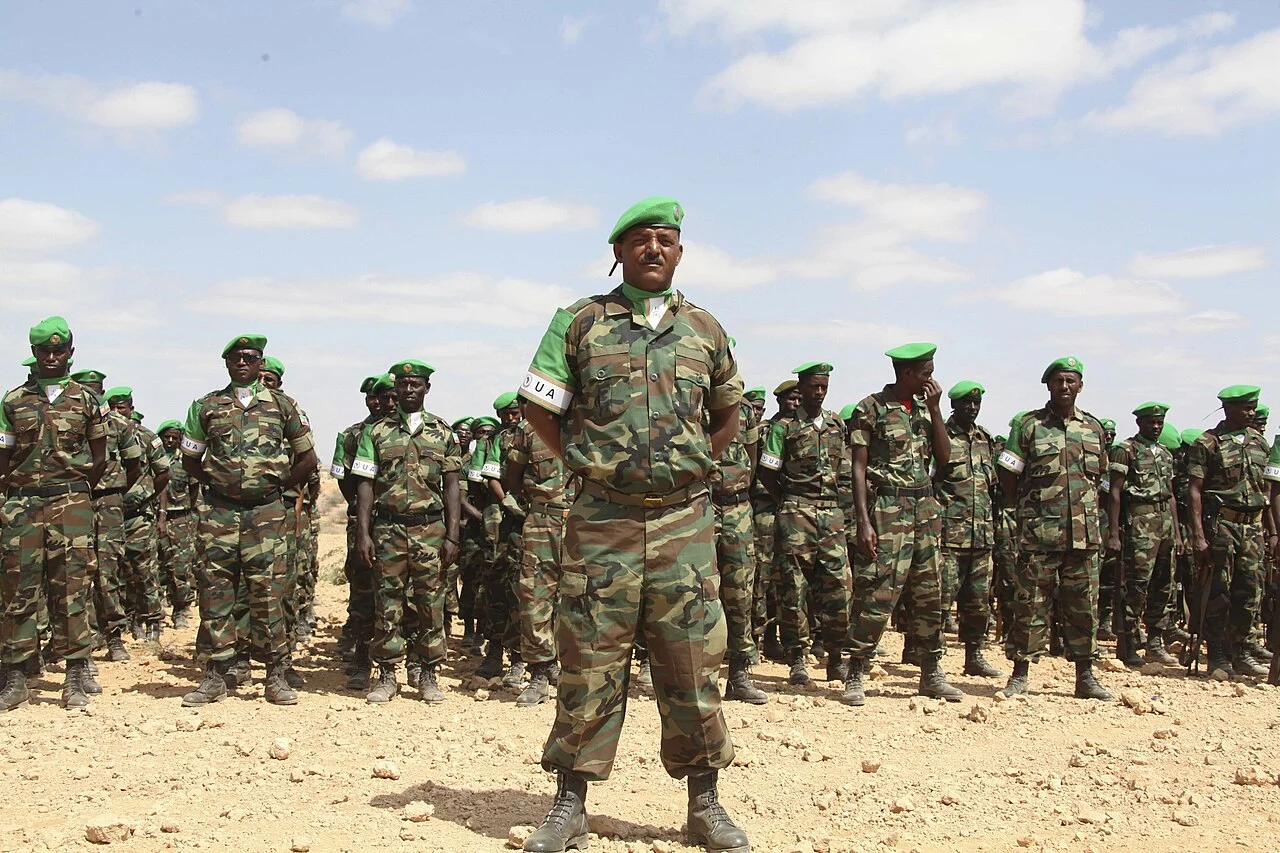
Photo: African Union troops from the Ethiopian contingent of AMISOM stand in formation during a ceremony in Belet Weyne, Somalia, February 2014. Credit: AMISOM Public Information / Ilyas A. Abukar, public domain (CC0), via Wikimedia Commons.
Ethiopia is most often cited as having Africa’s largest army, with trackers reproducing a figure of roughly 503,000 active personnel. Egypt is second at 438,500, a number that traces to the IISS Military Balance and is the most solidly sourced figure in the top five. Below them the picture becomes far less certain: Eritrea, Nigeria, Morocco and Sudan all have claimed or estimated forces above 150,000, but none has an official, independently verified count, and Sudan’s figure has been scrambled entirely by the civil war that began in April 2023. This is a ranking of reported personnel strength, not of combat capability – DefenceMENA’s companion piece on the strongest militaries in Africa by Global Firepower’s composite index shows how differently the continent is ordered once equipment, budgets and logistics are weighted in.
| Rank | Country | Active personnel (reported) | Confidence | Source |
|---|---|---|---|---|
| 1 | Ethiopia | ~503,000 | Reported – likely a 2020–22 Tigray-war peak figure, not current strength | GFP/IISS-reproduced; DefenceMENA Ethiopia profile |
| 2 | Egypt | 438,500 | Confirmed – named IISS Military Balance count | IISS Military Balance, via DefenceMENA Egypt profile |
| 3 | Eritrea | 200,000–350,000 | Not confirmed – opaque, largely open-ended national-service conscripts | Wikipedia/GlobalMilitary compilation of IISS/CIA-derived estimates |
| 4 | Nigeria | 200,000–230,000 | Estimated – no official Nigerian government figure published | Open-source trackers, via DefenceMENA fighter-aircraft file |
| 5 | Morocco | 196,000–200,000 | Reported – no official Moroccan MoD figure found | Wikipedia/Global Firepower-derived compilation |
| 6 | Sudan (SAF) | 120,000–200,000 | Pre-war (2023) baseline only; post-2023 strength unknown amid civil war | EUAA country-of-origin report, 2025; SAF 2023 statement |
| 7 | Algeria | ~130,000 | Estimated – smaller personnel base than its equipment holdings suggest | Open-source trackers, via DefenceMENA strongest-militaries-africa |
| 8 | DR Congo (FARDC) | 123,300–140,000 | Not confirmed – secondary compilations disagree; force quality separately disputed | Wikipedia (citing IISS 2026); Critical Threats |
| 9 | Angola | 107,000–120,000 | Reported – no SIPRI country breakout | Wikipedia/GlobalSecurity.org, via DefenceMENA Angola profile |
| 10 | South Africa (SANDF) | 69,392 | Confirmed – official count, 30 June 2025 (61,006 Regular + 8,386 Reserve Force) | South African Department of Defence, parliamentary reply, July 2025 |
| 11 | Uganda | ~45,000 | Estimated | Open-source aggregator compilation |
| 12 | Chad | 37,750–45,000 | Estimated – figures from 2020 and 2024 differ | Wikipedia (2024); Helgi Library/SIPRI-derived (2020) |
| 13 | Zimbabwe | ~29,000 | Estimated | Open-source aggregator compilation |
| 14 | Tanzania | 25,000–28,000 | Estimated | World Bank/Wikipedia compilation |
| 15 | Kenya | ~24,000 | Reported – essentially unchanged for a decade across trackers | DefenceMENA Kenya profile, IISS/CIA-style trackers |
Why the two biggest figures are also the two most disputed
Ethiopia’s 503,000 figure is the one most frequently repeated across trackers, including Global Firepower, but DefenceMENA’s own profile of the Ethiopian National Defence Force treats it with caution: the number almost certainly reflects the force’s mobilised peak during the 2020–22 Tigray war rather than the smaller standing force that exists today, and Ethiopia’s post-war demobilisation and rehabilitation programme has been steadily drawing personnel down since. No current, independently verified replacement figure has been published, so the 503,000 figure persists in most open rankings even as it goes stale. Egypt’s 438,500 sits on firmer ground: it is the IISS Military Balance’s named count, reproduced consistently by GFP and other trackers, and DefenceMENA’s own Egypt profile breaks it down by service – roughly 310,000 Army, 18,500 Navy, 30,000 Air Force and 80,000 Air Defence Forces, with 479,000 reserves on top. That gap in sourcing quality between the two largest figures on the continent is itself a useful lesson in how personnel rankings are built: most are compilations of compilations, not fresh headcounts.
The claimed-but-unconfirmed middle tier: Eritrea, Nigeria, Morocco
Eritrea’s force size is genuinely hard to pin down. Estimates range from 150,000 to 350,000 across GlobalMilitary, Wikipedia and CIA-derived trackers, and the spread exists because Eritrea runs an open-ended national-service system that blends military and civilian labour; no independent body has published a verified count, and Eritrea’s government does not publish one itself. DefenceMENA treats the figure as reported, not confirmed, and places it in a wide range rather than picking a single number. Nigeria’s estimated 200,000–230,000 active personnel, similarly, has no official government source: the figure comes from open-source trackers reproduced across several DefenceMENA pieces, including the fighter aircraft flown by African air forces file, and Nigeria’s own security establishment does not publish a current total. Morocco’s 196,000–200,000 figure follows the same pattern – widely repeated by Wikipedia and Global Firepower, but with no Moroccan Ministry of Defence statement found to confirm it. None of these three numbers should be read as more precise than the ranges given.
Sudan: a number that stopped meaning anything in April 2023
Sudan deserves a category of its own. Before the civil war between the Sudanese Armed Forces (SAF) and the Rapid Support Forces (RSF) began in April 2023, the EUAA’s country-of-origin reporting and SAF’s own statement put the Sudanese Armed Forces at somewhere between 120,000 and 200,000 personnel. Two and a half years of war have made that baseline unusable: both sides have recruited, lost, and reorganised troops at a pace no outside tracker has measured, and DefenceMENA’s own strongest militaries in Africa profile already treats Sudan’s Global Firepower ranking as indicative only for the same reason. The RSF’s own leadership has claimed a force of up to 450,000, a figure that appears only in RSF leader Mohamed Hamdan Dagalo’s own statements and should be read as an UNVERIFIED SOCIAL CLAIM from a combatant party, not a confirmed count – it is not included in the ranking table above, which covers recognised state armed forces. Libya and Somalia are excluded from this ranking entirely for the same structural reason: both have fragmented or rival force structures without a single authoritative personnel count.
Large on paper, strained in practice: DR Congo, Algeria, Angola
The Democratic Republic of Congo’s FARDC illustrates why raw personnel counts can mislead. Reported strength ranges from 123,300 (an IISS 2026 figure reproduced by Wikipedia, not independently verified against the primary Military Balance text) to 140,000 (Critical Threats’ estimate), but DefenceMENA’s own reporting on the SAMIDRC mission in the DRC found that FARDC struggled against the AFC/M23 offensive in North and South Kivu through 2024–2025 despite its nominal size, a gap between headcount and battlefield performance covered in DefenceMENA’s account of SAMIDRC’s equipment record in the DRC. Algeria’s roughly 130,000 active personnel is, by contrast, a smaller force than its equipment holdings would suggest: Algeria’s near-1,500 main battle tanks and six Kilo-class submarines, financed by hydrocarbon revenue and detailed in the strongest militaries in Africa piece, sit on top of a comparatively modest personnel base. Angola’s reported 107,000–120,000, covered in DefenceMENA’s Angola military-strength profile, likewise comes with no SIPRI country breakout and relies on Wikipedia and GlobalSecurity.org compilations rather than an official figure.
The professional-force outliers: South Africa and Kenya
South Africa is the one country in this ranking with a genuinely solid, current, official number: 69,392 active SANDF members as of 30 June 2025, confirmed in a parliamentary reply from South Africa’s Department of Defence and split into 61,006 Regular Force and 8,386 Reserve Force members. That is smaller than Uganda’s, Chad’s and several other forces that do not place in GFP’s African top ten, and far smaller than the four countries GFP ranks ahead of it on personnel grounds – a reminder that GFP’s composite index rewards South Africa’s industrial base and equipment stock, not force size, a distinction DefenceMENA’s South Africa military-strength profile covers in more depth. Kenya’s roughly 24,000 active personnel, drawn from DefenceMENA’s own Kenya profile and essentially unchanged for a decade across IISS- and CIA-style trackers, places it well outside this top 15 altogether despite Kenya’s recent, well-documented equipment modernisation drive.
Methodology and definitions
“Active personnel” in this piece means uniformed, full-time active-duty service members across all branches of a state’s recognised armed forces, excluding reserves, paramilitary and gendarmerie forces unless a source’s figure bundles them in (noted where applicable) and excluding non-state or rival armed groups. No single, current, authoritative dataset covers all 54 African states at once: SIPRI’s public military-expenditure fact sheets report spending, not headcounts, and the IISS Military Balance, the most authoritative personnel count available, is a paid publication DefenceMENA could not access directly for every country in this list; where a figure is attributed to IISS here, it is as reproduced by a secondary compilation (chiefly Wikipedia’s infoboxes), not verified against IISS’s own text, and is labelled accordingly. Global Firepower is used only as a discovery tool for which countries are commonly cited as having large forces, never as the source of a personnel figure itself. Where sources disagree, both ends of the range are given rather than DefenceMENA choosing one; where DefenceMENA has published a full country profile, such as Egypt’s, Ethiopia’s, Angola’s or Kenya’s, that profile’s figures and caveats take precedence over any additional estimate used here. This page was published on 26 October 2026 and will be updated when a new IISS Military Balance edition, an official government statement, or new SIPRI/GFP data becomes available.
Last updated: 26 October 2026.
Frequently asked questions
Which African country has the biggest army?
By most-reproduced active-personnel figures, Ethiopia, at roughly 503,000. That figure is widely repeated but almost certainly reflects the Ethiopian National Defence Force’s mobilised strength during the 2020–22 Tigray war rather than its current size, and no verified current replacement has been published. Egypt, at 438,500 on the IISS Military Balance’s named count, has the most solidly sourced large figure on the continent.
Which African country has the most soldiers, excluding disputed wartime figures?
If Ethiopia’s figure is treated as a stale wartime peak, Egypt’s IISS-sourced 438,500 is the largest confirmed active-personnel count on the continent.
Is army size the same as military strength?
No. Global Firepower’s composite 2026 index, covered in DefenceMENA’s strongest militaries in Africa ranking, places Egypt first and South Africa fourth in Africa, even though South Africa’s roughly 69,000 active personnel is smaller than at least nine other African forces. Composite indices weight equipment, budgets, logistics and geography alongside personnel, and personnel alone says nothing about training, readiness or combat record.
How many soldiers does Sudan have?
Unknown with any confidence. The Sudanese Armed Forces were estimated at 120,000–200,000 before the civil war began in April 2023; two and a half years of fighting against the Rapid Support Forces have made that baseline unreliable, and no verified current figure exists for either side. The RSF’s own leadership has claimed up to 450,000 fighters, an unverified claim from a combatant party.
Why isn’t Libya or Somalia in this ranking?
Both countries have fragmented or rival armed forces without a single authoritative national personnel count, the same structural problem that affects Sudan’s figure, so DefenceMENA excludes them from a ranking that assumes one state, one army.
Where does South Africa’s personnel figure come from?
A South African Department of Defence parliamentary reply dated July 2025, giving 69,392 total SANDF members as of 30 June 2025 – 61,006 in the Regular Force and 8,386 in the Reserve Force. It is the only figure in this ranking confirmed by a current official government statement rather than an open-source compilation.
A note on the numbers: this ranking leans more heavily on secondary compilations (Wikipedia infoboxes citing IISS, GlobalSecurity.org, Critical Threats, GlobalMilitary.net) than most DefenceMENA pages, because the IISS Military Balance itself sits behind a paywall DefenceMENA could not access for this run, and no free, current, country-by-country personnel dataset exists for Africa. Every figure above is labelled Confirmed only where a named primary or official source was found (Egypt, South Africa); everything else is labelled Reported, Estimated or Not confirmed, and ranges are given where sources disagree by more than a rounding error. Readers citing this page should treat ranks 3–9 in particular as approximate ordering within a cluster of broadly comparable, poorly sourced figures, not a precise league table.
Sources
- Wikipedia, Armed Forces of the Democratic Republic of the Congo (citing IISS 2026)
- Critical Threats, Armed Forces of the Democratic Republic of the Congo (FARDC)
- Wikipedia, Royal Moroccan Armed Forces
- Wikipedia, Sudanese civil war (2023–present)
- EUAA, Sudan Country of Origin Information: Major state and non-state armed groups (2025)
- Wikipedia, Eritrean Defence Forces
- GlobalSecurity.org, Eritrea Military Personnel
- Wikipedia, Chadian National Army
- Helgi Library, Armed Forces Personnel (Total), Chad
- Wikipedia, Tanzania People’s Defence Force
- Parliamentary Monitoring Group, South African Department of Defence reply on SANDF personnel strength (July 2025)
- Wikipedia, South African National Defence Force
- DefenceMENA, How strong is Egypt’s military in 2026?
- DefenceMENA, How Strong Is Ethiopia’s Military in 2026?
- DefenceMENA, Is Angola’s Military as Strong as Its Oil Wealth Suggests?
- DefenceMENA, Kenya Is Rearming Fast, But Its Air Force Still Flies 1970s Jets
Related on DefenceMENA: Strongest Militaries in Africa in 2026, Ranked | African Defence Budgets, Ranked | SAMIDRC in the DRC: What Combat Against M23 Showed About South African Equipment