How Strong Is Lebanon’s Military, and Where Does Hezbollah Fit In?



Lebanon’s state army is small, underfunded and kept running almost entirely on foreign grants, while the country’s most powerful armed actor, Hezbollah, sits outside the state’s chain of command altogether. This profile sets out what the Lebanese Armed Forces (LAF) actually operate in 2026, what Hezbollah is assessed to still hold after two years of Israeli strikes, and why the two cannot be added together into a single national total.
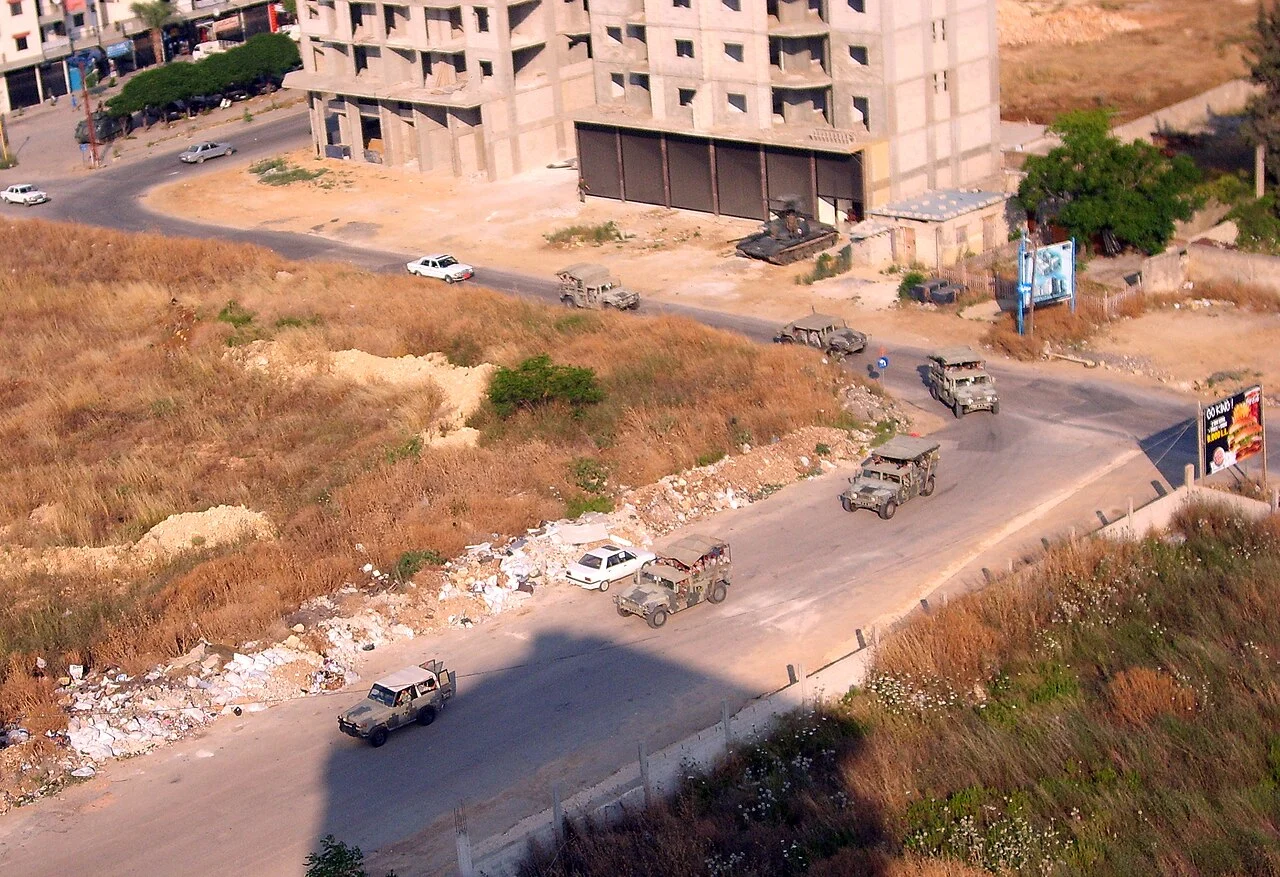
Photo: A Lebanese Armed Forces convoy on patrol. Credit: FunkMonk, CC BY-SA 3.0, via Wikimedia Commons
Lebanon is not a single-military case, and any answer to “how strong is Lebanon’s army” has to start by separating two different things. The Lebanese Armed Forces are the recognised state military: roughly 60,000–80,000 personnel, no fighter jets, no air-defence system, and an inventory built from decades of second-hand donations from the United States, France and other partners. Hezbollah is a non-state, Iran-aligned armed movement that fought a full year of war with Israel in 2023–24 and still fields rockets, drones and anti-tank missiles that outmatch the LAF’s own firepower, even after heavy losses. Since the November 2024 ceasefire, the LAF has deployed into the south in an attempt to become the only armed actor there, a process that is incomplete and contested. This profile covers the LAF’s verified equipment and budget, what is documented about Hezbollah’s degraded arsenal, and where foreign aid is now headed.
Every figure below carries a status label: In service, Delivered, Under delivery, Contracted, Ordered, Planned, Reported (unconfirmed) or Status unclear. Lebanon publishes no consolidated public inventory, Hezbollah publishes none at all, and open-source counts for both diverge by a wide margin between sources, so this profile flags ranges as Estimated rather than printing a single false-precision number.
| Indicator | Figure | Year / source |
|---|---|---|
| Lebanese Armed Forces personnel | Roughly 60,000–80,000 active, estimates diverge; about 7,500+ deployed south of the Litani River | 2025–26, EUAA / open-source compilations (Estimated) |
| LAF defence budget | Around US$241 million (2023, SIPRI); separate industry estimates run far higher and are not reconciled with SIPRI | 2023, SIPRI (latest confirmed; Estimated) |
| US security assistance since 2006 | More than US$2.5 billion in grant military aid to Lebanon; about US$1.7 billion of that to the LAF specifically | Cumulative to 2022, US State Department / US Embassy Beirut |
| Saudi aid package frozen since 2016 | US$3 billion pledge frozen in 2016; a resumption was raised again in March 2025 but not confirmed as restored | 2016 freeze; 2025 request, regional press (Reported, unconfirmed outcome) |
| LAF main battle tanks | Roughly 115–300 ageing M48A5, M60A3 and T-54/T-55, open-source counts disagree sharply | 2025–26, Habtoor Research vs. GlobalMilitary.net (Estimated, wide range) |
| LAF fixed-wing combat aircraft | None; air force limited to light attack/trainer aircraft and helicopters, no air-defence interceptors | 2025–26, multiple open-source compilations |
| Hezbollah rocket/missile stockpile | Estimated at roughly 15–20% of its pre-October 2023 arsenal after Israeli strikes; baseline estimates for that arsenal range from about 75,000 to 150,000 projectiles | 2024–26, Israeli defence and government sources (Reported, unconfirmed, wide range) |
Two armed forces, not one: the Lebanese Armed Forces and Hezbollah
Any serious account of military power in Lebanon has to treat the Lebanese Armed Forces and Hezbollah as separate subjects, because they are. The LAF is the constitutional military, commanded through the Ministry of Defence and the army’s own General Staff, financed overwhelmingly by foreign grants and subject to international reporting requirements tied to that aid. Hezbollah is a Shia Islamist movement and militia founded in the 1980s with Iranian backing that fields its own command structure, its own weapons procurement through Iran and historically through Syria, and its own decision to go to war, independent of the Lebanese cabinet. For decades Hezbollah’s arsenal has been assessed by Western and Israeli sources as larger and more capable in rockets, anti-tank and anti-ship missiles than anything the LAF fields, even though the LAF is the only one of the two recognised under international law as Lebanon’s army.
The gap between the two reached a new phase after Hezbollah entered the Israel-Gaza war in support of Hamas in October 2023, triggering a year of cross-border exchanges with Israel that escalated into a full air campaign and a ground incursion in autumn 2024. A ceasefire took effect on 27 November 2024, with its framework calling for Hezbollah to withdraw north of the Litani River and for the LAF to deploy into the vacated area as the only armed actor there, alongside the continued presence of UNIFIL. Reporting through 2025 and into September 2026 shows that first phase, covering the area south of the Litani, as nearly but not fully complete, while a second phase covering the area north of the Litani has been described by Lebanon’s own cabinet as under a “calculated postponement” rather than cancelled. An LAF officer cited by FDD’s Long War Journal in September 2026 said a full disarmament push north of the river would require complete LAF deployment, recovery of the south and an end to continuing Israeli strikes, conditions not yet met.
This profile therefore does not attempt to produce a single combined “Lebanon military strength” total. The tables below cover the LAF’s own declared and reported inventory. A separate section further down sets out what is documented about Hezbollah’s degraded post-war arsenal, sourced mainly to Israeli military and government assessments that themselves carry an obvious interest in presenting Hezbollah as diminished, and flagged accordingly. For the regional security picture, see the Middle East desk and the Jordan and Iraq profiles, two other states where documented non-state or parallel forces complicate a single inventory count.
Defence budget: aid-dependent, and only partly visible
SIPRI’s most recent confirmed figure for Lebanon’s military expenditure is about US$241 million in 2023, itself a roughly 10% rise on 2022 in an economy that collapsed after 2019 and remains in crisis. That figure measures Lebanese state spending and does not capture the much larger flow of foreign grant equipment, training and salary support that keeps the LAF operating; industry market-research estimates of Lebanon’s “defence budget” that run into the billions of dollars use a different, broader definition and are not reconciled with SIPRI’s narrower state-expenditure series in the sources reviewed for this profile, so both numbers are reported separately rather than combined.
The single largest external funder has been the United States. The State Department and the US Embassy in Beirut have both put cumulative US security assistance to Lebanon at more than US$2.5 billion since 2006, of which a 2018 State Department breakdown put nearly US$1.7 billion specifically with the LAF and more than US$160 million with the Internal Security Forces. A separate, Israel-focused think tank has cited a higher figure of “over US$3 billion,” which this profile treats as Reported but unconfirmed against an official US source. Deliveries have continued through the LAF’s 2025–26 budget crisis: a shipment of 47 Humvees and five trucks reportedly reached the Port of Beirut under US aid programmes on 29 September 2026, according to Lebanese press citing the army’s own statement, though the exact count should be treated as single-sourced until an official US or LAF statement confirms it independently.
Gulf funding has been more volatile. Saudi Arabia froze a US$3 billion military aid package to Lebanon in 2016, a decision regional reporting has linked both to the storming of the Saudi embassy in Tehran that year and to Riyadh’s objection to Hezbollah’s weight in Lebanese politics. President Joseph Aoun, elected in January 2025 after the war weakened Hezbollah, made Saudi Arabia his first foreign visit as president in March 2025 and told Asharq Al-Awsat he hoped to reactivate the frozen aid. The sources available for this profile do not confirm whether that aid has since been restored, so it is recorded here as Reported (unconfirmed) rather than Delivered or Resumed.
Personnel and force structure
Estimates of LAF active personnel vary by source and by what is counted. The EU Asylum Agency’s 2025 country report put total strength at roughly 80,000, with 7,522 personnel deployed south of the Litani River by June 2025 as part of the post-ceasefire plan. GlobalMilitary.net’s 2026 index instead lists about 60,000 active personnel. This profile treats the true figure as Estimated in the 60,000–80,000 range rather than picking one source as authoritative. The army is organised into regular infantry and mechanised brigades, a small number of special forces and commando units, an air force and a navy, all under the LAF Commander and the Lebanese Ministry of Defence; Joseph Aoun himself commanded the LAF from 2017 before his election as president in January 2025, a background regional press has read as significant given the army’s post-war role.
Army: ageing armour, US-donated light vehicles
The LAF’s armoured inventory is one of the clearest examples of conflicting open-source counts in this profile. A 2025 Habtoor Research report put total main battle tanks at around 115, mostly US-supplied M48A5 and M60A3 models dating to the Cold War. GlobalMilitary.net’s 2026 index instead lists 302 tanks, including 185 T-54s, 60 M48A5s and 47 T-55s, a mix that reflects decades of mismatched donations from different patrons; the EUAA report cites a middle figure of roughly 200. None of these figures should be read as precise, and all describe tanks that are decades old by any count.
Lighter armour is better documented because recent US donations are reported individually. The LAF has received US-donated M113 armoured personnel carriers in large numbers (reported around 1,400 in service, Estimated), plus smaller, named deliveries of up-armoured Humvees, including a reported 47 Humvees and five trucks landed at Beirut port in September 2026, and earlier shipments of eight (of a planned total of 32) M2 Bradley infantry fighting vehicles donated by Washington. Older French support included ten VAB Mephisto anti-tank vehicles armed with HOT missiles, delivered in November 2018. Artillery includes US-donated M198 and other towed howitzers from earlier aid tranches; a dedicated modern self-propelled artillery capability is not documented in the sources reviewed.
| System | Origin | Quantity | Status | Source |
|---|---|---|---|---|
| M48A5 / M60A3 main battle tank | United States (donated, Cold War-era) | Estimated 60–115+ (count disputed) | In service | Habtoor Research 2025; GlobalMilitary.net 2026 |
| T-54 / T-55 main battle tank | Soviet-era stock | Estimated up to 232 per one count; disputed | Status unclear | GlobalMilitary.net 2026 (Estimated, disputed) |
| M113 armoured personnel carrier | United States (donated) | Estimated ~1,400 | In service | GlobalMilitary.net 2026 (Estimated) |
| M2 Bradley infantry fighting vehicle | United States (donated) | 8 delivered of a reported 32-vehicle donation | Delivered (partial); remainder Under delivery / Status unclear | Defence-Blog; Breaking Defense 2021 |
| VAB Mephisto anti-tank vehicle | France (donated) | 10 | Delivered / In service | Alma Center 2025, citing French Ministry of Armed Forces |
| Humvee (M1151/M1152 family) | United States (donated, multiple tranches since 2016) | 50 (2016 tranche) plus 47 reported September 2026; cumulative total not independently confirmed | Delivered / In service | US Embassy Beirut 2016; Lebanese press (Cedar News, via aggregators), September 2026 |
Air force: no fighters, no air defence
The Lebanese Air Force operates no fighter jets and no dedicated air-defence missile system, a gap unique among the region’s state militaries covered in this series. Its combat capability is limited to a small number of light attack and trainer aircraft: open-source counts put the fleet at around 80 aircraft in total, including roughly six to nine A-29 Super Tucano light attack/trainer aircraft supplied by the United States, alongside UH-1H Huey and other utility and training helicopters used mainly for transport, reconnaissance and close support against non-state armed groups rather than for air defence. The EUAA’s narrower count lists only about five fixed-wing aircraft and 30 helicopters, underlining how much the totals move depending on what is classed as “aircraft.” There is no publicly documented Lebanese air-defence radar or missile network of any kind; Lebanese airspace sovereignty has instead been a recurring point of friction with Israel, whose aircraft have operated over Lebanon without an LAF intercept capability to contest it.
Navy: a coastal force built around UNIFIL cooperation
The Lebanese Navy is a small coastal force whose main documented role is maritime interdiction against arms smuggling, run jointly with the UNIFIL Maritime Task Force, which was deployed at the Lebanese government’s own request. Lebanese patrol craft, including vessels named in UNIFIL reporting such as Tabarja and Naqoura, take part in regular Maritime Interdiction Operation drills alongside UNIFIL frigates; the navy has also begun integrating more fully into twice-monthly UNIFIL maritime surveillance patrols. No major surface combatants, submarines or anti-ship missile batteries are documented in Lebanese Navy service; its inventory is built around fast patrol boats, not blue-water or even meaningful littoral combat capability.
Drones, missiles and long-range strike: a state-side gap, and a non-state arsenal
The LAF itself is not documented as operating armed drones or long-range strike missiles; open-source reporting on Lebanese state military drone use has focused on small reconnaissance types rather than any armed or long-range system. The long-range and precision-strike capability associated with Lebanon in the open-source record belongs almost entirely to Hezbollah, not the LAF, which is the core reason this profile treats the two separately throughout.
What is documented about Hezbollah’s post-war arsenal, assessed mainly through Israeli military and government statements that should be read as Reported rather than independently verified: Israeli officials said in late 2024 that around 80% of Hezbollah’s rockets with ranges up to 40 km had been destroyed, with medium-range rocket stocks said to have fallen from an estimated 5,000 to fewer than 1,000, and short-range stocks from an estimated 44,000 to below 10,000. Precision-guided missiles, initially numbered in the hundreds by Israeli estimates, were said to be reduced to under a hundred. A Wall Street Journal report citing Israeli officials in 2025 put the surviving arsenal at between 11,000 and 13,000 projectiles, or roughly 15% of its pre-October 2023 total, while other Israeli assessments describe an overall reduction of 70–80%. Pre-war baseline estimates themselves range widely, from around 75,000 (Alma Center) to around 150,000 rockets and missiles in other 2023-era counts, which is why this profile reports the loss as a percentage range rather than converting it into a single absolute number. Despite the losses, Hezbollah fired around 200 rockets into northern Israel in a single night as recently as March 2026, according to press reporting, indicating a residual launch capability even after two years of attrition. The group’s supply route through Syria, a major historical channel for Iranian-origin weapons, has been described by regional security analysts as significantly disrupted since the fall of the Assad government, though the open-source record does not quantify the effect precisely.
Defence industry and localisation
Lebanon has no significant domestic defence industry documented in the sources reviewed for this profile, and none of the LAF’s major equipment programmes involve local production or technology transfer of the kind seen elsewhere in this series’ Gulf profiles. The LAF’s own small-scale workshops handle maintenance and refurbishment of donated equipment rather than manufacturing. This is consistent with a force whose procurement model is grant-driven rather than purchase-driven: donors choose much of what the LAF receives, which is a structural reason inventories are mismatched across different equipment generations and national origins.
Main foreign suppliers
The United States is by far the LAF’s largest documented supplier by both volume and continuity, having provided the bulk of the force’s armoured vehicles, small arms, training aircraft and ammunition since 2006 under cumulative grant aid exceeding US$2.5 billion. France is the next most consistent Western partner, with donations including the VAB Mephisto vehicles and earlier credit-line support agreed at a 2014 Rome donor conference. The United Kingdom has also provided equipment and training over the years, though the sources reviewed for this profile did not give a figure comparably precise to the US or French totals, so UK support is recorded here as Reported rather than quantified. Saudi Arabia was historically a major prospective funder through its now-frozen 2016 pledge, whose possible revival remains unconfirmed. No current major Russian, Chinese or Turkish supply relationship to the LAF is documented in the sources reviewed; this is one of the few profiles in this series where the supplier picture is almost entirely Western and aid-based rather than commercial.
Recent procurement and aid: a 12-month timeline
| Date | Event | Value | Status |
|---|---|---|---|
| January 2025 | Joseph Aoun, former LAF Commander, elected President of Lebanon | — | Confirmed political event, not a procurement |
| March 2025 | President Aoun’s first foreign trip, to Saudi Arabia, raises possible reactivation of the frozen 2016 US$3 billion Saudi military aid pledge | Up to US$3 billion (if revived) | Reported (unconfirmed); outcome not established in sources reviewed |
| Through 2025 | LAF reports progress deploying forces south of the Litani River under the November 2024 ceasefire framework | — | In progress / Reported largely complete by some officials, contested by Israeli assessments |
| January 2026 | Lebanese cabinet discussion on disarmament north of the Litani River ends without a decision, described by officials as a “calculated postponement” | — | Status unclear / Planned, no schedule set |
| September 2026 | LAF reinforces positions in Nabatieh; officers state the deployment does not amount to a Hezbollah disarmament operation in the city | — | Confirmed deployment; disarmament scope explicitly disputed |
| 29 September 2026 | US-funded delivery of Humvees and trucks reaches Port of Beirut, per Lebanese press citing the army | 47 Humvees, 5 trucks (reported) | Delivered (single-sourced count) |
Modernisation priorities and what is changing
The LAF’s documented priorities are less about new capability and more about sustaining and slowly modernising what it already has while absorbing a larger operational role in the south. The post-ceasefire plan commits the army to eventually becoming the only armed actor between the Blue Line and the Litani River, a mission that by the LAF’s own officers’ account requires more troops, more logistics support and continued foreign funding before it can be extended north of the river. President Aoun’s push to re-engage Gulf donors, and particularly to test whether Saudi Arabia will restore its frozen aid package, is the most consequential funding question for the force heading into 2027, though its outcome remains unresolved in the sources available. On the US side, continued Humvee and vehicle deliveries through September 2026 indicate Washington’s assistance programme is active and ongoing despite broader US foreign-aid reviews elsewhere in the region during 2025–26, though this profile found no comprehensive, dated 2026 account of total US funding levels to compare against prior years.
A note on the numbers
Lebanon is one of the harder subjects in this series to quantify with confidence. The LAF publishes no public inventory, so every equipment count here traces back to open-source compilations (Habtoor Research, GlobalMilitary.net, the EU Asylum Agency) that disagree with each other by a factor of two or more on tanks and aircraft. Hezbollah’s arsenal is even less verifiable: every figure in this profile for Hezbollah’s rockets and missiles comes from Israeli military or government sources, which have an evident interest in presenting the group as degraded, and no independent, non-Israeli verification of the post-war totals was found. Where this profile gives a range rather than a single number, treat the range, not either endpoint, as the usable figure.
Sources
- EU Asylum Agency, Lebanon country report (2025)
- Habtoor Research, “Is the Lebanese Army Equipped to Confront Hezbollah?” (September 2025)
- GlobalMilitary.net, Lebanon army index (2026)
- FDD’s Long War Journal, on LAF deployment in Nabatieh (September 2026)
- Now Lebanon, on the first phase of the Litani deployment
- L’Orient-Le Jour, on President Aoun’s March 2025 Saudi Arabia visit
- Alma Center, “International External Aid to the Lebanese Army” follow-up report (2025)
- FDD, “Missing the Mark” monograph on US security assistance to Lebanon (2022)
- Macrotrends / SIPRI-derived data, Lebanon military spending series
- The Times of Israel, on Hezbollah’s post-war rocket arsenal
- Naharnet, “What remains of Hezbollah’s weapons arsenal?”
- Naharnet, on US military assistance deliveries to Lebanon