Denel Rooivalk vs Mi-24/Mi-35: Africa’s Attack Helicopters Compared

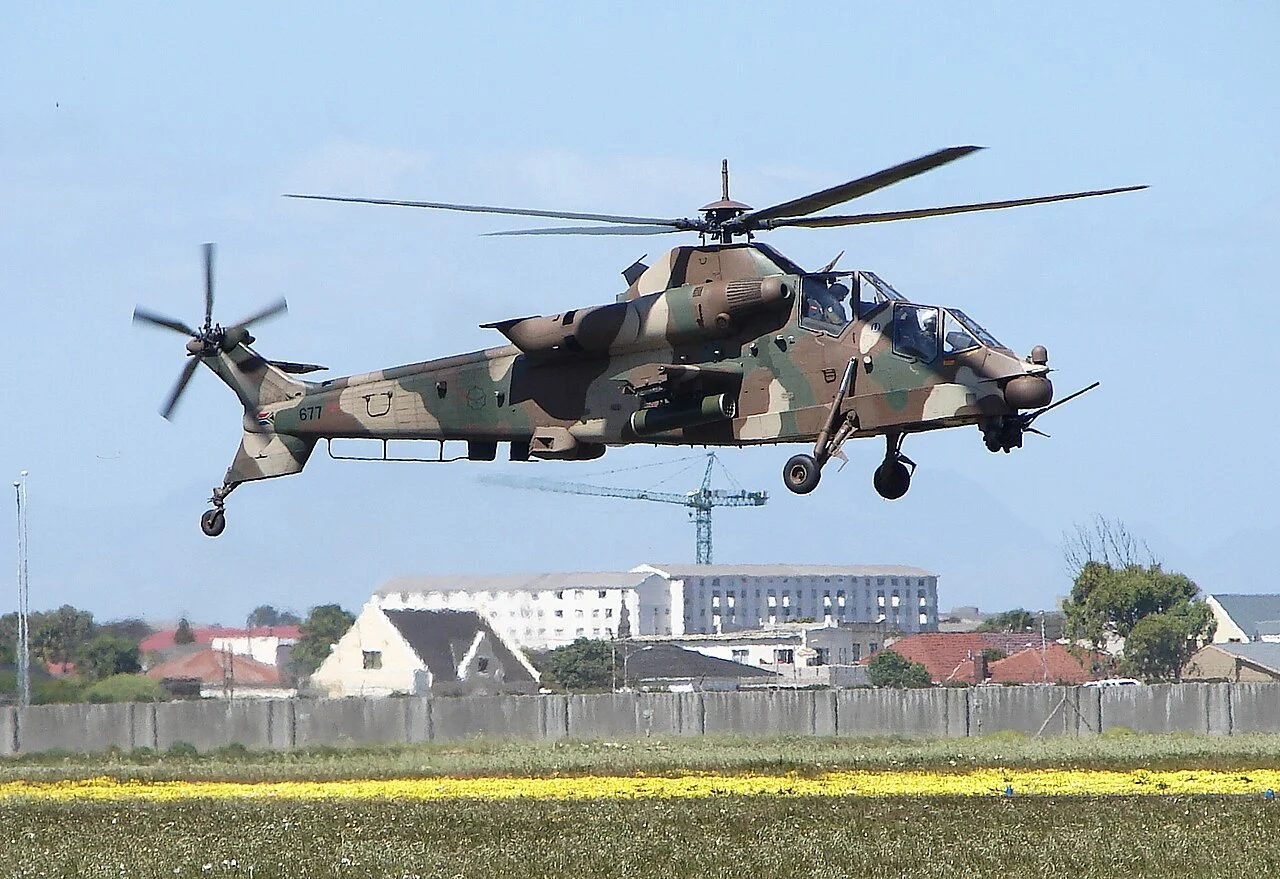


South Africa’s locally designed Rooivalk and the Soviet-era Mi-24/Mi-35 family are the two attack helicopter types that actually fly combat missions for African air forces today. This comparison sets their manufacturer-published performance figures against each other and tracks which African states operate each type, with sourced status labels, as of October 2026.
DEFENCE AFRICA | Head-to-head | Data as of October 2026
Only two attack helicopter families have flown sustained combat operations for African armed forces in the past fifteen years: the Denel Rooivalk, built in South Africa and operated nowhere else, and the Mil Mi-24/Mi-35 “Hind” family, inherited or purchased from Russia and now in service from Algeria to Sudan. Both have flown against insurgents, both have taken losses, and both sit at the centre of their air forces’ sustainment problems. They were never sold as competitors in the same tender, so this is not a procurement shoot-out. It is a comparison of the specifications each manufacturer has published, the countries that actually fly each type, and what combat use in Africa has shown about both.
The two helicopters emerged from very different industrial bases. The Rooivalk (originally the AH-2) was developed by Denel Aviation from the late 1980s as a home-grown gunship for the then-South African Defence Force, drawing on Alouette and Puma-era rotor technology and emerging only after South Africa was cut off from most Western arms markets. The Mi-24 traces to the Mil design bureau’s 1970s requirement for a Soviet battlefield gunship that could also carry troops, and its export variants, culminating in the Mi-35M and Mi-35P, have been Russia’s standard rotary attack export for four decades.
Key facts
- Denel built 12 Rooivalk airframes for the South African Air Force’s 16 Squadron between 1998 and 2011; no other state operates the type (Shephard Media, 2016; Army-Technology).
- Armscor told Parliament’s defence portfolio committee in 2023 that only a minority of the SAAF’s 11-aircraft operational Rooivalk pool was serviceable (DefenceMENA, 2026, citing Armscor).
- FlightGlobal’s World Air Forces directory credited Sudan with 35 Mi-35s, Algeria with 30 Mi-24 SuperHind Mk IIIs and Nigeria with 15 Mi-35s plus 18 more on order, in its 2023-2025 editions.
- Three SAAF Rooivalks deployed to the DRC under MONUSCO’s Force Intervention Brigade from October 2013 to December 2024, flying their first combat mission on 4 November 2013.
- Nigeria, Mali and Uganda have each lost Mi-24/35s in or around combat operations since 2014; no Rooivalk loss in the DRC has been confirmed.
Denel Rooivalk: South Africa’s indigenous gunship, a fleet of one operator
The Rooivalk is a tandem-seat, twin-engine attack helicopter built around a stub-wing airframe roughly 18.65 metres long with a 15.22-metre main rotor diameter and a maximum take-off weight of about 8,750 kg (Army-Technology; GlobalSecurity.org, widely repeated technical figures). It is powered by two Topaz (Makila 1K2) turboshafts. Denel and various aggregators cite a dash speed near 309 km/h, but neither Denel nor the SAAF has published an official maximum speed or combat radius figure, so that number should be read as a widely repeated estimate rather than a confirmed specification.
Its confirmed combat armament, drawn from South African Air Force reporting on its DRC deployment, is a 20 mm F2 cannon and 70 mm folding-fin unguided rockets. Denel’s own marketing and Army-Technology’s project page additionally list the ZT-6 Mokopa laser-guided anti-tank missile (quoted range over 8.5 km) and a short-range air-to-air missile — sources differ on whether that missile is the Mistral or Denel’s own V3P/Darter — as part of the aircraft’s designed weapons suite, though DefenceMENA’s own reporting on the DRC deployment does not confirm either missile type was actually fired there.
Twelve Rooivalk Mk1 airframes were delivered to 16 Squadron at AFB Bloemspruit between 1998 and 2011, and South Africa remains the type’s only operator. The fleet’s serviceable number is not publicly disclosed: Armscor told Parliament’s defence portfolio committee in 2023 that only a minority of an 11-aircraft operational pool was flyable, and in 2025 Armscor reported that the Rooivalk’s R2.5 billion maintenance contract had been funded to only R469 million against a R7.7 billion SAAF-wide shortfall. Three Rooivalks withdrawn from the DRC in late 2024 are undergoing assessment and repair at Denel, with no confirmed return-to-service date. A Mk1.1 upgrade, covering sighting-system and cannon-reliability work, has been under discussion with Airbus Helicopters since a 2016 memorandum of understanding, and Denel Aeronautics submitted a further phased Mk1.1 proposal to the SAAF in September 2026 that remains unfunded — reportedly under negotiation rather than contracted.
Mi-24/Mi-35: the Soviet-era type that still equips most African gunship fleets
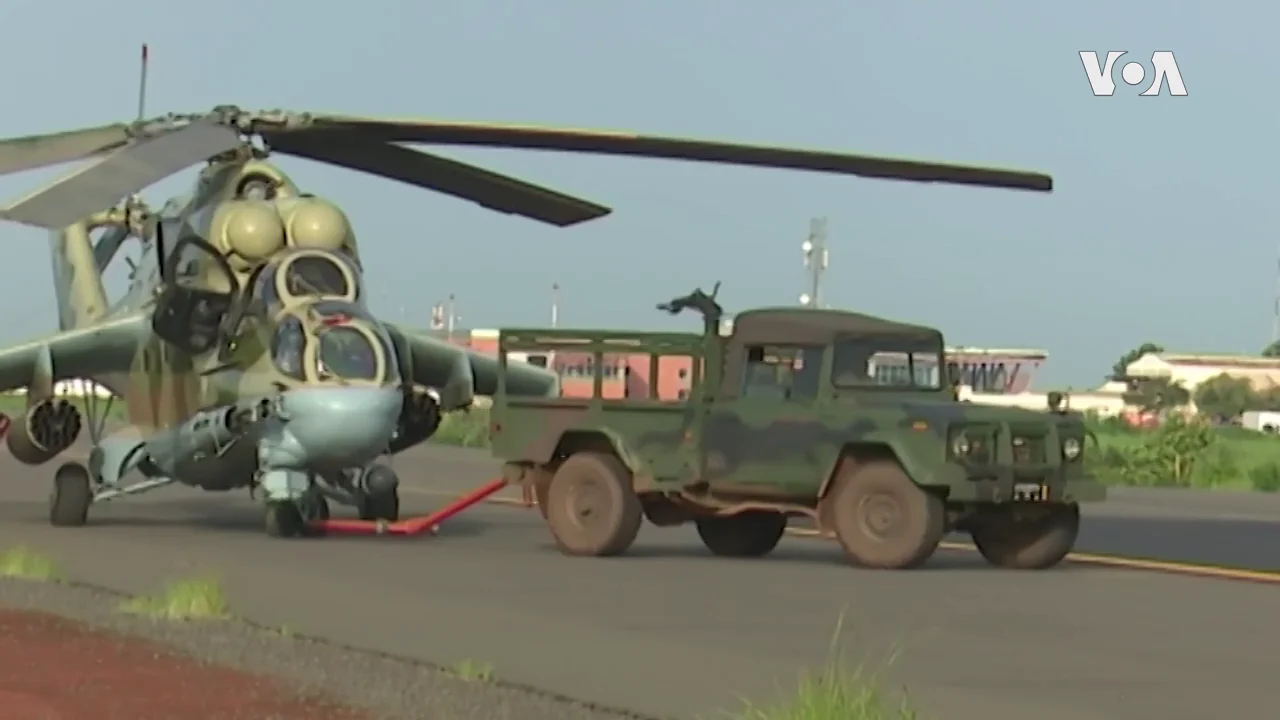
The baseline Mi-24, as compiled from published technical references, is larger and heavier than the Rooivalk: a maximum take-off weight of around 12,000 kg, two Isotov TV3-117 turboshafts rated at 1,600 kW each, a published maximum speed of 320 km/h, a cruise speed of 270 km/h and a normal range of about 450 km. The modernised Mi-35M export variant that Nigeria and Mali fly carries a new five-blade rotor, uprated engines and a fixed, retractable-free undercarriage; its armament has migrated from the original flexible 12.7 mm machine gun to a twin-barrel GSh-23L (or fixed GSh-30K on the Mi-24P) cannon, 9K114 Shturm or 9M120 Ataka anti-tank missiles carried in pairs on the wingtip pylons, and S-8 or S-24 unguided rocket pods. Published figures on the Ataka’s range vary between roughly 6 km and 8 km depending on the source, which is a reminder that export-brochure and open-source figures for this family are not always consistent.
Unlike the Rooivalk, which carries only a two-person crew, the basic Mi-24 design keeps a small troop or technician cabin behind the cockpit — a legacy of its original Soviet “flying BMP” requirement that the Rooivalk’s designers deliberately dropped in favour of a pure gunship.
FlightGlobal’s World Air Forces directory, in its 2023-2025 editions, recorded the type across at least eight African air forces: Sudan (35 Mi-35s), Algeria (30 Mi-24 SuperHind Mk IIIs), Nigeria (15 Mi-35s in service with 18 more on order), Angola (14 Mi-24s), Mali (8), Uganda (6 Mi-35s), Guinea (3 Mi-25s) and Niger (1 Mi-35, plus two ex-Algerian Mi-24 SuperHind Mk IIIs donated in 2026). Sudan’s figure predates the serviceability collapse its air force has suffered in the current civil war and should be read with that caveat rather than as a current operational count. As DefenceMENA has reported in detail, Nigeria’s helicopters have flown against Boko Haram and ISWAP, Mali’s against JNIM and separatist forces around Kidal and Gao, and Uganda’s in Operation Shujaa against the ADF in eastern DR Congo, with confirmed losses in all three countries since 2014, including a Mi-24P captured by rebel fighters near Gao in April 2026. Nigeria’s follow-on order for 12 more Mi-35Ms, placed in 2019, was still described by a Russian official in 2023 as only partially fulfilled.
| Specification | Denel Rooivalk (Mk1) | Mi-24/Mi-35 family (Mi-24 baseline / Mi-35M export) |
|---|---|---|
| Manufacturer | Denel Aviation, South Africa | Rostvertol / Russian Helicopters, Russia |
| Crew | 2 (pilot and weapons system officer, tandem) | 2 flight crew, plus a small cabin for troops or a technician |
| Max take-off weight | ~8,750 kg | ~12,000 kg (Mi-24 baseline) |
| Max speed | ~309 km/h (widely repeated, not officially confirmed) | 320 km/h (Mi-24 baseline, published technical references) |
| Range | Not officially published | ~450 km normal range (Mi-24 baseline) |
| Cannon | 20 mm F2 (confirmed in DRC combat use) | GSh-23L 23 mm (VP/VM/35M) or fixed GSh-30K (P) |
| Guided missile | ZT-6 Mokopa ATGM (manufacturer-published; not confirmed fired in DRC) | 9K114 Shturm / 9M120 Ataka ATGM |
| Unguided rockets | 70 mm FFAR (confirmed in DRC combat use) | S-8 or S-24 rocket pods |
| African operators | 1 (South Africa) | At least 8 (Sudan, Algeria, Nigeria, Angola, Mali, Uganda, Guinea, Niger) |
Operators and status across Africa
| Country | Type | Reported fleet | Status |
|---|---|---|---|
| South Africa | Rooivalk Mk1 | 12 built; number serviceable undisclosed | Operational (16 Squadron); Mk1.1 further upgrade reportedly under negotiation |
| Sudan | Mi-35 | 35 (World Air Forces 2024) | Operational on paper; serviceability disrupted by the civil war, published figures vary |
| Algeria | Mi-24 SuperHind Mk III | 30 (World Air Forces 2024) | Operational |
| Nigeria | Mi-35P/M | 15 in service; 18 more on order | Operational, with the 2019 follow-on order reported partially fulfilled |
| Angola | Mi-24 | 14 (World Air Forces 2025) | Operational |
| Mali | Mi-24D/P, Mi-35M | 8 (World Air Forces 2025) | Operational, with confirmed losses since 2023 |
| Uganda | Mi-24/Mi-35 | 6 Mi-35 (World Air Forces 2024) | Operational, flying in Operation Shujaa |
| Guinea | Mi-25 | 3 (World Air Forces 2024) | Operational |
| Niger | Mi-35, Mi-24 SuperHind Mk III | 1 Mi-35; 2 ex-Algerian Mi-24 delivered 2026 | Operational / delivered |
Sustainment and the industrial angle
The two programmes illustrate opposite sustainment problems. The Rooivalk is the harder case technically: with only 12 airframes ever built and Denel the sole source of spares, airframes, and the Mk1.1 upgrade kit, the SAAF has no alternative supplier and depends entirely on Denel’s own uneven finances for parts and overhauls — a dynamic also visible in Airbus and Denel’s 2026 maintenance-backlog partnership. A single state operator and a single domestic manufacturer means there is no export revenue to offset fleet-wide support costs, and no Mk2 launch customer has emerged since Denel marketed the design to Poland, Nigeria and Egypt in 2016.
The Mi-24/35 family faces a different problem: broad distribution but uneven access to Russian factory support since 2022, as sanctions and the war in Ukraine have complicated some African states’ ability to secure timely spares, upgrades and technician training directly from Rosvertol. Nigeria’s experience, where a 2019 follow-on order for 12 Mi-35Ms was still reported “partially fulfilled” by a Russian official in 2023, points to delivery friction rather than a lack of demand. States such as Mali and Uganda extend service life with field-level maintenance rather than factory overhauls, which is part of why both have suffered Mi-24/35 losses attributed to technical or undetermined causes rather than only to enemy fire.
Why it matters for Africa
Attack helicopters remain one of the few platforms African air forces can reliably use against insurgent and non-state forces that lack air defences, which is why both types keep flying despite their sustainment problems. The Rooivalk shows what a single-operator, domestically built gunship costs to keep flying once its manufacturer’s balance sheet comes under strain: South Africa cannot simply buy spares off a shelf, and every airframe lost to attrition or storage is one of only 12 ever made. The Mi-24/35 family shows the opposite risk — wide availability and relatively low unit cost have made it the default gunship for cash-constrained air forces from the Sahel to the Horn, but that same affordability has often meant minimal factory-level sustainment, patchy training pipelines and fleets that look larger on paper than they fly in practice. Neither type has a clear successor on order across the continent, which means procurement decisions made in the next few years — on Rooivalk Mk1.1 funding, or on further Mi-35 orders from Nigeria and others — will shape African attack-helicopter capability for a generation.
Sources
- DefenceMENA: Rooivalk in the DRC — What Combat Use Actually Showed
- DefenceMENA: Mi-24 and Mi-35 Attack Helicopters in Africa
- DefenceMENA: Denel — Inside South Africa’s State-Owned Defence Giant
- DefenceMENA: Airbus and Denel Sign Partnership to Fix SAAF Helicopter Maintenance Backlog
- Army-Technology: Rooivalk Attack Helicopter
- Shephard Media: Operational Rooivalk Finally Delivered to SAAF
- Mil Mi-24, operator and specification data compiled from FlightGlobal’s World Air Forces directory (Hoyle, 2023-2025 editions)
- Military Africa: Mali Receives Additional Mi-35M Hind-E Helicopter From Russia
- HeliHub: Nigerian Air Force Receives First Mi-35M Delivery