General Dynamics Company Profile: What the World’s Fifth-Largest Arms Maker Builds, and Where Africa Fits In

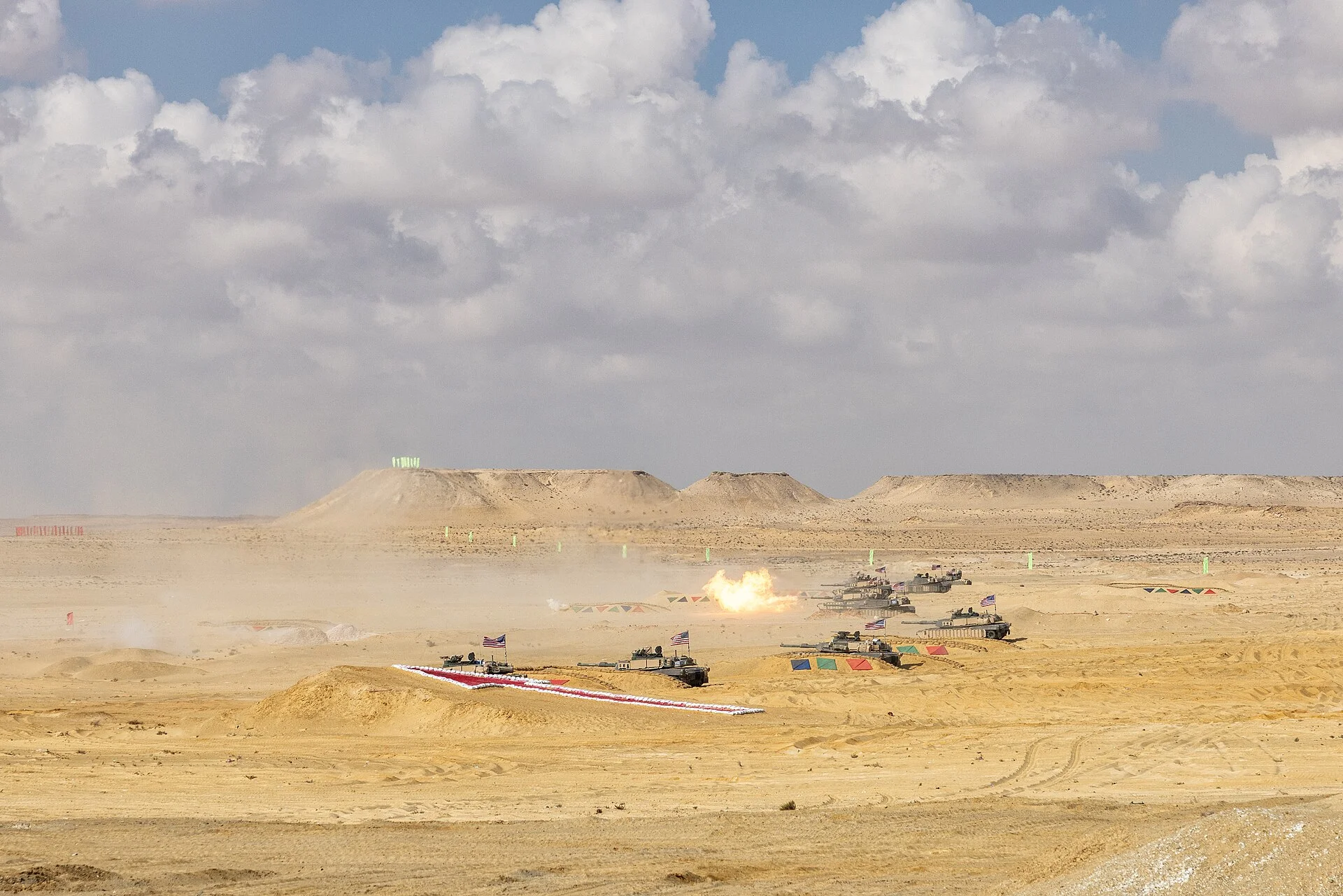


General Dynamics is a US defence and aerospace group that builds the M1 Abrams tank, the Stryker and LAV wheeled armoured vehicles, the Piranha and ASCOD families in Europe, nuclear-powered submarines and Arleigh Burke-class destroyers for the US Navy, and Gulfstream business jets. SIPRI ranks it fifth in the world by arms revenue, with $33.6 billion in 2024. In Africa its documented footprint is narrow but deep: Egypt assembles M1A1 Abrams tanks in a Cairo plant under a co-production programme that dates back to the 1980s, and Morocco operates Abrams tanks supplied from US surplus stocks.
Photo: a US Army M1A2 SEPv3 Abrams, built by General Dynamics Land Systems, firing during exercise Bright Star 25 at Mohamed Naguib Military Base, Egypt, in September 2025. Credit: U.S. Army photo by Joseph Kumzak, via Wikimedia Commons, public domain (US government work).
This profile is part of DefenceMENA’s Global Defence Industry series, which works through the SIPRI Top 100 from an African perspective. It covers what General Dynamics makes, where it sits in the rankings, and what is actually on the public record about its African and Middle Eastern customers. All figures are dated; nothing has been estimated to fill a gap.
Key facts (as of 24 October 2026)
- Full name: General Dynamics Corporation (NYSE: GD), headquartered in Reston, Virginia.
- Founded: 1952, as the parent company of the Electric Boat submarine yard (General Dynamics).
- Chairman and chief executive: Phebe N. Novakovic, since 2013.
- SIPRI Top 100 (2024 data, published December 2025): fifth, with arms revenue of $33.63 billion, about 70% of total revenue of $47.72 billion (SIPRI).
- Company results for 2025: revenue $52.6 billion, net earnings $4.2 billion, year-end backlog $118 billion (General Dynamics, 28 January 2026).
- Latest quarter: second-quarter 2026 revenue of $14.1 billion, up 8.1% on a year earlier, with backlog of $136.5 billion at the end of the quarter (General Dynamics, 29 July 2026). Third-quarter results had not been published by 24 October 2026.
- Workforce: about 117,000 people (2025 annual report, Form 10-K).
- Revenue from customers in Africa and the Middle East: $2.02 billion in 2025, under 4% of the group total. The company does not report Africa separately (10-K).
From a submarine yard to a four-segment group
General Dynamics was formed in 1952 around Electric Boat, the yard that christened USS Nautilus, the first nuclear-powered submarine, in 1954. It bought Convair in 1953 and, in 1982, Chrysler’s defence business, which became General Dynamics Land Systems and has been responsible for the Abrams ever since (company history).
The early 1990s brought a sharp contraction. The company sold almost everything except its military vehicle and submarine businesses, including, in 1993, the Fort Worth aircraft plant that built the F-16. That is why the F-16 is now a Lockheed Martin product (see our Lockheed Martin profile).
Rebuilding started in the mid-1990s:
- Shipbuilding: Bath Iron Works (1995) and NASSCO (1998).
- Business aviation: Gulfstream (1999).
- European armoured vehicles: Santa Bárbara Sistemas in Spain (2001), Steyr-Daimler-Puch Spezialfahrzeug in Austria (2003) and the Swiss Piranha maker MOWAG (2004). Together they form General Dynamics European Land Systems.
- Canadian wheeled vehicles: General Motors Defense (2003), now General Dynamics Land Systems–Canada, maker of the LAV.
- IT services: CSRA in 2018 for $9.7 billion, the largest acquisition in the company’s history.
What does General Dynamics make?
The company reports four segments. Its 2025 annual report gives the following revenue by segment, in descending order (Form 10-K).
Marine Systems: $16.72 billion
Nuclear-powered submarines alone brought in $12.61 billion. Electric Boat is the prime contractor for the Columbia-class ballistic-missile submarine and builds the Virginia-class attack submarine with HII. Bath Iron Works is one of two builders of the Arleigh Burke-class (DDG-51) destroyer. NASSCO builds auxiliary and support ships.
Technologies: $13.47 billion
This segment comprises GDIT, which provides IT services to US government customers, and General Dynamics Mission Systems, which makes communications, command-and-control and cyber products.
Aerospace: $13.11 billion
Mostly Gulfstream business jets and aircraft services. This is largely civil work, which is one reason the company’s total revenue is higher than SIPRI’s arms-revenue figure.
Combat Systems: $9.25 billion
This is the segment most relevant to African and Middle Eastern armies. Military vehicles brought in $4.97 billion and weapon systems and munitions $3.10 billion. Its main lines are:
- Tanks: the Abrams family, including the M1A2 SEPv3 and the next-generation M1E3 under development for the US Army.
- Wheeled vehicles: the Stryker and the LAV. Land Systems–Canada is producing 515 new LAVs for the Canadian Army.
- European vehicles: the Piranha, ASCOD and Ajax families. Land Systems is producing the Ajax for the British Army.
- Munitions: the Ordnance and Tactical Systems business.
The company says more than 12,000 of its Pandur, Piranha and other light armoured vehicles are in service worldwide. In 2025 the segment booked $9.2 billion of combined awards for wheeled and tracked vehicles from international customers (10-K).
Where General Dynamics sits in the SIPRI Top 100
SIPRI’s December 2025 fact sheet covers 2024 and is the latest edition available. It places General Dynamics fifth, the same position as for 2023. Its arms revenue rose by 8.1% to $33.6 billion, the largest increase among the four US companies in the top five.
SIPRI attributes most of the growth to the Columbia- and Virginia-class submarine programmes. It also records the other side: in 2024 the Columbia programme was estimated to be up to $17.0 billion over budget, and the first boat at least 16 months behind schedule (SIPRI fact sheet, PDF).
Two cautions apply to that ranking:
- Revenue is not quality. SIPRI ranks companies by arms revenue only. It says nothing about the quality of their products.
- The figures measure different things. SIPRI’s $33.6 billion is not comparable with the company’s $52.6 billion. SIPRI counts arms and military services only, which excludes most Gulfstream sales, and the two figures cover different years.
General Dynamics in Africa: what is documented
Egypt: the only Abrams production line outside the United States
Egypt’s M1A1 programme is General Dynamics’ main African connection. Since 1992 the company has supplied the components for kits that are shipped to a factory near Cairo and turned into tanks for the Egyptian Land Forces.
In November 2011 General Dynamics Land Systems received a $395 million contract for 125 kits, the eleventh increment of the programme. The company said this would take the number of tanks co-produced in Egypt to 1,130 (General Dynamics, 17 November 2011).
A 1993 US Government Accountability Office review concluded that the co-production arrangement had raised costs and might not meet many of its goals (GAO, NSIAD-93-203). The local work is real, but it is better described as assembly and partial manufacture than as a full transfer of tank technology.
The programme is now moving from new production to modernisation. On 20 December 2024 the US Defense Security Cooperation Agency notified Congress of a possible sale to Egypt to refurbish and upgrade 555 M1A1 tanks to the M1A1SA configuration. The notification gives:
- Estimated cost: $4.69 billion, funded through US Foreign Military Financing.
- Contractor: General Dynamics Land Systems.
- Location: the refurbishment would take place at the Egyptian Tank Plant in Cairo.
- Duration: US government and contractor teams would make visits for up to ten years.
The notification also states that Egypt is the only country other than the United States that produces the M1A1 (Federal Register, 12 January 2026). A notification approves a possible sale; it is not a signed contract. DefenceMENA found no public contract award for this case by 24 October 2026. For Egypt’s wider tank fleet, see Egypt’s tanks: M60 Patton to M1A1 Abrams and the American core of Egypt’s arsenal.
Morocco: surplus tanks, upgrade notification and support contracts
Morocco’s Abrams came from US Excess Defense Articles stocks rather than new production. In November 2018 the DSCA notified Congress of a possible sale, estimated at $1.259 billion, to enhance 162 of these tanks to one of three standards: M1A1 SA, M1A2M or the US Marine Corps M1A1 version (Federal Register, 6 February 2019).
In September 2025 Morocco was among eight countries funding work under a $26.8 million modification to General Dynamics Land Systems’ Abrams technical-support contract. The modification took the contract’s total value to $1.062 billion (Morocco World News, citing the US Department of Defense). The other seven were Australia, Egypt, Iraq, Kuwait, Poland, Saudi Arabia and Taiwan.
See how the United States became a major supplier to Morocco and Morocco’s Oshkosh HET A1 order for its Abrams fleet.
Other African links
- Cameroon (reported): Janes reported in 2018 that Cameroon’s Rapid Intervention Battalion (BIR) operated General Dynamics Peace Keeping Security Vehicles donated by the United States in 2015 and 2016 (Janes, 6 June 2018). DefenceMENA has not found a General Dynamics statement on the vehicles.
- Ghana (estimated): the Ghana Army is credited in IISS-derived inventories with legacy MOWAG Piranha I vehicles. MOWAG became part of General Dynamics only in 2004, so these are older Swiss-built vehicles, not a recent General Dynamics sale.
- Group-level disclosure: the 2025 annual report describes a growing installed base of Abrams tanks in “Europe, the Middle East, North Africa and Indo-Pacific” (10-K).
DefenceMENA found no documented sale of General Dynamics ships, submarines or Stryker vehicles to an African state.
Middle East customers
The Middle East record is larger than the African one. All the figures below are notified or announced values, not delivery counts.
- Saudi Arabia:
- Abrams: in August 2016 the DSCA notified a possible $1.15 billion sale of up to 153 M1A1/A2 tank structures, for conversion to 133 M1A2S tanks and 20 battle-damage replacements, with General Dynamics Land Systems as prime contractor (Federal Register, 23 August 2016).
- LAV: in February 2014 the Canadian government announced that General Dynamics Land Systems–Canada had won a 14-year contract, via the Canadian Commercial Corporation, to supply light armoured vehicles to Saudi Arabia (Government of Canada). No official value was published. CBC reported about US$10 billion.
- Kuwait: a 2016 US notification covered upgrading 218 M1A2 tanks to the M1A2K standard, valued at about $1.7 billion (Defense News).
- Iraq: a December 2008 DSCA notification covered 140 M1A1 tanks upgraded to the M1A1M standard, with a value of up to $2.16 billion (DSCA, archived).
Related coverage: the biggest defence deals of Saudi Arabia, main battle tanks of Arab armies and Iraq’s four-force military.
Status at a glance
| Country | Programme | Type of record | Status as of 24 Oct 2026 |
|---|---|---|---|
| Egypt | M1A1 co-production (Cairo) | Company contract announcements; GAO | 1,130 tanks covered by increments up to 2011 (company figure) |
| Egypt | 555 M1A1 to M1A1SA refurbishment | DSCA notification, Dec 2024 | Proposed sale; no public contract award found |
| Morocco | 162 Abrams enhancement | DSCA notification, Nov 2018 | Notified; final contract scope not published |
| Morocco, Egypt | Abrams technical support | US contract modification, Sep 2025 | Contracted (FMS funding) |
| Cameroon | Peace Keeping Security Vehicle | Janes (2018) | Reported in service with the BIR |
| Saudi Arabia | M1A2S; LAV | DSCA notification, 2016; Canadian government, 2014 | Notified; contract announced (value not official) |
| Kuwait, Iraq | M1A2K; M1A1M | US notifications, 2016 and 2008 | Notified (values are maximums) |
International alternatives, by product category
General Dynamics competes in several unrelated markets, so the alternatives differ by product. The table lists competitors by category only. It is not a ranking and does not compare specifications.
| Category | General Dynamics | Turkish | Chinese | European / other |
|---|---|---|---|---|
| Main battle tank | M1 Abrams | Altay (BMC) | VT-4 (NORINCO) | Leopard 2 (KNDS), K2 (Hyundai Rotem), Leclerc (KNDS) |
| 8×8 armoured vehicle | Stryker, LAV, Piranha | PARS (FNSS), ARMA (Otokar) | VN1 (NORINCO) | Boxer, Patria AMV, Mbombe 8 (Paramount, South Africa) |
| Tracked IFV | ASCOD / Ajax | Kaplan / Tulpar (FNSS / Otokar) | ZBD-04 (NORINCO) | CV90 (BAE Systems Hägglunds), Lynx (Rheinmetall) |
| Artillery ammunition | GD-OTS | MKE | NORINCO | Rheinmetall, Nammo, Rheinmetall Denel Munition (South Africa) |
At sea there is no African market for the company’s core products. No African navy operates nuclear-powered submarines, and the Virginia and Columbia classes are not offered for general export.
Procurement and industrial considerations for African buyers
- Route to market. Abrams and Stryker sales normally go through US Foreign Military Sales: the US government contracts with General Dynamics on the buyer’s behalf. Egypt’s programme is funded through US Foreign Military Financing. LAVs have been sold through Canada’s government-to-government channel. Piranha and ASCOD sales come from European subsidiaries under their own national export controls.
- Notification is not a contract. DSCA values are estimated ceilings. Quantities and configurations can change when a sale is signed, and some notified sales are never concluded.
- Sustainment dependence. The Egyptian notification lists AGT-1500 gas-turbine engines, X-1100 transmissions, sights and spare parts. Long-term readiness depends on a US supply chain and on continued US approval.
- Re-transfer limits. US-origin equipment cannot be passed to a third country without US government consent under the Arms Export Control Act.
- Local industry. Egypt’s Cairo plant is the clearest African example of industrial participation with a top-five arms company. GAO’s 1993 assessment is a reminder that co-production can cost more than buying finished vehicles.
- Surplus stock. Morocco shows that a lower-cost route exists through Excess Defense Articles, but it depends on which hulls the US has available.
FAQ
What does General Dynamics make?
Abrams tanks, Stryker, LAV, Piranha and ASCOD/Ajax armoured vehicles, artillery munitions, Virginia- and Columbia-class nuclear submarines, Arleigh Burke-class destroyers, military IT and communications systems, and Gulfstream business jets.
Is General Dynamics the maker of the Abrams tank?
Yes. General Dynamics Land Systems has built and developed the Abrams since the company bought Chrysler’s defence business in 1982.
Does General Dynamics make the F-16?
Not any more. General Dynamics developed and built the F-16 at Fort Worth, but sold that business in 1993. The F-16 is now a Lockheed Martin product.
Which African countries use General Dynamics products?
The documented cases are Egypt (M1A1 Abrams, co-produced in Cairo) and Morocco (Abrams from US surplus, with US-funded support). Janes has reported US-donated General Dynamics security vehicles in Cameroon. Ghana’s legacy Piranha I vehicles predate MOWAG’s purchase by General Dynamics.
Where does General Dynamics rank in the SIPRI Top 100?
Fifth for 2024, with arms revenue of $33.63 billion (SIPRI, December 2025).
Why is SIPRI’s figure lower than the company’s revenue?
SIPRI counts arms and military services only and excludes most civil Gulfstream sales. The company’s $52.6 billion is total revenue for 2025, a different year.
Sources
- SIPRI, The SIPRI Top 100 Arms-producing and Military Services Companies, 2024 (December 2025) and fact sheet PDF
- General Dynamics, fourth-quarter and full-year 2025 results (28 January 2026)
- General Dynamics, second-quarter 2026 results (29 July 2026)
- General Dynamics, 2025 annual report on Form 10-K (SEC)
- General Dynamics, Our history
- General Dynamics Land Systems, $395 million Egyptian co-production contract (17 November 2011)
- US GAO, Military Aid to Egypt: Tank Coproduction Raised Costs and May Not Meet Many Program Goals (1993)
- DSCA notifications in the Federal Register: Egypt, Abrams refurbishment (published 12 January 2026); Morocco, Abrams enhancement (6 February 2019); Saudi Arabia, M1A2S (23 August 2016); Iraq, M1A1M (2008, archived)
- Government of Canada, LAV export contract announcement (14 February 2014, archived); CBC News
- Defense News (Kuwait, 2016); Morocco World News (September 2025); Janes via Mack Defense (Cameroon, 2018)
Last reviewed 24 October 2026. SIPRI figures are for 2024, company financials for 2025. DSCA notifications are approvals of possible sales, not contracts. This profile will be updated when SIPRI publishes its next Top 100 or when a new African contract is documented.