Egypt’s Tornex Pushes Its Jabbar Drone Family at Back-to-Back Defence Shows



Egyptian firm Tornex has used back-to-back defence shows this year to roll out the Jabbar, a family of unmanned aircraft ranging from a small target drone to a stealth-shaped, turbojet-powered variant — part of a broader push by Cairo’s private defence sector to move from operating imported drones to building its own.
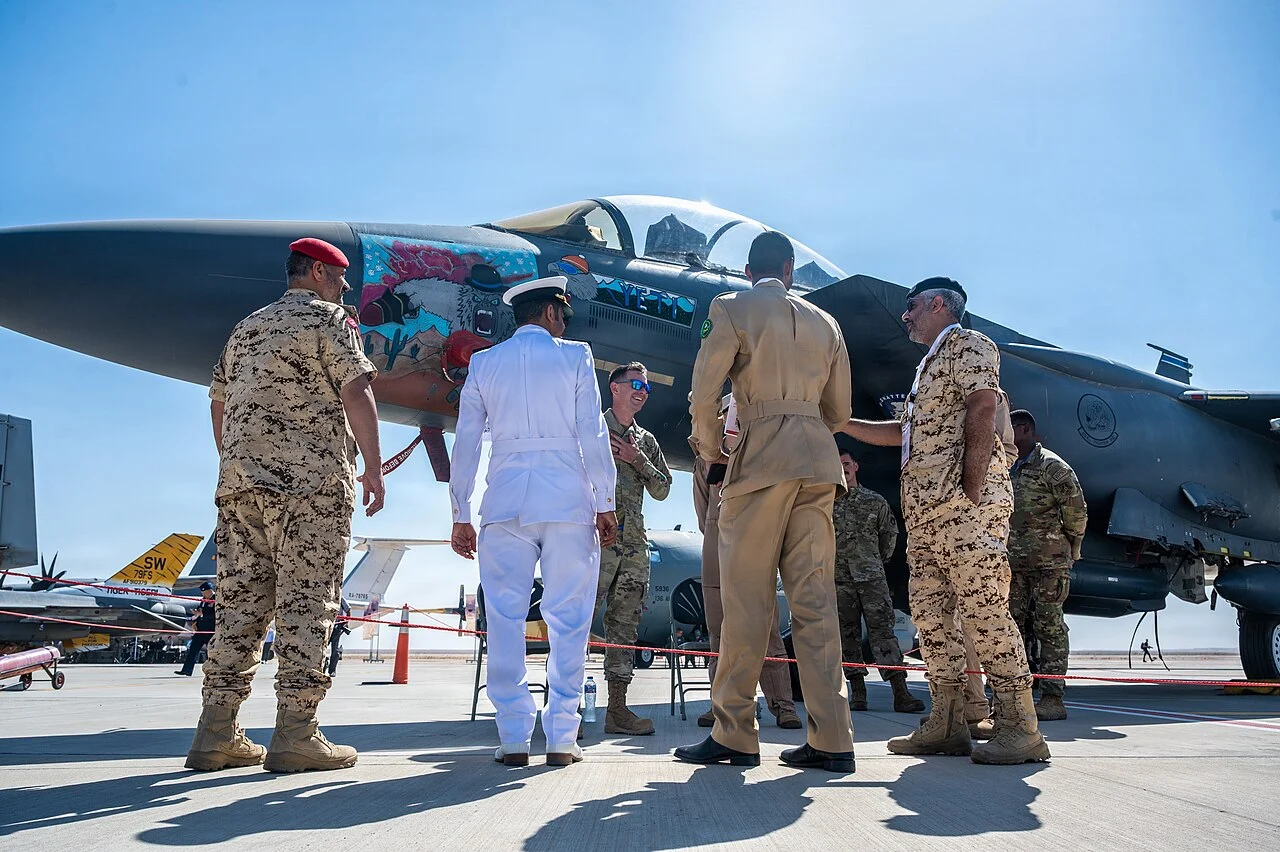
Photo: A French Air Force Rafale performs at the Egypt International Airshow, El Alamein, September 2026, where Tornex displayed its Jabbar drone family. Credit: U.S. Air Force photo by Staff Sgt. Christopher Tam, Public domain, via Wikimedia Commons
Tornex, a private Egyptian unmanned-systems manufacturer, has spent 2026 putting its Jabbar family of drones in front of as many buyers as possible, most recently at the second El Alamein International Airshow on 8-10 September, where President Abdel Fattah El-Sisi opened a show drawing more than 260 exhibitors from roughly 80 countries. The newest and smallest member of the family, the Jabbar 50, made its debut there, though only as rendered images; defence outlet Quwa, which covered the show, said it could not confirm that a physical airframe yet exists.
A family built around training, with room to grow
The Jabbar line first appeared at EDEX 2025 in Cairo, alongside Tornex’s other unmanned systems, and the company has pitched most of the range as training and target drones for air-defence units rather than as front-line strike weapons — though several variants are built with enough payload and range to do more than that if a customer wanted it.
The Jabbar 150 is the baseline model: a 150 kg piston-engined aircraft with a canard layout, roughly 10 hours of endurance, and a nose-mounted commercial electro-optical gimbal that lets an operator pick out targets, marketed by Tornex specifically for air-defence training. The Jabbar 200 steps up to 200 kg, a claimed top speed of 200 km/h, up to 14 hours of endurance and a 50 kg payload; Tornex says it can fly out to 2,500 km, though it has not published flight-test data to back the figure. Tornex markets the 200 as a target drone that could double as a long-range loitering munition, and its delta-wing shape bears a visual resemblance to Iran’s Shahed-136. At the top of the range, the Jabbar 250 swaps the piston engine for a small turbojet and a low-observable fuselage shape intended to reduce its radar cross-section, standing in for the fast, low-signature threats that air-defence crews increasingly have to train against; Jane’s puts its performance at 576 km/h, a 1,500 km range and 2.5 hours of endurance carrying a 50 kg payload. Unlike the Jabbar 50, the 250 has been seen as hardware rather than a render — Quwa photographed a physical example on Tornex’s stand at El Alamein.
Tornex is not alone in showing this kind of system. Amstone International Group, another private Egyptian firm, exhibited both the Jabbar 150 and 200 at the same shows, describing the 150 in particular as a long-endurance system with a strike-related role. Tornex also builds smaller systems alongside the Jabbar line: the Voltex-10, an electric fixed-wing drone for close-range threat emulation, and the Voltex-5, a compact, tube-launched loitering munition that resembles the US Switchblade, plus two guidance kits, the GK-10 and GK-6, with claimed circular error probable figures of under 30 metres and 2 metres respectively.
No confirmed orders yet
For all the hardware on display, no customer has been announced for any Jabbar variant, and no order from Egypt’s own armed forces has been confirmed either. The unverified range claim on the Jabbar 200 and the absence of a flight-test record for the 250 mean the family’s real performance, rather than its marketing numbers, is still an open question — one that will likely only be settled if Tornex publishes test data or a contract materialises.
The broader picture is still notable for what it signals about Egypt’s defence-industrial ambitions. The Jabbar family sits alongside work from the state-owned Arab Organization for Industrialization (AOI), which displayed its Hamza-1 and Hamza-3 drones and the UDJAT and WEDJAT counter-drone interceptors at the same shows, and alongside Cairo’s continuing push to localise foreign technology — including the Turkish state manufacturer MKE’s decision to open its first African subsidiary, Zafer, in Egypt, and a roughly $350 million Egypt-Türkiye defence package agreed in February that bundled Türkiye’s Tolga air-defence system with industrial infrastructure investment.
Why it matters for Africa
Egypt’s drone sector matters to the rest of the continent for reasons that go beyond its own order book. Egypt is already one of Africa’s largest arms importers and one of the few African states building a credible domestic unmanned-systems industry rather than buying finished drones outright, a path other African governments — several of which operate Turkish Bayraktar TB2s or Chinese Wing Loong IIs bought off the shelf — are watching closely as they weigh whether to build local assembly and design capacity of their own. A credible, exportable Egyptian training and target-drone line would also give African air forces and air-defence units a regional alternative to Turkish, Chinese, Iranian or Western suppliers, at a moment when demand for realistic, low-signature training targets is rising across the continent’s air-defence programmes. Whether Tornex’s claims survive contact with an actual flight-test programme or an export contract is the detail worth watching next. More on Egypt’s wider force posture is available in DefenceMENA’s Egypt military profile.
Sources
- Military Africa: “Egypt’s Tornex promotes Jabbar Drone family at defence exhibitions”
- DefenceMENA: “Turkey’s MKE Launches Zafer, Its First African Subsidiary, in Egypt”