Morocco and UAE Deepen Military Ties as Algeria Cuts Off Abu Dhabi



As Algeria severs diplomatic and airspace ties with the United Arab Emirates, Morocco is doing the opposite: deepening a military relationship that now covers joint training, industrial cooperation and a long-discussed transfer of Mirage 2000-9 fighters. The split shows how the Western Sahara dispute is reshaping defence alignments across North Africa.
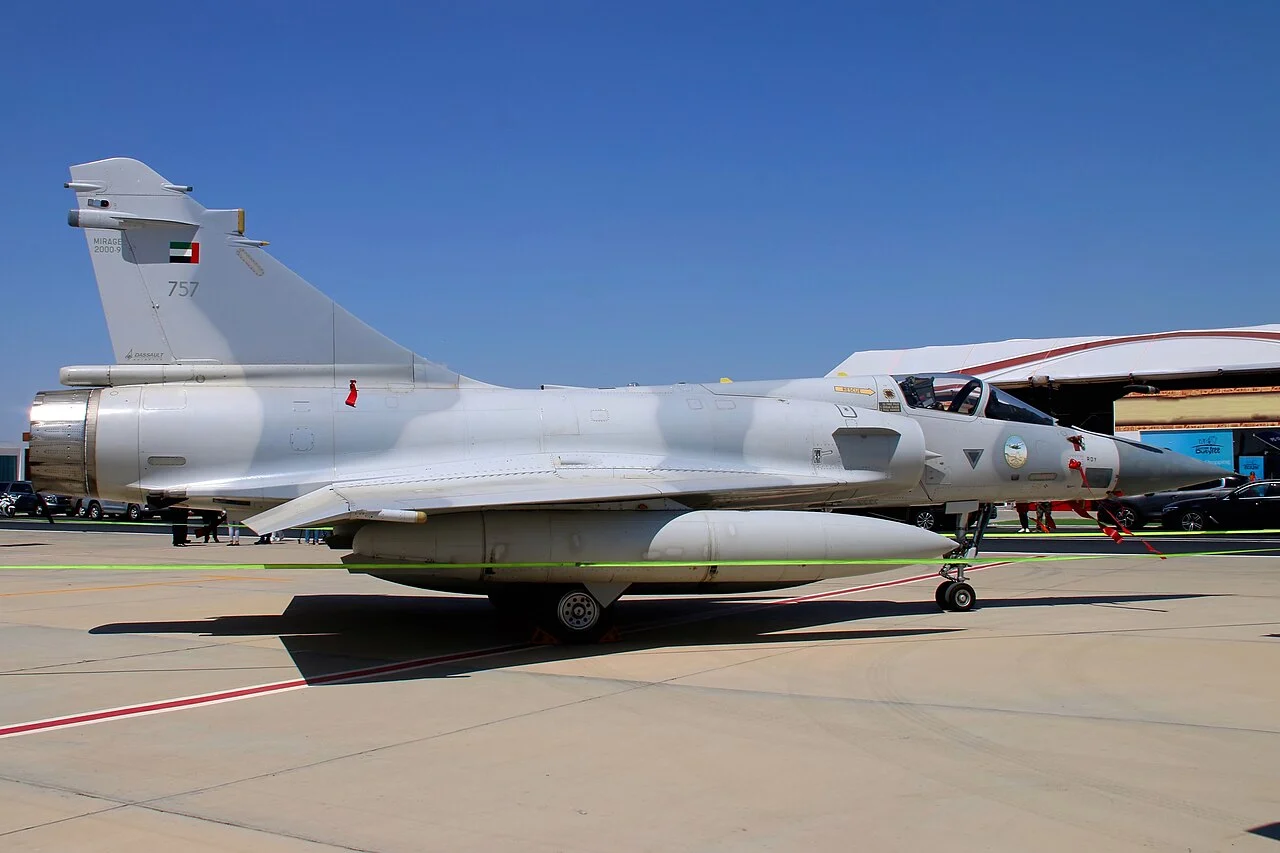
Photo: A UAE Air Force Dassault Mirage 2000-9, the type Abu Dhabi has discussed transferring to Morocco. Credit: Colin Cooke Photo, CC BY-SA 2.0, via Wikimedia Commons
Morocco and the United Arab Emirates have used the past fortnight to formally widen a decades-old military relationship, even as Algeria has gone the other way, cutting diplomatic relations with the UAE and closing its airspace to Emirati aircraft. The contrast captures a region where defence partnerships are increasingly read through the lens of the Western Sahara dispute, as Military Africa reported this week.
A joint committee meeting in Rabat
The third session of the Moroccan-Emirati Joint Military Committee was held in Rabat on 5-6 October. Lieutenant General Mohammed Berrid, Inspector General of Morocco’s Royal Armed Forces (FAR) and commander of its Southern Zone, led the Moroccan side on the instructions of King Mohammed VI. He received a UAE delegation headed by Major General Issa Saif bin Ablan Al Mazrouei, the UAE Armed Forces Chief of Staff.
The two sides discussed four areas: defence capability development, military industrial cooperation, training and the exchange of expertise. Moroccan state media reported that both officials praised the pace of cooperation so far and pledged to widen it further, though no outcome document or new contract was published alongside the meeting. King Mohammed VI separately awarded Al Mazrouei a decoration — reported as the Grand Officer rank of the Military Order of Merit in English-language coverage and as “Grand Cordon” in the French-language FAR communiqué carried by Le Matin — in recognition of his role in strengthening bilateral ties. The Emirati delegation went on to attend the Marrakech Air Show, held 7-10 October.
The relationship did not start this month. Morocco and the UAE signed their first military cooperation agreement in 1980, followed by a broader framework in May 2006 covering training, exchange visits and operational, technical and material assistance; the joint committee has since alternated between Rabat and Abu Dhabi. Al Mazrouei himself met Berrid at the 2024 Marrakech Air Show, two years before this month’s upgraded session. In 2020 the UAE became the first non-African state to open a consulate in Laayoune, in Western Sahara, and bilateral trade was reported above $800 million in 2021.
Algeria’s rupture with Abu Dhabi
The Rabat meeting lands against the backdrop of a sharp deterioration in Algeria’s own relationship with the UAE. On 10 September, Algeria’s foreign ministry announced it was cutting diplomatic relations with Abu Dhabi, saying it had “exhausted all means” of preserving ties and accusing the UAE of “provocative or hostile” actions, according to Reuters. Algiers gave the Emirati ambassador 48 hours to leave the country. From midnight on 11 September, Algeria’s defence ministry closed its airspace to UAE-registered civil and military aircraft, though existing UAE commercial flights to and from Algiers were given an exemption running to the end of 2026. The UAE said it hoped the measure would prove temporary.
Algeria has not given a detailed public explanation for the break. Several outlets link it to the UAE’s support for Morocco’s position on Western Sahara and to Abu Dhabi’s normalisation of relations with Israel. Algeria and Morocco have themselves had no diplomatic relations since 2021: Algiers backs the Polisario Front’s push for an independent Western Sahara, while Rabat offers the territory autonomy under Moroccan sovereignty. Morocco’s government has said it regrets Algeria’s decision over the UAE and has called for dialogue.
The Mirage 2000-9 question
The most consequential item hanging over the Morocco-UAE track is hardware, not diplomacy: a long-discussed plan for the UAE to transfer around 30 of its older Dassault Mirage 2000-9 fighters to the Royal Moroccan Air Force. The Mirage 2000-9 is an Emirati-specific variant of the Mirage 2000-5, built around a more modern radar and electronic warfare suite than the baseline export version, and would represent a significant capability step for a Moroccan fighter fleet that currently mixes F-16s with ageing Mirage F1s. A report from early May said the UAE had postponed the handover, citing regional instability, and was keeping the jets at Al Dhafra Air Base in the meantime; the same report noted a parallel maintenance contract between Safran Aircraft Engines and Global Aerospace Logistics covering the Mirage’s M53-P2 engines.
The UAE’s own fighter fleet has been moving upmarket for several years. Abu Dhabi ordered 80 Dassault Rafale F4 aircraft from France in December 2021, and the pace of Rafale deliveries has effectively set the timeline for when the older Mirage 2000-9s become available to hand down. Morocco, for its part, has been diversifying its own suppliers rather than waiting on the UAE alone: it has pursued guided-munitions agreements with the UAE’s EDGE Group, including the Desert Sting 16 and Thunder P-31 deal DefenceMENA covered in October, and continues to operate and expand its F-16 fleet, detailed in DefenceMENA’s F-16 Fighting Falcon explainer.
Why it matters for Africa
For Morocco, the upgraded joint committee gives Rabat a high-level channel into the UAE’s defence-industrial base at the precise moment Algeria is cutting that channel off for itself. The practical gains for Morocco’s armed forces lie less in the ceremony in Rabat than in what follows from it: training slots, industrial cooperation agreements and, if it eventually goes through, a fleet of more capable fighters at a fraction of new-build cost. Algeria’s airspace closure has little direct military effect on Morocco’s own posture, since the two air forces were not flying through each other’s territory in any meaningful way before the rupture. Its significance is political — it confirms that Algiers now treats the UAE as a party to the Western Sahara dispute and the wider North African rivalry with Rabat, rather than as a neutral Gulf partner. For the rest of the continent, the episode is a reminder that Gulf states’ defence-industrial reach into Africa, visible from Sahel counter-drone deals to Red Sea basing arrangements, is rarely free of the regional politics that come with it, and that African governments weighing Gulf partners increasingly have to price in those politics alongside the hardware on offer. Background on the two militaries at the centre of this story is available in DefenceMENA’s Morocco military profile and Algeria military profile.
Sources
- Military Africa: “Morocco and UAE Deepen Military Ties as Algeria Isolates Abu Dhabi”
- DefenceMENA: “Morocco Signs EDGE Deal for Desert Sting 16 and Thunder P-31 Guided Munitions”
- DefenceMENA: “F-16 Fighting Falcon: Specs, Variants and Who Flies It in the MENA Region”