Oman fields one of the smallest armed forces in the Gulf, built mainly on British and American equipment bought over four decades, and it sits on the only sea passage out of the Persian Gulf. This profile sets out what the Sultan’s Armed Forces operate in 2026, what is still on order, and how the war in Iran reached Omani ports in 2026.
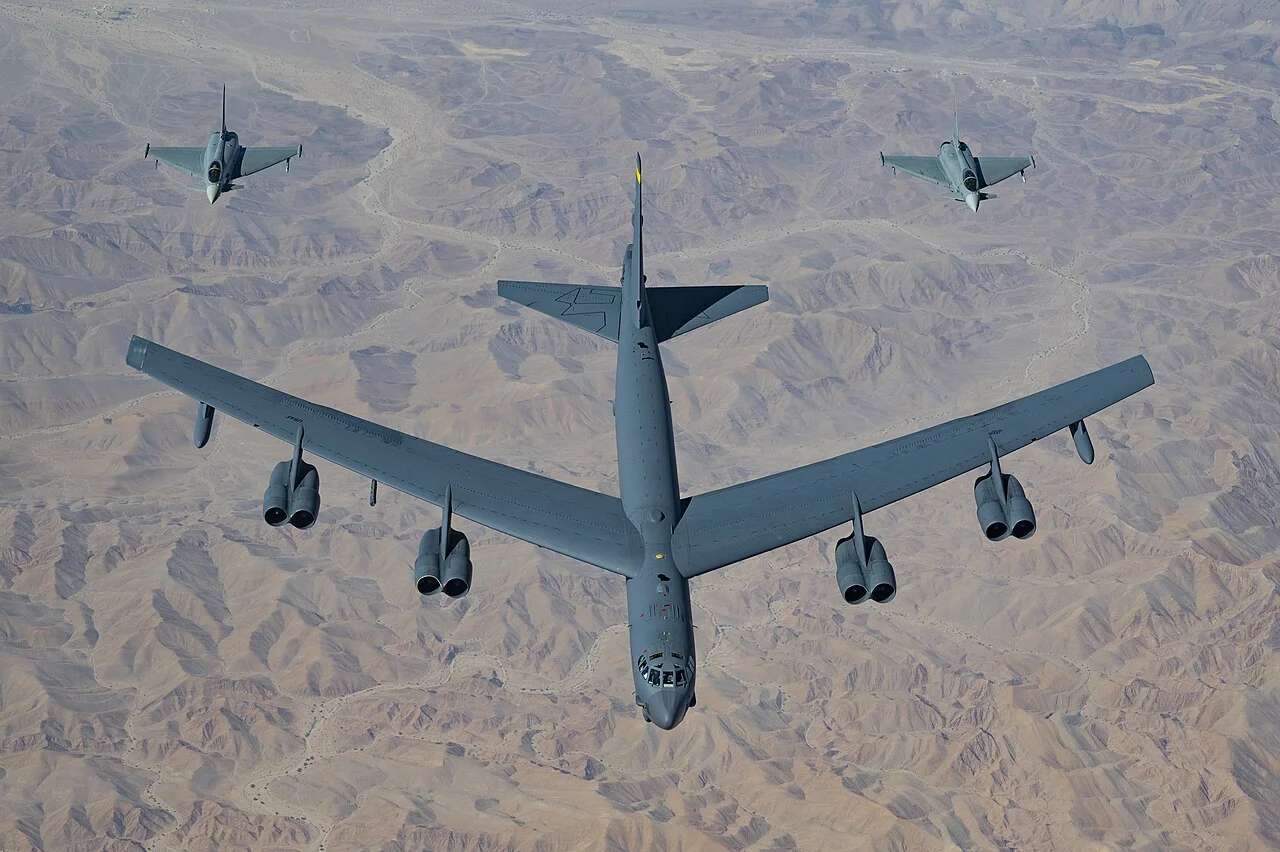
Photo: A U.S. Air Force B-52H Stratofortress flies alongside Royal Air Force of Oman Eurofighter Typhoons above Oman, 29 March 2022. Credit: U.S. Air Force photo by Staff Sgt. Jerreht Harris, public domain, via Wikimedia Commons
Oman answers the headline question differently from its Gulf neighbours. It is not trying to out-arm Saudi Arabia or the UAE: with around 45,000 active personnel and a mid-sized air force of Typhoons and F-16s, its military is built to secure the Musandam Peninsula on the Strait of Hormuz, patrol a long coastline, and give the Sultanate leverage as a mediator rather than a combatant. That role was tested directly in 2026, when Iranian drones and missiles struck Omani ports during the wider war with Israel and the United States, even though Oman was not a party to the fighting. What Oman does not have is a long-range air-defence system of the THAAD or Patriot type, a submarine force, or the Turkish armed drones that most of its GCC neighbours have bought since 2022.
Every line below carries a status label: In service, Delivered, Under delivery, Contracted, Ordered, Planned, Reported (unconfirmed) or Status unclear. An order is not a delivery, and a delivery is not an operational unit. Oman publishes no order of battle, so most figures below come from open-source compilations and are marked Estimated.
| Indicator | Figure | Year / source |
|---|---|---|
| Military expenditure | About US$5.5 billion; roughly 5.5–5.7% of GDP; about 20% of government spending | 2025, SIPRI data as reported by MilitarySpend.org (secondary; Estimated) |
| Active personnel | About 42,600–45,000 across the Royal Army, Royal Air Force and Royal Navy, plus a separate Royal Guard of about 4,500–5,000 | 2024–25, open-source compilations (Estimated) |
| Services | Royal Army of Oman, Royal Air Force of Oman, Royal Navy of Oman; Royal Guard of Oman reports separately to the Sultan | Sultan’s Armed Forces structure |
| Main historical suppliers | United Kingdom and United States for major platforms; France for vehicles, missiles and helicopters; no SIPRI supplier-share breakdown published for Oman specifically in 2021–25 | Open-source compilations; SIPRI |
| Defence industry | Small: ammunition production (OMPC) and a Turkish MRO office (Aselsan, opened Muscat, Feb 2025); no major domestic platform production | 2025, Tactical Report |
| 2026 security shock | Iranian drone and missile strikes on the ports of Duqm, Salalah and the Sohar industrial zone, March–August 2026 | 2026, Wikipedia compilation of press reporting (Estimated casualty and incident counts) |
| Largest recent US notification | US$188 million F-16 sustainment package | 7 September 2026, US State Department |
Military overview and security environment
The Sultan’s Armed Forces comprise the Royal Army of Oman, the Royal Air Force of Oman and the Royal Navy of Oman, all under the Ministry of Defence. The Royal Guard of Oman, an estimated 4,500 to 5,000 personnel, and the Royal Oman Police, which runs coast guard and internal security functions, sit outside this chain and are not covered in the tables below.
Oman’s defining security fact is geography: the Musandam Peninsula sits on the southern shore of the Strait of Hormuz, the only sea passage out of the Persian Gulf, and Oman’s southern ports of Duqm and Salalah lie outside the strait, which is why the United States built access to them into a 2019 framework agreement. That geography became a liability in 2026. After US and Israeli strikes on Iran began in late February 2026, Iran launched a sustained campaign of drone and missile attacks on shipping and port infrastructure across the Gulf and the Strait of Hormuz. Oman was targeted repeatedly despite not being a belligerent: reporting compiled by Wikipedia from press sources records strikes on Duqm port and tankers on 1 March (three killed, three injured), a fuel-tank fire at Duqm and two drones intercepted near Salalah on 3 March, an attack on Salalah port on 11 March, a strike on the Sohar industrial area on 13 March that killed two expatriate workers and injured eleven, and two drones crashing into Salalah port on 28 March, with sporadic attacks on shipping continuing into the summer. Independent tallies of the dead and injured vary by source, so this profile does not repeat a single running total beyond noting that multiple incidents caused fatalities.
Oman was, by most regional accounts, the least targeted Gulf state relative to its exposure, and it used the crisis to reinforce its long-standing role as an intermediary between Washington and Tehran. Oman’s foreign minister, Badr al-Busaidi, hosted and convened US–Iran contacts through the year, and a June 2026 memorandum between the US and Iranian presidents reportedly named Oman as a party Iran would consult on the future administration of the Strait of Hormuz. By August 2026 Gulf reporting described Iran, Oman and the United States as close to an interim arrangement on transit through the strait. None of this is a defence capability in the conventional sense, but it explains why Oman’s own military posture — modest, defensive and diversified in its suppliers — has not changed as sharply as those of states more directly at war.
For the wider Gulf picture, see the Middle East desk and the profiles of Saudi Arabia, the UAE and Qatar, all of which faced the same Iranian campaign with larger and more layered defences.
Defence budget: what the figures do and do not show
Open-source compilations citing SIPRI put Oman’s 2025 military spending at about US$5.5 billion, equivalent to roughly 5.5 to 5.7% of GDP and about 20% of total government spending — among the highest defence-to-budget ratios in the Gulf, though from a small absolute base compared with Saudi Arabia or the UAE. A market-research forecast cited by Army Technology projects the defence budget growing at a compound annual rate of about 2.6% through 2029, with the acquisition portion of that budget growing faster, at roughly 3.9% a year, reaching a cumulative US$1.7 billion in acquisition spending over 2025–29. These are forecasts, not confirmed allocations, and none of the figures in this section come from an Omani government budget document published in English; they are treated as Estimated throughout.
Personnel and force structure
Open-source compilations put total active personnel at roughly 42,600 to 45,000, split across the Royal Army of Oman (about 25,000, the largest branch), the Royal Air Force of Oman (about 5,000) and the Royal Navy of Oman (about 4,200). The Royal Guard of Oman, a separate force answering directly to the Sultan, is estimated at 4,500 to 5,000 and is not counted in the service totals above. One compilation lists a reserve of about 100,000, a figure this profile treats with caution given the country’s population of roughly 4.6 million; it is marked Estimated and unverified against an official source.
Royal Army of Oman
The army’s roughly 25,000 personnel are organised into two main infantry brigades and supporting units, headquartered at Muaskar al Murtafa’a near Seeb. Its armour is a mix of British, American and Turkish-built vehicles bought in stages since the 1980s. The 38 Challenger 2 tanks, ordered from the UK in two batches in 1994 and 1997 and delivered by 2001, are now the subject of an open decision: as the UK Army converts its own Challenger 2 fleet to the Challenger 3 standard, Oman has not stated whether it will seek the same upgrade or acquire the roughly 50 to 60 Challenger 2 hulls the UK will have surplus once that programme completes, according to Army Technology reporting. Older M60A1/A3 tanks (about 79 in open-source counts) and FV4201 Chieftain tanks delivered in the 1980s round out the fleet, alongside FV101 Scorpion light tanks.
The most significant recent land deal is Turkish: FNSS of Türkiye delivered around 172 Pars wheeled armoured fighting vehicles to Oman between 2017 and 2020, one of the larger Turkish land-systems exports to the Gulf. Air defence at army level mixes Russian, French, British and American systems, a diversification pattern common in a force that has bought opportunistically over decades rather than standardising on one supplier.
| System | Origin | Quantity | Status | Source |
|---|---|---|---|---|
| Challenger 2 main battle tank | United Kingdom | 38 (ordered 1994 and 1997) | In service; upgrade or Challenger 3 path undecided | Army Technology; open-source compilations |
| M60A1 / M60A3 Patton | United States | About 79 (6 A1, 73 A3) | In service, ageing | Open-source compilations |
| FV4201 Chieftain | United Kingdom | 27 (delivered 1981–85) | Status unclear | Open-source compilations |
| FV101 Scorpion light tank | United Kingdom | About 120 | In service | Open-source compilations |
| FNSS Pars wheeled AFV | Türkiye | About 172, delivered 2017–2020 | Delivered | Open-source compilations |
| Mowag Piranha II | Switzerland | About 174 | In service | Open-source compilations |
| Panhard VBL scout car | France | About 124 (8 with TOW) | In service | Open-source compilations |
| VAB / WZ-551 / Spartan / Fahd / Saxon / V-100 (APC mix) | France / China / UK / Egypt–Germany / UK / US | 56 / 50 / 34 / 31 / 15 / 15 | In service | Open-source compilations |
| G6 Rhino self-propelled 155 mm | South Africa | 24 | In service | Open-source compilations |
| Rapier, Crotale NG, Mistral, Pantsir-S1E, NASAMS, Stormer HVM (army air defence) | UK / France / Russia / Norway–US / UK | 28 Rapier, 54 Mistral, 12 Pantsir-S1E, 4 Stormer HVM; Crotale and NASAMS quantities not published | In service; Rapier upgraded to Mk2 missile | Open-source compilations; Defense Industry Daily |
Royal Air Force of Oman
RAFO’s roughly 5,000 personnel fly a two-type combat fleet built around a 2012 British contract and an earlier American one. Twelve Eurofighter Typhoon Tranche 3A aircraft, ordered under a £2.5 billion (about US$3.95 billion) contract signed on 21 December 2012 alongside eight Hawk advanced jet trainers, were delivered by 2017–18 and fly with No. 8 Squadron at RAFO Adam. Oman became only the second Middle Eastern operator of the Typhoon after Saudi Arabia. The F-16 fleet is older: 17 F-16C and 6 F-16D Block 50 aircraft, the first delivered from 2005 with further aircraft approved by Washington in 2010 and 2011, fly with Nos. 18 and 20 Squadrons at RAFO Thumrait. On 7 September 2026 the US State Department notified Congress of a possible US$188 million sale of F-16 sustainment support — spare parts, software and ground-handling equipment — with no contractor named and no delivery schedule disclosed; it is a support package, not new aircraft.
Beyond the fighters, RAFO’s Hawk fleet (10 Hawk Mk203 light-attack aircraft, 3 older Hawk Mk103 trainers and 8 Hawk AJT advanced trainers from the 2012 contract) covers weapons and pilot training. Transport rests on 3 C-130H and 2 C-130J-30 Hercules plus 8 Airbus C295s split between 4 tactical-airlift C295M and 4 C295 MPA maritime-patrol aircraft, the latter giving Oman one of the Gulf’s more capable maritime-surveillance fleets for its size. The helicopter fleet includes 18 NH90 TTH (assembled on the French production line), 13 Westland Lynx Super Mk120 for anti-surface warfare and search and rescue, and a handful of Bell 429 and Bell 206 light helicopters.
| System | Origin | Quantity | Status | Source |
|---|---|---|---|---|
| Eurofighter Typhoon (Tranche 3A) | UK / Europe | 12 | In service (delivered 2017–18) | GOV.UK; Bloomberg |
| F-16C/D Block 50 | United States | 23 (17 C, 6 D) | In service | Wikipedia compilation; The Defense Post |
| F-16 sustainment package | United States | US$188 million, no contractor named | Planned (possible sale notified 7 Sep 2026) | US State Department; The Defense Post |
| BAE Hawk Mk203 / Mk103 / AJT trainer | United Kingdom | 10 / 3 / 8 | In service | Open-source compilations |
| C-130H / C-130J-30 Hercules | United States | 3 / 2 | In service | Open-source compilations |
| Airbus C295M / C295 MPA | Spain / Europe | 4 / 4 | In service | Open-source compilations |
| NH90 TTH | France / Europe | 18 | In service | Open-source compilations |
Royal Navy of Oman
The navy’s roughly 4,200 personnel operate a fleet built to patrol Oman’s long coastline on both the Gulf of Oman and the Arabian Sea rather than to fight a blue-water campaign. Three Khareef-class corvettes (Al Shamikh, Al Rahmani, Al Rasikh), built by BAE Systems at Portsmouth under a package reported at around £400 million that also covered training, were commissioned between 2013 and 2014. Two older Qahir-class corvettes add smaller combatants. Patrol capability was expanded through a US$703 million April 2012 contract with Singapore Technologies Marine for four Al-Ofouq-class offshore patrol vessels (Al-Seeb, Al-Shinas, Sadh, Khassab), plus three older Al Bushra-class and one Al Mabrukah-class patrol ship. Two amphibious and two auxiliary vessels round out the fleet. Oman operates no submarines.
| System | Origin | Quantity | Status | Source |
|---|---|---|---|---|
| Khareef-class corvette | United Kingdom (BAE Systems) | 3 | In service (commissioned 2013–14) | Open-source compilations |
| Qahir-class corvette | United Kingdom | 2 | In service, older | Open-source compilations |
| Al-Ofouq-class OPV | Singapore (ST Marine) | 4 | Delivered (2012 contract, US$703 million) | Naval-technology.com |
| Al Bushra-class patrol vessel | Open-source compilations list as locally / regionally built | 3 | In service | Open-source compilations |
| Al Mabrukah-class patrol vessel | United Kingdom | 1 | In service | Open-source compilations |
| Submarines | – | 0 | No programme | Open-source compilations |
Air defence: the gap next to Oman’s neighbours
This is the clearest capability gap in Oman’s order of battle. Saudi Arabia, the UAE, Qatar and Kuwait each operate or have ordered long-range systems such as Patriot or THAAD, according to an Al Jazeera infographic on GCC air-defence capabilities published in September 2025; Oman is not listed among them. Oman’s ground-based air defence instead rests on short- and medium-range systems bought from multiple suppliers over time: towed Rapier (28 fire units, with the missile upgraded to the Mk2 standard, according to Defense Industry Daily), French Crotale NG and Mistral (54 missiles in open-source counts), Russian Pantsir-S1E self-propelled systems (12), and reported NASAMS and Stormer HVM (4) batteries whose quantities are not independently published. This mix gives Oman point and short-range coverage around key sites but not the layered, long-range shield that shielded some of its neighbours’ capitals during the 2026 Iranian missile and drone campaign. None of the sources reviewed for this profile describe a THAAD-, Patriot- or S-400-class acquisition under discussion for Oman.
Drones and unmanned systems
Oman is one of only two Gulf Cooperation Council states, alongside Bahrain, that had not acquired Turkish-made armed drones as of August 2026, according to Forbes reporting on the spread of Bayraktar-family systems across the Arab world; Kuwait, by contrast, ordered 18 Bayraktar TB2s in a US$370 million deal with deliveries beginning in July 2025. No confirmed Omani drone procurement, armed or unarmed, appears in the sources reviewed for this profile. This is listed as a gap rather than a prediction of what Muscat will buy next.
| System | Origin | Quantity | Status | Source |
|---|---|---|---|---|
| Bayraktar TB2 or other armed UAS | – | 0 confirmed | Reported gap; no acquisition confirmed | Forbes, August 2026 |
Defence industry and foreign suppliers
Oman’s domestic defence industry is small. The Oman Munitions Production Company (OMPC) manufactures small-arms ammunition for the armed forces, and in February 2025 Turkish electronics firm Aselsan opened a dedicated Muscat office to provide localised maintenance and post-sales support for radar, communications and electronic systems already in Omani service, according to Tactical Report. Oman has explored industrial cooperation with Saudi and Emirati defence firms under GCC frameworks and runs a “Partnership for Development” offset programme tied to foreign contracts, but it has not committed to a major domestic platform-production programme comparable to Saudi Arabia’s SAMI or the UAE’s EDGE. The force remains dependent on imports, historically dominated by the United Kingdom and United States for major platforms, with France supplying vehicles, missiles and helicopters, and more recent additions from Türkiye (FNSS armoured vehicles, Aselsan support), Switzerland, South Africa, Russia and Singapore. SIPRI’s regional arms-transfer tables do not publish a separate Oman supplier-share breakdown for 2021–25 comparable to the one available for Saudi Arabia, so the roles below are described qualitatively rather than by percentage share.
| Supplier | Principal systems and role | Source |
|---|---|---|
| United Kingdom | Challenger 2 and Chieftain tanks, Hawk trainers, Eurofighter Typhoon (as part of the Eurofighter consortium), Khareef and Qahir-class corvettes; the historical core supplier | Open-source compilations; GOV.UK |
| United States | F-16C/D fleet and its sustainment, M60 tanks, C-130 Hercules, MANPADS; recent activity limited to support packages rather than new platforms | US State Department; The Defense Post |
| France | VBL and VAB vehicles, NH90 helicopters, Crotale NG and Mistral air defence | Open-source compilations |
| Türkiye | FNSS Pars armoured vehicles delivered 2017–2020; Aselsan MRO office opened in Muscat, February 2025 | Open-source compilations; Tactical Report |
| Singapore | Al-Ofouq-class offshore patrol vessels (2012 contract, US$703 million) | Naval-technology.com |
| Russia | Pantsir-S1E short-range air defence | Open-source compilations |
The country desks for the United Kingdom and the United States carry the running news on each relationship.
Recent developments: the last 12 months
| Date | Event | Value | Status |
|---|---|---|---|
| Feb 2025 | Aselsan (Türkiye) opens Muscat office for localised electronics and radar MRO support | Not disclosed | Announced |
| Late Feb 2026 | US and Israeli strikes on Iran begin, triggering a wider regional war | – | – |
| 1 Mar 2026 | Iranian drones strike Duqm port and tankers offshore; 3 killed, 3 injured | – | Attack (documented) |
| 3 Mar 2026 | Fuel tank hit at Duqm; two drones intercepted near Salalah | – | Attack / interception (documented) |
| 11 Mar 2026 | Salalah port targeted; fuel tanks set ablaze | – | Attack (documented) |
| 13 Mar 2026 | Sohar industrial area struck; 2 expatriate workers killed, 11 injured | – | Attack (documented) |
| 28 Mar 2026 | Two drones crash into Salalah port | – | Attack (documented) |
| Feb–Aug 2026 | Oman’s foreign minister mediates recurring US–Iran contacts in Muscat | – | Diplomatic (documented) |
| Jun 2026 | US–Iran presidential memorandum reportedly names Oman as a party to be consulted on future Strait of Hormuz administration | – | Reported |
| 5 Aug 2026 | Iran, Oman and the US reported close to an interim Hormuz transit arrangement | – | Reported (unconfirmed as final) |
| 7 Sep 2026 | US notifies possible F-16 sustainment sale to Oman | US$188 million | Planned (possible sale) |
Modernisation priorities and what is changing
Three things stand out from the record rather than from speculation about intent. First, Oman’s hardware modernisation is incremental and support-focused: the only confirmed US action in the past year is a sustainment package for an existing F-16 fleet, not a new platform, and the open question on Challenger 2 is whether Oman upgrades or expands an existing British-built tank fleet rather than replacing it wholesale. Second, Oman is diversifying its supplier base at the margins, adding a Turkish MRO presence (Aselsan) on top of its British, American and French core, in a pattern similar to smaller-scale moves elsewhere in the Gulf, though without the large drone or armoured-vehicle contracts Turkish suppliers have signed with Saudi Arabia, Qatar or Kuwait. Third, and most consequentially for how the country is covered, Oman’s most important “capability” in the 2026 crisis was diplomatic rather than military: its channel to Tehran and its consultative role in future Strait of Hormuz arrangements did more to shape outcomes on its territory than any equipment programme did.
A note on the numbers
Oman does not publish an order of battle, a defence budget breakdown by service, or SIPRI-style supplier percentages specific to its own imports. Personnel and inventory figures in this profile come from open-source compilations that draw on IISS-type data and are marked Estimated throughout. Casualty figures for the 2026 strikes are drawn from a Wikipedia compilation of press reporting rather than an Omani government tally, and are presented as documented incidents rather than a single verified total. Where sources disagreed or were silent, this profile says so rather than filling the gap. It does not predict Omani procurement or diplomatic intentions beyond what has already been announced or reported.
Sources
- MilitarySpend.org, Oman Military Spending 2025 (SIPRI-based)
- SIPRI, World Military Expenditure 2025
- Army Technology, Oman’s main battle tank spend and defence budget forecast
- Army Technology, Oman’s Challenger 2/Challenger 3 decision
- Wikipedia (open-source compilation with references), Royal Air Force of Oman
- Wikipedia (open-source compilation with references), Royal Army of Oman
- Wikipedia (open-source compilation with references), Royal Navy of Oman
- Wikipedia (compilation of press reporting), 2026 Iranian strikes on Oman
- The Defense Post, US approves $188 million F-16 sustainment sale to Oman (September 2026)
- US State Department, Oman – F-16 Sustainment (7 September 2026)
- Bloomberg, Oman buys 12 Typhoon, 8 Hawk aircraft from BAE (December 2012)
- Naval-technology.com, Al-Ofouq-class patrol vessels
- Al Jazeera, What are the GCC’s air defence capabilities? (September 2025)
- Forbes, Turkey’s homegrown armed drones are now ubiquitous in the Arab world (August 2026)
- Tactical Report, Oman’s 2025 defense budget: strategic needs and military industry initiatives
- Middle East Institute, with the US and Iran on a knife-edge, can Oman mediate?
- Al Jazeera, Iran, Oman, US ‘close’ to Hormuz deal (August 2026)