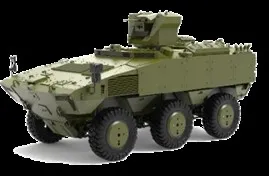
The 6×6 member of Türkiye’s New Generation Vehicles (YNA) family is built by FNSS for the mechanised units of the Turkish Land Forces. Türkiye’s Presidency of Defence Industries (SSB) is procuring 33 vehicles in different configurations, each with high ballistic and mine protection, a command-and-control suite, an electronic jamming system and a laser warning system. The critical design phase has been completed and qualification activities are scheduled to begin in January 2027.
Photo: Presidency of Defence Industries (SSB), Türkiye.
What is the FNSS 6×6 new-generation vehicle?
In February 2025 SSB signed the New Generation Vehicles contracts with Turkish industry, and FNSS was selected to produce its PARS ALPHA family in 8×8 and 6×6 forms for the mechanised armoured units of the Land Forces. The 6×6 project is the smaller of the two, but it is not a lightweight afterthought. SSB describes a vehicle with high ballistic and mine protection, increased mobility, an advanced command-and-control system and weapons able to detect and engage the enemy at the maximum possible range, backed by active and passive protection.
The family’s defining design choice is a front-mounted power pack. Moving the engine forward lets the driver, commander and crew sit together in one compartment, improves the driver’s field of view and places more mass between the crew and a blast under the front wheels. On a 6×6 the result is a compact vehicle that is easier to handle in towns and on narrow roads than an 8×8 while keeping the same protection philosophy. FNSS has said that the 6×6 trades some payload for that agility.
Key specifications
| Manufacturer | FNSS Savunma Sistemleri (Ankara, Türkiye) |
| Programme | 6×6 New Generation Vehicles (YNA) project |
| Product family | PARS ALPHA new-generation wheeled armoured vehicles |
| Procurement authority | Presidency of Defence Industries (SSB) |
| Turkish user | Land Forces Command (mechanised armoured units) |
| Quantity | 33 vehicles in different configurations |
| Status (SSB, Sept 2026) | Critical design complete; qualification from January 2027 |
| Protection | High ballistic and mine/IED protection; active and passive protection |
| Electronics | Command, control and communications system; jamming system; laser warning system |
| Patrol configuration | Two weapon turrets: 12.7 mm and 7.62 mm |
| PARS family export users | Oman (PARS III 6×6 and 8×8); Malaysia (8×8) |
SSB’s list of shareable features is short but telling. Alongside high ballistic and mine and IED protection, the vehicle carries a command, control and communications system, a jamming system and a laser warning system. The jammer is the kind of equipment armies now fit to defeat radio-controlled roadside bombs and to disrupt the control links of small drones, while the laser warning system alerts the crew when the vehicle is being lased by a rangefinder or a missile guidance unit. Together they reflect what Turkish units have learned from more than a decade of counter-terrorism operations and from recent conflicts in which armoured vehicles were tracked and attacked from the air.
The patrol configuration is armed with two weapon turrets, one carrying a 12.7 mm heavy machine gun and the other a 7.62 mm machine gun. Two independent turrets let the crew watch and engage two sectors at once, which is valuable on border and route patrols where threats can come from any direction. Other configurations in the 33-vehicle order cover different mission equipment; SSB has not published the full breakdown.
The SSB programme and Turkish service
The YNA programme is one of SSB’s most important land projects of the decade, because it begins the replacement of the tracked ACV-15 generation in the mechanised brigades with modern wheeled vehicles designed in Türkiye. FNSS and Turkish officials have spoken of a long-term requirement measured in the thousands, and the first contracts are designed to qualify the different variants before larger production orders follow.
According to SSB’s September 2026 status report, the critical design period for the 6×6 vehicles has been completed and qualification activities are planned to start in January 2027. Anadolu Agency reported in July 2025 that the PARS ALPHA had come through a four-year SSB prototype and test process before the contract, and that first deliveries are planned for 2028. The 6×6 thus moves in step with the 8×8 vehicles of the same family, which DefenceMENA covers in a separate file.
The programme is also a showcase for SSB’s supply-chain policy. Protection, communications, electronic warfare and weapon stations come from Turkish companies, and the vehicle is designed around Turkish subsystems that can be supported locally throughout its life.
Who operates it?
The new 6×6 YNA vehicle has a single launch customer, the Turkish Land Forces Command. It is not yet in export service, but it builds on a family with a solid export record. Oman’s Royal Army ordered 172 PARS III vehicles in 2015, comprising 145 8×8 and 27 6×6 vehicles across 13 variants; the first was handed over in July 2017 and deliveries were completed in 2020. Oman’s 27 PARS III 6x6s were the first FNSS 6×6 vehicles to enter any army’s inventory, in reconnaissance, command, training, mortar fire controller and armoured personnel carrier versions, and FNSS later signed a contract to establish a depot-level maintenance facility in Oman. Malaysia, the first PARS export customer, received 257 8×8 vehicles built with local partner DefTech as the AV8 Gempita.
In July 2025 FNSS told Anadolu Agency that it was in talks with several countries about the PARS ALPHA and was close to an agreement with one of them, without naming it. DefenceMENA treats the new 6×6 as export-ready but without a confirmed foreign customer at this stage.
Can the PARS ALPHA 6×6 go to Africa?
The 6×6 format fits a large part of Africa’s demand better than heavier 8x8s. Many African armies need protected mobility for border security, counter-insurgency and route patrols rather than for high-intensity mechanised warfare, and they must operate over long distances with limited workshops. A 6×6 is cheaper to buy and run, lighter on bridges and ferries, and easier to recover. The patrol configuration with 12.7 mm and 7.62 mm turrets matches the firepower these missions require, and an integrated jammer addresses the radio-controlled IEDs that have become the main killer of soldiers in the Sahel, the Lake Chad basin and Somalia.
Oman’s experience is directly relevant. The Omani PARS III fleet operates in desert heat, dust and long-range patrol conditions comparable with those in North Africa and the Sahel, and the in-country maintenance facility shows that FNSS is prepared to localise support. FNSS has no confirmed African government contract yet, as our FNSS company profile notes, but Turkish armoured vehicles from other manufacturers already serve across the continent, as shown in our survey of Turkish systems in African service.
Likely candidates include North African armies that run large wheeled fleets and value local production, such as Morocco, Algeria and Egypt; West African states facing jihadist insurgencies, such as Nigeria, Senegal, Côte d’Ivoire and Mauritania; and East African forces including Kenya, which need protected patrol vehicles for border security. For each, the PARS ALPHA 6×6 offers a modern Turkish alternative with a mature export pedigree behind it.
How it compares
The 6×6 sits between protected 4×4 patrol vehicles and full-size 8×8 infantry carriers. Compared with 4×4 MRAPs it offers more internal volume, better cross-country mobility and room for heavier mission systems; compared with 8x8s it is lighter, cheaper and easier to support. Its integrated jammer and laser warning system give it a level of self-protection more often seen on heavier vehicles, which is what makes it interesting for buyers who want one platform for patrol, command and reconnaissance tasks.
Related: FNSS company profile; ASELSAN company profile; Turkish systems in African service.
Frequently asked questions
Who makes the Turkish 6×6 new-generation armoured vehicle?
FNSS Savunma Sistemleri builds it under SSB’s 6×6 New Generation Vehicles project. It belongs to FNSS’s PARS ALPHA new-generation wheeled vehicle family.
How many 6×6 YNA vehicles is Türkiye buying?
SSB is procuring 33 6×6 armoured wheeled vehicles in different configurations for the mechanised armoured units of the Turkish Land Forces.
When does qualification start?
SSB reports that the critical design period has been completed and that qualification activities are planned to begin in January 2027.
What weapons does the patrol version carry?
The patrol configuration has two weapon turrets, one with a 12.7 mm heavy machine gun and one with a 7.62 mm machine gun.
Has any FNSS 6×6 been exported?
Yes. Oman’s Royal Army operates 27 PARS III 6×6 vehicles in five variants as part of a 172-vehicle order. The new PARS ALPHA 6×6 has no announced export customer yet.