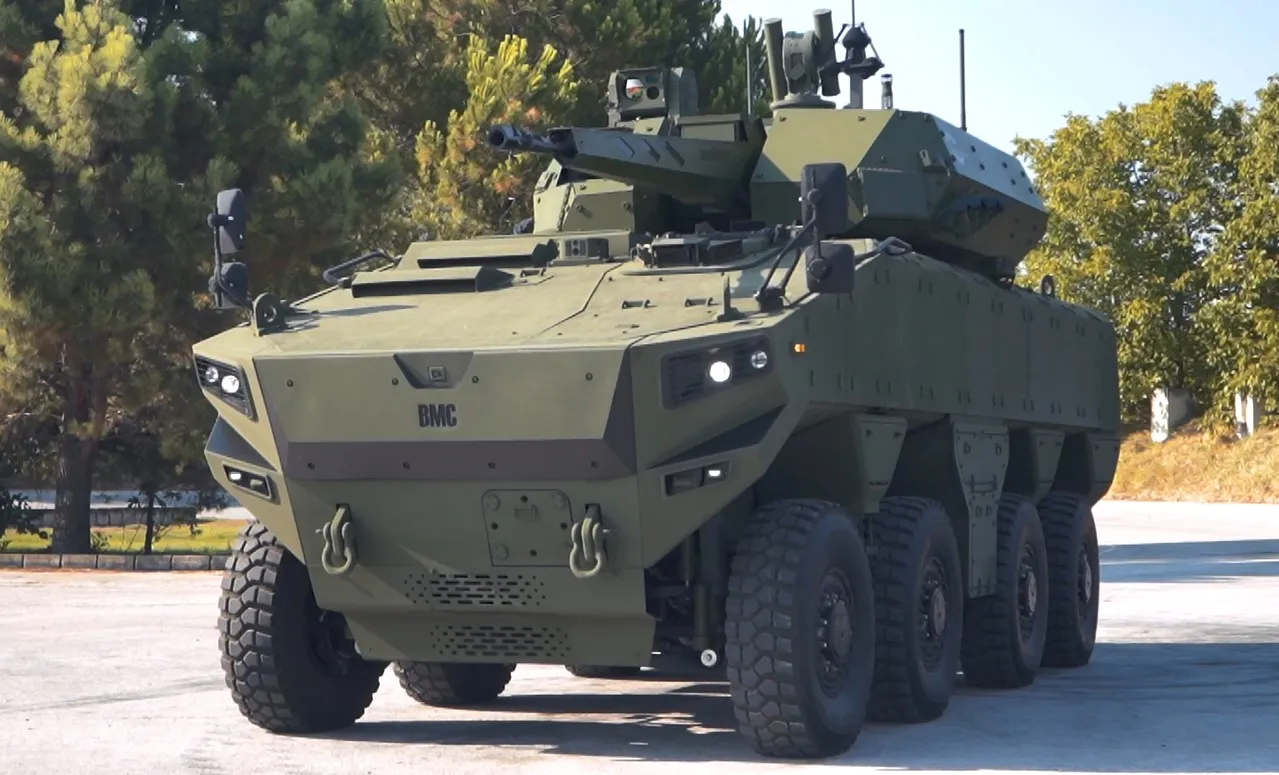
The 35 mm Turreted New Generation Vehicles project gives the Turkish Land Forces the heavy-hitting member of its new wheeled family: 29 BMC ALTUĞ 8×8 armoured vehicles armed with a 35 mm cannon and protected by ASELSAN’s AKKOR active protection system. Türkiye’s Presidency of Defence Industries (SSB) designed the requirement around a vehicle that can detect the enemy at the greatest possible range and engage it with heavy firepower, while staying alive against rockets, missiles and mines. Critical design activities are under way.
Photo: Presidency of Defence Industries (SSB), Türkiye.
What is the ALTUĞ 8×8 with 35 mm turret?
Türkiye’s New Generation Vehicles (YNA) programme has two strands. FNSS is building its PARS ALPHA family in 8×8 and 6×6 versions, covered in separate DefenceMENA files such as our PARS ALPHA 6×6 profile. The second strand, the 35 mm Turreted YNA project, was awarded to BMC, which signed a contract with SSB on 24 February 2025 for 29 ALTUĞ 8×8 armoured combat vehicles and their integrated logistic support. Where the other YNA vehicles focus on carrying troops and specialist equipment, the ALTUĞ is the fire-support and infantry fighting vehicle of the family, built around a medium-calibre cannon.
The ALTUĞ is a conventional 8×8 with the engine at the front right and a rear troop compartment, produced at BMC’s facilities in Ankara alongside the Altay main battle tank. BMC presents it as an infantry fighting vehicle and armoured personnel carrier family, with heavier fire-support versions also shown at exhibitions, and it says the design aims for a localisation rate of up to 80 percent.
Key specifications
| Manufacturer | BMC (Ankara production, Türkiye) |
| Programme | 35 mm Turreted New Generation Vehicles (YNA) project |
| Procurement authority | Presidency of Defence Industries (SSB) |
| Contract | Signed with SSB on 24 February 2025; 29 vehicles plus integrated logistic support |
| Turkish user | Land Forces Command (mechanised armoured units) |
| Status (SSB, Sept 2026) | Critical design activities continue; deliveries planned from 2027 |
| Main armament | 35 mm dual-feed automatic cannon in an unmanned turret |
| Active protection | ASELSAN AKKOR hard-kill system (in qualification) |
| Engine (BMC data) | Caterpillar C13, 711 hp; Allison 4000 automatic transmission |
| Mobility (BMC data) | Over 110 km/h; over 700 km range; 60% gradient; 120 cm fording |
| Crew (BMC data) | 3 crew plus 9 dismounts |
| Export status | Shown at EDEX 2023 (Cairo) and DIMDEX 2026 (Doha); no export contract announced |
SSB’s shareable specifications focus on three elements: high ballistic and mine and IED protection, a command, control and communications system, and AKKOR. BMC’s own data sheet fills in the rest. The vehicle is powered by a 711 hp Caterpillar C13 engine coupled to an Allison 4000 automatic transmission, giving more than 20 hp per tonne, a road speed above 110 km/h and a range of more than 700 km. It climbs a 60 percent slope, crosses a 2.3 m trench and fords 1.2 m of water, and it is rated for operation between minus 32 and plus 49 degrees Celsius. A crew of three, comprising commander, gunner and driver, is joined by nine dismounted soldiers.
The turret is unmanned and carries a 35 mm dual-feed automatic cannon with 100 ready rounds, a coaxial 7.62 mm machine gun and a 12.7 mm machine gun, together with eight smoke grenade launchers. Commander and gunner both have stabilised day and thermal sights with laser rangefinders, which gives the vehicle a hunter-killer capability: the commander can search for the next target while the gunner engages the current one. At DIMDEX 2026 in Doha the ALTUĞ was displayed with ASELSAN’s SARP 100/35 unmanned turret, and Army Recognition reported that first SARP 100/35 deliveries for the ALTUĞ are planned for 2027.
Fire support and the counter-drone role
The choice of 35 mm is deliberate. It gives the mechanised infantry a weapon that can defeat other armoured vehicles and fortified positions at long range, and it is the calibre Türkiye already uses for its KORKUT self-propelled air-defence gun, whose programmable air-burst ammunition was designed for small aerial targets. A stabilised 35 mm turret with a modern fire-control system and hunter-killer sights gives an infantry battalion a credible answer to the small drones and loitering munitions that now shadow ground units in every recent war, as well as to helicopters at short range.
AKKOR: ASELSAN’s active protection
The most significant item on the SSB list is AKKOR, the active protection system developed by ASELSAN under a separate SSB project. It was designed to give main battle tanks effective hard-kill protection against the asymmetric anti-tank threats they face on today’s battlefield. Its critical subsystems are a high-resolution active phased-array radar and smart interceptor munitions, and SSB highlights a high level of protection against the rockets and missiles most frequently encountered in the field. The project is in its qualification phase. Fitting it to a wheeled 8×8 brings tank-level survivability to infantry units, which are far more often the target of shoulder-fired rockets and guided missiles. More on the company behind it is in our ASELSAN company profile.
The SSB programme and Turkish service
SSB’s September 2026 status report notes that critical design activities for the 35 mm turreted vehicles are continuing, with deliveries to the Land Forces planned to begin in 2027 under the BMC contract. The project brings together several of SSB’s long-term priorities: a domestic 8×8 platform, a domestic unmanned medium-calibre turret, a domestic active protection system and domestic command-and-control equipment, all integrated by Turkish companies. The 29-vehicle order is the first step in fielding that combination in the mechanised armoured units.
Who operates the ALTUĞ?
The Turkish Land Forces Command is the launch customer. BMC has actively presented the ALTUĞ to export audiences, including at EDEX 2023 in Cairo, which BMC described as one of the most important defence fairs in Africa and the Middle East, and at DIMDEX 2026 in Doha, where it appeared in the hall of Qatar’s Barzan Holdings. No export contract has been announced, and DefenceMENA has found no confirmed foreign operator, so the vehicle should be described as in Turkish production and offered for export.
Can the ALTUĞ go to Africa?
The ALTUĞ fits the armies on the continent that are building or rebuilding mechanised forces. North African militaries such as Egypt, Algeria and Morocco operate large armoured fleets and are looking at modern 8×8 infantry fighting vehicles; Nigeria, Angola and Ethiopia have older Soviet-era tracked carriers in service that will need replacement. For these buyers, an 8×8 that combines a 35 mm cannon, long road range and an active protection system offers combat power without the logistic burden of a tracked fleet.
The threat picture in Africa also argues for the two features that define this variant. Rocket-propelled grenades and anti-tank guided missiles are widespread in African conflicts, from the Sahel to Sudan and Somalia, and hard-kill protection against them changes the calculation for mechanised units. At the same time, armed groups in several theatres have begun using commercial drones for reconnaissance and attack, and a stabilised 35 mm turret is a practical counter-drone weapon at company level. As our survey of Turkish systems in African service shows, Turkish land systems from Otokar, BMC and Nurol Makina already serve on the continent, which gives BMC an established network for training and support.
How it compares
The ALTUĞ joins a crowded field of 8×8 infantry fighting vehicles offered to African and Middle Eastern armies by European, Chinese and other suppliers. Its distinguishing points are the combination of a 35 mm unmanned turret with an indigenous active protection system, a strong power-to-weight ratio and a Turkish industrial base that can offer local production. For buyers that want protection and firepower without political conditions on use or support, it is a serious contender.
Related: ASELSAN company profile; Türkiye and Qatar arms deals; Turkish systems in African service.
Frequently asked questions
What is the 35 mm Turreted New Generation Vehicles project?
It is an SSB programme to supply the Turkish Land Forces with 29 8×8 armoured vehicles armed with a 35 mm turret. BMC won the contract on 24 February 2025 with its ALTUĞ 8×8.
What protects the ALTUĞ against missiles?
The SSB specification includes AKKOR, ASELSAN’s hard-kill active protection system, which uses a high-resolution active phased-array radar and smart interceptor munitions against rockets and missiles.
Can the 35 mm turret engage drones?
The 35 mm calibre is the same one Türkiye uses for its KORKUT air-defence gun with programmable air-burst ammunition, and a stabilised 35 mm turret is an effective weapon against small drones at short range.
When will the ALTUĞ enter Turkish service?
Critical design activities are under way, and deliveries to the Land Forces are planned to begin in 2027.
Has the ALTUĞ been exported?
No export contract has been announced. BMC has shown the vehicle at EDEX 2023 in Cairo and DIMDEX 2026 in Doha.