Türkiye’s Military Partnership With Qatar Runs on Troops and Factories, Not Fighter Jets



Türkiye has never sold Qatar a fighter jet, a frigate or a main battle tank. Yet it keeps a permanent garrison on Qatari soil, Doha owns close to half of the Turkish company that builds Türkiye’s own battle tank, and the two countries’ state defence firms are now building unmanned systems and naval programmes together — one of them for a customer in Southeast Asia, not the Gulf. Here is what the Türkiye-Qatar defence relationship actually consists of, item by item.
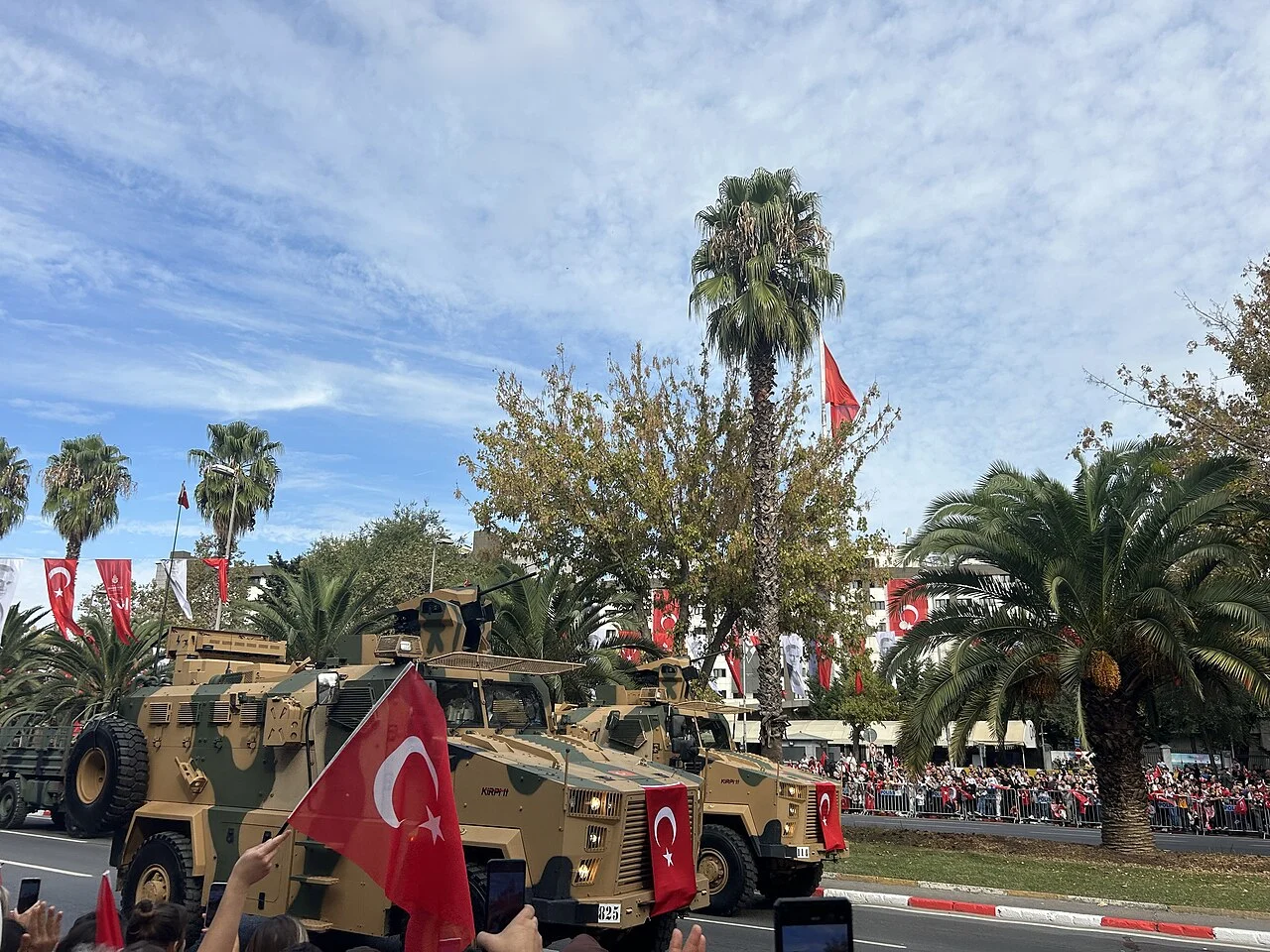
Photo: A BMC Kirpi II armoured vehicle on display in Türkiye (file photo, from the same manufacturer family as the Kirpi and Amazon 4x4s delivered to Qatar from 2018). Credit: Bjelica, CC BY-SA 4.0, via Wikimedia Commons.
Qatar’s arms imports are dominated by the United States, Italy, the United Kingdom and France, which between them account for almost all of the value SIPRI tracks (see DefenceMENA’s Qatar military-strength profile). Türkiye does not appear as a separate line in that value-based measure, and it has sold Doha no fighter aircraft, no air-defence system and no major surface combatant. What it has built instead is a basing relationship that dates to the 2017 Gulf blockade, a mid-tier armoured-vehicle order, and an increasingly two-way industrial partnership centred on Qatar’s state defence company, Barzan Holdings — one strand of which now has Doha financing Turkish warship exports to Indonesia rather than buying ships itself. This profile is a companion to DefenceMENA’s existing anatomy of what Türkiye sells Morocco and to its coverage of Qatar’s three-fighter air force.
| Earliest documented link | Defence cooperation agreement, late 2014; first Turkish troops arrive at Tariq bin Ziyad base, Doha, in 2015 |
| First confirmed equipment contract | Ejder Yalçın 4×4 armoured vehicle (Nurol Makina), 342 units, delivered from late 2017 |
| Türkiye’s rank among Qatar’s suppliers | Not separately broken out by SIPRI in 2020–24 (US 48%, Italy 20%, UK 15%, France 14%) |
| Flagship basing arrangement | Permanent Turkish garrison, reported at up to 3,000 of a planned 5,000-capacity site; six Turkish F-16s reported deployed, July 2024 (both Estimated; no official headcount published) |
| Flagship industrial stake | Qatar has held 49.9% of Turkish manufacturer BMC since 2014, via Barzan Holdings; BMC’s new Ankara (Kahramankazan) plant delivered Türkiye’s first production Altay tanks on 28 October 2025 |
| What is still only reported | A ~100-unit Altay tank order for Qatar’s own army (no activated export contract found); undisclosed terms of the January 2026 STM–Barzan UAV production agreement |
How the relationship formed
Türkiye and Qatar signed a defence cooperation agreement in late 2014, which Türkiye’s parliament approved in June 2015; the first Turkish troops arrived at the Tariq bin Ziyad base in southern Doha that same year. For its first two years the arrangement drew little outside attention. That changed in June 2017, when Saudi Arabia, the UAE, Bahrain and Egypt imposed a blockade on Qatar and listed the closure of Türkiye’s base among their 13 demands for lifting it. Ankara called the demand “unrealistic,” Doha rejected it outright, and Türkiye’s parliament fast-tracked a separate April 2016 troop-deployment agreement that same month. New Turkish troop contingents were dispatched to Doha in December 2017, publicly framed as reinforcement against the blockading states.
The same 2017–2018 window produced the relationship’s first confirmed equipment and industrial deals: a 342-unit order for Nurol Makina’s Ejder Yalçın 4×4, deliveries of which began in late 2017; a 2018 contract for 50 BMC Kirpi mine-resistant vehicles and 35 BMC Amazon 4x4s; and the founding, at the DIMDEX exhibition in Doha in 2018, of BARQ, a joint venture between ASELSAN and Barzan Holdings for remote weapon stations and electro-optic systems. Since then the relationship has widened from vehicle sales into naval shipbuilding, unmanned systems and a reciprocal flow of Qatari capital into Turkish industry — most visibly Doha’s 49.9% stake in BMC, the company that in October 2025 began delivering Türkiye’s own Altay main battle tank.
A base, not a sale: troops and an air detachment
The largest single element of the Türkiye-Qatar relationship is not a weapons contract at all. The Tariq bin Ziyad garrison has never had an official headcount published by either government; reported figures range from around 300 troops at the 2015 start to a planned 3,000 on a site said to be able to hold up to 5,000, and in July 2024 open-source trackers reported six Turkish F-16s deploying there — the first confirmed Turkish combat-aircraft presence in Qatar, though not a transfer of aircraft to Qatari service. All of these figures are Estimated. What is documented is the political function: during the 2017–2021 blockade, the Turkish base was both a named target of the blockading states’ demands and a visible sign that Doha had a military guarantor outside the Gulf Cooperation Council. Qatar’s Türkiye desk follows the wider record of the Turkish military and industrial relationship across the region.
| System | Manufacturer | Contract / Announcement | Quantity | Delivery | Current status | Source |
|---|---|---|---|---|---|---|
| Ejder Yalçın 4×4 armoured vehicle | Nurol Makina | Contracted; deliveries from late 2017 | 342 | Delivered | In service | Army Recognition; Defence Turkey |
| BMC Kirpi MRAP and Amazon 4×4 | BMC | Contracted 2018 | 50 Kirpi + 35 Amazon (85 total) | Delivery status unclear | Contracted; status unclear | Defense Mirror |
| BARQ joint venture (remote weapon stations, electro-optics) | ASELSAN / Barzan Holdings | Founded at DIMDEX 2018; expanded with new agreements at DIMDEX, Jan 2026 | Joint venture, not a unit count | Ongoing; expanding into new technology areas | In service (RWS/EO product line); JV expanding | EDR Magazine; Defaiya; Turdef |
| Qatari 49.9% equity stake in BMC | BMC | Acquired 2014, held via Barzan Holdings / Es Mali Yatırım; Turkish-side 50–51% majority sold to Tosyalı Holding, June 2021 | 49.9% equity | Ongoing shareholding, not an equipment purchase | In service (financial/industrial stake) | Janes; Daily Sabah; The Peninsula |
| BMC Ankara (Kahramankazan) tank and AFV plant; first Altay tanks delivered to Turkish Armed Forces | BMC (49.9% Qatari-owned) | Opened 28 October 2025, attended by Qatar’s Deputy PM for Defence Affairs | Plant rated at 8 Altay + 10 Altuğ per month; 85 Altay-T1 (2026–28) and 165 Altay-T2 (2028+) scheduled, for Türkiye’s own forces | Delivered (to Türkiye); Qatar’s own purchase not confirmed | Industrial stake confirmed; Qatari Altay order Reported (unconfirmed) | The Peninsula; Defense Mirror; The Defense Post |
| Bayraktar TB2 combat drone | Baykar | Quantity and date not officially disclosed | About 6 aircraft, 3 ground stations (Estimated) | In service | In service (Estimated) | Open-source inventory directories |
| Dearsan FAC-50 fast attack craft (“Halul 11” project) | Dearsan | Contract reported signed 2023, publicly announced at DIMDEX, March 2024 | 2 vessels | Keels laid Istanbul, Dec 2024; first hull (Al Wakrah) launched 17 Nov 2025; second (Al Ghariyah) launched 14 Feb 2026; delivery due 2027 | Under delivery | Naval News; The Defense Post; Janes |
| CAKIR anti-ship missile, armament for the FAC-50s | Roketsan | Specified as the platform’s primary anti-ship weapon | Fit for 2 vessels | Not yet delivered (platform under delivery) | Reported | Naval News; The Defense Post |
| STM strategic cooperation on unmanned systems (local UAV production) | STM / Barzan Holdings | Signed at DIMDEX, 20 January 2026 | Not disclosed | Not yet in production | MoU / goodwill agreement; no binding production contract confirmed | STM; Daily Sabah; C4 Defence |
| TAIS–Barzan frigate programme for Indonesia (two Istanbul-class-derived frigates) | TAIS Shipyards; Barzan Holdings as financier/intermediary | Indonesia–TAIS contract at IDEF 2025 (Istanbul); Barzan–TAIS agreement signed at DIMDEX, 19 January 2026 | 2 frigates, about US$1 billion | Not yet delivered | Contracted (Indonesia side); Agreement signed, legal form reported inconsistently (MoU vs purchase deal) on the Barzan side | Naval News; Defense News; Janes |
| Altay main battle tank, direct Qatari purchase | BMC | Reported figure, no public contract found | ~100 reported | Not applicable | Reported (unconfirmed) | TRT World; Defense News |
| “Badr” defence-industry memorandum (Qatar, Türkiye, Pakistan, Indonesia) | Qatar MoD, Türkiye’s SSB, Pakistan’s DIPO, Indonesia’s MoD | Signed Doha, 21 October 2026 | Framework only, no unit or budget figures | Not applicable | Signed MoU; no specific programme announced | Qatar News Agency; Gulf Times |
Two rows need a caveat. The reported 100-unit Altay order for Qatar has circulated in Turkish and Gulf press for years, but it has never produced a signed, activated export contract that either government has confirmed — it should not be read as part of Qatar’s current or scheduled inventory, and it is easy to confuse with Qatar’s separate, verified 49.9% financial stake in the company that builds the Altay for Türkiye’s own army. And the TAIS–Barzan frigate agreement is reported by some outlets as a purchase contract and by others, including TAIS’s own social-media statement, as a memorandum of understanding; DefenceMENA treats it as signed but not yet a binding sale pending clearer documentation from either company.
Land systems: Qatar’s mid-tier armour, and a stake in Türkiye’s own tank
Türkiye’s clearest equipment footprint in Qatar is in wheeled armour. The Ejder Yalçın, Nurol Makina’s protected 4×4, has been in Qatari service since deliveries began in late 2017, with 342 vehicles making it the single largest confirmed unit count of any Turkish system sold to Qatar — comparable in scale to the Ejder Yalçın orders DefenceMENA has tracked for other operators across the region. A 2018 contract added 50 BMC Kirpi mine-resistant vehicles and 35 BMC Amazon 4x4s, though open sources have not confirmed a full delivery status for that order. Reports of a roughly 100-unit Altay main battle tank purchase for Qatar have circulated since at least the mid-2020s, repeated by outlets including TRT World and Defense News, but no activated export contract has surfaced from either side.
What is separate from, and frequently confused with, that reported tank order is Qatar’s industrial stake in BMC itself. Doha’s 49.9% holding — structured variously in different reports as a direct Qatar Armed Forces Industry Committee stake, a holding via the special-purpose vehicle Es Mali Yatırım, or (per Qatar’s own government statements) via Barzan Holdings — dates to 2014, when businessman Ethem Sancak first acquired the company and then sold roughly half its shares to the Qatari side. The Turkish-side majority has since changed hands; steelmaker Tosyalı Holding bought out Sancak’s and the Öztürk family’s combined stake, reported at 50–51%, in June 2021. Qatar’s 49.9% has stayed constant through that change. On 28 October 2025, Turkish President Recep Tayyip Erdoğan opened BMC’s new tank and armoured-vehicle plant at Kahramankazan, near Ankara, where Qatar’s Deputy Prime Minister and Minister of State for Defence Affairs, Sheikh Saoud bin Abdulrahman Al Thani, attended alongside senior Qatari officers. The ceremony marked the delivery of Türkiye’s first production Altay main battle tanks to its own armed forces — BMC is scheduled to build 85 Altay-T1s between 2026 and 2028 and 165 Altay-T2s from 2028, all for the Turkish Land Forces. Qatar’s stake entitles it to a share of that production programme’s commercial return; it is not evidence that Qatar itself is buying Altay tanks, and DefenceMENA could not find a contract confirming that it is.
Naval cooperation: a customer, a missile and an unusual financier role
Qatar’s one direct warship order from Türkiye is for two Dearsan-built FAC-50 fast attack craft, under a project Janes has referred to as “Halul 11.” Dearsan’s own account puts the contract signing in June 2023; most other outlets, including Naval News and The Defense Post, date the public announcement to DIMDEX in Doha in March 2024. Both vessels had their keels laid in Istanbul in December 2024; Naval News reported the first hull, Al Wakrah, launched on 17 November 2025, and the second, Al Ghariyah, on 14 February 2026, with delivery of both due in 2027. Roketsan’s CAKIR anti-ship missile is specified as the class’s primary strike weapon, alongside a reported Sungur short-range air-defence fit, though neither system has been delivered yet since the platform itself remains under construction.
The more unusual naval story is reversed in direction. At DIMDEX in January 2026, Türkiye’s TAIS Shipyards and Qatar’s Barzan Holdings signed an agreement worth about US$1 billion covering two Istanbul-class-derived frigates — not for the Qatari navy, but for Indonesia. The underlying sale had already been formalised between Indonesia’s Ministry of Defense and TAIS at the IDEF exhibition in Istanbul in 2025; what Barzan added in January 2026 was financing, acting, according to industry sources cited by Defense News and Janes, as an intermediary or prime contractor on Indonesia’s behalf and extending Indonesia a loan to fund the purchase. The arrangement means Qatari capital, not a Qatari naval requirement, is underwriting a Turkish shipyard’s export order to a third country — a financing role Doha has not disclosed in such explicit form with any of its Western suppliers.
Unmanned systems and electronics: BARQ, and a new push into local UAV production
Qatar’s confirmed Turkish drone fleet is small: open-source inventory directories list around six Bayraktar TB2 aircraft with three ground control stations, figures that are Estimated rather than officially confirmed by either Ankara or Doha. The deeper and longer-running tie is industrial. BARQ, the joint venture ASELSAN and Barzan Holdings founded at DIMDEX in 2018 to produce remote weapon stations and electro-optic reconnaissance systems for Qatar’s armed forces, was expanded with new agreements at DIMDEX in January 2026, signed by ASELSAN vice president Özgür Taylan Sarı and Barzan Group chief executive Mohammed Badr Al-Sadah, adding unspecified “high-technology areas” alongside local production capability in Qatar; a Turkish-language explainer on the venture’s product lines is available from Envanter Medya. Separately, and on the same DIMDEX sidelines, STM signed what it called a “strategic cooperation” agreement with Barzan on 20 January 2026 covering local production, integration and development of STM’s tactical UAV line in Qatar; STM itself has described it as a goodwill agreement rather than a binding production contract, and neither company has disclosed financial terms or a production timeline.
Where the “Badr” memorandum fits
On 21 October 2026, Qatar, Türkiye, Pakistan and Indonesia signed a four-way defence-industry memorandum in Doha — covering joint production, technology transfer, research and training rather than any specific weapons programme — which DefenceMENA has covered in detail separately. For the Türkiye-Qatar relationship specifically, the memorandum is best read as a widening of the same BARQ-and-STM pattern — formal government-to-government cover for industrial cooperation that until now had been negotiated company by company — rather than as a new bilateral programme in its own right. No budget, timeline or named system has been attached to it.
How Türkiye compares with Qatar’s other suppliers
SIPRI’s Arms Transfers Database for 2020–24 puts the United States at 48% of the value of Qatar’s arms imports, Italy at 20%, the United Kingdom at 15% and France at 14%; Germany and Türkiye are not broken out separately, reflecting both countries’ lower-value, mid-tier product mix next to Qatar’s F-15QA fighters, Italian-built Al Zubarah and Musherib-class ships, Typhoon jets and Rafales. That value measure understates what Türkiye actually holds in the relationship: a permanent troop presence with no equivalent among Qatar’s Western suppliers, an equity stake in a foreign tank manufacturer that none of them has sought, and a financing role in a third-country warship export that is closer to merchant banking than to arms sales.
| Supplier | SIPRI 2020–24 share (approx.) | Signature platforms | Distinguishing edge |
|---|---|---|---|
| United States | 48% | F-15QA, Patriot, NASAMS, HIMARS, Apache, MQ-9B | High-end platforms, Al Udeid basing, interoperability, financing channels |
| Italy | 20% | Al Zubarah and Musherib-class ships, M-346 trainer | Naval shipbuilding programme, training aircraft |
| United Kingdom | 15% | Eurofighter Typhoon, Hawk, joint RAF-QEAF squadron | Integrated training squadron based in the UK |
| France | 14% | Rafale, MBDA coastal defence, Exocet, VAB | Long-standing fighter and missile relationship |
| Türkiye | Not separately broken out by SIPRI | Ejder Yalçın, BARQ (ASELSAN-Barzan), Dearsan FAC-50, Bayraktar TB2 | Only supplier with permanent troops on Qatari soil and an equity stake in its own defence manufacturer |
What is pending or only reported
Several figures in this relationship remain unconfirmed by either government: the ~100-unit Altay order for Qatar’s own forces; the financial terms and timeline of the STM-Barzan UAV production agreement; the precise current troop strength at Tariq bin Ziyad, last estimated rather than officially stated; and whether the TAIS-Barzan Indonesian frigate arrangement is a binding sale or a memorandum, which outlets describe differently. Neither Ankara nor Doha routinely publishes contract-level detail for this relationship, so most of the figures above trace back to Turkish and Qatari trade press, naval-industry outlets covering DIMDEX, and company statements rather than ministry announcements.
A note on the numbers
Several details in Turkish and Gulf reporting conflict in ways worth flagging. Qatar’s exact shareholding vehicle in BMC is described inconsistently — directly, via Es Mali Yatırım, or via Barzan Holdings — though the 49.9% figure itself is consistent across sources. The Turkish-side stake sold to Tosyalı Holding in 2021 is given as both 50.1% and 51.1% in different reports. The Dearsan FAC-50’s length is given as 50.7 metres by Janes and as roughly 43 metres by Naval News. And the number of Altay tanks physically handed over at the 28 October 2025 Kahramankazan ceremony is reported as low as three in Turkish-language coverage, even as English-language outlets describe the event simply as the “first delivery.” Figures above follow the primary or most detailed source available for each claim.
Sources
- SIPRI Arms Transfers Database
- GlobalSecurity.org, Tariq bin Ziyad base
- Al Jazeera, Turkish troop reinforcement, December 2017
- The Defense Post, Türkiye rejects demand to close Qatar base
- Naval News, Dearsan FAC-50 contract
- Janes, Dearsan FAC-50 specifications
- Naval News, TAIS–Barzan Indonesia frigate agreement
- Defense News, Türkiye-Qatar deals at DIMDEX 2026
- STM, strategic cooperation on unmanned systems in Qatar
- EDR Magazine, ASELSAN-Barzan BARQ expansion
- The Peninsula Qatar, BMC factory inauguration, Ankara
- The Defense Post, first Altay tank deliveries
- Janes, Tosyalı Holding’s BMC stake purchase
- DefenceMENA, Qatar military-strength profile