Morocco’s Aerodrive Wins First Local Loitering-Munition Order: What Is Confirmed



A Moroccan start-up has been credited with the kingdom’s first confirmed domestic loitering-munition order, but the deal is older than this month’s wave of coverage suggests. Here is what is actually confirmed about Aerodrive Engineering Services’ 500-drone contract, and what still isn’t.
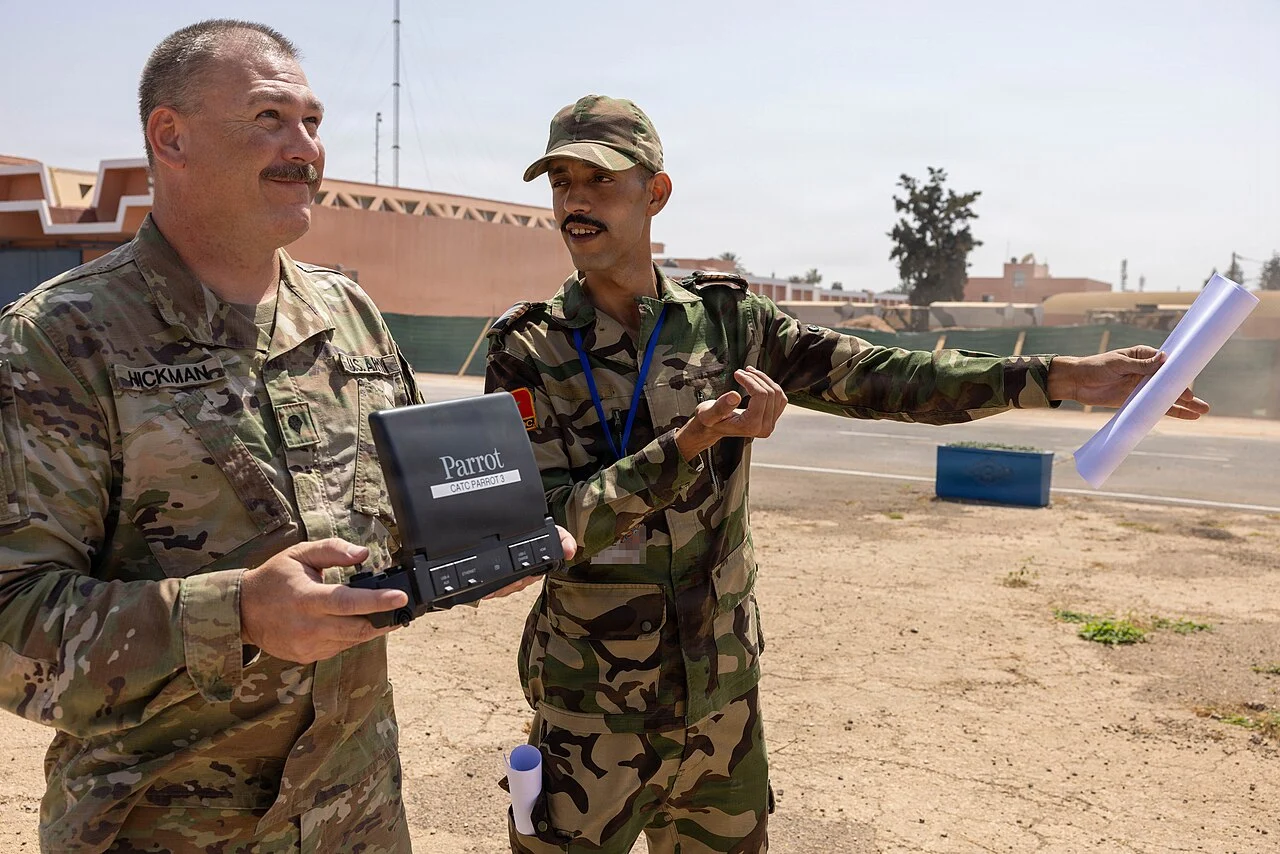
Photo: A Royal Moroccan Armed Forces soldier trains on a small unmanned aerial system alongside Utah National Guard instructors, September 2026. Credit: U.S. Army 128th MPAD / 1st Sgt. Tim Beery, Public domain, via Wikimedia Commons
Military Africa reported on 12 October, citing the specialist outlet Unmanned Africa, that Rabat-area manufacturer Aerodrive Engineering Services (AES) had secured an order to supply the Royal Moroccan Armed Forces (FAR) with 500 loitering munitions, with the kingdom’s defence staff requiring the company to open a production line on Moroccan soil. Several outlets have since repeated the figure. The contract itself, however, traces back further than the recent headlines imply.
What Is Actually Confirmed
The underlying report was first carried in Spanish by Infodefensa and picked up locally by Bladi.net on 24 May 2026, which said General Mohammed Berrid, the FAR’s chief of staff, had validated the acquisition of 500 attack drones from AES. The deal requires AES to build a new assembly line at Benslimane, an industrial zone between Casablanca and Rabat that Morocco has turned into a hub for military drone manufacturing, with the line expected to become operational around 2027.
AES is a Moroccan company founded by engineer Sofiane Amkoui. Its track record to date is the Atlas ISTAR, a reconnaissance and surveillance drone the company describes as fully designed and built in Morocco, with roughly 1,000 units produced at its Benguerir facility since 2024. The 500-unit loitering-munition order would be AES’s first move from surveillance platforms into armed, one-way strike systems — hence the “first domestic” framing used by Military Africa and other outlets this month.
What remains unconfirmed: neither AES nor the Administration de la Défense Nationale has issued a public statement naming the contract value, the exact munition’s designation, its range or warhead size, or a firm delivery schedule. No manufacturer has released imagery of the system. The claim rests on Infodefensa’s reporting, relayed through Bladi.net in May and through Unmanned Africa and Africa Intelligence in October, without an independent primary-source confirmation in between.
A Story That’s Older Than This Month’s Headlines
The gap between the original May report and the October wave of coverage is itself notable. Nothing in the more recent pickups points to a new signing, a groundbreaking at Benslimane, or an updated timeline — the 2027 production date cited in October is the same one reported in May. Readers encountering this story for the first time this month should treat it as a six-month-old procurement decision resurfacing in the news cycle, not a fresh announcement.
Benslimane: Morocco’s Emerging Drone Hub
The AES order sits inside a broader Moroccan push to localise unmanned-systems production at Benslimane and nearby sites. Israel’s BlueBird Aero Systems, a subsidiary of Israel Aerospace Industries, has already opened a line there to build its SpyX loitering munition, reportedly making Morocco the first country in North Africa to manufacture that class of weapon under license. BDS, another Moroccan firm, has separately announced a GPS-free, 2,000km-range drone prototype. Turkey’s Baykar has committed up to $250 million to a Moroccan subsidiary that opened in 2025, and Paris-based Harmattan AI signed a letter of intent in October to build its Irifi strike drone in Morocco, with an engineering centre already running in Rabat.
Rabat’s pattern across all of these deals is consistent: foreign or homegrown UAV and munitions suppliers are asked to pair any FAR order with a local production or technology-transfer commitment, rather than simply exporting finished hardware. That approach mirrors how Morocco has handled larger platform purchases, tying contracts for systems like the Barak MX air-defence battery to industrial offsets.
What the FAR Already Flies
Morocco already operates one of the continent’s largest fleets of armed drones, built mostly on imported airframes. The FAR flies Israeli Harop loitering munitions and Chinese Wing Loong- and CH-4-type armed UAVs, alongside the GPS-denial-focused Matador prototype under development domestically. An AES-built loitering munition, if it reaches service, would add a second indigenous strike-drone line to that mix alongside whatever BlueBird and Harmattan AI eventually deliver from Benslimane — giving Morocco multiple parallel, and potentially competing, domestic programmes in the same weapon class.
Why It Matters for Africa
North Africa’s drone-manufacturing contest is increasingly playing out inside Morocco’s own borders rather than between African states and foreign suppliers. Egypt, Algeria and Nigeria have each pursued local UAV assembly or licensing deals of their own, but no other African country has attracted this concentration of foreign loitering-munition and strike-drone manufacturers — Israeli, Turkish and now French — building on its own soil at the same time. For the rest of the continent, Morocco’s experience will be a test case for whether “build locally” requirements actually produce sovereign production capacity, or mostly relabel foreign-designed systems as domestic. Algeria, Morocco’s principal regional rival, has so far relied on Chinese and Russian imports for comparable systems rather than hosting manufacturing on its own territory, a contrast that is likely to feature in the two countries’ long-running arms competition.
Sources
- Military Africa: “Morocco’s Aerodrive Wins First Domestic Loitering Munition Deal”
- Bladi.net: “Défense : Le Maroc passe à la vitesse supérieure avec la fabrication de 500 drones kamikazes”
- DefenceMENA: Morocco and Harmattan AI to Build 2,000km-Range Irifi Strike Drone Locally
- DefenceMENA: What Does Morocco’s Military Arsenal Look Like in 2026?