A Moroccan defence startup says it has completed and flight-tested a prototype attack drone that can navigate roughly 2,000 kilometres without GPS, using terrain-recognition software instead of satellite positioning. The claim comes from the company itself and has not yet been verified by independent testing or a Moroccan government statement.
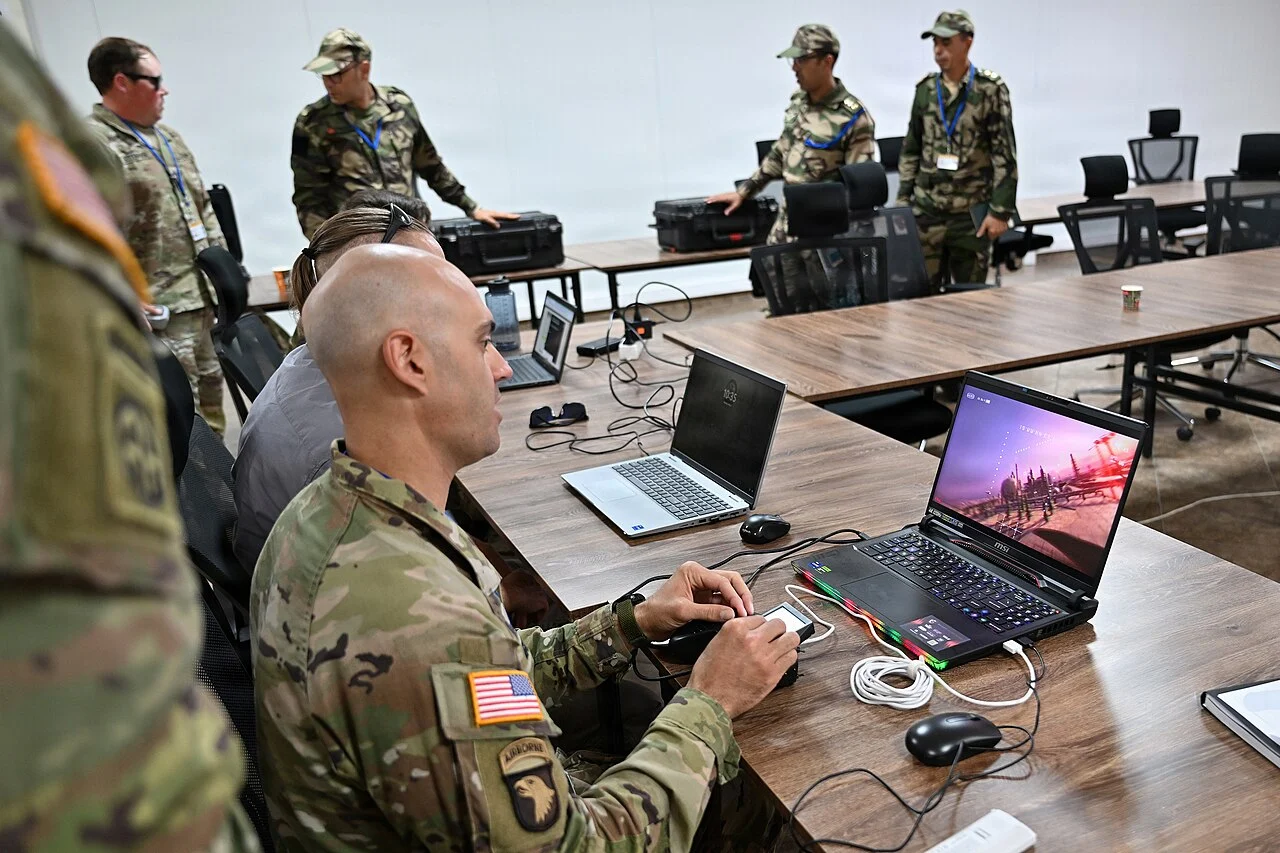
Photo: Royal Moroccan Air Force personnel take part in unmanned-systems training during the African Lion 26 exercise in Agadir, Morocco (file photo, not the BDS prototype). Credit: U.S. Army SETAF-AF / Jason Johnston, Public domain, via Wikimedia Commons
Ballistic Defense System (BDS), a Rabat-based company, says its prototype identifies and closes on a target autonomously, without relying on GPS, GLONASS or BeiDou satellite navigation. According to Assahifa and Yabiladi, a test video shows the drone locating and flying toward a mock air-defence launcher styled on an HQ-9 or S-300 system, suggesting the company is pitching the design as a strike weapon against enemy air-defence sites rather than a reconnaissance platform. BDS says design, software and manufacturing were all carried out in Morocco.
Who Is Behind It
BDS is led by Fahd Laamoumi, a Belgian-Moroccan aerospace engineer trained at Polytechnique Mons in Belgium and ISAE-SUPAERO in Toulouse, with earlier stints at NASA’s Ames Research Center and at McKinsey & Company, according to Yabiladi’s interview with him. Laamoumi told the outlet that BDS has spent more than a year self-funding development of the embedded software that lets the drone “identify, detect and collide with a target autonomously,” and that writing that software — rather than building the airframe — has consumed roughly 90 percent of the company’s research effort. He said the hardest part has been hiring engineers experienced in computer-vision modelling and flight-control robotics, a skills gap he argues is now Morocco’s main constraint on building a domestic strike-drone industry rather than funding or political will.
A Fast-Growing Moroccan Drone Sector
The BDS prototype adds a new, smaller player to a Moroccan drone posture that has grown quickly over the past two years. Morocco already operates one of Africa’s largest military drone fleets — Hespress reported that the Royal Armed Forces held roughly 223 drones as of 2023, ranking behind only Egypt on the continent — built around Israeli-made WanderB and ThunderB systems from BlueBird Aero Systems. Rabat has since moved to add Turkish Bayraktar Akıncı platforms and Chinese Wing Loong X aircraft, and a separate Moroccan firm, Aerodrive Engineering Services, has been developing its own Atlas Eastar I drone with an eye toward domestic manufacturing at scale. BDS’s pitch is narrower and more specific: a low-cost, jam-resistant strike drone rather than a surveillance platform, aimed at the same electronic-warfare-heavy environment that has shaped drone combat in Ukraine and Libya.
Morocco’s overall military drone posture is covered in more detail in DefenceMENA’s roundup of military drones operated across Africa.
How Real Is the Claim
The 2,000-kilometre range and GPS-independent guidance are BDS’s own figures, published via a company statement and demonstration video rather than an independently verified flight test. No Moroccan defence ministry or Royal Armed Forces statement has confirmed the figures, and performance claims for the follow-on P2 and P3 models mentioned by BDS remain undocumented. Terrain-relative and vision-based navigation that avoids GPS jamming is a real and increasingly common approach — it has been used in various forms by Russian, Ukrainian and Israeli systems — but achieving reliable accuracy at 2,000 kilometres without any satellite reference would be a significant technical achievement for a small private company, and outside observers have not yet been able to test it.
Why It Matters for Africa
If BDS’s technology performs anywhere close to its stated specifications, it would give Morocco a domestically designed strike-drone option at a moment when GPS jamming and spoofing have become standard features of conflicts from Ukraine to the Sahel and Libya, where several African air forces already operate GPS-guided drones from Turkey and China. A homegrown, jam-resistant system would reduce Rabat’s reliance on foreign suppliers for a capability increasingly seen as essential, and would add to a broader push by Morocco, Algeria, Egypt and South Africa to build indigenous drone and precision-strike industries rather than remain purely importers. For now, though, the story is a capability claim from a single company, not a fielded system, and its real value to African militaries will depend on whether BDS can back the numbers with an independently observed test.
Sources
- Assahifa — Morocco’s BDS Completes First Prototype of Autonomous Drone with a Range of 2,000 Kilometres
- Yabiladi — Fahd Laamoumi, pionnier de la technologie des drones autonomes au Maroc
- Hespress — Le Maroc possède la deuxième plus importante flotte de drones militaires en Afrique