Saudi Arabia spends more on its armed forces than any other country in the Middle East, buys most of what it fields from the United States, and is now trying to build a growing share of it at home. This profile sets out what the kingdom operates in 2026, what is only ordered or notified, and where the open-source numbers are thin.
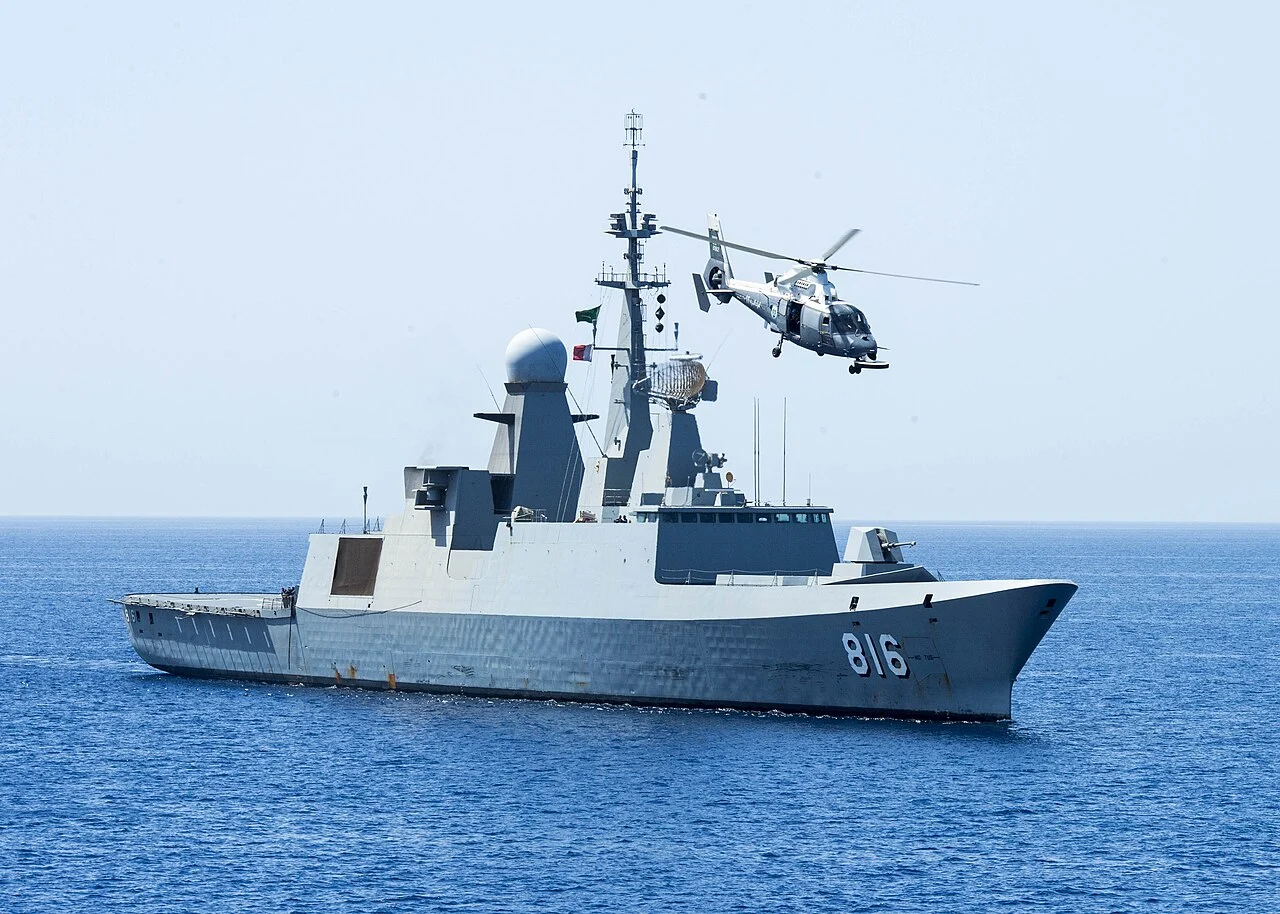
Photo: The Royal Saudi Navy frigate Al Dammam (816) during exercise Eager Lion 2014. Credit: U.S. Navy photo by Mass Communication Specialist Seaman Jesse A. Hyatt, public domain, via Wikimedia Commons
The short answer to the question in the headline is that Saudi Arabia has the region’s largest defence budget and one of its most expensive air forces, a deep air-defence network that was tested in earnest in 2026, and an army built around American armour. What it does not have is a submarine force, a combat fleet of fifth-generation aircraft or, yet, a large domestic arms industry. SIPRI ranked it the world’s eighth-largest military spender in 2025 and the third-largest arms importer in 2021–25, but its imports fell by almost a third against the previous five years while it shifted money into local production, missile defence and sustainment.
Every line below carries a status label: In service, Delivered, Under delivery, Contracted, Ordered, Planned, Reported (unconfirmed) or Status unclear. An order is not a delivery, and a delivery is not an operational unit. Where sources disagree, the table shows a range marked Estimated. Saudi Arabia publishes no inventory, so most quantities come from open-source compilations.
| Indicator | Figure | Year / source |
|---|---|---|
| Military expenditure | US$83.2 billion, up 1.4% on 2024; about 6.5% of GDP; 8th in the world | 2025, SIPRI (estimate) |
| Ministry of Defence allocation | Nearly US$64 billion (about SAR 240 billion) | 2026 budget, reported by Tactical Report (secondary; Estimated) |
| Active personnel | About 257,000–279,000, plus roughly 100,000 in the National Guard | 2025–26, open-source compilations of IISS-type data (Estimated) |
| Services | Land Forces, Air Force, Naval Forces, Air Defense Forces, Strategic Missile Force | Ministry of Defence structure |
| Arms imports | 6.8% of global imports, third largest importer, down 31% on 2016–20 | 2021–25, SIPRI |
| Main suppliers | United States 77%, Spain 9.5%, France 4.6% | 2021–25, SIPRI |
| Localisation of military spending | 24.89% at end-2024; target above 50% by 2030 | GAMI, announced November 2025 |
| Largest pending fighter deal | 48 F-35 aircraft, US$24.3 billion, notified to Congress | 17 September 2026, US State Department (possible sale; not a contract) |
Military overview and security environment
The Saudi Arabian Armed Forces answer to the Ministry of Defence and comprise five services: the Royal Saudi Land Forces, the Royal Saudi Air Force, the Royal Saudi Naval Forces, the Royal Saudi Air Defense Forces (RSADF) and the Royal Saudi Strategic Missile Force. The National Guard, a separate force of roughly 100,000 in open-source estimates, sits outside the ministry’s chain and is not covered in the tables below.
Two documented events shaped the last twelve months. On 17 September 2025 Riyadh and Islamabad signed a Strategic Mutual Defence Agreement, which commits both states to treat an attack on one as an attack on both, according to analysis by IISS and the Middle East Institute; its operational detail has not been published. Then, after US and Israeli strikes on Iran began on 28 February 2026, Iran fired missiles and drones at targets across the Gulf, including Saudi Arabia. Saudi defence authorities reported interceptions of missiles and drones aimed at Prince Sultan Air Base, Riyadh airport and oil sites, and Al Jazeera reported further attacks on Gulf states after a US–Iran ceasefire in April. Independent counts of interceptions and damage differ, so this profile does not quote a single tally. Many of the drone and missile launches aimed at Saudi territory in 2026 have been attributed to the Houthi movement fighting from Yemen, where the internationally recognised government, the Houthis and several other armed factions remain locked in a multi-sided war covered in DefenceMENA’s Yemen military strength profile.
For the wider picture of how the Gulf compares, see the Middle East desk and the profiles of the UAE, Qatar, Oman, whose ports were also struck during the 2026 campaign, and Kuwait, which is rebuilding its air defences after the June 2026 attack on Kuwait International Airport. For Cairo’s contrasting supplier mix, read the Egypt military strength profile.
Defence budget: what the figures do and do not show
SIPRI’s estimate for 2025 is US$83.2 billion, a rise of 1.4% on 2024, equal to about 6.5% of GDP. SIPRI prints the figure in square brackets in its table, which is its way of flagging an estimate made with more than usual uncertainty. The Ministry of Defence line in the 2026 state budget is lower, reported at nearly US$64 billion, or around SAR 240 billion. The two series do not measure the same thing, and the sources reviewed here do not reconcile them, so neither should be read as the other’s error. Neither includes the full cost of financing and sustaining US-supplied systems, which Washington notifies to Congress case by case; those notifications are covered in the timeline below.
Personnel and force structure
Open-source compilations of IISS-type data put the active force at about 257,000 to 279,000 depending on the year and counting method, with the Land Forces the largest component. The RSADF is estimated at about 16,000 personnel. Saudi Arabia does not publish a breakdown by service. Treat all headcounts as Estimated.
Royal Saudi Land Forces
The army’s armour is American at its core, with French and Chinese equipment in supporting roles. The US Foreign Military Sales channel is still active: on 4 September 2026 the State Department notified Congress of a possible US$750 million sale of 60 AGT-1500 engines to keep the Abrams fleet running. Separately, the White House said in November 2025 that Saudi Arabia would buy “nearly 300 American tanks”; no variant, contract or delivery schedule has been published, so it is listed below as Planned.
| System | Origin | Quantity | Status | Source |
|---|---|---|---|---|
| M1A2S Abrams main battle tank | United States | About 575 hulls (Estimated); the same source lists about 150 more on order | In service | Army Recognition; open-source compilations |
| M1 Abrams AGT-1500 engines | United States | 60 engines | Planned (possible sale notified 4 Sep 2026) | US State Department via Army Recognition |
| New US tanks, unspecified | United States | “Nearly 300” | Planned (announced Nov 2025; no contract published) | White House fact sheet, 18 Nov 2025 |
| M60A3 Patton | United States | About 450 (Estimated) | Status unclear, ageing | Open-source compilations |
| AMX-30 | France | About 290 (Estimated), largely in storage | Status unclear | Open-source compilations |
| M2A2 Bradley IFV, AMX-10P, M113 family | United States / France | No recent official figure | In service | Open-source compilations |
| CAESAR 155 mm self-propelled gun | France | About 156 (Estimated) | In service | Open-source compilations |
| PLZ-45 155 mm self-propelled gun | China | About 54 (Estimated) | In service | Open-source compilations |
| M109A6 Paladin | United States | 177 ordered in 2018 (as listed by open sources) | Status unclear | Open-source compilations |
Readers comparing Saudi armour with its neighbours can use the main battle tanks of Arab armies comparison.
Royal Saudi Air Force
The air force flies three combat types. The F-15 family is the backbone: about 84 F-15SA were delivered by 2020 alongside older F-15S and F-15C/D aircraft, and there is no official serviceable count. Some 71 to 72 Eurofighter Typhoons have been in service since 2008–09 under the Project Salam contract. The Panavia Tornado IDS, delivered from 1986, is at or near the end of its service life. On 3 February 2026 the State Department also notified a possible US$3.0 billion F-15 sustainment package.
The largest open question is the next fighter. On 17 September 2026 the State Department approved and the Defense Security Cooperation Agency notified Congress of a possible sale of 48 F-35A aircraft, 49 F135 engines and support for US$24.3 billion. This is an approval to negotiate, not a contract: Congress has a review period, an Israel-related qualitative military edge debate is under way, and deliveries would be several years away even on a smooth path. In parallel, BAE Systems said at the World Defense Show in February 2026 that it remained hopeful of a follow-on Typhoon order for around 54 aircraft, with a local final-assembly package; FlightGlobal reported that no order had been announced. The F-15EX and the Rafale have also been mentioned as options in press reports.
| System | Origin | Quantity | Status | Source |
|---|---|---|---|---|
| F-15SA Strike Eagle | United States | About 84 delivered by 2020 | In service | Key.Aero; open-source compilations |
| F-15S / F-15C/D (older) | United States | No recent official figure | In service, part upgraded to SA standard (Status unclear) | Key.Aero |
| Eurofighter Typhoon (Tranche 2) | UK / Europe (BAE Systems) | 71–72 | In service | FlightGlobal; Key.Aero |
| Typhoon follow-on | UK | About 48–54 under discussion | Planned (no order announced) | FlightGlobal, Feb 2026 |
| Panavia Tornado IDS | UK / Germany / Italy | Delivered from 1986; remaining number not published | Retirement imminent | Key.Aero |
| F-35A Lightning II | United States | 48, with 49 engines | Planned (US$24.3 bn possible sale notified 17 Sep 2026) | US State Department; US News |
| F-15 sustainment | United States | US$3.0 billion package | Planned (notified 3 Feb 2026) | DSCA notification |
| JDAM-ER guidance kits | United States | 10,004 kits with bomb bodies, US$5.0 billion | Planned (notified 4 Sep 2026) | US State Department via Army Recognition |
Royal Saudi Naval Forces
The navy operates two fleets, the Eastern Fleet from Jubail on the Gulf and the Western Fleet in the Red Sea. Its surface force is a French and American legacy being refreshed by Spanish-designed corvettes. The three Al Riyadh-class frigates (Sawari 2, an air-defence variant of the La Fayette design) entered service in 2002–04; four older Al Madinah-class frigates date from 1981–86; four US-built Badr-class corvettes date from 1981–83. Navantia’s five Avante 2200 corvettes, known as the Al Jubail class, were delivered between March 2022 and 2024 under a contract signed in 2018 worth about €1.8 billion. A follow-on contract for three more was placed in December 2024: the first, HMS Almadinah, was launched at San Fernando on 22 June 2026, the keel of the second, HMS Neom, was laid in May 2026, and the other two are due to be completed in Saudi Arabia with SAMI Navantia by 2029. Note that Al Madinah is both an older frigate class and the name of the new corvette. Saudi Arabia has studied submarines but has not started a programme.
| System | Origin | Quantity | Status | Source |
|---|---|---|---|---|
| Al Riyadh-class frigate (Sawari 2) | France | 3 | In service | Open-source compilations |
| Al Madinah-class frigate | France | 4 | In service, ageing | Open-source compilations |
| Badr-class corvette | United States | 4 | In service, ageing | Open-source compilations |
| Al Jubail-class corvette (Avante 2200), first batch | Spain | 5 | Delivered (2022–24) | Navantia; The Defense Post |
| Al Jubail-class corvette, second batch | Spain / Saudi Arabia | 3 | Under delivery (first launched 22 Jun 2026; completion by 2029) | The Defense Post, June 2026 |
| Submarines | – | 0 | No programme started | Open-source compilations |
Air defence by tier
The RSADF is where recent money has gone. At the top tier, Saudi Arabia signed a 2017 agreement for seven THAAD batteries, reported as 44 launchers, 360 interceptors and seven AN/TPY-2 radars for about US$15 billion. The first battery was inaugurated in July 2025, and crews for a fourth battery finished training at Fort Bliss in January 2026. Army Recognition notes that interceptor production is a bottleneck, with some missiles due only in the second half of the decade. In May 2025 Lockheed Martin, GAMI and AIC Steel confirmed the first locally produced THAAD missile round pallet, a small but concrete localisation step.
The Patriot force is the long-range workhorse. Open sources list 108 M902 launchers in six battalions (Estimated), and on 30 January 2026 the State Department notified a possible US$9.0 billion sale of 730 PAC-3 MSE interceptors to replenish stocks; DefenceMENA’s dedicated Patriot equipment file covers that order and the force’s three-decade combat history in depth. In the medium tier, Riyadh signed a US$3.2 billion contract with a LIG Nex1-led Korean consortium for the Cheongung II (M-SAM II), reported as ten batteries, plus an US$867 million Hanwha Systems radar contract; Janes reported at WDS 2026 that the first Saudi systems are due in 2028. The older I-Hawk (about 128 launchers) is being displaced. The short tier uses Shahine and Crotale (estimated 141 and 40 units), and point defence relies on Skyguard guns and Stinger missiles. For alternatives Gulf buyers weigh, see 5 alternatives to Patriot for MENA; for the UAE’s layered approach, the evolution of UAE integrated air and missile defence. The THAAD desk follows the system across the region.
| System | Origin | Quantity | Status | Source |
|---|---|---|---|---|
| THAAD | United States | 7 batteries planned (44 launchers, 360 interceptors) | Under delivery: first battery in service July 2025; fourth battery crews trained Jan 2026 | SPA; Army Recognition |
| Patriot PAC-2 / PAC-3 | United States | 108 launchers, 6 battalions (Estimated) | In service | Open-source compilations |
| PAC-3 MSE interceptors | United States | 730 | Planned (US$9.0 bn possible sale notified 30 Jan 2026) | DSCA via The Defense Post |
| Cheongung II (M-SAM II) | South Korea | 10 batteries reported | Contracted; first delivery 2028 | KED Global; Janes |
| I-Hawk | United States | About 128 launchers (Estimated) | In service, ageing | Open-source compilations |
| Shahine / Crotale | France | About 141 / 40 (Estimated) | In service | Open-source compilations |
| Skyguard 35 mm, Stinger | Switzerland / United States | About 60 Skyguard systems (Estimated) | In service | Open-source compilations |
Drones and missiles
The Saudi drone fleet rests on Chinese designs, with a Turkish type now in the pipeline. It has bought CH-4 and Wing Loong II armed drones from China; open sources cite at least 15 Wing Loong IIs, and a 2017 plan for local assembly, but no current fleet figure has been published, and a reported AVIC–GAMI production arrangement is Status unclear. From Türkiye, Baykar, Aselsan and Roketsan signed agreements in Riyadh in July 2023 to build and localise the Bayraktar Akinci: Aviation Week and Anadolu Agency describe a deal reported at about US$3 billion, with SAMI as the local partner and up to 70% local content in the reported plan. Baykar’s chief technology officer confirmed in August 2025 that production lines were being set up in the kingdom and first locally assembled aircraft are expected in 2026; delivery of an operational Akinci fleet is not yet independently confirmed, so it is listed as Under delivery (unconfirmed).
Separately, at the World Defense Show 2026 in Riyadh, ROKETSAN signed cooperation and joint-production agreements with state-owned SAMI covering cruise missiles and anti-tank guided missile systems; the specific missile models were not named and no contract value is public. See DefenceMENA’s ROKETSAN in the Middle East page for the full record.
On strike missiles the picture is opaque. The Strategic Missile Force is a separate service, but open sources give no recent official inventory and this profile does not repeat unverified system counts. The recent munitions sales, JDAM-ER and PAC-3 MSE, are above.
| System | Origin | Quantity | Status | Source |
|---|---|---|---|---|
| Wing Loong II | China | At least 15 (Estimated) | In service | Defense News; open-source compilations |
| CH-4 | China | No recent figure | Status unclear | Defense News |
| Bayraktar Akinci | Türkiye / Saudi Arabia (SAMI) | Not published | Under delivery (unconfirmed); local assembly expected from 2026 | Aviation Week; Anadolu Agency |
Defence industry and localisation
Vision 2030 sets a target of localising more than 50% of military spending by 2030. The General Authority for Military Industries (GAMI), the regulator, announced in November 2025 that the figure reached 24.89% at the end of 2024. One market-research source puts the earlier level at roughly 19–20%; GAMI says it verifies its figures through working groups and external audits. Saudi Arabian Military Industries (SAMI), the state holding company, is the vehicle: it runs or has announced ventures with Navantia (corvettes), Boeing, Lockheed Martin, BAE Systems, Leonardo and, for drones, Baykar. In March 2026 SAMI and Boeing signed a memorandum of agreement to form a joint venture aiming to localise more than 55% of maintenance for fixed- and rotary-wing military aircraft. BAE Systems Arabia and SAMI Advanced Electronics were among the firms GAMI honoured for localisation.
The honest assessment is that the target is a long way from met: 24.89% is a share of spending, not of capability, and much of it is maintenance, assembly and support. The steps that would change the picture are in-country final assembly of the next fighter, long-term sustainment for THAAD and Patriot, and the second-batch corvettes built in Saudi yards.
Who supplies Saudi Arabia’s arsenal
SIPRI’s 2021–25 data show how concentrated the base is: the United States supplied 77% of Saudi major-arms imports, Spain 9.5% and France 4.6%. Saudi Arabia took 12% of all US arms exports, the largest single US recipient. Its imports fell 31% between 2016–20 and 2021–25, while Middle East imports as a whole fell 13% and Qatar’s more than doubled. SIPRI gives no separate Saudi share for the United Kingdom, Italy, China or Türkiye in this period, so the table below describes roles rather than shares. The longer story of the contracts is in The Biggest Defence Deals of Saudi Arabia.
| Supplier | SIPRI share, 2021–25 | Principal systems and role | Source |
|---|---|---|---|
| United States | 77% | F-15SA, Abrams, Patriot, THAAD, munitions; F-35 pending | SIPRI; US State Department |
| Spain | 9.5% | Avante 2200 corvettes (Navantia), with local build in second batch | SIPRI; Navantia |
| France | 4.6% | Sawari 2 frigates, Shahine and Crotale, CAESAR, AMX-30 (legacy) | SIPRI; open-source compilations |
| United Kingdom | Not separately reported | Typhoon (in service), Tornado (retiring); follow-on not ordered | FlightGlobal |
| Italy | Not separately reported | Rome lifted its restriction on arms exports to Saudi Arabia in 2023; no major contract confirmed here | Breaking Defense; Decode39 |
| South Korea | Not separately reported | Cheongung II (M-SAM II) and radar contracts | KED Global; Janes |
| China | Not separately reported | Armed drones, PLZ-45 howitzers | Defense News; open-source compilations |
| Türkiye | Not separately reported | Akinci production agreement with Baykar, Aselsan and Roketsan; local content is the stated advantage | Aviation Week; Anadolu Agency |
The country desks for Saudi Arabia and the United States carry the running news on each relationship.
Recent procurement: the last 12 months
| Date | Event | Value | Status |
|---|---|---|---|
| 17 Sep 2025 | Saudi–Pakistan Strategic Mutual Defence Agreement signed | Not disclosed | Signed; detail unpublished |
| Nov 2025 | GAMI reports 24.89% localisation at end-2024 | – | Announced |
| 18 Nov 2025 | US–Saudi Strategic Defense Agreement; White House cites future F-35 deliveries and nearly 300 tanks | Not disclosed | Announced; no contracts published |
| Jan 2026 | Fourth THAAD battery crews complete training at Fort Bliss | Part of the 2017 programme | Under delivery |
| 30 Jan 2026 | US notifies 730 PAC-3 MSE interceptors | US$9.0 billion | Planned (possible sale) |
| 3 Feb 2026 | US notifies F-15 sustainment package | US$3.0 billion | Planned (possible sale) |
| Feb 2026 | World Defense Show: BAE hopes for ~54 more Typhoons; M-SAM II first delivery put at 2028 | – | Planned / Contracted |
| Mar 2026 | SAMI and Boeing sign memorandum for an aircraft-maintenance joint venture | Not disclosed | Planned |
| 22 Jun 2026 | HMS Almadinah, first of three additional Avante 2200 corvettes, launched (keel of HMS Neom laid May) | Part of Dec 2024 contract | Under delivery |
| 4 Sep 2026 | US notifies JDAM-ER kits and AGT-1500 engines | US$5.0 billion and US$750 million | Planned (possible sales) |
| 17 Sep 2026 | US approves possible sale of 48 F-35A | US$24.3 billion | Planned (Congress review pending) |
Modernisation priorities and what is changing
Three priorities show in the record rather than in speculation. The first is air and missile defence depth: the THAAD build-out, the PAC-3 MSE replenishment and the Korean medium-range system all follow a period in which Saudi Arabia’s defences were used in earnest. The second is the fighter fleet’s replacement cycle, with Tornado retiring, the F-15 fleet being sustained and two competing next-generation paths, US F-35 and a European Typhoon follow-on, both unconfirmed as contracts. The third is localisation, where the stated goal of 50% by 2030 is being pursued through joint ventures rather than fully domestic design. Supplier diversification is visible at the margins, with Spain in naval construction, Korea in air defence and Türkiye and China in drones, but the US share of 77% means the core of the force remains American.
A note on the numbers
Saudi Arabia does not publish an order of battle. Personnel and inventory figures here come from open-source compilations that repeat IISS-type data and are marked Estimated. SIPRI’s arms-transfer figures are trend-indicator values, not prices, and measure deliveries of major arms, so an order can be counted years after it is announced. US State Department notifications describe possible sales that Congress and the buyer can still change or abandon. Where the sources reviewed for this profile disagreed or were silent, this article gives a range or says there is no recent official figure. It does not predict Saudi intentions.
Sources
- SIPRI, Trends in World Military Expenditure 2025 (April 2026)
- SIPRI, Trends in International Arms Transfers, 2025 (March 2026)
- SIPRI press release, global arms flows (March 2026)
- GAMI, localisation of military spending reaches 24.89%
- The Defense Post, Saudi localisation aims for 50% by 2030 (November 2025)
- US State Department, Kingdom of Saudi Arabia – F-35 Lightning II (17 September 2026)
- Reuters via US News, US clears $24.3 billion F-35 sale (17 September 2026)
- US State Department, Kingdom of Saudi Arabia – AGT-1500 Engines (4 September 2026)
- Army Recognition, US approves JDAM-ER sale (September 2026)
- The Defense Post, US approves $9 billion Patriot sale (February 2026)
- The White House, fact sheet on the US–Saudi partnership (November 2025)
- Saudi Press Agency, first THAAD unit launched
- Army Recognition, fourth THAAD battery training (2026)
- The Defense Post, sixth Avante 2200 corvette launched (June 2026)
- Navantia, first Avante 2200 corvette delivered
- FlightGlobal, BAE upbeat over follow-on Typhoon prospect (February 2026)
- Janes, first Saudi and Iraqi M-SAM IIs due in 2028 (WDS 2026)
- KED Global, LIG Nex1 inks $3.2 billion deal with Saudi Arabia
- Aviation Week, Turkey’s drone diplomacy scores Saudi success
- Anadolu Agency, Turkish drone maker’s deal with Saudi Arabia
- Aviation Week, inside Saudi Arabia’s defence localisation push
- Defense News, Chinese and Saudi firms create drone joint venture
- Breaking Defense, Italy lifts its arms restrictions on Saudi Arabia
- Al Jazeera, Iranian missiles intercepted over Saudi Arabia (March 2026)
- Al Jazeera, Gulf states report attacks after Iran–US truce (April 2026)
- IISS, the Pakistan–Saudi Arabia defence relationship (2026)
- Army Recognition, Saudi Arabia received 153 additional M1A2 tanks
- Open-source compilation of Saudi forces and equipment (Wikipedia, with references)