Turkish-Made Amazon Armoured Vehicles Spotted in Haftar-Aligned Libyan Parade

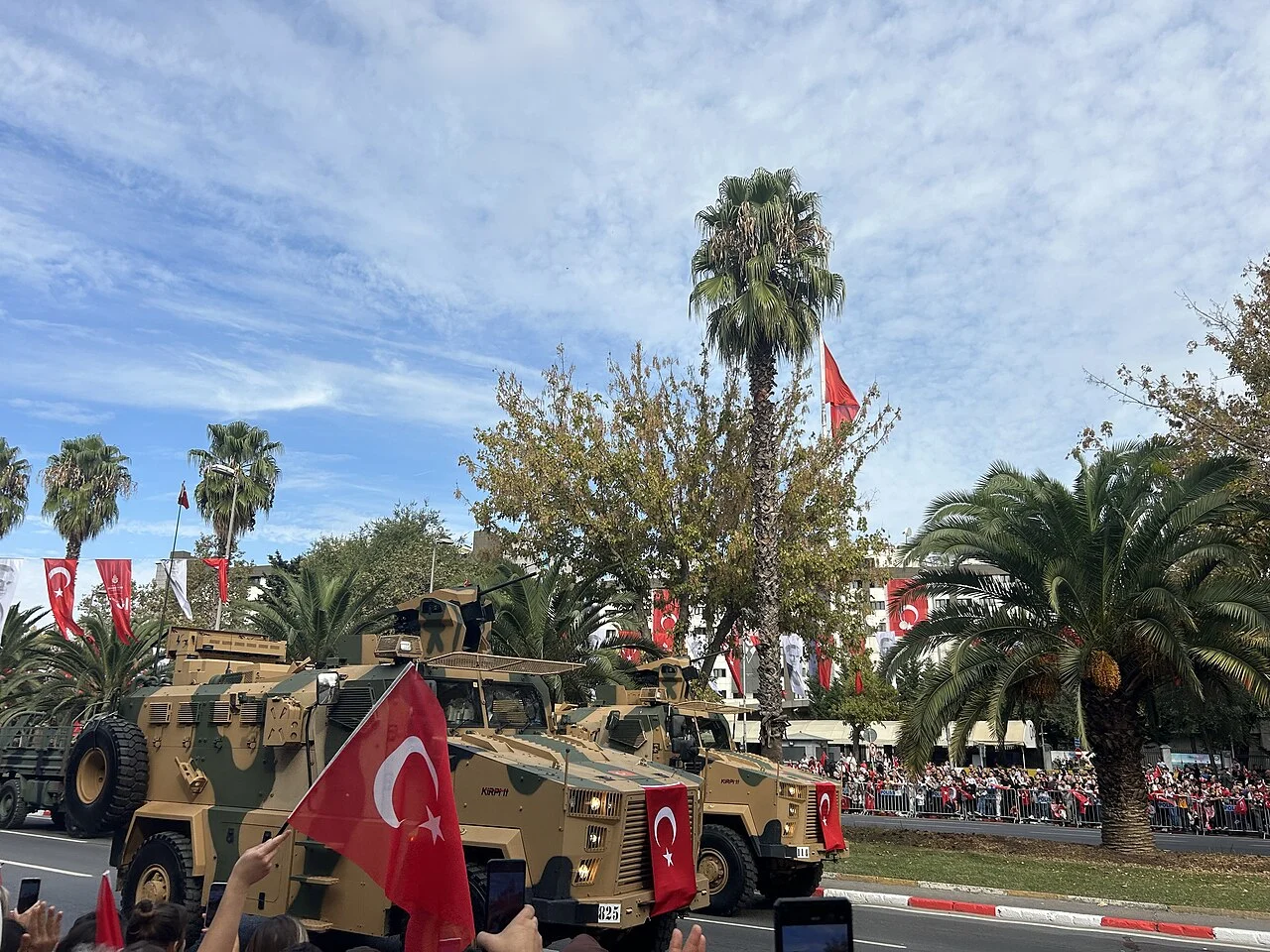


Roughly 90 Turkish-made BMC Amazon 4×4 armoured vehicles appeared in a parade staged by the Libyan Arab Armed Forces (LAAF) in the country’s east, footage released on 17 October shows — despite Ankara’s defence ties running almost exclusively through the rival, Tripoli-based government.
Photo: A BMC Kirpi II armoured vehicle, from the same Turkish manufacturer’s product family as the Amazon seen in Libya. Credit: Bjelica, CC BY-SA 4.0, via Wikimedia Commons
The video, circulated online and credited to the General Command of the Libyan Arab Armed Forces, showed roughly 90 of the vehicles rolling through a parade ground in eastern Libya, territory under the control of forces aligned with Khalifa Haftar. Military Africa first reported the sighting on 23 October, noting that the vehicles were externally identical to BMC’s Amazon design except for the letters “ANS” where the manufacturer’s own branding would normally appear — a detail that echoes unmarked armoured vehicles supplied to Libyan forces in 2020.
A vehicle built for internal security, not front-line armour
The Amazon is the smallest armoured vehicle in BMC Otomotiv’s lineup, built on a V-hulled chassis designed to deflect mine and roadside-bomb blasts upward and away from the crew compartment. It carries up to seven people and, according to the manufacturer, can reach 120 km/h with a range of roughly 800 km on a single tank — figures that have not been independently verified. BMC first displayed the Amazon publicly at the Eurosatory show in Paris in 2016; an upgraded version, unveiled in 2023, had previously been seen only in Syrian service. Outside Syria, the original variant is known to be in use with Qatar and Turkmenistan.
Several of the vehicles in the Libya parade footage were fitted with remote-controlled weapon stations, a common configuration that lets a 7.62mm or 12.7mm machine gun be aimed and fired from inside the armoured hull rather than exposing a gunner through a hatch. The vehicle’s size and armament profile point toward policing, border control and internal security roles rather than sustained front-line combat — a role better suited to Türkiye’s heavier Kirpi family, which BMC has supplied to Libya before.
A murky supply chain with a history of surprises
Whether the roughly 90 Amazons reached the LAAF through a direct sale, a transfer from a third party or some other route is not publicly confirmed. The ambiguity fits a pattern: Türkiye’s documented defence relationship in Libya runs through the Tripoli-based Government of National Unity (GNU), not the LAAF, which has spent years fighting GNU-aligned forces for control of the country. Ankara and Tripoli signed a security cooperation agreement and a maritime boundary memorandum in 2019, after which Turkish advisers, armed drones and armoured vehicles began flowing to GNU forces.
The clearest earlier precedent came in 2019, when more than a dozen BMC Kirpi II mine-resistant vehicles were photographed being unloaded at Tripoli port in violation of a UN arms embargo on Libya. The LNA (the LAAF’s predecessor designation) responded at the time by declaring a naval blockade of western Libyan ports. A 2020 assessment of captured Kirpis by LNA-aligned forces found their performance in Libyan conditions underwhelming. Turkish-made M60 tanks were also reported in LNA-contested areas around 2020, a single Akinci drone was spotted with Haftar-aligned forces in 2024, and Libya separately ordered Hürkuş-C light attack aircraft from Türkiye in 2022 — all signs that Turkish equipment has moved through Libya’s fractured political landscape in ways that do not map neatly onto which government Ankara formally backs.
Türkiye’s footprint in Libya is set to continue regardless of who ends up operating the Amazons. Turkey’s parliament approved a 24-month extension of its military mission in Libya on 22 December 2025, running from January 2026 to roughly early 2028. The mission is described officially as training and advisory in nature, and the motion cited the absence of elections and the need to protect a fragile ceasefire as justification for the extension.
Other equipment visible in the same parade footage points to a wider pattern of diversifying suppliers on the LAAF side: Jordanian-made Al-Wahsh 4×4 vehicles fitted with anti-tank guided missile launchers resembling Jordanian firm Jadara’s Terminator system — a combination not previously documented in Libya — alongside jet-powered uncrewed aircraft that appeared visually identical to Belarus’s Mirotvorets loitering munition.
Why it matters for Africa
Libya remains one of the few African states where multiple foreign militaries and defence suppliers compete openly for influence inside a single fractured security sector, and Turkish industry’s apparent reach into both sides of that divide complicates any clean read of who Ankara’s equipment actually serves on the ground. For BMC and other Turkish manufacturers pushing into African markets, unmarked or rebranded exports — like the “ANS” markings reported here — raise the risk that transfers end up in the hands of armed actors outside formal government-to-government channels, a reputational exposure Turkish firms have mostly avoided in their larger, publicly announced African deals with countries such as Nigeria and Niger. For other African security forces weighing Turkish armour, the Amazon’s apparent migration toward internal-security roles in Libya offers a real-world data point on where the vehicle fits: lighter urban and border-security missions rather than the mechanised combat role filled by Kirpi-class MRAPs elsewhere on the continent.
Sources