Uganda Rotates in Battle Group 48 to Somalia as AUSSOM Funding Crisis Deepens

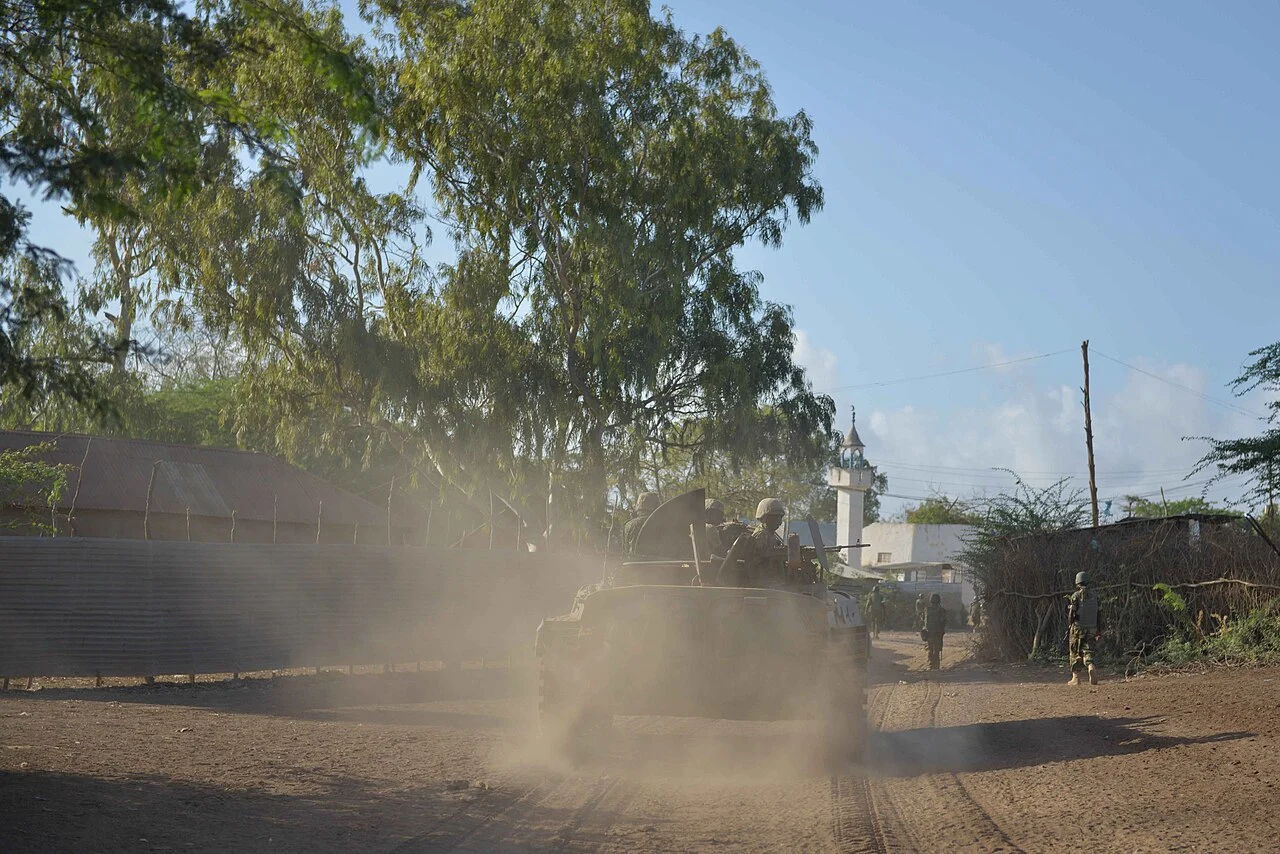


Uganda’s People’s Defence Forces handed frontline duties in Somalia’s Sector One to a newly arrived Battle Group 48 on October 10, even as the African Union mission the unit serves under faces a funding standoff that could leave it without the money to keep units like it supplied in the field.
Photo: Ugandan troops serving with the African Union mission patrol a town in Somalia. Credit: AMISOM Public Information, CC0, via Wikimedia Commons
The handover, confirmed by the Uganda People’s Defence Forces (UPDF) on its own website, saw Battle Group 48 under Col Michael Opio Ocuka take over forward operating bases from the outgoing Battle Group 45 in Sector One, the zone of southern Somalia that Ugandan troops have held since the African Union’s original intervention began in 2007. A week later, on October 17, commanders from both battle groups toured positions together in the Barawe and Beldamin sub-sectors of Lower Shabelle region, the UPDF said, as part of the handover process.
It is, on its face, a routine rotation of the kind the UPDF has carried out roughly every six months for nearly two decades. What makes this one different is the uncertainty hanging over the mission itself, at a moment when rival Somali factions are already contesting territory around Baidoa and the federal government in Mogadishu is moving against figures it accuses of al-Shabaab ties, underlining how much of the burden for the country’s internal security still rests on troops like Uganda’s.
A mission running out of money
Battle Group 48 is deployed under the African Union Support and Stabilisation Mission in Somalia (AUSSOM), which replaced the African Union Transition Mission in Somalia (ATMIS) in January 2025 and is in turn the successor to the original AMISOM force Uganda joined in 2007. AUSSOM is authorised for up to 11,826 uniformed personnel and 680 police, but its day-to-day logistics, fuel, rations and medical support are run not by the African Union itself but by a separate United Nations office, the UN Support Office in Somalia (UNSOS).
That arrangement is now in doubt. According to reporting by The East African and an analysis published by the Institute for Security Studies, Washington sent a diplomatic note on July 1 stating it would not object to the UN Security Council renewing AUSSOM’s Chapter VII mandate when it comes up in December, but that it would oppose any renewal that keeps UNSOS, or any other UN-funded logistics arrangement, running past the mission’s current mandate expiry on December 31, 2026. The US had already withdrawn its roughly 25 percent share of UNSOS funding in October 2025, contributing to a cut in the office’s 2026/27 budget to about $481.7 million, down 7.5 percent on the previous year.
The stated US rationale, per the same reporting, is that the Somali federal government has not taken full ownership of its own security functions or sustained gains made against al-Shabaab. Talks aimed at finding a replacement funding arrangement are reported to be underway in New York, Washington, Addis Ababa and Mogadishu, but no alternative donor has stepped forward to close the gap.
Uganda’s own exit timeline
Uganda is AUSSOM’s largest troop contributor, with around 4,500 soldiers on the mission’s approved deployment list, on top of a separate bilateral contingent that Kampala has kept in Somalia since late 2024 under a direct security pact with the Somali federal government, reported at anywhere from roughly 2,000 to as many as 6,000 troops depending on the source. That bilateral force operates outside the AU mandate and would, in principle, be unaffected by any AUSSOM wind-down.
Uganda’s own political signalling on withdrawal has been inconsistent. In January 2026, Chief of Defence Forces Gen Muhoozi Kainerugaba said on social media that Uganda was “withdrawing completely from Somalia,” and Ugandan officials have since cited August 1, 2027 as the deadline for all UPDF forces, AUSSOM and bilateral alike, to be out of the country. But in August 2026, Defence Minister Kiryowa Kiwanuka said Ugandan forces would stay under the bilateral arrangement even if the AU mission itself collapsed. Uganda has contributed troops to Somalia continuously since March 2007, first under AMISOM and now AUSSOM, making it the force’s longest-serving and largest troop-contributing nation.
Battle Group 48 itself trained for 16 weeks at the UPDF’s Internal Peace Support Operations Training Centre at Camp Singo in Nakaseke District before deploying, following the same pre-deployment cycle used for Battle Group 47, which arrived in May 2026. Brig Gen Jackson Kayanja, addressing the outgoing and incoming units, is reported by the UPDF to have told troops that “personal discipline is the key to your success,” a standard line in UPDF deployment ceremonies that nonetheless points to the force’s continued emphasis on conduct in a mission already under scrutiny over funding and endgame.
Why it matters for Africa
AUSSOM’s troubles are a live test of whether African-led peace support operations can survive without the open-ended US-backed UN logistics chain that has underwritten AU missions in Somalia for nearly two decades. If UNSOS funding lapses at the end of December and no substitute is found, Uganda’s roughly 4,500 AUSSOM troops, together with contingents from Ethiopia, Kenya, Djibouti and Burundi, would be left without assured fuel, rations and casualty evacuation in an active counter-insurgency theatre, a scenario that would test not just Uganda’s bilateral fallback but the AU’s broader claim that it can sustain large peace operations on its own resources. For Kampala, a rotation that would ordinarily pass unremarked is now unfolding against a deadline that could reshape, or end, the deployment Battle Group 48 has just joined.
Sources
- UPDF: “UPDF Welcomes Battle Group 48 To Somalia Mission Area”
- Military Africa: “Uganda rotates fresh battle group into Somalia”
- The East African: “US funding exit casts doubt on AU peace mission in Somalia”
- ISS Africa: “Rethinking the AU’s Somalia peace mission after US funding cuts”