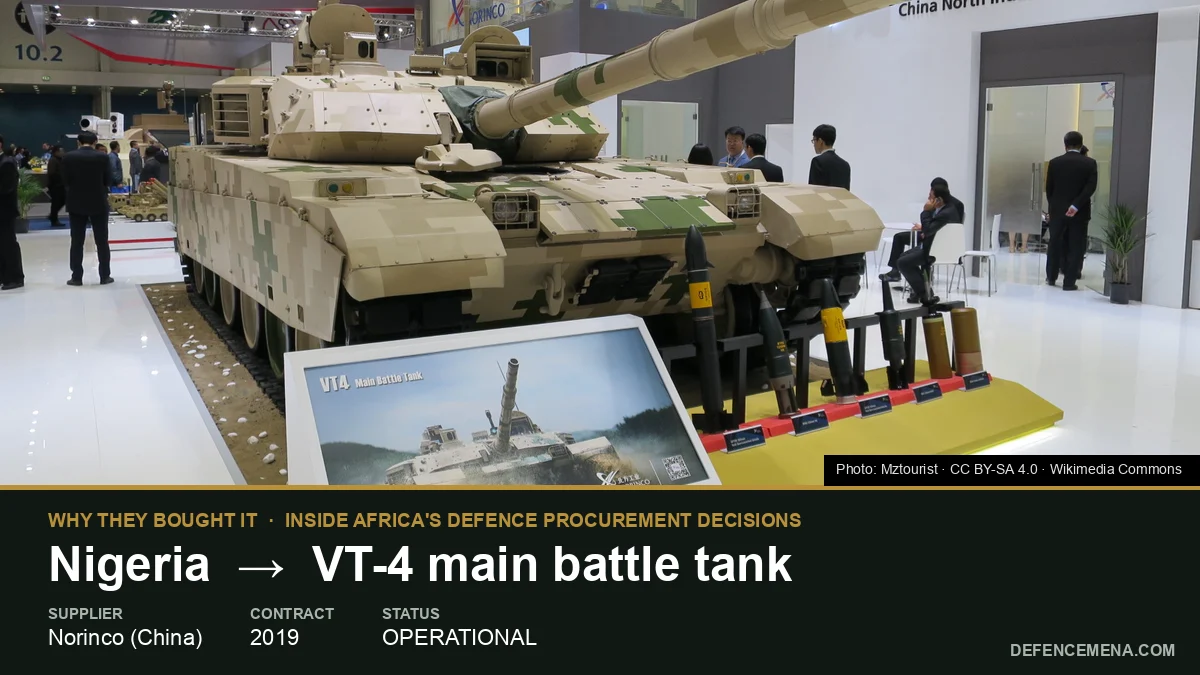
Nigeria bought the Norinco VT-4 because the Army needed new main battle tanks for the north-east campaign against Boko Haram and ISWAP, and a Chinese package of tanks, ST1 wheeled tank destroyers and SH-5 105 mm self-propelled guns was what the government funded and received. The first 17 vehicles were offloaded at Apapa, Lagos, on 8 April 2020 under a contract reported at about $152 million and signed in 2019; a second batch followed in October 2020, and the tanks went into combat in January 2021. No competition was ever made public, and the exact number of VT-4s has never been officially disclosed.
Photo: Norinco's VT4 (MBT-3000) export tank at IDEX 2017. Nigeria received its first VT-4s at Lagos in April 2020. Photo: Mztourist, CC BY-SA 4.0, via Wikimedia Commons. Credit: Mztourist, CC BY-SA 4.0, via Wikimedia Commons.
- Country
- Nigeria
- System
- VT-4 MBT + ST1 8×8 tank destroyer + SH-5 105 mm SP howitzer
- Supplier
- Norinco (China)
- Quantity
- 17 vehicles in first batch; further batches Oct 2020 and 2022; per-type totals not disclosed
- Contract year
- 2019
- Status
- OPERATIONAL
- Main requirement
- Armoured firepower for north-east counter-insurgency (officially stated)
- Training
- Crews trained in China before delivery
- Localisation
- Norinco maintenance centre, Bauchi (opened Aug 2026)
- Known alternatives
- None documented; T-90 (separate, cancelled budget line)
What capability did Nigeria need?
By 2019 the Nigerian Army had been fighting a full-scale insurgency in Borno, Yobe and Adamawa for a decade, and the armour it kept in the theatre was wearing out. In May 2019 the then Defence Minister, Brigadier General Mansur Dan-Ali, listed what the federal government had funded for the Army: 35 main battle tanks, 25 Typhoon mine-resistant vehicles, 10 Spartan armoured personnel carriers, mine-clearing vehicles and troop carriers, alongside ships and aircraft for the other services. That list, carried by defenceWeb, is the closest thing to a documented requirement that exists in the public record.
The stated purpose was never ambiguous. When the first Chinese vehicles arrived in April 2020, Lieutenant General Lamidi Adeosun, the Army’s Chief of Policy and Plans, told reporters that “both the military and the government are really very serious to tackle the security problems across the nation.” Six months later the Chief of Army Staff, Lieutenant General Tukur Buratai, said the Army had “recently took delivery of key logistical and defensive platforms to re-invigorate our operations” against the insurgents. The requirement, officially stated, was heavier and more reliable direct-fire and artillery support for troops in the north-east.
What did it already operate?
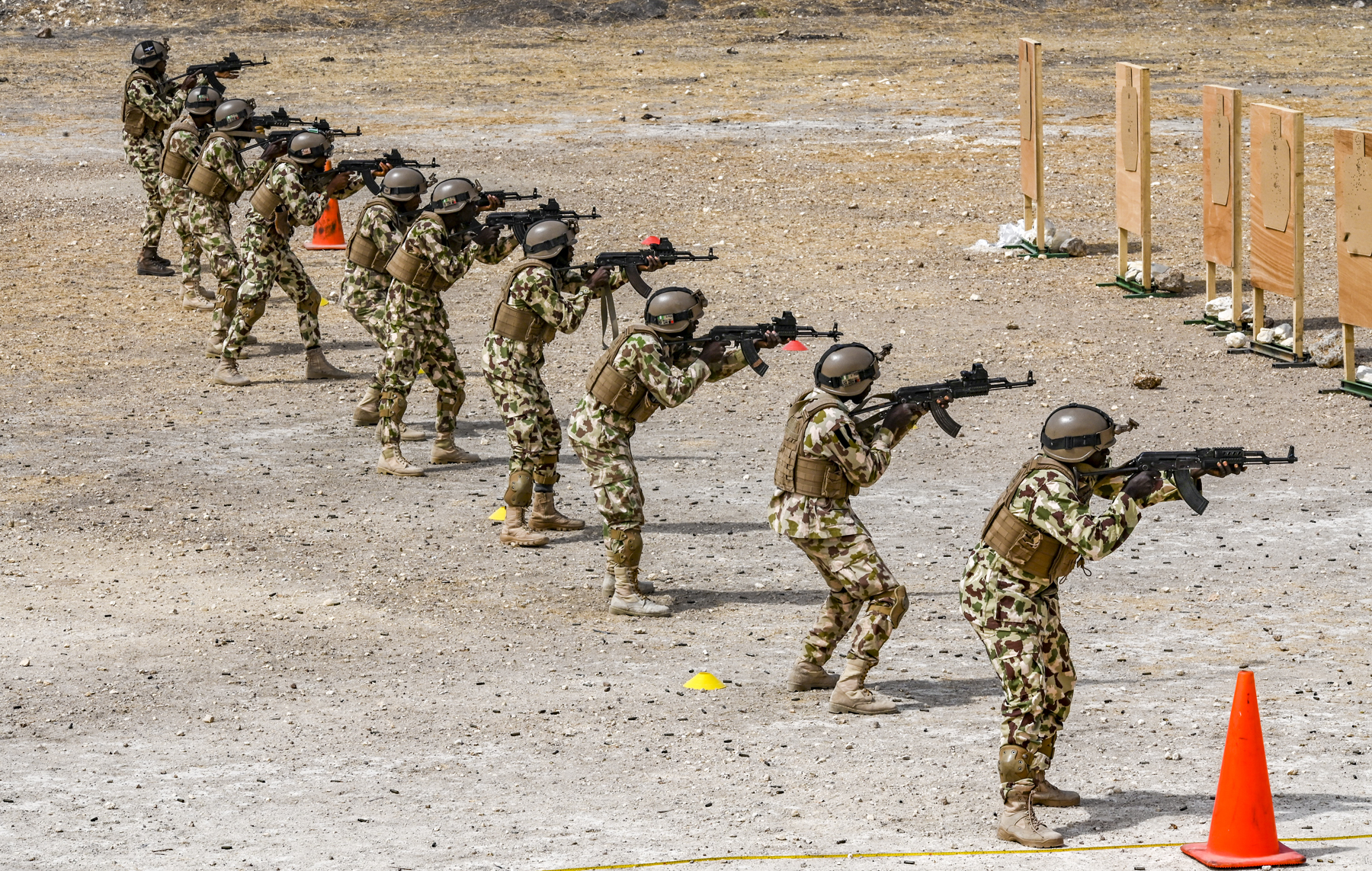
Nigeria’s armoured corps was built around the British Vickers Mk 3, bought in the 1980s and 1990s, together with older T-55s. When the insurgency escalated, Abuja went to the second-hand market. In early 2015 defenceWeb reported Czech company Excalibur flying T-72M1 tanks, BMP infantry fighting vehicles and RM-70 rocket launchers to Nigeria on an An-225, from a batch of 58 T-72s Hungary had sold to Excalibur in 2014. Further T-72 variants came from Ukraine. The Nigerian Army inventory therefore entered 2019 with three tank types from three eras and no common logistics chain.
The T-72s solved an urgent problem and then became one. In April 2022 Army Recognition, citing the Defense News Nigeria account, reported that the thirty-year-old Vickers had proved more reliable in combat than the T-72s, which had been bought without spares and were being cannibalised to keep a share of the fleet running. Military Africa reported in January 2022 that at least 25 T-72s had been refitted and readied for operations after being described as dilapidated, and that they would operate alongside the new VT-4s. Whether Abuja anticipated this when it ordered the VT-4 is not documented, but the contrast between a tank bought with training and spares and a tank bought from surplus without them runs through the whole story.
What system was selected?
The VT-4, also marketed as the MBT-3000, is Norinco’s export main battle tank: about 52 tonnes, a 125 mm smoothbore gun with autoloader, a 1,200 hp engine, a road speed of around 70 km/h and a remote weapon station with a 12.7 mm machine gun, according to the specifications published at delivery. Thailand was the first export customer; Shephard reported in April 2020 that Bangkok had received 48 of 52 ordered, and that Nigeria became the second export user.
Nigeria did not buy the tank alone. The package offloaded at Apapa also contained the ST1, an 8×8 wheeled vehicle with a 105 mm gun that Norinco markets as a tank destroyer, and the SH-5, a 6×6 truck-mounted 105 mm howitzer with a quoted range of 18 km. The Army’s own October 2020 statement listed “VT-4 main battle tanks, ST1 8×8 tank destroyers and SH-5 self-propelled artillery” among the platforms received since April; press reports on the second batch also mention SH-2 122 mm guns. For the comparison with Algeria’s Russian armour see VT-4 vs T-90 in Africa.
Which alternatives were considered?
No tender for the Nigerian tank requirement was published and no competing bid has been documented. One related decision is on the record. In April 2021 Military Africa, citing a Ministry of Defence letter of award reported by Punch, described a $43.68 million line for 10 second-generation T-90 tanks from Russia, funded from the $1 billion the presidency approved in 2019, being replaced on 5 February 2020 by 60 Isotrex Legion mine-resistant vehicles and 24 Phantom II armoured personnel carriers. That letter has not been published by the ministry, so the figures remain reported rather than official. It shows that Russian tanks were on Abuja’s shopping list at the same time as the Chinese package, and that the money went to protected mobility instead.
| Alternative | Class | Status of consideration | Source |
|---|---|---|---|
| Uralvagonzavod T-90 (10, $43.68m line) | Main battle tank | REPORTED ALTERNATIVE (separate budget line, cancelled Feb 2020) | Military Africa, Apr 2021 |
| Refurbished T-72 (further surplus buys) | Main battle tank | SAME-CLASS MARKET ALTERNATIVE (no competition documented) | defenceWeb, Feb 2015 |
| Vickers Mk 3 overhaul | Main battle tank (in service) | SAME-CLASS MARKET ALTERNATIVE (no competition documented) | Army Recognition, Apr 2022 |
| Isotrex Legion / Phantom II | MRAP / APC | REPORTED ALTERNATIVE (took over the T-90 funds) | Military Africa, Apr 2021 |
Why was the VT-4 selected?
Officially stated: the north-east campaign. Every Nigerian statement on the package ties it to the insurgency. Adeosun in April 2020 framed the delivery as evidence of how “serious the Federal Government of Nigeria is in making sure that the Nigerian Army is not only equipped but contains the problem of insecurity.” Buratai, in October 2020, listed the Chinese vehicles among platforms that had “undoubtedly enhanced the effectiveness of our troops.” No official statement explains why this manufacturer rather than another.
Documented in procurement material: a funded line for 35 tanks. Dan-Ali’s May 2019 statement that 35 main battle tanks had been funded is the only planning figure on record. The Chinese contract was signed the same year. Whether the 35 was written around the VT-4 or the VT-4 was fitted to the 35 is not public.
Analysts assess: a complete package from one supplier. The April 2020 shipment included, according to Army Recognition, 15 forty-foot containers of spares and accessories, and Nigerian crews had already been trained in China. That is the opposite of the T-72 experience, and it is reasonable to read the contract as a reaction to it. This remains an assessment: no Nigerian official has said the T-72 spares problem drove the choice.
Analysts assess: wheels as much as tracks. The ST1 and SH-5 are wheeled, which matters on Nigeria’s road network between Maiduguri and the operating areas. Army Recognition’s report on the first combat use noted that VT-4s, ST1s and SH-5s were deployed together. A buyer seeking only tanks would not have taken two wheeled 105 mm platforms in the same contract.
Possible but unconfirmed: financing and speed. For this deal there is no public financing document, no stated delivery schedule and no Nigerian comment on either, so the article does not claim them. The documented timeline is contract in 2019 and first delivery in April 2020, which is quick, but whether that reflected Norinco stock, a Nigerian priority or both is unknown.
Reported by Military Africa: tanks lost out to MRAPs elsewhere in the budget. The T-90 swap shows that by February 2020 Abuja was prepared to give up a tank line for protected mobility. It did not give up the Chinese package, which was already contracted and on its way.
What was included in the contract?
The public description of the 2019 contract covers VT-4 tanks, ST1 tank destroyers, SH-5 howitzers, spares in containers, and crew training in China. Shephard and Military Africa both describe the April 2020 cargo as 17 armoured vehicles plus “other items”; the second batch added more VT-4, ST1 and self-propelled artillery. Ammunition, simulators, recovery vehicles and the length of the support period have not been disclosed.
How much did it cost?
The figure used by every outlet, from defenceWeb to Army Recognition, is about $152 million for the 2019 Norinco contract. That is a package value for tanks, tank destroyers, howitzers, spares and training; it is not a tank price. Shephard quoted a VT-4 value of $5.25 million per unit in April 2020, which should be treated as a press estimate rather than a disclosed contract figure. Neither the Nigerian Ministry of Defence nor Norinco has published a breakdown, and this article does not derive a unit price from the package value. The cost of the second batch, of the 2022 shipment and of the 15 SH-2 and SH-5 guns reported in August 2023 is not public.
How many were ordered?
The only firm number is 17 vehicles in the first batch, with the split between VT-4, ST1 and SH-5 never stated. Adeosun said at the quayside that “what you are seeing here is just a tip of the iceberg. Others are still coming.” A second batch was announced at the Chief of Army Staff’s conference in Maiduguri in October 2020, again without numbers. Army Recognition reported a further batch en route in May 2022, citing the Defense News Nigeria account. Press tallies of the VT-4 fleet range from “at least six” in April 2021 to the 35 tanks of the 2019 plan; a Russian trade report in 2023 said 30. None is an official Nigerian count. Africa’s largest tank fleets ranked treats the Nigerian VT-4 total as undisclosed for that reason.
Training, maintenance and support
Crew and maintainer training took place in China before the first delivery. Adeosun said in April 2020 that the trained personnel had not yet been able to return because of COVID-19 travel restrictions, so the tanks landed before their crews. By October 2020 Buratai was describing post-delivery training as ongoing with induction into the theatre to follow. Spares arrived with the first shipment.
The support picture changed in 2025 and 2026. On 6 May 2025 the Ministry of Defence announced that Minister of State Bello Matawalle had signed a memorandum in China with a defence manufacturer it did not name, later identified in press coverage as Norinco, covering maintenance and upgrade of existing hardware, servicing of battle tanks, new small-arms ammunition lines and workshops at Kaduna and Kachia, in partnership with DICON. On 27 August 2026, according to Military Africa, a Nigerian Army and Norinco joint service centre began operating at Obienu Barracks, the Armoured Corps base in Bauchi, with capacity for 20 vehicles and fourth-line repair of the VT-4, ST1, SH-5, Type 89 carriers and CS/VP3 mine-resistant vehicles. Major General Chima Ekeator was quoted as saying equipment brought there “will go back as new.”
Local production or technology transfer
There is no local assembly of the VT-4 and no stated plan for one. The May 2025 memorandum speaks of technology transfer and local production, but the items actually specified are ammunition lines and component workshops, not armoured vehicles. The Bauchi centre is a maintenance and repair facility, which is where most tank localisation in Africa realistically begins. For a wider look at how Chinese land systems are supported on the continent, see who supplies Africa’s weapons.
Delivery and operational status
- 2014–2015T-72 tanks arrive from Hungarian and Czech stocks via Excalibur, and from Ukraine, for the Boko Haram campaign.
- May 2019Defence Minister Dan-Ali says the government has funded 35 main battle tanks and other Army equipment.
- 2019Contract with Norinco for VT-4, ST1 and SH-5, reported at about $152 million.
- 5 Feb 2020Reported MoD letter replaces a $43.68 million line for 10 T-90s with Isotrex MRAPs and APCs.
- 8 Apr 2020First batch of 17 vehicles offloaded at Apapa, Lagos; crews trained in China.
- Oct 2020Second batch announced at the Chief of Army Staff’s conference in Maiduguri; post-delivery training continues.
- Jan 2021VT-4, ST1 and SH-5 committed to Operation Tura Takaibango in the north-east; first combat use of the VT-4.
- May 2022Further batch reported en route from China.
- Aug 2023About 15 SH-2 and SH-5 self-propelled howitzers reported received.
- Aug 2026Nigerian Army–Norinco joint service centre opens at Bauchi for VT-4, ST1 and SH-5 maintenance.
Status: OPERATIONAL. The VT-4, ST1 and SH-5 are in service with the Nigerian Army Armoured Corps and artillery and have been in the north-east theatre since early 2021. Detailed serviceability is not public.
Has it been used operationally?
Yes. The Army launched Operation Tura Takaibango on 7 January 2021 from 27 Brigade’s tactical headquarters at Buni Gari in Yobe State, to reinforce Operation Lafiya Dole across Adamawa, Borno and Yobe. Army Recognition, citing the Russian BMPD blog, reported on 11 January 2021 that VT-4 tanks, ST1 tank destroyers and SH-5 howitzers had been committed, the type’s first combat use anywhere. The Army has not published an after-action account of the armour’s performance.
What has operational use shown?
At public level, three things. First, the package was used as a package: tracked tanks, wheeled guns and wheeled artillery moved together. Second, there is no public claim that the tanks changed the outcome of an operation that cost the infantry dearly. Third, the Army chose to invest in deep maintenance for these specific vehicles five years later, which suggests the fleet has been worked hard. Claims of VT-4 losses have circulated on social media since 2021; the Army has neither confirmed nor described any, and this article does not repeat the specifics.
Did Nigeria order more?
Whether the later deliveries were new orders or instalments of the 2019 contract has not been made public; the press describes the October 2020 and May 2022 shipments as part of the same programme. The 15 SH-2 and SH-5 guns reported in August 2023, during the ECOWAS stand-off with Niger’s junta, are the clearest sign of a follow-on artillery buy, though the Army did not announce them and the report rests on a Nigerian military-news social account. A fresh VT-4 order has not been reported. What is confirmed is the support relationship: the 2025 memorandum and the 2026 Bauchi centre tie Nigeria’s armour to Norinco for years to come.
What does this tell us about African procurement?
The Nigerian VT-4 decision is less about China than about the difference between buying tanks and buying a tank capability. The T-72s of 2014 and 2015 were an emergency purchase of hulls. The Chinese contract of 2019 bought hulls, guns, spares, training and, eventually, a repair line on Nigerian soil. The second approach costs more up front and is harder to criticise five years on, and Nigeria’s experience with the T-72 fleet is a useful explanation of why other African armies have made the same trade.
The second lesson is about opacity. Nigeria has one of the largest defence budgets in Africa, yet the number of tanks bought is still unknown six years after the first delivery. Everything public comes from quayside remarks, a conference speech and a leaked letter about a different purchase.
Third, the deal shows how procurement and war fighting interact. The T-90 line was traded for MRAPs while the Chinese tanks were at sea; the VT-4 went into action within nine months of landing; the howitzers were topped up during a regional crisis in 2023. African armour buys are seldom part of a long force-design cycle. They are made under pressure, and the systems that survive are the ones whose suppliers stay engaged afterwards, which is why the Bauchi centre is the most interesting line in the record. The pattern is familiar from why African countries buy Chinese drones, where sustainment rather than sticker price has decided whether a fleet stays in the air.
Finally, the mixed package is itself a signal. A buyer in a counter-insurgency does not need many tanks; it needs firepower that can reach a road ambush in Borno before it ends. The ST1 and the SH-5 are wheeled answers to that need, and Nigeria took them in the same contract as the tanks, a combination other African armies shopping for artillery and armour have since examined.
Procurement record
| Field | Value |
|---|---|
| Country | Nigeria |
| Service | Nigerian Army (Armoured Corps; artillery) |
| System | VT-4 (MBT-3000) main battle tank, with ST1 8×8 105 mm tank destroyer and SH-5 6×6 105 mm self-propelled howitzer |
| Manufacturer | China North Industries Corporation (Norinco) |
| Origin | China |
| Category | Main battle tank / land package |
| Requirement | Armoured firepower and mobile artillery for north-east counter-insurgency (officially stated); 35 MBTs funded in 2019 plan |
| Order date | 2019 (month not disclosed) |
| Contract date | 2019 (month not disclosed) |
| Quantity | 17 vehicles in first batch (Apr 2020); further batches Oct 2020 and 2022; per-type totals not disclosed |
| Contract value | About $152 million (package, reported; official figure not published) |
| Delivery | 8 Apr 2020 (first batch, Apapa); Oct 2020 (second); 2022 (further batch reported); Aug 2023 (c. 15 SH-2/SH-5 reported) |
| Operational status | OPERATIONAL (combat use from Jan 2021) |
| Training | Crews trained in China pre-delivery; post-delivery training in Nigeria 2020 |
| Support | Spares shipped with first batch; May 2025 MoD–Norinco memorandum on tank servicing; joint service centre at Bauchi from Aug 2026 |
| Localisation | Maintenance and repair at Bauchi; no local assembly |
| Tech transfer | Announced in 2025 memorandum for ammunition and components; none documented for armoured vehicles |
| Confirmed competitors | None documented |
| Follow-on order | Not confirmed; 2023 SH-2/SH-5 batch reported; VT-4 total undisclosed |
| Primary source | Nigerian Army statements via defenceWeb (Apr and Oct 2020); Nigerian MoD statement via ThisDay (May 2025) |
| Last verified | 5 October 2026 |
FAQ
How many VT-4 tanks does the Nigerian Army have?
Not officially disclosed. The first batch of April 2020 was 17 vehicles including ST1 tank destroyers and SH-5 howitzers, and further batches arrived in October 2020 and 2022. The 2019 procurement plan funded 35 main battle tanks; press estimates of the VT-4 fleet run from around 17 to 35.
What is the VT-4 tank price for Nigeria?
The whole 2019 package of tanks, tank destroyers, howitzers, spares and training was reported at about $152 million. Shephard quoted a VT-4 value of $5.25 million per tank in 2020 as an estimate. No official unit price has been published, and the package value cannot be divided by a quantity that is itself unknown.
Does the Nigerian VT-4 tank have problems?
The Army has published no reliability data. What is documented: crews were delayed in China by COVID-19 in 2020, the tanks were committed to combat within nine months, and in 2026 the Army opened a Norinco-supported fourth-line repair centre at Bauchi for the fleet. Claims of combat losses circulate on social media without official confirmation. By contrast, the Army’s surplus T-72s were reported to suffer chronic spares shortages.
Why did Nigeria buy Chinese tanks instead of Russian T-90s?
No official explanation exists. A reported Ministry of Defence letter shows a $43.68 million line for 10 T-90s being replaced in February 2020 by Isotrex MRAPs and APCs, while the Chinese package, signed in 2019, went ahead. The two decisions were separate budget lines.
Has the Nigerian VT-4 been used in combat?
Yes. VT-4s, ST1s and SH-5s were committed to Operation Tura Takaibango in Nigeria’s north-east in January 2021, the first combat use of the VT-4 by any army.
What else came with the VT-4 package?
ST1 8×8 wheeled tank destroyers with a 105 mm gun, SH-5 6×6 105 mm self-propelled howitzers, containers of spares, and crew training in China. Later shipments added SH-2 122 mm howitzers.
Is Nigeria building or repairing VT-4 tanks locally?
Repairing, not building. A Nigerian Army–Norinco joint service centre at Obienu Barracks, Bauchi, began operating in August 2026 with fourth-line maintenance for the VT-4, ST1 and SH-5. No local assembly has been announced.
More from Why They Bought It
Sources
- defenceWeb – Nigerian military receives tanks, artillery from China (9 April 2020)
- defenceWeb – Nigerian Army reveals new acquisitions (15 October 2020)
- ThisDay – Matawalle meets Chinese defence equipment manufacturer to enhance Nigeria’s military capabilities (6 May 2025)
- PRNigeria – Nigeria, China seal landmark defence pact to boost local arms production (6 May 2025)
- Military Africa – Nigerian Army and NORINCO commence operations in Bauchi (September 2026)
- Shephard – Nigeria takes delivery of first batch of Chinese VT4s (9 April 2020)
- Military Africa – Nigerian Army receives new VT4 MBT, ST1 light tanks and SH-5 self-propelled howitzers (9 April 2020)
- Army Recognition – China delivers VT4 tanks, SH5 howitzers, 8×8 ST1 tank destroyers to Nigerian Army (10 April 2020)
- Military Africa – Nigeria receives more VT4, ST1 tanks, SH2, SH4 self-propelled artillery and KIA tactical vehicles (8 October 2020)
- Military Africa – The Nigerian Army tests new VT4 and ST-1 tanks before battle (29 October 2020)
- Ripples Nigeria – Nigerian Army launches Operation Tura Takaibango in North-East (7 January 2021)
- Army Recognition – First combat use of Chinese-made VT4 tanks (11 January 2021)
- Vanguard – Nigerian military receives tanks, artillery from China (25 March 2021)
- Military Africa – Nigeria cancels T-90 MBT order for Isotrex MRAPs, procures various arms (April 2021)
- Military Africa – Nigeria’s T-72 main battle tanks repaired and readied for offensive (7 January 2022)
- Army Recognition – Nigerian Army old Vickers Mk3 MBTs more reliable than recent T-72M MBTs (5 April 2022)
- Army Recognition – Nigerian Army to receive second batch of Norinco VT-4 tanks (3 May 2022)
- Army Recognition – Nigeria receives new Chinese SH2 and SH5 self-propelled howitzers amid tensions with Niger (22 August 2023)
- VPK.name (citing TSAMTO) – Nigeria has resumed negotiations with Russia on the purchase of T-90S tanks (August 2023)
- defenceWeb – Nigeria receiving T-72s and other weapons from Czech Republic (2 February 2015)
Last updated: 5 October 2026. This article is updated in place when the procurement status changes.