African governments that bought Chinese armed drones did so, on the record, because they had an armed-reconnaissance requirement in an internal or border conflict: Boko Haram and banditry in Nigeria, Islamic State in Sinai and smuggling on the Libyan border for Egypt, rebels in eastern Congo for the DRC. Low price, fewer export conditions and quick delivery are also cited widely, but almost always by analysts and trade press rather than by the buyers, and no African customer has been shown to have turned down a US drone in favour of a Chinese one. The documented buyers are Nigeria, Egypt, Algeria, Morocco, Ethiopia, the Democratic Republic of Congo and, most recently, Côte d’Ivoire and Chad. Angola and Zambia are not documented as buyers of Chinese armed drones in the sources reviewed.
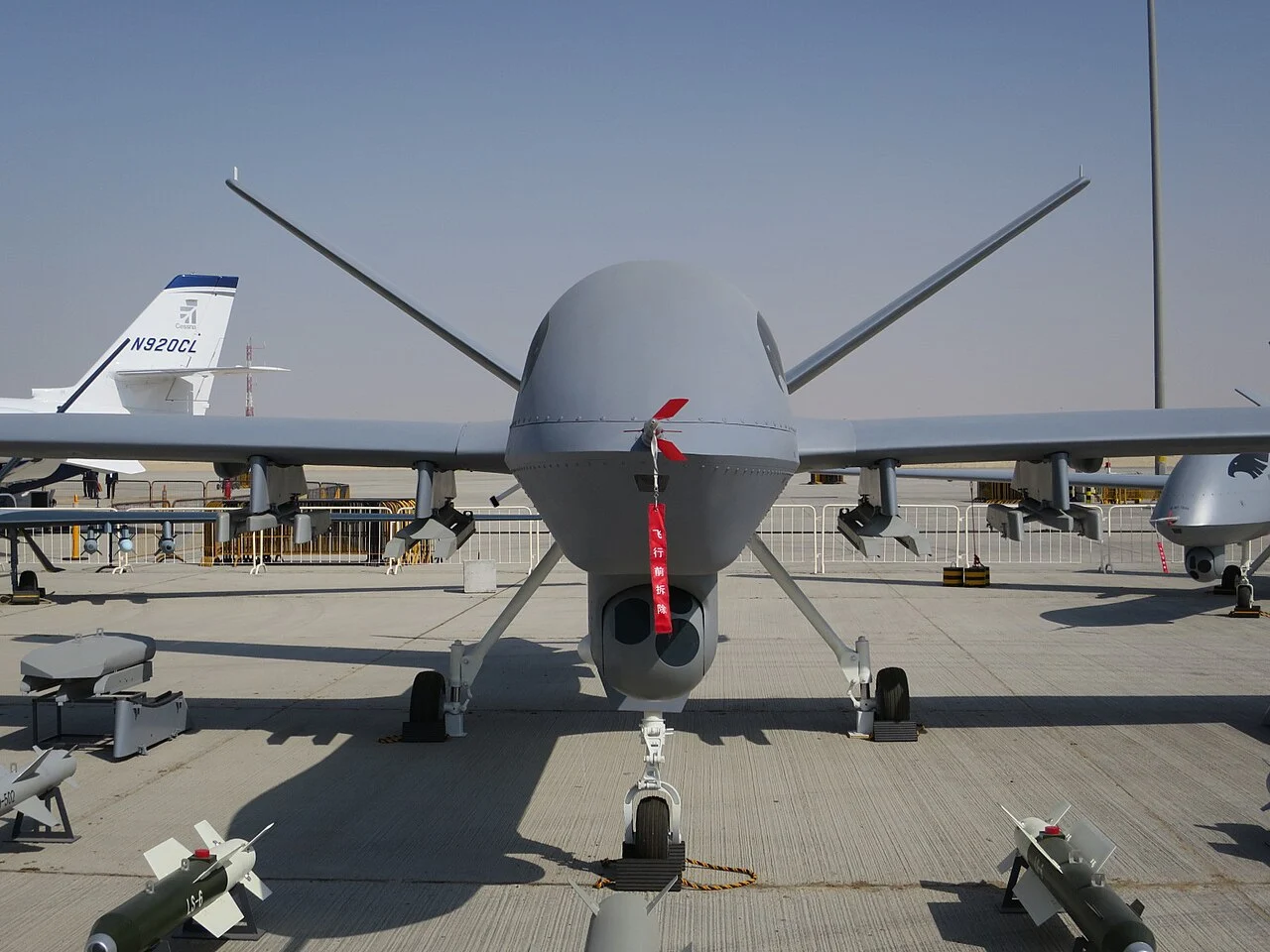
Photo: Wing Loong II on static display at the Dubai Airshow, November 2017. Credit: Mztourist, Wikimedia Commons (CC BY-SA 4.0). The aircraft is not in African service.
This explainer follows one question: why did each customer choose this system? The answer comes from official statements, released footage, satellite imagery and named reporting. Where a reason is only asserted in general terms about “Chinese drones in Africa”, it is marked as such, and where the record is silent this article says so.
| Item | What the record shows | Status |
|---|---|---|
| Systems | Wing Loong I and II (Chengdu / AVIC), CH-3 and CH-4 (CASC), later WJ-700 reported for Egypt | Confirmed types |
| Documented armed-drone customers | Nigeria, Egypt, Algeria, Morocco, Ethiopia, DR Congo, Côte d’Ivoire, Chad | Varies by country; see timeline |
| Indicative unit price | About $1 million per Wing Loong I or II aircraft; about $3 million with ground control equipment | Analyst estimate, not a contract price |
| Customer-stated reason | Counter-insurgency and border security requirements | Official statements (Nigeria) and context (Egypt, DRC) |
| Documented US refusal to an African customer | None found | Unverified |
| Local production | None documented for Wing Loong or CH-4; licensed ASN-209 reported in Egypt | Limited |
What capability did these customers need?
The requirement in each documented case is persistent surveillance with a strike option over territory that is hard to cover with crewed aircraft. Nigeria’s Chief of Air Staff, Air Marshal Sadique Abubakar, disclosed in October 2020 that the Air Force had concluded the purchase of eight armed UAVs from China, and the aircraft were based at Gusau for Operation Hadarin Daji against banditry in the north-west (The Defense Post). Egypt, according to Oryx, almost immediately used its Wing Loong I aircraft in Sinai against Islamic State and from bases on the Libyan border for anti-smuggling operations. The DRC ordered CH-4s to fight rebels in the east, and reporting on the follow-on Wing Loong II talks ties the interest to the M23 conflict (Military Africa).
For Algeria and Morocco no comparable public statement of requirement was found. Their purchases are usually placed in the context of regional rivalry and Western Sahara operations, but that is analysts’ framing, not a stated government reason.
What did they operate before?
Nigeria’s first Chinese armed drone sighting was a crashed CH-3 photographed in Borno in January 2015 (Popular Science), so the Wing Loong II and CH-4 orders of 2020–2021 built on an existing Chinese relationship. Algeria followed a similar path: Oryx describes the CH-3A, then the more capable CH-4B, then a reported Wing Loong II order. Morocco reportedly began with four Wing Loong I aircraft acquired in 2020, likely gifted by the UAE, and later sought Wing Loong II as a replacement (Hespress; Military Africa). For the wider fleet picture see our list of military drones operated across Africa.
Timeline of documented purchases
| Country | System | Year | Quantity | Status | Source and grade |
|---|---|---|---|---|---|
| Nigeria | CH-3 | By Jan 2015 | Not published | Operational | Crash photograph (Popular Science); independent |
| Nigeria | Wing Loong II, CH-4B, CH-3B | Oct–Nov 2020 | Eight armed UAVs announced; reports of the mix vary (two Wing Loong II, four CH-4B, two CH-3B) | Delivered | Chief of Air Staff and Air Force spokesman (official); mix from Military Africa |
| Nigeria | Wing Loong II | 2023 | At least five | Operational | Military Africa; imagery-based, not an official count |
| Egypt | Wing Loong I | 2016 onward | Unknown; claims of 75+ judged an overestimate by Oryx | Operational | Official video, 14 Oct 2018 (defenceWeb); Oryx |
| Egypt | Wing Loong 1D, Wing Loong II, CH-5 | 2021 reports | 32 Wing Loong 1D rumoured | Unconfirmed | Oryx: not sighted in Egypt as of December 2021 |
| Egypt | WJ-700 | June 2025 (reported) | 10; about $400 million reported | Ordered, per reports | Military Africa citing Arabic and Chinese reports; not officially confirmed |
| Algeria | CH-3, CH-4 | Shown Oct 2018 | Not published | Operational | Official visit footage (defenceWeb); Oryx |
| Algeria | Wing Loong II | Sept 2021 order; first seen May 2023 | 24 reported ordered | Delivered (first batch) | Order reported; delivery from satellite imagery via Hespress |
| Morocco | Wing Loong I | 2020 | Four | Operational | Likely UAE gift; Military Africa |
| Morocco | Wing Loong II | Oct 2022 (reported) | Not specified | Reported | Morocco World News, relayed by The Defense Post; no official confirmation |
| Ethiopia | Wing Loong I | Nov 2021 | At least one | Operational | Airbus satellite imagery at Harar Meda (PAX) |
| DR Congo | CH-4 | Feb 2023 order; deliveries from May 2023 | Nine ordered; three delivered by mid-2023 | Delivered / operational | defenceWeb; Military Africa; reports differ on batch timing |
| DR Congo | Wing Loong II | 2025 | Three, in talks with CATIC | Not finalised | Military Africa, April 2025 |
| Côte d’Ivoire | Wing Loong II | Contract June 2024; seen Aug 2026 | Two seen; contract also covers three K-8 trainers | Delivered | Official Air Force video, 10 Aug 2026 (Military Africa); price undisclosed |
| Chad | CH-4 | Aug 2026 | Four airframes seen | Delivered | Footage at Abeche (defenceWeb); not formally announced |
| Zambia | CH-4 | — | — | Unverified | Appears in an operator listing only; no independent confirmation found |
| Angola | Chinese armed drone | — | — | Not documented | None found |
The counts above differ between outlets, and defenceWeb’s regional tally (Algeria 24, Morocco 14, DR Congo 9, Egypt 4, Nigeria 3, Ethiopia unknown) is a summary that lags later deliveries. Treat quantities as reported, not audited.
What was purchased?
The Wing Loong II is a medium-altitude, long-endurance armed drone; the figures reported for it include endurance of 20 hours or more and a payload of up to 480 kg (Military Africa), with Nigeria’s air force spokesman citing longer endurance figures and a weapons list that includes laser-guided bombs and AKD-10 missiles (The Defense Post). Those numbers are manufacturer or official claims and have not been independently tested. The CH-4 is smaller: defenceWeb reports a maximum take-off weight of 1,330 kg, a 345 kg payload and endurance up to 40 hours. Egypt’s Wing Loong I aircraft were photographed carrying AKD-10 and TL-2 missiles (Oryx). No public source gives the full contract scope, such as ground stations, spares, weapons stocks or support, for any African customer.
What did it cost?
| Figure | What it is | Source |
|---|---|---|
| About $1 million | Estimated price of a Wing Loong I or II aircraft alone; not a disclosed African contract price | Defence Procurement International; defenceWeb |
| About $3 million | Estimate for a Wing Loong II including ground control equipment | Defence Procurement International (Atul Chandra, November 2021) |
| “15 times” cheaper | Comparative claim against US drones, given as a general statement | defenceWeb; no named US system or contract |
| About $400 million for 10 | Reported Egyptian WJ-700 deal, roughly $40 million per system | Military Africa, citing unofficial reports |
| Undisclosed | Nigeria 2020 purchase, Algeria Wing Loong II, DRC CH-4, Côte d’Ivoire Wing Loong II, Chad CH-4 | No official figure found |
None of these is a contract value for a specific African order. The $1 million and $3 million figures are estimates of aircraft and system prices and should not be multiplied by quantities to derive a deal value. Claims that Chinese firms accept natural resources as payment are made in general terms by defenceWeb, and Defence Procurement International refers to flexible payment terms; no African deal reviewed here documents either arrangement.
Why were these systems selected?
| Reason | Evidence | Strength |
|---|---|---|
| Armed reconnaissance for counter-insurgency and border security | Nigerian Air Force statements; Egyptian operations in Sinai and on the Libyan border; DRC use against M23 | Documented (official or observed) |
| Lower price | Analyst estimates of about $1 million per aircraft; no African buyer has published a price comparison | Reported, general |
| Fewer export restrictions than US drones | Analysts point to US missile-technology controls and China’s non-membership of the Missile Technology Control Regime; no African customer is shown to have applied for and been refused a US armed drone | Analyst claim; unverified per country |
| No political conditions | Commentary on China’s non-interference approach to arms sales; no customer statement located | Analyst claim |
| Delivery speed | Nigeria: announcement October 2020, aircraft inducted November 2020. DRC: order February 2023, first deliveries May 2023. Counter-example: Algeria’s Wing Loong II, ordered September 2021 for delivery by end-2022, was first seen in May 2023 | Mixed; based on public dates only |
| Training package | About 70 Nigerian personnel trained in China (Military Africa); seven months of Moroccan training in China (Hespress) | Reported |
| Continuity with earlier Chinese types | Nigeria CH-3 then Wing Loong II; Algeria CH-3A, CH-4B, then Wing Loong II; Morocco Wing Loong I then II | Documented sequence, motive inferred |
| Local production or transfer | None documented for armed drones | Not a factor on the record |
The one reason with direct evidence is the operational requirement. The others are plausible and widely repeated, but they describe why Chinese drones are attractive in general, not what any particular ministry decided.
Were alternatives considered?
| Category | System | Evidence |
|---|---|---|
| Confirmed competitor | None found | No public tender or head-to-head evaluation for any African Chinese drone purchase |
| Reported alternative | Turkish Bayraktar TB2 and Israeli types in Morocco | Morocco reportedly operates 13 TB2 (about $70 million) and Israeli Heron and Hermes 900 drones as parallel purchases (Military Africa). These are additional buys, not a comparison outcome |
| Reported alternative | US drones in Morocco | Military Africa lists US-origin drones in Morocco’s inventory; this shows a customer buying from both Chinese and Western suppliers |
| Theoretical | General Atomics MQ-9 Reaper | Widely described as export-restricted; no African customer documented as having requested it and been refused |
| Theoretical | Other Chinese or third-country armed drones | Same broad role; no evidence they were evaluated |
It would be wrong to say any African customer “chose Wing Loong over” a named rival. Several customers, Morocco most clearly, buy from more than one supplier, which points to diversification rather than a single winner-take-all decision. Our TB2, Wing Loong II and CH-4 comparison covers the systems side by side.
Training and support
Public detail is thin. Military Africa reports that 70 Nigerian Air Force personnel and technicians trained in China. Hespress reports that Moroccan Air Force personnel completed a seven-month course in China. For Egypt, Algeria, Ethiopia, the DRC, Côte d’Ivoire and Chad no training, spares or support arrangement was found in open sources. Satellite imagery shows the DRC completed a hangar at N’Dolo by May 2023 (defenceWeb), which is infrastructure, not a support contract.
Delivery and operational service
| Claim | Who made it | Grade |
|---|---|---|
| Nigerian Wing Loong II operating from Gusau against banditry | Nigerian Air Force spokesman, via The Defense Post | Official |
| Egyptian Wing Loong strike shown in Air Force anniversary video, October 2018 | Egyptian military video, via defenceWeb | Official |
| Egyptian strikes in North Sinai in March 2017 mostly by Wing Loong aircraft | Secondary reporting | Unverified battlefield claim |
| Wing Loong I in Ethiopia, November 2021 | Airbus satellite imagery analysed by PAX | Independent |
| One DRC CH-4 shot down by M23 in January 2024 | Military Africa | Reported, not independently confirmed here |
| Three CH-4B losses in Algeria within months, two during trials | Oryx | Independent analysis; reliability data otherwise absent |
| Wing Loong II first batch in Algeria, May 2023 | Analyst imagery reading, relayed by Hespress | Independent, single-source |
No African customer has published availability or mission-capable rates, and casualty claims from drone strikes in Nigeria, the DRC or Ethiopia come from governments or conflict parties and are not independently verified.
Industrial cooperation
For the Wing Loong and CH-4 families none is documented in Africa. defenceWeb reports that Egypt operates the ASN-209 observation drone under licence, and Military Africa reports Egyptian plans with NORINCO and Havelsan on the Hamza-2 and Hamza-1 drones through the Arab Organisation for Industrialisation. These are separate programmes, and licensed assembly is not indigenous design or production. A claim that part of Morocco’s Chinese drone order would be built locally appeared in one trade summary but not in the Moroccan press or defence reporting reviewed, so it is treated as unverified. Maintenance, repair and overhaul capability for Wing Loong or CH-4 in Africa is not documented.
Was it a good fit? Documented trade-offs
| Dimension | Evidence in favour | Trade-off or open question |
|---|---|---|
| Mission | Armed, long-endurance platform matches surveillance and light-strike needs in Sinai, north-west Nigeria and eastern Congo | No published assessment of effect on the conflicts concerned |
| Cost | Estimated about $1 million per aircraft | Ground stations, weapons and support costs are not public |
| Delivery | Nigeria and DRC received first aircraft within months of announcement | Algeria’s Wing Loong II arrived later than planned |
| Reliability | Continued repeat purchases by Nigeria, Algeria, Morocco and the DRC suggest satisfaction, but that is an inference | Three CH-4B crashes in Algeria; one reported shoot-down in the DRC |
| Weapons | Chinese air-to-ground missiles and bombs in the same package | Resupply arrangements and stock levels not public |
| Political | China does not, on analysts’ account, attach human-rights conditions | Dependence on one supplier for spares and upgrades; customer statements absent |
How they compare with same-class alternatives
A strict comparison would mislead, because no African buyer published one. What the record supports: the Wing Loong II and CH-4 sit in the medium-altitude, long-endurance class, priced by analysts at roughly $1 million per aircraft, against the general claim that US equivalents cost many times more. Morocco’s reported 13 Bayraktar TB2 at about $70 million work out to about $5 million each on that reported total, but the package scope is not public, so the figures are not like for like. Endurance and payload numbers come from manufacturers and vary between sources (20 hours in one report, 26 to 31 hours in another for the Wing Loong II depending on configuration). See our comparison article and the TB2 operator list for the wider field.
Africa-wide consequence
Chinese armed drones are now in service or delivered in North, West, Central and East Africa. The buyers include states with Western supply relationships, such as Morocco, and states with Russian ones, such as Algeria (see Inside Algeria’s Russian-built arsenal), which suggests the drones were not tied to one bloc. Egypt’s wider sourcing pattern is covered in our analysis of Egyptian supplier diversification. Nothing in the sources shows that one country’s purchase caused another’s, so the spread should be read as a pattern, not a chain of influence.
What happened next
Repeat and larger orders followed. The DRC is reported to be negotiating three Wing Loong II with CATIC after taking CH-4s. Egypt is reported to have contracted 10 WJ-700 aircraft in June 2025, a report not officially confirmed. Algeria’s Wing Loong II fleet began arriving in 2023. In August 2026 an official Ivorian Air Force video confirmed two Wing Loong II at Bouaké under a June 2024 contract, and footage showed four CH-4 airframes at Abeche in Chad, which had not been formally announced.
FAQ
Why do African countries buy Chinese drones?
The documented driver is a need for armed surveillance in internal and border conflicts. Price, fewer export conditions and delivery speed are commonly cited but come mainly from analysts, not from the buyers.
Which African countries operate Wing Loong drones?
Nigeria, Egypt, Algeria, Morocco, Ethiopia and, per an August 2026 official video, Côte d’Ivoire. Morocco’s Wing Loong II is reported but not officially confirmed.
Which African countries operate the CH-4?
Nigeria, Algeria, the DRC and, per August 2026 footage, Chad. Zambia appears in one listing without independent confirmation.
Did the US refuse to sell armed drones to these countries?
No refusal to a specific African customer was found. US export controls on armed drones are cited as a general factor by analysts.
How much does a Wing Loong II cost?
Analysts estimate about $1 million per aircraft and about $3 million with ground equipment. No African contract price has been published.
Do African countries build Chinese drones locally?
None is documented for the Wing Loong or CH-4. Egypt reportedly builds the ASN-209 under licence and is reported to be pursuing other co-production.
Related reading
- Bayraktar TB2 vs Wing Loong II vs CH-4: armed drones in Africa
- Military drones operated across Africa in 2026
- Which African countries operate the Bayraktar TB2?
- Why Nigeria bought the A-29 Super Tucano (another Nigerian procurement)
- Nigerian Air Force aircraft inventory
- Nigeria’s military strength in 2026
- Egypt’s military strength in 2026
- Inside Algeria’s Russian-built arsenal
- Egypt’s defence supplier diversification
- Military equipment database
Sources
- defenceWeb, Chinese UAVs finding a large market in Africa
- defenceWeb, Algeria, Egypt unveil Chinese UAVs (2018)
- defenceWeb, DRC operating CH-4 UAVs (2023)
- defenceWeb, Chinese UCAVs at Chadian military base (2026)
- Oryx, The Middle East’s Game of Drones: Egypt’s UAV Arsenal (December 2021)
- Oryx, Algiers Calling: Assessing Algeria’s Drone Fleet (December 2021)
- PAX, Ethiopia now confirmed to fly Chinese armed drones (November 2021)
- The Defense Post, Nigeria takes delivery of Chinese drones (November 2020)
- The Defense Post, Morocco buys Chinese military drones (October 2022)
- Military Africa, Nigeria’s Wing Loong II drones arrive discreetly (2023)
- Military Africa, Morocco acquires Wing Loong II drones (October 2022)
- Military Africa, DR Congo acquiring Wing Loong II drones (April 2025)
- Military Africa, Egypt acquiring Chinese WJ-700 combat drones (December 2025)
- Military Africa, Ivory Coast confirms Chinese Wing Loong II drones (August 2026)
- Hespress, Algeria tests Chinese Wing Loong II drones as Morocco eyes similar deal (June 2023)
- Defence Procurement International, Why China’s armed UAVs are a global export success (November 2021)
- Popular Science, Did an armed Chinese-made drone just crash in Nigeria?
- China-Global South Project, DR Congo buys nine Chinese attack drones (February 2023)