Why DR Congo Bought the Chinese CH-4 Attack Drone: Deal, Losses and Results



The Democratic Republic of Congo bought nine Chinese CH-4 attack drones in 2023 because its army had no armed, loitering strike capability to use against the Rwanda-backed M23 rebellion in North and South Kivu, and because China offered the aircraft faster and with fewer conditions than Western alternatives subject to export controls. The order was announced in February 2023, the first three drones arrived within months and were based at Kavumu military airport near Bukavu, and the remaining six followed over the following year. Kinshasa has not disclosed what it paid. Congolese forces have used the CH-4 to strike M23 positions since 2023, M23 has repeatedly claimed to have shot several down, and by 2025 Kinshasa was negotiating a further batch of Chinese Wing Loong II drones to rebuild the fleet.
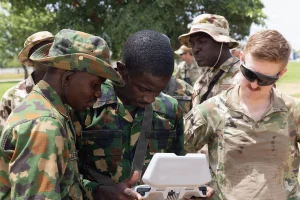
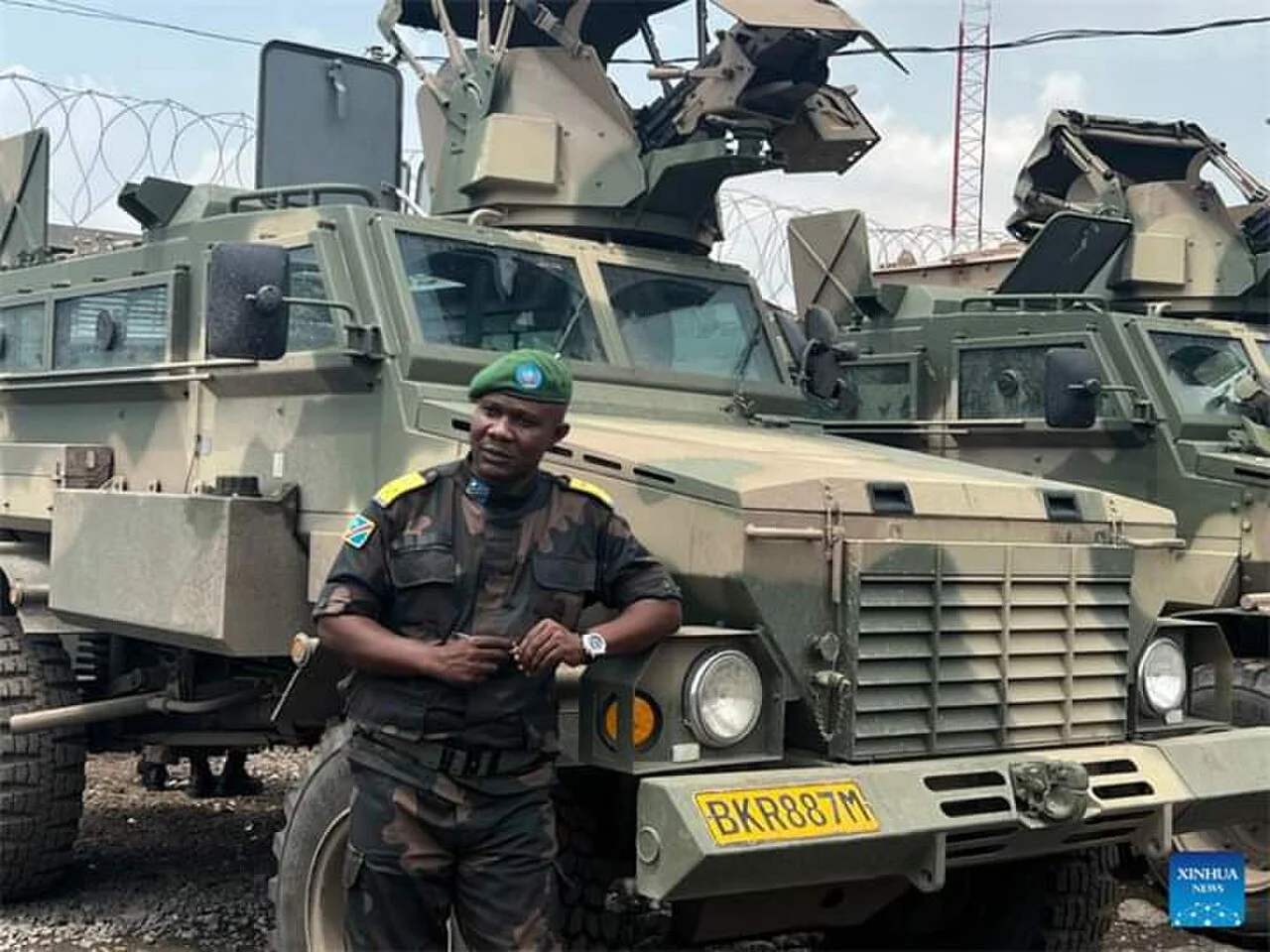
Photo: An FARDC soldier beside a South African National Defence Force Mamba armoured personnel carrier, August 2024. Credit: Thabiso Doyisa (CC BY-SA 4.0).
This explainer follows one question: why did this African customer choose this system? The answer below comes from open-source defence reporting, Africa-focused outlets and the claims of the warring parties themselves, since no DRC government statement, Chinese government notification or contract document has been published. Where the record is thin or contested, this article says so rather than filling the gap with a plausible motive.
| Item | What the record shows | Status |
|---|---|---|
| Customer | Armed Forces of the Democratic Republic of the Congo (FARDC) | Confirmed |
| System | CH-4 (Caihong-4 / “Rainbow”) medium-altitude, long-endurance armed drone, built by China Aerospace Science and Technology Corporation (CASC); DRC’s batch is reported as the CH-4B strike/reconnaissance variant | Reported, CH-4B variant not officially confirmed |
| Quantity | 9 ordered and delivered in 2023–2024 | Delivered, fleet since reduced by claimed losses |
| Route | Direct Chinese commercial/government sale; no Foreign Military Sales-style public notification exists for this transaction | Confirmed by reporting, not by an official notice |
| Contract value | Not disclosed | Unknown |
| Base | Kavumu military airport, South Kivu, near Bukavu | Reported |
| Parallel acquisition | Six Turkish Bayraktar TB2 drones, also reported acquired in 2023 | Reported, separate programme |
| Local production | None documented | — |
What capability did DRC need?
The requirement traces to the collapse of the 2013 ceasefire with M23 and the rebel group’s resurgence from late 2021, which UN Group of Experts reports describe as backed by regular Rwandan army units operating inside Congolese territory. By 2022–2023 FARDC faced a mobile, well-armed adversary in the mountainous terrain of North and South Kivu, and had no modern platform that could loiter over that ground, identify targets and strike them. Congo’s existing combat aircraft — ageing Soviet-era Sukhoi Su-25 attack jets and Mi-24/Mi-35 gunships — were a conventional strike force, not an intelligence, surveillance and reconnaissance (ISR) and precision-strike capability suited to a counter-insurgency fight against a dispersed rebel force. China Global South, citing an Africa Intelligence report, said the drones were bought specifically “for use in war against M23 rebels.” No DRC government statement naming the requirement in those terms has been found; the characterisation above comes from secondary reporting, not from Kinshasa itself.
What did FARDC operate before?
Before 2023, Congo’s air arm was built around a handful of Sukhoi Su-25 ground-attack jets and Mi-24/Mi-35 attack helicopters, most acquired or refurbished with Ukrainian, Belarusian or Russian support in the 2000s and 2010s, plus utility and transport helicopters. None offered persistent overhead coverage, and FARDC had no armed uninhabited aircraft at all. From mid-2023 the Southern African Development Community’s SAMIDRC mission added South African Rooivalk attack helicopters and other SANDF equipment to the fight, a separate procurement and deployment this site has covered in SAMIDRC in the DRC: what combat against M23 showed about South African equipment and the Rooivalk’s DRC combat record; that mission ended in March 2025. The CH-4 and, separately, Turkish Bayraktar TB2 drones were Congo’s own parallel answer to the same gap in persistent ISR and strike capability.
Procurement timeline
| Stage | Date | What happened | Source |
|---|---|---|---|
| Context | Late 2021–2022 | M23 rebellion resumes in North Kivu; UN experts later report direct Rwandan army involvement | UN Group of Experts reporting, via Reuters/Bloomberg |
| Wider Chinese shopping | March 2023 | DRC separately reported to be discussing Chinese J-10C fighters, part of a broader turn to Chinese suppliers | Meta-Defense; The Diplomat |
| Order announced | 21–23 February 2023 | Africa Intelligence reports DRC has ordered nine CH-4 drones from China | Africa Intelligence, via China Global South |
| First batch | May 2023 | First three CH-4 drones delivered | Military Africa; Army Recognition (4 July 2023) |
| Basing | 2023 | Drones stationed at Kavumu military airport, South Kivu | Military Africa; Army Recognition |
| Parallel Turkish order | 2023 | Six Bayraktar TB2 drones reported to enter DRC service the same year | Military Africa |
| Remaining deliveries | By December 2023 or by May 2024 (sources conflict) | Remaining six CH-4s delivered, completing the nine-drone order | Military Africa (dates disputed between its own 2023 and 2024 reporting) |
| Operational use begins | 2023 | FARDC begins using CH-4s operationally against M23 | Military Africa; subsequent M23 shootdown claims imply the type was already flying combat missions |
| First claimed loss | 24 February 2024 | M23 spokesman Lawrence Kanyuka says the group downed a DRC CH-4; FARDC did not confirm | Military Africa |
| Second claimed loss | January 2025 | M23 claims a further CH-4 shootdown, reported to leave eight of nine in service | Militaeraktuell; Military Africa |
| Fleet top-up sought | From around April 2025 | DRC reported in talks to buy three Wing Loong II drones from China’s CATIC; not confirmed as finalised | Military Africa; Militaeraktuell |
| Further claimed losses | 10 and 15 November 2025 | AFC/M23 claims CH-4 downings at Masisi and Walungu; one report puts the surviving fleet at five of nine | Military Africa reporting of AFC/M23 claims; not confirmed by Kinshasa |
| Continued strikes | Late 2025–2026 | FARDC drone strikes on M23 positions reported through early 2026, including a strike reported to have killed a senior M23 commander in Masisi in February 2026 | Critical Threats Project Congo War Security Review |
| Additional CH-4 order | — | None found beyond the original nine | Unknown |
Two things stand out. First, there was no public evaluation or tender: the record shows a requirement and a direct Chinese sale, not a competition. Second, the sourcing on exact delivery dates and on how many CH-4s remain flyable is genuinely inconsistent between outlets, and no official DRC or Chinese figure has been published to settle it; this article has flagged every point where accounts disagree rather than picking the cleaner-sounding version.
What was purchased?
Reporting describes the order as nine CH-4 drones, with the DRC’s batch widely assumed to be the CH-4B variant: an armed reconnaissance-and-strike aircraft with a reported payload of up to 345 kg across six hardpoints, able to carry AR-1/AR-2 air-to-surface missiles, AKD-10 anti-tank missiles and small precision-guided bombs, with an endurance of up to 40 hours and a top speed around 235 knots (Army Recognition). No DRC or Chinese source has confirmed the variant designation or the exact weapons fit delivered; it is inferred from the type’s known export configuration, not stated by either government.
What did it cost?
| Figure | What it is | Source |
|---|---|---|
| Not disclosed | No contract value for the DRC’s nine-drone order has been published by Kinshasa, Beijing or CASC | — |
| $1–2 million per aircraft (analyst estimate, not DRC-specific) | CSIS and the ChinaPower Project’s general estimate for the CH-4 and similar Chinese MALE drones | CSIS; ChinaPower Project |
| $4 million per aircraft (alternative general estimate) | A separate estimate cited for the CH-4 class, used for comparison with the $16 million-plus MQ-9 Reaper | Secondary defence-trade commentary |
| $700 million for 30-plus CH-4s across multiple customers since 2014 | A CASC-linked aggregate figure covering Saudi Arabia, Iraq and others; implies a much higher blended per-unit cost once training, weapons and support are included, and should not be read as a DRC per-unit price | Industry reporting citing CASC |
No reliable per-unit or total price exists for the DRC’s purchase specifically. Multiplying a generic $1–2 million estimate by nine would be a guess, not a documented figure, and this article does not do that. Financing arrangements, whether cash, barter, resource-linked credit or a government loan, are likewise undocumented in available sources.
Why was the system selected?
| Factor | Evidence | Strength |
|---|---|---|
| Affordability relative to Western armed drones | Reporting attributes the choice to “affordability and less stringent purchase conditions” compared with options such as the US MQ-9 Reaper, which is both costlier and export-restricted | Secondary reporting (Army Recognition, citing UASVision/Military Africa), not an official DRC statement |
| Fewer end-use and export conditions than Western suppliers | Same sourcing frames China’s willingness to sell armed drones without the human-rights and end-use conditions the US and European suppliers typically attach | Secondary reporting; no DRC or Chinese statement confirms this as a stated reason |
| Speed of delivery | Order reported in February 2023, first aircraft delivered within roughly three months, fast relative to Western FMS-style timelines of a year or more | Documented by delivery dates; speed is not itself stated as a selection reason by Kinshasa |
| Price | No DRC-specific contract value exists to compare against alternatives | Unknown |
| Local production or technology transfer | None documented; contrasts with Myanmar, which holds a CH-4 production licence | Not a factor on the record |
| Diplomatic/financing relationship | China is a major investor in DRC’s mining and infrastructure sectors; no source directly ties the drone sale to those broader ties | Context only, not documented as a cause |
No published DRC evaluation explains why the CH-4 was chosen over any specific rival on performance grounds. The clearest documented reason is pricing and the absence of the conditions that slow or block Western drone sales, not a technical comparison.
Were alternatives considered?
| Category | System | Evidence |
|---|---|---|
| Confirmed parallel acquisition, not a rejected competitor | Bayraktar TB2 (Turkey) | DRC acquired six TB2s in the same year, 2023; this was a second, concurrent drone programme rather than a system DRC evaluated and passed over |
| Confirmed follow-on acquisition | Wing Loong II (China, CATIC) | Reported from 2025 as a further Chinese drone purchase to rebuild numbers after claimed CH-4 losses; not confirmed as finalised as of this writing |
| Theoretical same-class alternative | US MQ-9 Reaper / General Atomics MQ-1-class systems | Referenced in reporting only as a price and export-control comparison, not as a system DRC sought to buy |
| Reported, unconfirmed | Chinese J-10C fighter jets | Reported in March 2023 as a separate, larger Chinese offer under discussion; no confirmation DRC proceeded |
It would be wrong to describe this as “DRC chose the CH-4 over the TB2”: both were bought the same year and both remain in FARDC service, which points to parallel multi-sourcing of drone capability rather than a single competitive selection.
Training and support
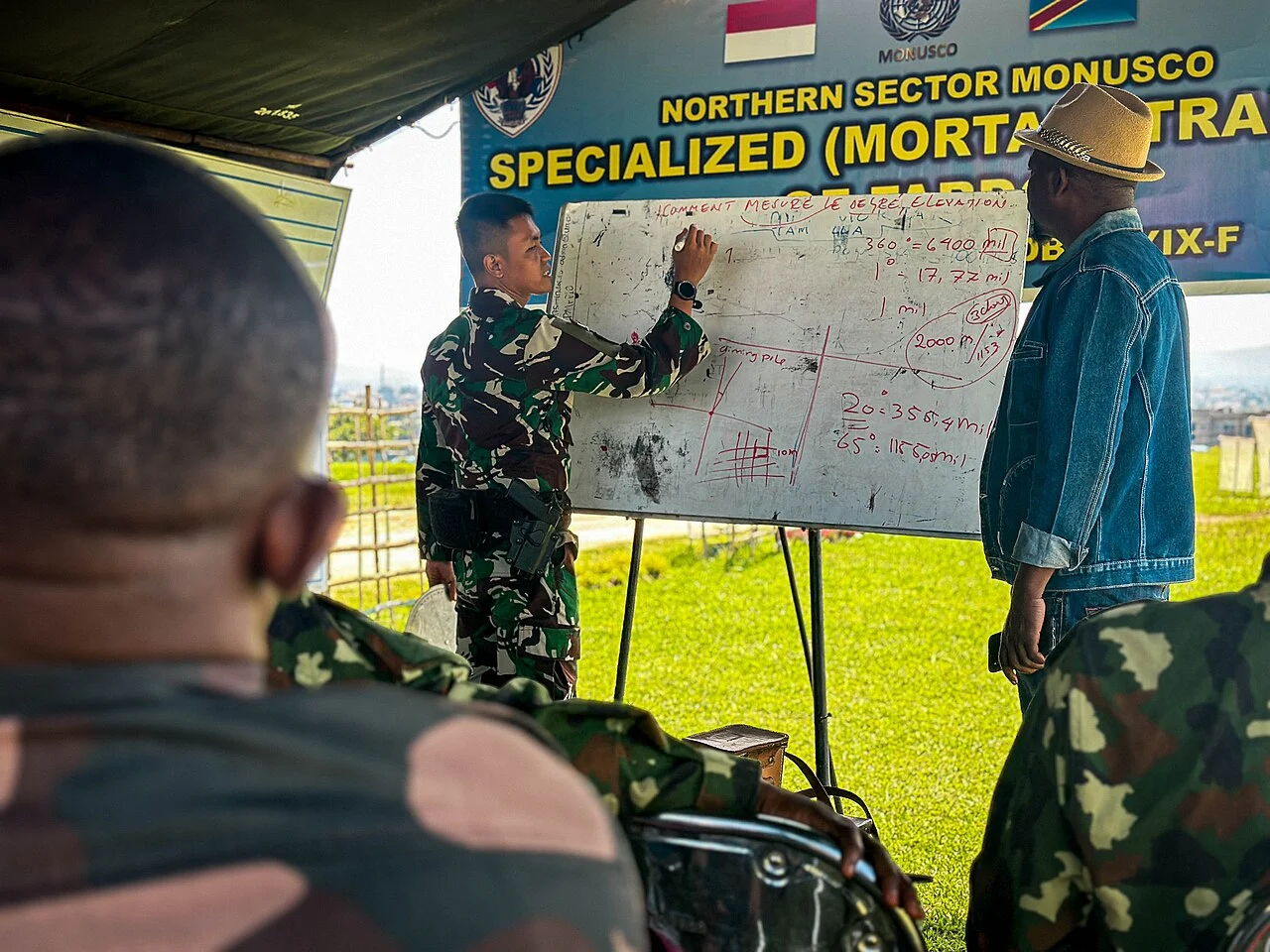
No source documents where or how FARDC personnel were trained to operate the CH-4, whether Chinese technicians or contractors are present in Congo, or what sustainment arrangement covers the fleet. This is a genuine gap in the public record, not an omission by this article. The only training detail found in reporting concerns a different programme: a MONUSCO-run course for 120 FARDC personnel in Ituri in September–October 2025 that covered drone operation alongside GPS and telecommunications skills, which is peacekeeping-mission training, not Chinese CH-4 type training, and should not be conflated with it.
Delivery and operational service
The CH-4s are based at Kavumu military airport in South Kivu, within range of the North and South Kivu conflict zone, and were reportedly flying combat missions from 2023. M23 and its allied AFC coalition have repeatedly claimed to have shot CH-4s down: in February 2024, in January 2025, and twice more in November 2025 at Masisi and Walungu. Kinshasa has not confirmed any of these losses, and FARDC strikes against M23 positions, including a reported February 2026 strike said to have killed a senior M23 commander in Masisi, have continued through the period covered by this article.
| Claim | Who made it | Grade |
|---|---|---|
| CH-4 shot down, 24 February 2024 | M23 spokesman Lawrence Kanyuka | Unverified battlefield claim; FARDC did not confirm |
| CH-4 shot down, January 2025, fleet down to eight of nine | M23/AFC, relayed by defence-news outlets | Unverified battlefield claim |
| Two further CH-4 downings, 10 and 15 November 2025 (Masisi, Walungu) | AFC/M23 | Unverified battlefield claim; one outlet reported wreckage photos |
| Senior M23 commander killed in a drone strike, Masisi, February 2026 | Reported via Critical Threats Project’s Congo War Security Review | Independent monitoring summary of local and wire reporting, not an FARDC statement; drone type not specified |
| Fatal strikes affecting Goma, including a UN worker’s death, March 2026 | AFC/M23 and wire reporting | Contested; attribution and drone model both disputed, and this article does not attribute a specific strike to the CH-4 |
Civilian harm from Congolese government air and drone strikes has been reported separately in the same conflict, including a widely covered May 2024 strike on a Lac Vert displacement camp near Goma that killed civilians according to local officials; Rwanda denied responsibility and blamed Congolese-aligned militia. No source reviewed for this article names the CH-4 specifically as the platform used in that incident, and this article does not make that attribution.
Industrial cooperation
None is documented. Unlike Myanmar, which holds a licence to assemble CH-4s domestically, DRC’s drones were imported complete, with no reported local assembly, maintenance-repair-overhaul facility or technology-transfer arrangement. Any claim that DRC manufactures, licenses or co-produces any part of the CH-4 goes beyond the available record.
Was it a good fit? Documented trade-offs
| Dimension | Evidence in favour | Trade-off or open question |
|---|---|---|
| Mission | A MALE armed drone suits the loitering ISR-and-strike role FARDC lacked against a dispersed insurgency | Nine airframes is a small fleet, and reported losses of four or more by late 2025 would leave a materially smaller number flyable if those claims are accurate |
| Environment | Based at Kavumu, within operational range of the Kivu conflict zone without forward basing in contested territory | Mountainous terrain and weather in the Kivus are not addressed in any source reviewed |
| Air defence threat | Designed for permissive or lightly contested airspace | UN reporting describes Rwandan-linked mobile surface-to-air systems deployed in the same conflict zone; M23’s repeated shootdown claims, even if unconfirmed, point to a more contested air environment than the type was likely intended for |
| Weapons | AR-1/AR-2 and AKD-10 missiles reportedly give a precision-strike option | No DRC confirmation of which weapons were actually delivered or used |
| Training and maintenance | Aircraft were operational within months of ordering | No public information on sustainment, spares or whether Chinese contractors support the fleet day to day |
| Political | A sale with no reported end-use conditions, concluded quickly against a Western-equivalent process | Opacity cuts both ways: the lack of public contract terms also means no external check on price, quality or performance guarantees |
How it compares with same-class alternatives
A specification comparison is limited by how little DRC has disclosed about its own fleet. What the record supports: the CH-4 and the Bayraktar TB2 occupy a broadly similar MALE drone category and were bought by DRC in the same year, making them complementary rather than competing acquisitions in Congolese service; the CH-4 is understood to carry a heavier weapons payload than the TB2, while the TB2 has a larger published combat record across other African conflicts (Mali, Burkina Faso, Ethiopia, Libya); and the Wing Loong II, DRC’s reported 2025 follow-on purchase, is generally described as a larger, more capable airframe than either, roughly comparable in class to the US MQ-1 Predator. Our inventory page, which African countries operate the CH-4, and comparison piece, TB2 vs Wing Loong II vs CH-4 in Africa, cover the continent-wide picture; this article does not repeat that content.
Africa-wide consequence
DRC’s purchase was not the first African CH-4 sale — Nigeria, Egypt, Algeria and Morocco had already imported Chinese drones under the CH or Wing Loong families before 2023 — but it is among the clearest cases of a sub-Saharan African state fielding an armed Chinese drone in an active, high-intensity conventional-plus-insurgent war rather than for counter-terrorism patrols. This site’s continental piece, why African countries buy Chinese UAVs, sets out the broader pattern of price and low conditionality driving Chinese drone exports across the continent; nothing in the sources reviewed for this article shows DRC’s specific decision shaped other states’ purchases, so that link should be read as shared context, not proven influence.
What happened next
DRC did not stop at nine CH-4s. By 2025 it was reportedly negotiating three Wing Loong II drones from China’s CATIC to offset claimed combat losses, a deal not confirmed as finalised in the sources available at the time of writing. The CH-4s and TB2s have continued flying strike missions into 2026 alongside the wind-down of the separate South African-led SAMIDRC deployment. No evidence in the available record shows DRC has sought a Western-made armed drone as an alternative.
FAQ
Why did DR Congo buy the CH-4 drone?
To get an armed, loitering strike and reconnaissance capability its air force lacked against the M23 rebellion, reportedly chosen for its lower price and fewer purchase conditions compared with Western armed drones.
How many CH-4 drones does DRC have?
Nine were ordered and delivered in 2023–2024. M23 has claimed at least four shootdowns by November 2025, which Kinshasa has not confirmed, so the current flyable number is not publicly settled.
How much did DRC pay for the CH-4 drones?
No contract value has been disclosed by DRC, China or CASC. Generic analyst estimates put the CH-4’s unit cost at $1–4 million, but no DRC-specific figure exists.
Did DRC choose the CH-4 over the Turkish Bayraktar TB2?
No evidence supports that framing. DRC acquired both the CH-4 and the TB2 in 2023, operating them as parallel, not competing, programmes.
Has China sold DRC other weapons?
DRC was separately reported in March 2023 to be discussing Chinese J-10C fighter jets, and DRC has reportedly sought three additional Wing Loong II drones from 2025; neither has been confirmed as a completed, priced contract in the sources reviewed.
Does DRC build or maintain the CH-4 locally?
No. No local assembly, maintenance or technology-transfer arrangement is documented, unlike Myanmar, which holds a CH-4 production licence.
Related reading
- SAMIDRC in the DRC: what combat against M23 showed about South African equipment (combat record)
- The Rooivalk’s DRC combat record (combat record)
- Which African countries operate the CH-4 (equipment inventory)
- TB2 vs Wing Loong II vs CH-4 in Africa (comparison)
- Why African countries buy Chinese UAVs (continental analysis)
- Military equipment database
Sources
- China Global South, DR Congo buys nine Chinese attack drones for use in war against M23 rebels (23 February 2023)
- Army Recognition, Congo armed forces receive nine Chinese CASC CH-4 Rainbow combat drones (4 July 2023)
- Army Recognition, China delivers three more CH-4 drones to support DR Congo against M23 rebels (citing Military Africa, May 2024)
- Military Africa, DRC receives CH-4 drones from China (2023)
- Military Africa, M23 rebels down DR Congo CH-4 drone (2024)
- Military Africa, DR Congo acquiring Wing Loong II drones (April 2025)
- Militaeraktuell, Chinese Wing Loong II drones for the DR Congo
- The Diplomat, China sends military drones to DRC amid fears of regional war (March 2023)
- Bloomberg, UN Group of Experts say Rwanda is backing rebels fighting Congo (4 August 2022)
- Reuters via The Star, UN experts say Rwanda exercises command and control over M23 rebels (2 July 2025)
- Critical Threats Project, Congo War Security Review (25 February 2026)
- Africanews, Drone attack targets DRC’s strategic Kisangani airport (2 March 2026)