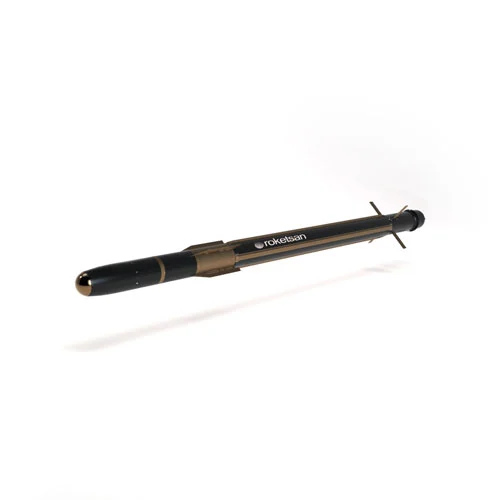
SUNGUR is ROKETSAN’s man-portable and vehicle-mounted short-range air defence missile, developed under a Turkish Presidency of Defence Industries (SSB) programme to replace the US-made FIM-92 Stinger in Turkish Armed Forces service. Guided by an imaging-infrared seeker in a lock-on-before-launch, fire-and-forget mode, SUNGUR has an official maximum range of 8 km and altitude of 4 km, and engages fixed-wing aircraft, helicopters and UAVs. It entered Turkish Land Forces Command service in July 2022, received a further delivery batch in February 2024, and in August 2024 Türkiye and Indonesia signed a strategic agreement under which ROKETSAN will supply Indonesia with SUNGUR alongside the ÇAKIR cruise missile and MAM-L smart micro munition — SUNGUR’s first publicly disclosed export interest.
Photo: ROKETSAN SUNGUR short-range air defence missile (MANPADS round), official product photo. Credit: ROKETSAN.
| Manufacturer | ROKETSAN (developer and prime manufacturer), under a Turkish Presidency of Defence Industries (SSB) programme |
| Type | Short-range air defence missile; man-portable (MANPADS) and vehicle-mounted configurations |
| Range | 500 m – 8 km (ROKETSAN official specification) |
| Altitude | Up to 4 km (sea level) |
| Warhead | High-explosive, semi-armour-piercing, programmable impact fuze |
| Guidance | Imaging infrared (IIR) seeker, lock-on before launch, fire-and-forget |
| Targets | Fixed-wing aircraft, rotary-wing/unmanned rotary-wing aircraft, UAVs |
| Status | Operational (Turkish Land Forces Command, since July 2022); selected by Indonesia under an August 2024 strategic agreement, not yet a confirmed unit contract |
| Confirmed users | Türkiye (operational); Indonesia (selected/agreed, not yet delivered) |
What is the SUNGUR missile?
SUNGUR is ROKETSAN’s short-range air defence missile, developed to give Turkish ground forces an organic, short-range counter to fixed-wing aircraft, helicopters and unmanned aerial vehicles. ROKETSAN’s official product description states the system was “developed for the short-range air defence of moving/stationary troops and facilities located in the battlefield and its surroundings” (ROKETSAN, official product page, accessed 4 October 2026). The programme began in 2013 as the Turkish Ministry of National Defence’s “Portable Air Defence Missile System” project, awarded to ROKETSAN with the specific goal of replacing the Turkish Armed Forces’ ageing US-made FIM-92B/C Stinger MANPADS (Army Recognition, 24 July 2022, citing then-SSB President İsmail Demir). SUNGUR is fielded in both a shoulder-fired, single-soldier MANPADS configuration and a vehicle-mounted configuration, and SSB has described it as a fourth-generation MANPADS.
Who manufactures SUNGUR — ROKETSAN’s role versus ASELSAN and SSB
SUNGUR was developed and is manufactured by ROKETSAN as prime contractor under an SSB-sponsored programme, distinct from the way responsibility is split on Türkiye’s longer-range, radar-cued air defence systems. On the HİSAR and SİPER families that form Türkiye’s layered “Steel Dome” (Çelik Kubbe) air defence architecture, ASELSAN supplies the radars, command-and-control and launchers while ROKETSAN builds the missile itself. SUNGUR does not follow that same split in public reporting: ROKETSAN is credited as the developer of the missile, seeker, warhead and launch system, and DefenceMENA has not found public sourcing attributing a specific SUNGUR subsystem to ASELSAN or another Turkish supplier. Readers researching Türkiye’s wider ASELSAN-built air defence portfolio — KORKUT, GÖKDENİZ, HİSAR, SİPER and İHTAR — can see the fuller company-by-company breakdown on DefenceMENA’s ASELSAN air defence and counter-drone systems page.
Development and delivery timeline
| Date | Milestone |
|---|---|
| 2013 | Turkish Ministry of National Defence launches the “Portable Air Defence Missile System” project with ROKETSAN, intended to replace FIM-92 Stinger |
| 2H 2021 | First batch of the vehicle-mounted SUNGUR variant delivered |
| 24 July 2022 | SSB announces SUNGUR has entered Turkish Armed Forces service; then-SSB President İsmail Demir states it is “at the service of the Turkish military” in both shoulder-launched and platform-mounted form |
| February 2024 | A further SUNGUR delivery to the Land Forces Command is announced, with inspection and acceptance procedures completed |
| 27 August 2024 | Türkiye and Indonesia sign strategic defence agreements in Jakarta under which ROKETSAN will supply Indonesia with SUNGUR, the ÇAKIR cruise missile and the MAM-L smart micro munition |
| 2025 | SUNGUR displayed at LandEuro 2025, reported by Army Recognition as marking Türkiye’s entry into the international short-range air defence (SHORAD) export market |
Sources: Army Recognition, 24 July 2022; Defence Turkey, March 2024; Army Recognition, 27 August 2024; Army Recognition, 2025 (LandEuro).
What is SUNGUR’s current status?
SUNGUR is operational with the Turkish Land Forces Command, which has received at least two confirmed delivery batches — an initial MANPADS/vehicle-mounted batch in 2021–2022, and a further batch announced in February 2024 — and uses the system as its standard short-range, man-portable air defence missile, intended to replace the FIM-92 Stinger. Beyond Türkiye, the only publicly confirmed interest comes from Indonesia, where an August 2024 government-to-government strategic agreement named SUNGUR, alongside ÇAKIR and MAM-L, as a system ROKETSAN will supply. Public reporting on that agreement does not disclose quantities, a contract value, or a delivery schedule, so DefenceMENA records Indonesia’s status as SELECTED rather than CONTRACTED or DELIVERED. No African or Middle Eastern country has a publicly confirmed SUNGUR order, contract or delivery as of 4 October 2026.
Range, guidance and warhead — what ROKETSAN discloses publicly
ROKETSAN’s official specification gives SUNGUR a range band of 500 m to 8 km and an altitude capability of up to 4 km at sea level, which the manufacturer describes as the longest range in its MANPADS class. Guidance is via an imaging infrared (IIR) seeker: the operator achieves lock-on before launch, after which the missile is fully fire-and-forget, with ROKETSAN citing resistance to countermeasures through automatic target tracking and a wide ±40° visual target-acquisition angle. The warhead is high-explosive, semi-armour-piercing, initiated by a programmable impact fuze, and propulsion is a two-stage solid-propellant rocket motor. Separately, a 2022 Army Recognition report citing SSB officials described SUNGUR as capable of 2.2+ Mach speed and fitted with an IFF (identification friend-or-foe) capability; these figures were not repeated on ROKETSAN’s current official product page, so DefenceMENA attributes them specifically to the 2022 SSB statement rather than treating them as a standing manufacturer specification. ROKETSAN’s materials also state SUNGUR can integrate with Türkiye’s HERİKKS-6 air-defence early-warning command-and-control network, without disclosing further integration detail.
Launch platforms and configurations
SUNGUR is fielded in a shoulder-fired, single-soldier MANPADS configuration and in vehicle-mounted configurations; Turkish defence-industry reporting describes a four-missile launcher integrated on BMC’s Vuran 4×4 vehicle alongside an electro-optical/infrared sighting system, though DefenceMENA has not independently verified the sensor supplier for that vehicle fit. ROKETSAN’s official product page additionally states that SUNGUR is designed for integration with “land and naval platforms and unmanned aerial vehicles,” but DefenceMENA has not found public reporting of a fielded naval- or UAV-launched SUNGUR configuration, and this article does not treat that broader platform list as evidence of operational deployment beyond the man-portable and land-vehicle forms described above.
Who operates the SUNGUR missile?
| Country | Status | Quantity | Contract value | Year | Source |
|---|---|---|---|---|---|
| Türkiye | OPERATIONAL | Not publicly disclosed | Not publicly disclosed | First batch 2021–2022; further batch Feb 2024 | Army Recognition, 24 Jul 2022; Defence Turkey, Mar 2024 |
| Indonesia | SELECTED (government-to-government strategic agreement; not a confirmed unit contract) | Not disclosed | Not disclosed | Agreement signed 27 Aug 2024 | Army Recognition, 27 Aug 2024; Overt Defense, 30 Aug 2024 |
No other country has publicly confirmed SUNGUR operator, order or contract status as of this writing. DefenceMENA will update this table, and this page’s status labels, if Indonesia’s agreement converts into a disclosed contract, or if another country is confirmed as a customer.
Are there confirmed African or Middle Eastern SUNGUR users?
No. As of 4 October 2026, DefenceMENA has found no public evidence of an African or Middle Eastern country ordering, contracting for, or operating SUNGUR. This is consistent with DefenceMENA’s broader finding, on its ASELSAN air defence coverage, that as of September 2026 no African or Arab state had been officially named as a buyer of any element of Türkiye’s Steel Dome-linked missile systems (HİSAR, SİPER, KORKUT). SUNGUR’s only publicly disclosed export interest to date, Indonesia, sits outside both regions. This page will be cross-linked from DefenceMENA’s planned “ROKETSAN in Africa” and “ROKETSAN in the Middle East” hub pages once any African or Middle Eastern SUNGUR evidence becomes public.
What has SUNGUR cost, and what do agreements include?
No public source discloses a SUNGUR unit price, a Turkish Armed Forces procurement value, or a value for the August 2024 Indonesia agreement. The Indonesia agreement is reported as covering three separate ROKETSAN systems — SUNGUR, ÇAKIR and MAM-L — together with separate memoranda of understanding on unmanned surface vehicles, tank modernisation and missile-system maintenance, but public reporting does not itemise cost or scope by system. This article does not estimate a price for SUNGUR missiles, launchers or any package.
How does SUNGUR compare with other short-range MANPADS?
The systems below are compared on the same basis: shoulder-fired, infrared-guided, short-range man-portable air defence missiles. Figures are each manufacturer’s or government’s own published or reported data, not independently tested like-for-like results.
| Missile | Origin / maker | Public range | Guidance | Status |
|---|---|---|---|---|
| SUNGUR | Türkiye / ROKETSAN | 500 m – 8 km (official) | Imaging infrared, lock-on before launch, fire-and-forget | Operational (Türkiye, 2022); selected by Indonesia (2024, not yet delivered) |
| FIM-92 Stinger | United States / Raytheon | Reported up to ~4.8 km | Infrared/ultraviolet seeker, fire-and-forget | Operational with dozens of countries; the system SUNGUR is intended to replace in Turkish service |
| 9K338 Igla-S | Russia / KBM | Reported up to ~6 km | Infrared seeker with counter-countermeasure logic, fire-and-forget | Operational, widely exported |
| Mistral 3 | France / MBDA | Reported up to ~6–7 km | Imaging infrared seeker, fire-and-forget | Operational, widely exported; also fielded on land, naval and helicopter mounts |
On ROKETSAN’s own published figure, SUNGUR’s stated 8 km maximum range is longer than the publicly reported figures for Stinger, Igla-S and Mistral 3; a full side-by-side comparison including cost, combat record and export history is planned as a separate DefenceMENA article once more operator evidence is public.
Related ROKETSAN systems
SUNGUR covers ROKETSAN’s short-range, infrared-guided air defence role. For the company’s man-portable anti-tank missile, see KARAOK Anti-Tank Missile Explained; for its drone-launched precision munitions, see MAM-L, MAM-C and MAM-T Explained; for its naval anti-ship missile, see ATMACA Anti-Ship Missile Explained; and for ROKETSAN’s full product range, see the ROKETSAN company hub. For ASELSAN’s longer-range, radar-cued HİSAR and SİPER missiles that sit above SUNGUR in Türkiye’s layered air defence architecture, see ASELSAN Air Defence and Counter-Drone Systems.
Frequently asked questions
What is the range of the SUNGUR missile?
ROKETSAN’s official specification gives a range band of 500 m to 8 km, with an altitude capability of up to 4 km at sea level. The manufacturer describes this as the longest range in its MANPADS class.
Which countries use the SUNGUR missile?
Türkiye operates SUNGUR with its Land Forces Command, in service since July 2022. Indonesia is the only other country publicly linked to SUNGUR, under an August 2024 strategic agreement; this has not yet been confirmed as a priced contract or delivery.
Is SUNGUR a replacement for the Stinger missile?
Yes. ROKETSAN developed SUNGUR under a 2013 Turkish Ministry of National Defence programme specifically intended to replace the US-made FIM-92B/C Stinger MANPADS in Turkish Armed Forces service.
Does SUNGUR come in a vehicle-mounted version?
Yes. In addition to the shoulder-fired MANPADS configuration, Turkish industry reporting describes a vehicle-mounted configuration, including a four-missile launcher integrated on BMC’s Vuran 4×4 vehicle. ROKETSAN’s own materials also describe land, naval and UAV platform integration at a general level, without confirming a fielded naval or UAV-launched configuration.
Has Indonesia ordered SUNGUR?
Not yet as a confirmed, priced contract. In August 2024, Türkiye and Indonesia signed a strategic agreement under which ROKETSAN will supply SUNGUR, ÇAKIR and MAM-L, but public reporting does not disclose quantities, value or a delivery date.
Who makes SUNGUR — ROKETSAN or ASELSAN?
ROKETSAN is the developer and prime manufacturer of SUNGUR. Unlike Türkiye’s longer-range HİSAR and SİPER air defence missiles, where ASELSAN supplies radars, command-and-control and launchers, DefenceMENA has not found public sourcing attributing a specific SUNGUR subsystem to ASELSAN.
Sources
- ROKETSAN: SUNGUR Air Defence Missile System, official product page (accessed 4 October 2026)
- Army Recognition: “Sungur MANPADS air defense missile system enters service in Turkish Armed Forces” (24 July 2022)
- Defence Turkey: “Sungur Air Defence Missile Delivery to the Turkish Land Forces Command” (March 2024)
- Army Recognition: “Turkey and Indonesia strengthen defense ties with strategic agreements on defense systems and missiles” (27 August 2024)
- Overt Defense: “Turkey and Indonesia Deepen Defense Ties with Strategic Agreements in Jakarta” (30 August 2024)
- Army Recognition: “Roketsan’s Sungur MANPADS displayed at LandEuro 2025 signals Türkiye’s entry into global SHORAD market” (2025)
- Envanter Medya: “VURAN Nedir? BMC’nin Yerli Motorlu Zırhlı Aracı” — Turkish-language background on the Vuran 4×4 vehicle used for SUNGUR’s vehicle-mounted configuration
- ROKETSAN: official website (accessed 4 October 2026)