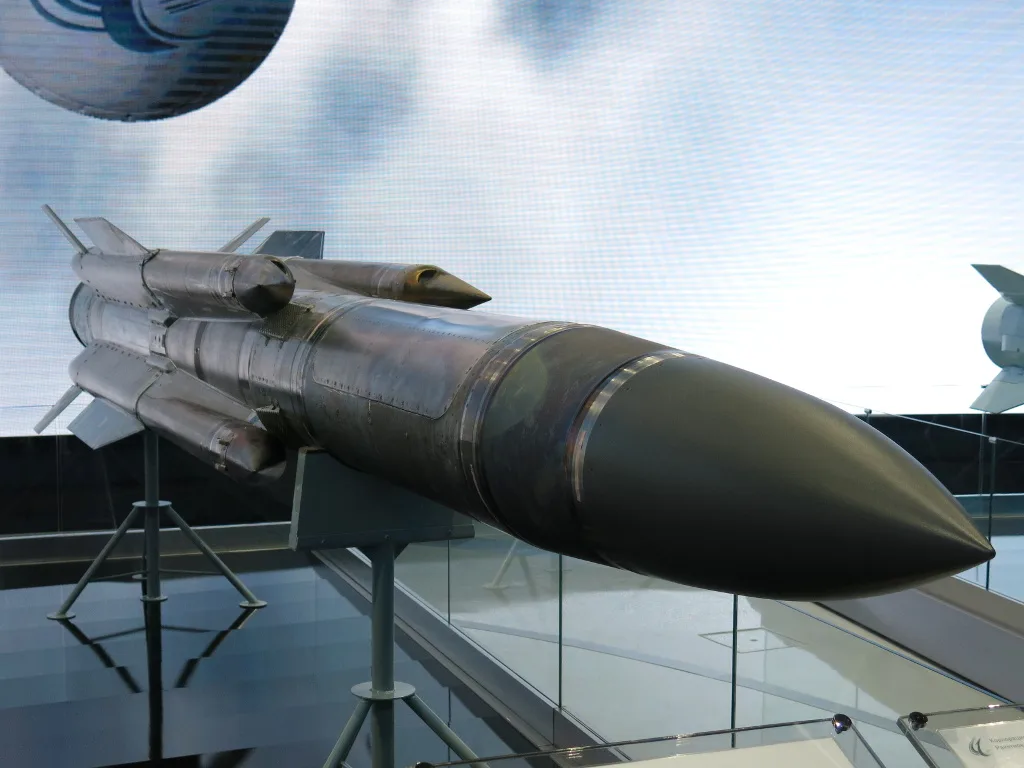
No African country has a confirmed hypersonic weapon, meaning a hypersonic glide vehicle or a hypersonic cruise missile. Several African armed forces do operate supersonic missiles. Algeria has the Kh-31 anti-ship missile for its Su-30MKA fighters, Uganda has the Kh-31P anti-radiation version, and Egypt has the P-270 Moskit ship-launched anti-ship missile, according to the SIPRI Arms Transfers Database. SIPRI also records the Russian Iskander system for an uncertain recipient that it names as Algeria. Iskander is a ballistic missile system, not a hypersonic glide weapon.
Photo: Kh-31 supersonic air-launched missile on display at Army-2018. Credit: Boevaya mashina, CC BY-SA 4.0, via Wikimedia Commons.
Supersonic and hypersonic: the definitions
- Subsonic: slower than the speed of sound (below Mach 1). Most anti-ship and land-attack cruise missiles in Africa, such as Exocet, Harpoon, Kh-35 and C-802, are subsonic.
- Supersonic: faster than sound, roughly Mach 1 to Mach 5. Supersonic missiles cut an opponent’s reaction time.
- Hypersonic: Mach 5 or faster. In current usage, a “hypersonic weapon” means one of two things. The first is a hypersonic glide vehicle, boosted by a rocket and then gliding and manoeuvring in the upper atmosphere. The second is a hypersonic cruise missile, powered by an air-breathing scramjet throughout flight.
Speed alone does not make a weapon “hypersonic” in this sense. Almost every ballistic missile with a range of a few hundred kilometres travels above Mach 5 on its way down, including the Scud missiles still held in parts of Africa. What sets hypersonic weapons apart is that they can sustain manoeuvring flight at those speeds. This is how the US Congressional Research Service distinguishes the categories.
Quick answer, verified 3 November 2026
- Hypersonic glide or cruise weapons in Africa: none confirmed
- Supersonic anti-ship (air-launched): Algeria, Kh-31 (125 delivered 2007–09)
- Supersonic anti-radar (air-launched): Uganda, Kh-31P (25 delivered 2011–12)
- Supersonic anti-ship (ship-launched): Egypt, P-270 Moskit (10, 2015–16)
- Quasi-ballistic Iskander: recipient uncertain; SIPRI names Algeria, deliveries in 2017
| Country | Missile | Role | Launch platform | Delivered | Confidence |
|---|---|---|---|---|---|
| Algeria | Kh-31 (SIPRI: Kh-31M) | Anti-ship | Su-30MKA | 2007–2009 (125) | High (SIPRI) |
| Uganda | Kh-31P | Anti-radiation | Su-30 | 2011–2012 (25) | High (SIPRI) |
| Egypt | P-270 Moskit | Anti-ship | Project-12421 (Tarantul) fast attack craft | 2015–2016 (10, second-hand) | High (SIPRI) |
| Algeria | 9M723 Iskander | Surface-to-surface (quasi-ballistic) | 9P78 launcher | 2017 (SIPRI: 75 missiles, 12 launchers) | Medium: SIPRI flags the recipient as uncertain |
Algeria: the Kh-31 on the Su-30MKA
SIPRI records 125 Kh-31 anti-ship missiles ordered in 2006 for Algeria’s Su-30MK fighters, delivered in 2007–09, with Kh-59 air-to-surface missiles in the same package. The Kh-31 is a ramjet-powered missile. It gives Algeria a fast air-launched option against ships in the western Mediterranean. Fleet background: Algeria’s Su-30MKA fleet and Algeria’s missile forces explained.
Uganda: Kh-31P anti-radiation missiles
Uganda’s purchase is less well known. SIPRI lists 25 Kh-31A1/Kh-31P missiles for its Su-30 fleet, delivered in 2011–12. The Kh-31P version homes on enemy radar emissions. See why Uganda bought the Su-30.
Egypt: P-270 Moskit
SIPRI records ten second-hand P-270 Moskit supersonic anti-ship missiles supplied by Russia as aid in 2015–16, for a Project-12421 (Tarantul) fast attack craft. Egypt’s main anti-ship missiles are subsonic: Harpoon, Exocet, and the older Otomat and P-15. See our Egypt vs Algeria comparison.
Iskander: fast, but not a hypersonic glide weapon
SIPRI records 12 9P78 Iskander launchers and 75 9M723 missiles delivered in 2017. It marks the recipient as uncertain, “reported as ‘state in Middle East or North Africa'”, and lists it under Algeria. The 9M723 is a short-range ballistic missile that flies a flattened, manoeuvring trajectory, and it exceeds Mach 5 in parts of its flight. It is not a hypersonic glide vehicle or scramjet cruise missile, so it does not change the answer above.
Is anyone in Africa developing hypersonic weapons?
No African government has announced a hypersonic weapon programme. Hypersonic glide vehicles and scramjet missiles have been fielded or tested mainly by Russia, China and the United States. Building these weapons requires advanced propulsion, heat-resistant materials and long-range test ranges, which are currently beyond Africa’s defence industries.
Frequently asked questions
Does Egypt have hypersonic missiles?
No hypersonic weapon delivery to Egypt is documented. Its fastest documented missiles are the supersonic P-270 Moskit and ballistic missiles of the Scud family.
Does Algeria have hypersonic missiles?
Not confirmed. Algeria has the supersonic Kh-31, and SIPRI attributes a 2017 Iskander delivery to it with an uncertainty flag. Iskander is a quasi-ballistic missile, not a hypersonic glide weapon.
What is the difference between supersonic and hypersonic?
Supersonic means faster than sound, from Mach 1 up to about Mach 5. Hypersonic means Mach 5 or faster, and in weapons it usually refers to manoeuvring glide vehicles or scramjet cruise missiles.
Sources
- SIPRI Arms Transfers Database – Kh-31, P-270 Moskit and Iskander entries for African recipients (accessed 3 November 2026)
- US Congressional Research Service – Hypersonic Weapons: Background and Issues for Congress (R45811)
- CSIS Missile Threat – 9K720 Iskander (SS-26)
Method: deliveries are SIPRI records and do not show current stock levels. Speed classes follow CRS definitions. No performance or targeting detail is given beyond the public category level.
Last verified: 3 November 2026