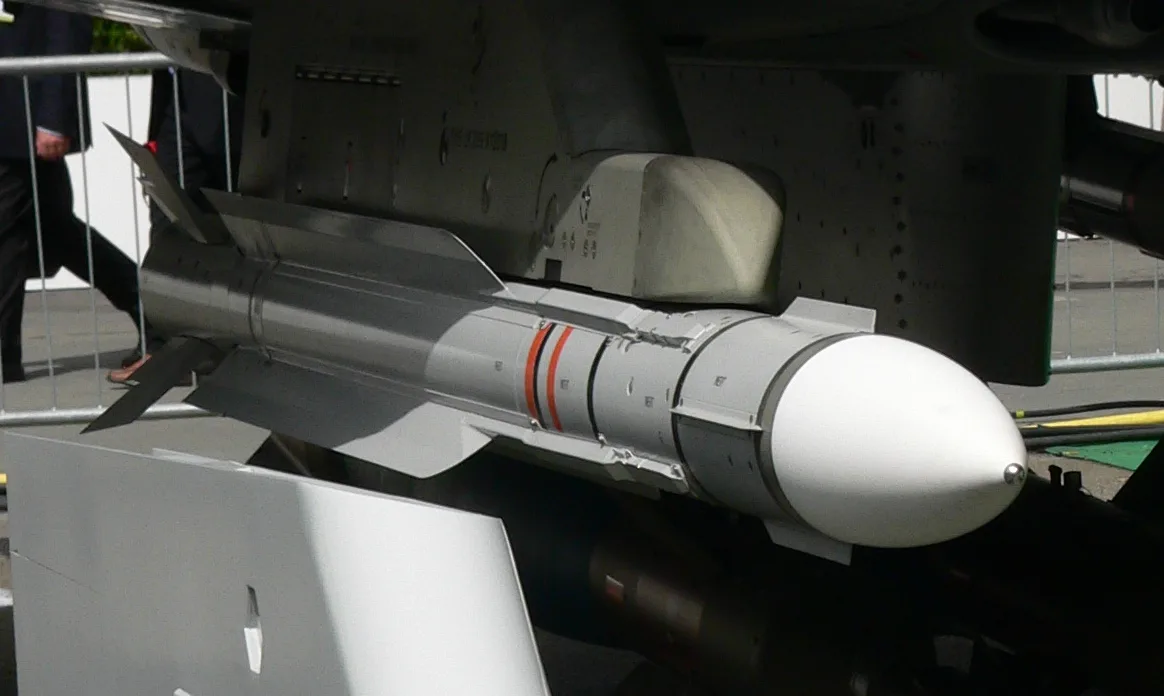
Three African air forces have documented deliveries of active-radar, beyond-visual-range (BVR) air-to-air missiles for their fighters: Egypt (MICA for Rafale, R-77 for MiG-29M2), Algeria (R-77 for Su-30MKA) and Morocco (AIM-120C-7 AMRAAM for F-16, MICA for Mirage F1). Algeria, Ethiopia, Eritrea and Chad have older semi-active radar R-27 missiles. Most other African fighter fleets rely on short-range infrared missiles such as the R-73, PL-5, PL-9 and IRIS-T. South Africa’s own A-Darter entered production in 2025.
Photo: MICA EM active-radar air-to-air missile on display. Credit: David Monniaux, CC BY-SA 3.0, via Wikimedia Commons.
Within visual range vs beyond visual range
An air-to-air missile is launched from an aircraft to destroy another aircraft. They fall into two broad groups:
- Within visual range (WVR): short-range missiles, almost always infrared-guided, used in a dogfight at distances where the pilot could in principle see the target.
- Beyond visual range (BVR): longer-range missiles guided by radar, fired at targets detected on the fighter’s own radar or a data link, well before visual contact.
How the missile finds its target: guidance and seekers
The seeker (homing head) in the missile’s nose decides how it is guided:
- Semi-active radar homing: the launching fighter keeps its radar on the target, and the missile homes on the reflected energy. Examples include the AIM-7 Sparrow and R-27R. The fighter has to keep the target illuminated until impact.
- Active radar homing: the missile carries its own small radar and switches it on for the final phase, so the pilot can turn away after launch. Examples include the AIM-120 AMRAAM, R-77 and MICA EM. See our explainer on the active radar seeker.
- Passive radar homing: homes on the target’s own radar emissions. This is used mainly by anti-radiation missiles rather than air-to-air missiles.
- Infrared and imaging infrared: homes on heat. Modern imaging-infrared seekers form a heat picture of the target, which makes them harder to decoy with flares. Examples include the AIM-9X, IRIS-T, A-Darter and MICA IR. See the infrared seeker explainer.
Infrared missiles are often described in generations. First-generation missiles could only lock onto the hot exhaust from behind. Second-generation missiles had cooled seekers with better sensitivity. Third-generation missiles could engage from all aspects, including head-on. Fourth-generation missiles added high off-boresight aiming with helmet sights and agile airframes, such as the R-73. Fifth-generation missiles use imaging-infrared seekers, such as the AIM-9X, IRIS-T and A-Darter. The labels are a general convention, and manufacturers do not always use them the same way.
Quick answer, verified 3 November 2026 (SIPRI deliveries)
- Active-radar BVR on fighters: Egypt, Algeria, Morocco
- Semi-active radar R-27: Algeria, Ethiopia, Eritrea, Chad
- Imaging-infrared short range: Morocco (AIM-9X), South Africa (IRIS-T, A-Darter)
- Older infrared short range: Nigeria (PL-9), Uganda (R-73), Zambia (PL-5E), Sudan (PL-8/Python-3)
| Country | Missile | Guidance | Aircraft | Delivered |
|---|---|---|---|---|
| Egypt | MICA | Active radar / IR (BVR) | Rafale | 2015–2019; further order delivered 2025 |
| Egypt | R-77, R-73 | Active radar (BVR); IR | MiG-29M2 | 2017–2020 |
| Egypt | AIM-7M, AIM-9M, AIM-9L/I | Semi-active radar; IR | F-16 | 1996–2021 |
| Algeria | R-77, R-73 | Active radar (BVR); IR | Su-30MKA | 2008–2009 |
| Algeria | R-27R/T, R-73 | Semi-active radar / IR | MiG-29, Su-30, MiG-29M | 1999–2024 |
| Morocco | AIM-120C-7 AMRAAM, AIM-9X Block II | Active radar (BVR); imaging IR | F-16 | 2014–2021 |
| Morocco | MICA, Magic-2 | Active radar / IR; IR | Mirage F1 (MF2000) | 2010–2012 |
| South Africa | IRIS-T; A-Darter (local) | Imaging IR | Gripen | 2009; A-Darter production 2025 |
| Ethiopia | R-27R/T, R-73 | Semi-active radar / IR | Su-27 | 1998–1999 |
| Eritrea | R-27R/T, R-73 | Semi-active radar / IR | MiG-29 | 1998, 2002 |
| Chad | R-27R/T | Semi-active radar / IR | MiG-29 | 2014 |
| Uganda | R-73 | IR | Su-30 | 2011–2012 |
| Nigeria | PL-9C | IR | F-7NI | 2010 |
| Sudan | Python-3 (PL-8) | IR | FTC-2000 | 2017–2018 |
| Zambia | PL-5E | IR | Not specified by SIPRI | 2016–2017 |
Not listed: missiles bought only for ground-based air defence. These include MICA for VL-MICA in Morocco and Botswana, IRIS-T for IRIS-T SLS in Egypt, Python-5 and Derby for SPYDER in Kenya, and TY-90 in Mauritania and Rwanda. Those are covered in our medium-range air defence guide.
Egypt: two BVR families
Egypt runs both Western and Russian fighter weapon chains. SIPRI records 150 MICA missiles for the first Rafale batch delivered from 2015 and 200 more for the second batch delivered in 2025. It also records 300 R-77 and 400 R-73 missiles for the MiG-29M2 fleet delivered from 2017 to 2020. Egypt’s F-16s carry US AIM-7M and AIM-9 variants. SIPRI does not list AIM-120 AMRAAM deliveries to Egypt. Background: Egypt’s Rafale fleet.
Algeria: R-77 on the Su-30MKA
SIPRI records 250 R-77 and 250 R-73 missiles ordered in 2006 for the Su-30MKA and delivered in 2008–09. R-27 and R-73 deliveries continued through 2024 for the MiG-29M. See Algeria’s Su-30MKA fleet.
Morocco: AMRAAM and AIM-9X on the F-16
Morocco is the only African country with documented AIM-120C-7 AMRAAM and AIM-9X Block II deliveries. SIPRI records 30 AMRAAMs delivered in 2015–16, four more in 2021, and 56 AIM-9X across two orders. Its upgraded Mirage F1s received MICA in 2010–12. See Morocco’s F-16 fleet.
South Africa: IRIS-T and the home-grown A-Darter
South Africa bought 25 IRIS-T missiles in 2008 as an interim weapon for its Gripens. Its own imaging-infrared A-Darter, developed by Denel Dynamics, was certified in 2019. The South African Air Force reported that Denel would deliver the first production missiles in July 2025. See how many Gripens South Africa has.
What the rest of Africa flies with
Most other African fighter and armed-trainer fleets carry short-range infrared missiles or none at all. For aircraft numbers by country, see fighter aircraft in African air forces. Claims that drones have used air-to-air missiles in Sudan are discussed separately in Sudan AKINCI and CH-95 air-to-air claims.
Frequently asked questions
Does Egypt have AMRAAM missiles?
SIPRI records no AIM-120 AMRAAM deliveries to Egypt. Its active-radar BVR missiles are the French MICA (Rafale) and the Russian R-77 (MiG-29M2).
Which African country has the best air-to-air missiles?
Egypt, Algeria and Morocco have the most capable documented stocks. All three have active-radar BVR missiles, and Morocco also has the imaging-infrared AIM-9X.
Does Nigeria have BVR missiles?
SIPRI lists no BVR air-to-air missile deliveries to Nigeria. The only documented air-to-air weapon is the short-range PL-9C for the F-7NI, delivered in 2010.
What is the difference between active and semi-active radar guidance?
An active radar missile carries its own radar for the final approach. A semi-active missile needs the launching aircraft’s radar to keep lighting up the target.
Sources
- SIPRI Arms Transfers Database – air-to-air missile entries for African recipients, 1995–2025 (accessed 3 November 2026)
- South African Air Force (saairforce.co.za) – Denel to deliver first production A-Darter missiles
- Engineering News, October 2019 – Denel missile completes development and is certified
- Janes – A-Darter AAM formally qualified
Method: missile deliveries are SIPRI records of transfers and do not show current stock levels. Missiles may have been fired in training, expired or been replaced. Guidance descriptions are general, and the article gives no performance or countermeasure detail.
Last verified: 3 November 2026