EU and South Africa Hold First Peace, Security and Defence Dialogue in Pretoria



The European Union and South Africa held their first Peace, Security and Defence Dialogue in Pretoria this month, a new annual forum meant to align the two sides on maritime piracy, the Mozambique Channel, the Great Lakes and the Horn of Africa.
The talks, confirmed by the European External Action Service (EEAS) and first reported locally by defenceWeb, were co-chaired by Cosmin Dobran, the EEAS’s acting Managing Director for Peace, Security and Defence, and Xolisa Mabhongo, Deputy Director-General at South Africa’s Department of International Relations and Cooperation (DIRCO). The dialogue traces back to the eighth EU-South Africa Summit in Cape Town in March 2025, where both sides agreed to set up a dedicated annual channel for security cooperation.
What was discussed
According to defenceWeb, the agenda ranged well beyond South Africa’s own borders. Dobran raised piracy and criminality along the east coast of Africa, tied to growing shipping traffic diverted around the Cape of Good Hope as vessels avoid the Red Sea. He also pressed South Africa on maritime security in the Mozambique Channel and asked whether an expanded SADC role alongside the EU’s Operation Atalanta off Somalia “made sense.”
Dobran would not say whether the EU plans to send more assets under Atalanta, nor whether South African Navy patrols under Operation Copper — Pretoria’s long-running but intermittently resourced anti-piracy deployment in the Mozambique Channel — would increase. The two sides also covered the Great Lakes region, the Horn of Africa, Gaza and Ukraine, along with counter-terrorism, cybersecurity, hybrid threats, space security and transnational organised crime.
“We want to work with like-minded countries and representative bodies in the best interests of all for peace and security,” Dobran said, according to defenceWeb.
A navy stretched thin
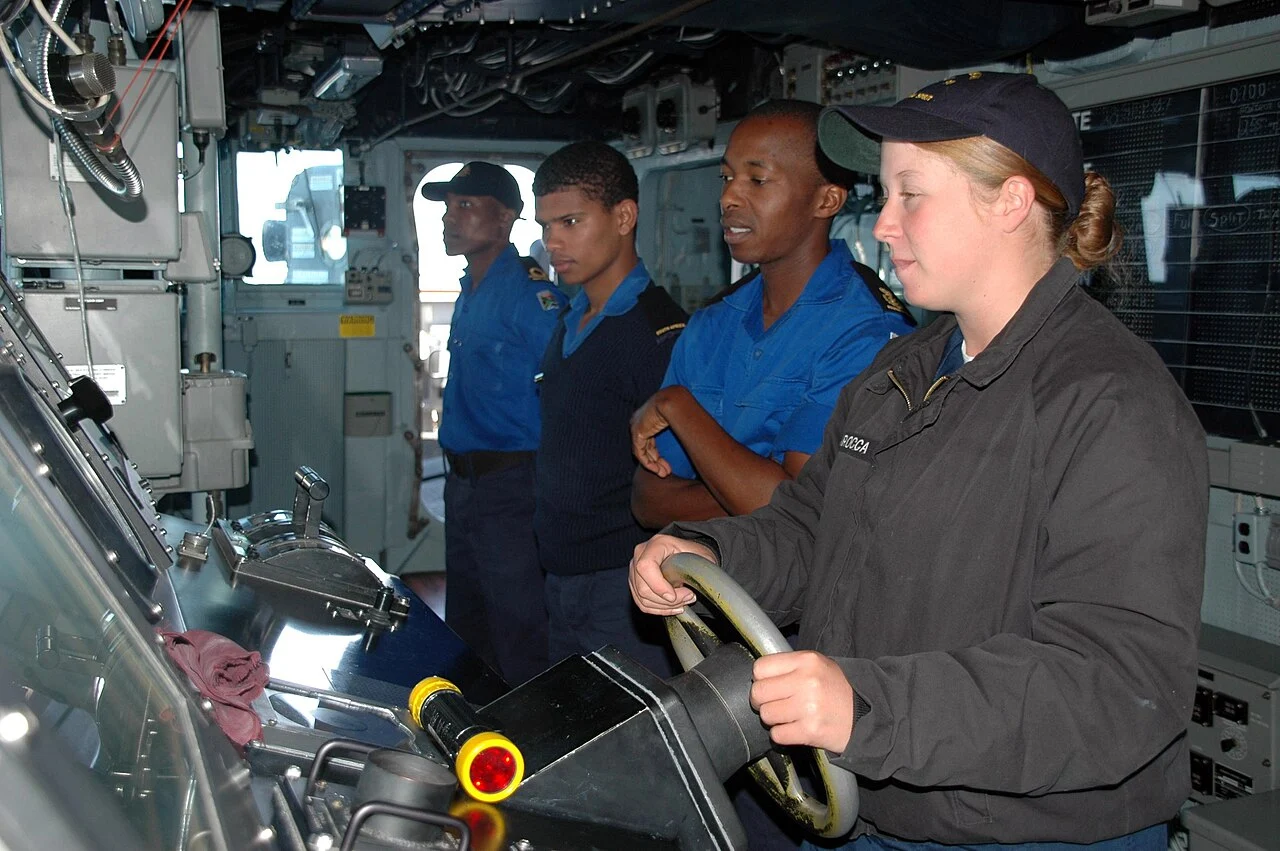
The timing matters for South Africa’s own capacity. The SA Navy has struggled to keep its Valour-class frigates and offshore patrol vessels consistently at sea, and DefenceMENA has previously reported on how budget and maintenance pressure have hollowed out the SANDF’s ability to sustain deployments it is nominally committed to. Operation Copper, which grew out of the 2010 hijacking of the Mozambican trawler Vega 5, has had no vessel on continuous station in the Mozambique Channel since 2022, according to open-source reporting, even as Mozambique’s own forces remain stretched by the Cabo Delgado insurgency that DefenceMENA covered in October.
That leaves the EU weighing whether its own Operation Atalanta — built originally to counter Somali piracy and now also active against Houthi threats to Red Sea shipping — should extend further south toward the Mozambique Channel, where piracy risk has resurfaced as a regional concern this year. The EU separately runs a military assistance mission in Mozambique that trains the country’s quick-reaction forces, plus the Irini mission enforcing the Libya arms embargo and the Aspides mission protecting Red Sea shipping.
No new money, no new mandate — yet
Unlike a procurement announcement or a signed security pact, this dialogue produced no budget figures, hull numbers or firm commitments. Both sides instead agreed to closer institutional exchanges on threat analysis and information sharing, and to treat the Pretoria meeting as the first of a recurring annual forum. The low-key outcome reflects where the relationship currently sits: South Africa wants EU backing for SADC’s security role without ceding the lead in its own waters, while Brussels is testing how far it can extend a Red Sea-focused naval posture southward without a mandate or hulls to match.
Why it matters for Africa
For Southern Africa, the dialogue is a signal rather than a deliverable. If it eventually produces EU support for SADC maritime patrols, or a revived mandate and budget for Operation Copper, it would mark a rare reversal of the decline in anti-piracy coverage of the Mozambique Channel — a route that matters disproportionately to Mozambique, Tanzania, Madagascar and South Africa’s own east-coast trade. The dialogue also gives South Africa a forum to push EU attention toward the Great Lakes and the Horn of Africa, regions where Pretoria has diplomatic weight but limited capacity to project force, at a moment when it has just wound down its own 27-year DRC peacekeeping commitment. Whether the forum becomes more than an annual talking shop will depend on whether Brussels puts ships, funding or a formal SADC-EU maritime framework behind the language agreed in Pretoria.
Sources
- defenceWeb: “Top EU diplomat looks to strengthen defence, peace and security ties with SA”
- European External Action Service: “EU-South Africa: First Peace, Security and Defence Dialogue took place in Pretoria”
- Institute for Security Studies: “Should SA renew its anti-piracy operation in the Mozambique Channel?”