Eleven East and southern African states plus eight international partners have endorsed plans for a Combined Counter-Piracy Task Force to police the Gulf of Aden and Western Indian Ocean, reviving coordinated naval patrols in waters where piracy has resurfaced after a decade of relative calm.
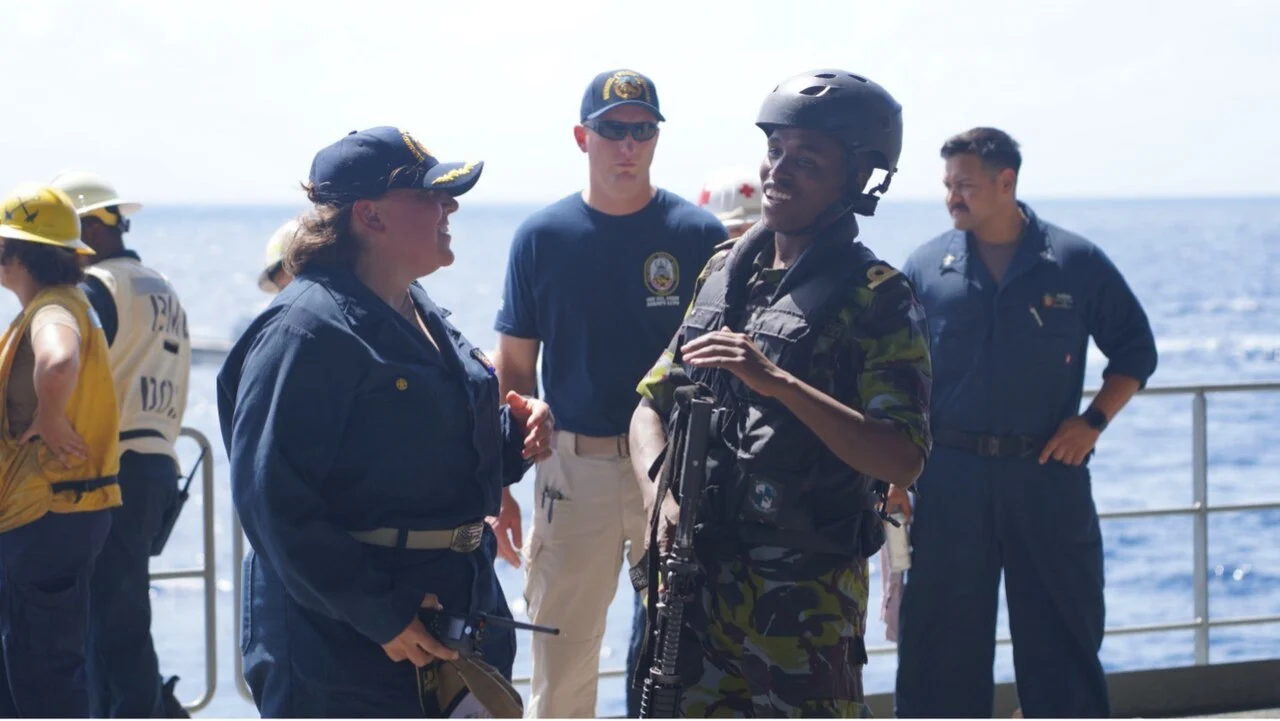
Photo: A member of the Kenya Defence Forces and the commanding officer of USS Hershel “Woody” Williams discuss visit, board, search and seizure (VBSS) tactics aboard the ship off Kenya, September 2024. Credit: U.S. Marine Corps photo by 94th Airlift Wing, Public Domain, via Wikimedia Commons
The recommendation to stand up the task force was agreed at a Djibouti Code of Conduct (DCoC) Steering Committee extraordinary meeting on 29 July, and endorsed by the DCoC’s National Focal Points on 5 August. Comoros, Djibouti, Ethiopia, Kenya, Madagascar, Mauritius, Mozambique, Seychelles, Somalia, South Africa and Tanzania signed on as regional members, alongside international partners Bahrain, France, Jordan, the Maldives, Oman, Saudi Arabia, the United Arab Emirates and Yemen. A dedicated working group, WG3, met in Mombasa, Kenya, from 7 to 9 September to begin drafting the task force’s mandate, geographic scope, command arrangements and resourcing.
What the task force would do
The Combined DCoC Counter-Piracy Task Force, as proposed, would let willing member states conduct coordinated maritime patrols and place “sea riders”, embarked naval officers from partner nations, aboard participating vessels to extend jurisdiction and boarding authority across the group. The model is explicitly drawn from the Combined Maritime Forces framework already used off West Africa, and is intended to improve maritime domain awareness across a patchwork of national waters and exclusive economic zones that pirates have historically exploited to evade single-country enforcement.
DCoC chair Metse Ralephenya said the resurgence of piracy in the region “has demonstrated that the underlying conditions that enable piracy have not been fully eliminated,” according to Africa Defense Forum. The World Bank and the European Union Naval Force (EUNAVFOR) Somalia’s Operation Atalanta have both recorded a rebound in attempted and actual attacks against merchant shipping since 2023, after a sustained multinational naval presence had driven Somali piracy incidents to near zero in the preceding decade. The UN’s International Maritime Bureau logged 24 attempted and actual incidents of piracy and armed robbery in the Red Sea and Gulf of Aden between April and July 2026 alone.
Built on a framework already 17 years old
The task force would operate under the Djibouti Code of Conduct, a maritime security framework adopted in 2009 by regional states to improve information-sharing and coordinate the repression of piracy and armed robbery against ships in the Western Indian Ocean and Gulf of Aden. The code was later broadened, as the Jeddah Amendment, to cover a wider range of illicit maritime activity, and has since become the principal diplomatic vehicle through which East African coastal states and international navies coordinate counter-piracy planning, distinct from EUNAVFOR’s Operation Atalanta and NATO’s earlier Operation Ocean Shield, both of which relied primarily on European and allied warships rather than African-led command structures.
Why it matters for Africa
A combined task force would mark one of the most significant African-led maritime security initiatives to emerge since the peak of Somali piracy in 2008-2012, when foreign navies, not regional states, supplied the bulk of enforcement capacity. For coastal economies from Djibouti to South Africa, a credible regional patrol mechanism matters directly: shipping insurers price piracy risk into Gulf of Aden and Western Indian Ocean transits, and elevated premiums or route diversions raise costs for fuel, grain and container traffic serving East African ports including Mombasa, Dar es Salaam and Djibouti City. For navies such as Kenya’s and Tanzania’s, formal sea-rider and boarding arrangements would also provide a structured channel for building interdiction capacity alongside partners like France, Saudi Arabia and the UAE, whose own shipping lanes and Red Sea interests give them a direct stake in the corridor’s security. The initiative also sits alongside, rather than replaces, national efforts: neighbouring Angola has separately taken delivery of six HT-100 naval drones for its new corvette fleet, part of a broader push by several African navies to add unmanned maritime-surveillance capacity, while further north Cameroon has been fighting to reclaim its shipping registry from Russia’s sanctions-evading “shadow fleet”, another reminder that maritime-domain security in African waters now spans piracy, illicit trafficking and flag-of-convenience abuse alike.